

Modèle du Concours National Commun (CNC) 2006 — Anglais — filières MP/PSI/TSI/BCPST (écoles d'ingénieurs)
⬇️ Télécharger le PDF Adresse permanente : wadifa-info.com/fr/modele-concours/2550
En bref
Ce document est une ancienne épreuve écrite du concours de Élève de CPGE scientifique organisé par Ministère de l'Enseignement Supérieur — Concours National Commun d'admission aux écoles d'ingénieurs (2006), publiée sur Wadifa Info en consultation et téléchargement PDF gratuits, avec une correction proposée.
- Organisme
- Ministère de l'Enseignement Supérieur — Concours National Commun d'admission aux écoles d'ingénieurs
- Grade
- Élève de CPGE scientifique
- Spécialité
- Anglais
- Année
- 2006
- Pages
- 3
- Langue des questions
- français
- Correction
- correction proposée disponible sur cette page
📝 Texte des questions (extrait automatiquement des pages scannées)
Ce texte est extrait automatiquement des images de l'épreuve et peut contenir des erreurs de lecture — les images ci-dessus font foi.
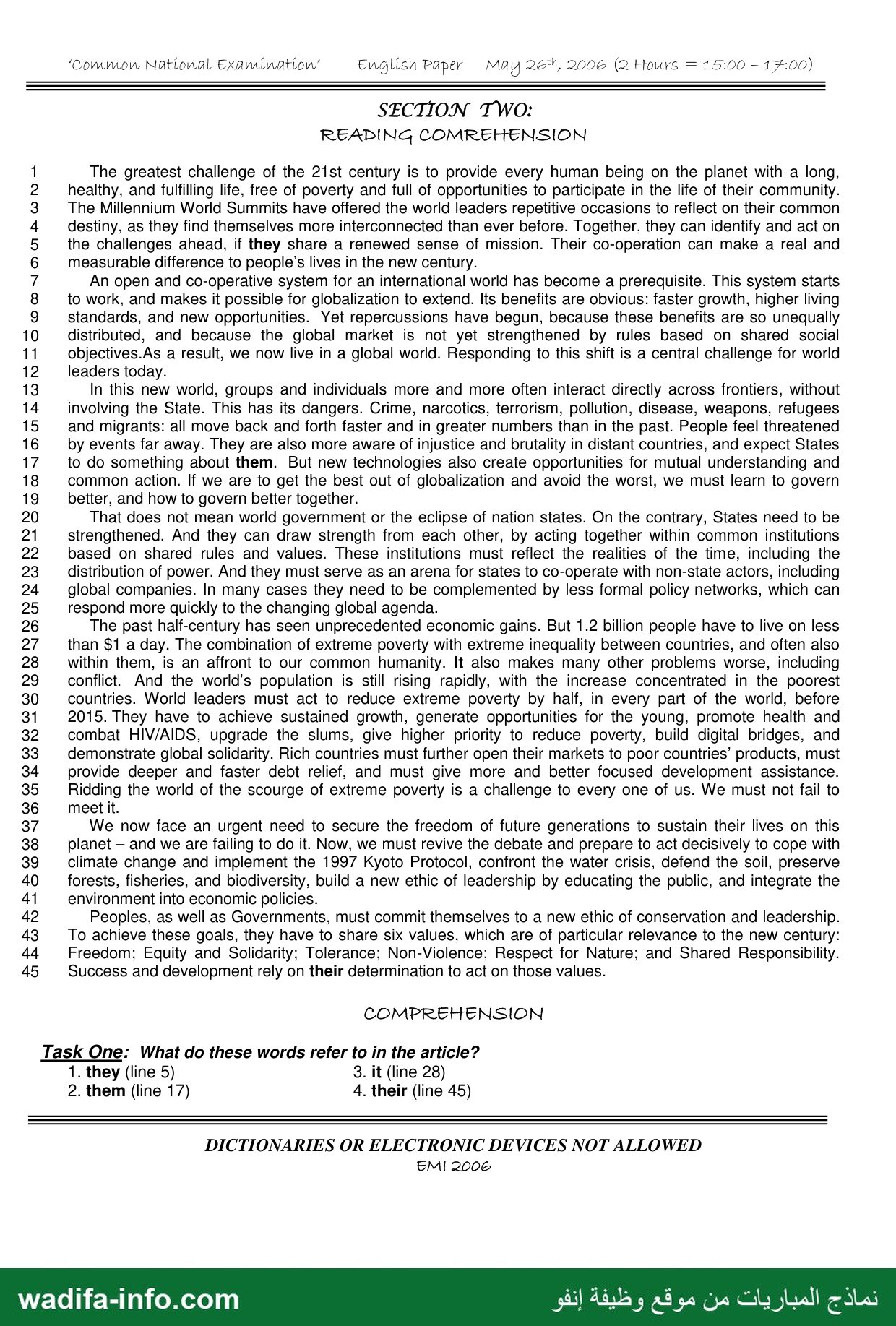
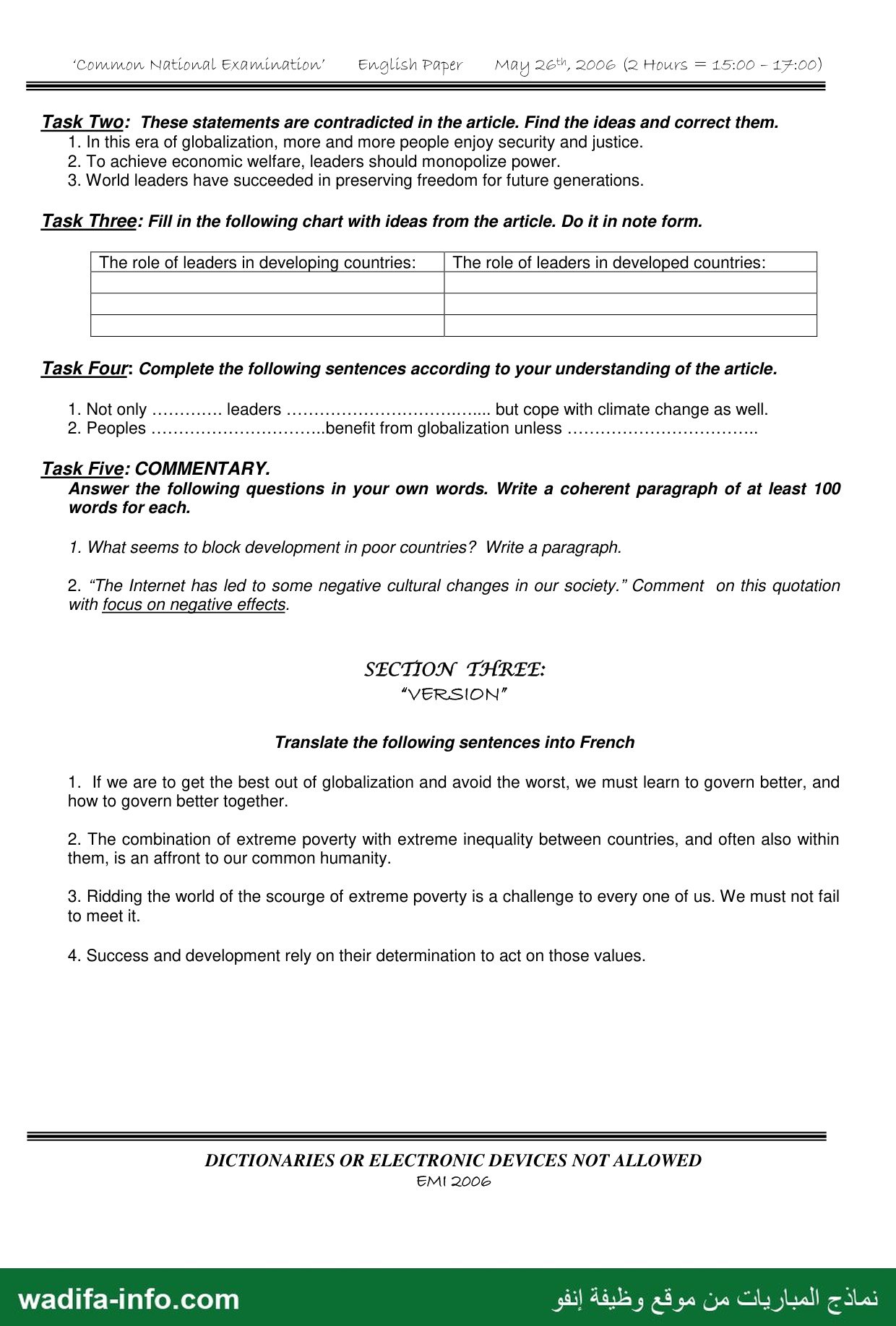
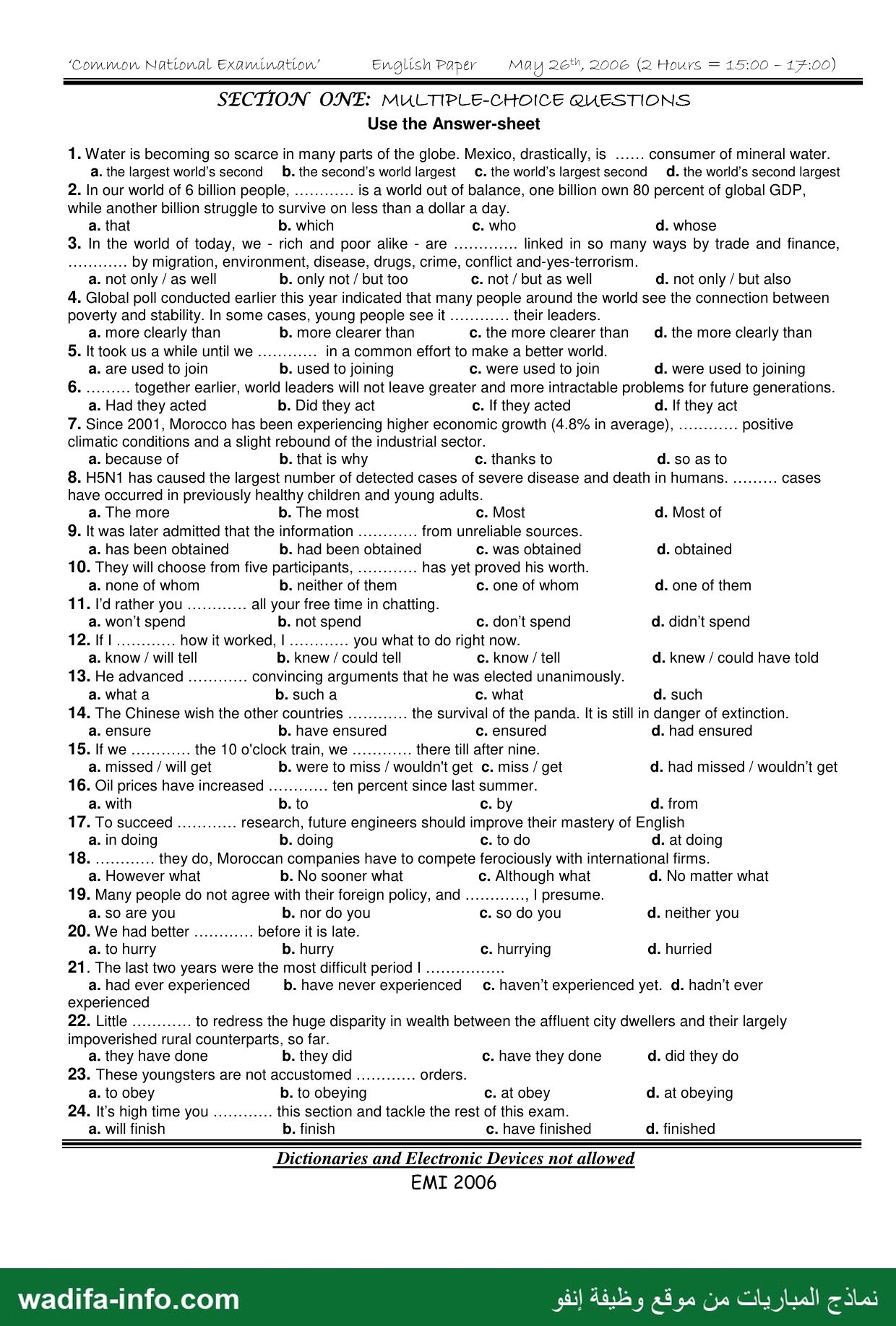
‘Common National اماما ماما لمر English Paper May 264, 2006 (2 Hours = 15:00 - 17:00) SECTION TWO: READING COMREHENSION 1 The greatest challenge of the 21st century is to provide every human being on the planet with a long, 2 healthy, and fufilling life, free of poverty and full of opportunities to participate in the life of their community. 3 The Millennium World Summits have offered the world leaders repetitive occasions to reflect on their common 4 destiny, as they find themselves more interconnected than ever before. Together, they can identify and act on 5 the challenges ahead, if they share a renewed sense of mission. Their co-operation can make a real and 6 measurable difference to 0600165 lives in the new century. 7 An open and co-operative system for an international world has become a prerequisite. This system starts 8 to work, and makes it possible for globalization to extend. Its benefits are obvious: faster growth, higher living 9 standards, and new opportunities. Yet repercussions have begun, because these benefits are so unequally 10 distributed, and because the global market is not yet strengthened by rules based on shared social 11 objectives.As a result, we now live in a global world. Responding to this shift is a central challenge for 0 12 leaders today. 13 In this new world, groups and individuals more and more often interact directly across frontiers, without 14 _involving the State. This has its dangers. Crime, narcotics, terrorism, pollution, disease, weapons, refugees 15 and migrants: all move back and forth faster and in greater numbers than in the past. People feel threatened 16 by events far away. They are also more aware of injustice and brutality in distant countries, and expect States 17 10 do something about them. But new technologies also create opportunities for mutual understanding and 18 common action. If we are to get the best out of globalization and avoid the worst, we must learn to govern 19 better, and how to govern better together. 20 That does not mean world government or the eclipse of nation states. On the contrary, States need to be 21 strengthened. And they can draw strength from each other, by acting together within common institutions 22 based on shared rules and values. These institutions must reflect the realities of the time, including the 23 distribution of power. And they must serve as an arena for states to co-operate with non-state actors, including 24 global companies. In many cases they need to be complemented by less formal policy networks, which can 25 respond more quickly to the changing global agenda. 26 The past half-century has seen unprecedented economic gains. But 1.2 billion people have to live on less 27 than 51 a day. The combination of extreme poverty with extreme inequality between countries, and often also 28 within them, is an affront to our common humanity. It also makes many other problems worse, including 29 conflict. And the world's population is still rising rapidly, with the increase concentrated in the poorest 30 countries. World leaders must act to reduce extreme poverty by half, in every part of the world, before 31 2015. They have to achieve sustained growth, generate opportunities for the young, promote health and 32 combat HIV/AIDS, upgrade the slums, give higher priority to reduce poverty, build digital bridges, and 33 demonstrate global solidarity. Rich countries must further open their markets to poor countries’ products, must 34 provide deeper and faster debt relief, and must give more and better focused development assistance. 35 Ridding the world of the scourge of extreme poverty is a challenge to every one of us. We must not fail to 36 meetit. 37 We now face an urgent need to secure the freedom of future generations to sustain their lives on this 38 planet — and we are failing to do it. Now, we must revive the debate and prepare to act decisively to cope with 39 climate change and implement the 1997 Kyoto Protocol, confront the water crisis, defend the soil, preserve 40 forests, fisheries, and biodiversity, build a new ethic of leadership by educating the public, and integrate the 41 environment into economic policies. 42 Peoples, as well as Governments, must commit themselves to a new ethic of conservation and leadership. 43 To achieve these goals, they have to share six values, which are of particular relevance to the new century: 44 Freedom; Equity and Solidarity; Tolerance; Non-Violence; Respect for Nature; and Shared Responsibility. 45 Success and development rely on their determination to act on those values. COMPREHENSION Task One: What do these words refer to in the article? 1. they (line 5) 3. it (line 28) 2. them (line 17) 4. their (line 45) DICTIONARIES OR ELECTRONIC DEVICES NOT ALLOWED EMI 2006 wadifa-info.com نماذج المباريات من موقع وظيفة إنفو Common National Examination English Paper Mar 264, 20062 (2 Hours = 15:00 - 17:00) Task Two: These statements are contradicted in the article. Find the ideas and correct them. 1. In this era of globalization, more and more people enjoy security and justice. 2. To achieve economic welfare, leaders should monopolize power. 3. World leaders have succeeded in preserving freedom for future generations. Task Three: Fill in the following chart with ideas from the article. Do it in note form. The role of leaders in developing countries: The role of leaders in developed countries: Task Four: Complete the following sentences according to your understanding of the article. 1. Not only ............. leaders ...................................... but cope with climate change as well. 2. 0600165 .م م 061798111017 0١00828101 UNIS scsi Task Five: COMMENTARY. Answer the following questions in your own words. Write a coherent paragraph of at least 100 words for each. 1. What seems to block development in poor countries? Write a paragraph. 2. “The Internet has led to some negative cultural changes in our society.” Comment on this quotation with focus on negative effects. SECTION THREE: “VERSION” Translate the following sentences into French 1. If we are to get the best out of globalization and avoid the worst, we must learn to govern better, and how to govern better together. 2. The combination of extreme poverty with extreme inequality between countries, and often also within them, is an affront to our common humanity. 3. Ridding the world of the scourge of extreme poverty is a challenge to every one of us. We must not fail to meet it. 4. Success and development rely on their determination to act on those values. DICTIONARIES OR ELECTRONIC DEVICES NOT ALLOWED EMI 2006 wadifa-info.com نماذج المباريات من موقع وظيفة إنفو ‘Common National Examination English Paper May 26%, 2006 (2 Hours = 15:00 - 17:00) SECTION ONE: MULTIPLE-CHOICE QUESTIONS Use the Answer-sheet 1. Water is becoming so scarce in many parts of the globe. Mexico, drastically, is ...... consumer of mineral water. a. the largest world's second b. the 560000 5 world largest ©. the world's largest second d. the world's second largest 2. In our world of 6 billion people, ............ 5ا a world out of balance, one billion own 80 percent of global GDP, while another billion struggle to survive on less than a dollar a day. a. that b. which c. who d. whose 3. In the world of today, we - rich and poor alike - are ............. linked in so many ways by trade and finance, .......... لا Migration, environment, disease, drugs, crime, conflict and-yes-terrorism. a. not only / as well b. only not / but too c. not / but as well d. not only / but also 4. Global poll conducted earlier this year indicated that many people around the world see the connection between poverty and stability. In some cases, young people see it ............ their leaders. a. more clearly than b. more clearer than c. the more clearerthan d.the more clearly than 5. It took us a while until we ............ in a common effort to make a better world. a. are used to join b. used to joining c. were used to join d. were used to joining 6. ......... together earlier, world leaders will not leave greater and more intractable problems for future generations. a. Had they acted b. Did they act c. If they acted d. If they act 7. Since 2001, Morocco has been experiencing higher economic growth (4.8% in average), .….......... positive climatic conditions and a slight rebound of the industrial sector. a. because of b. that is why c. thanks to d. so as to 8. H5N1 has caused the largest number of detected cases of severe disease and death in humans. ......... 5 have occurred in previously healthy children and young adults. a. The more b. The most c. Most d. Most of 9. It was later admitted that the information .…......... from unreliable sources. a. has been obtained b. had been obtained c. was obtained d. obtained 10. They will choose from five participants, ............ has yet proved his worth. a. none of whom b. neither of them c. one of whom d. one of them 11. l'd rather you ............ all your free time in chatting. a. won't spend b. not spend c. don't spend d. didn't spend 12.11 ............ howit worked, | ..….......... you what to do right now. a. know / will tell b. knew / could tell c. know / tell d. knew / could have told 13. He advanced ............ convincing arguments that he was elected unanimously. a. what a b. such a c. what d. such 14. The Chinese wish the other countries …....... the survival of the panda. It is still in danger of extinction. a. ensure b. have ensured c. ensured d. had ensured 15. Ifwe ............ 106 10 o'clock train, we ............ 11606 till after nine. a. missed / will get b. were to miss / wouldn't get c. miss / get d. had missed / wouldn't get 16. Oil prices have increased ............ ten percent since last summer. a. with b. to c. by d. from 17. To succeed ............ research, future engineers should improve their mastery of English a. in doing b. doing c. to do d. at doing 18. ............ they do, Moroccan companies have to compete ferociously with international firms. a. However what b. No sooner what c. Although what d. No matter what 19. Many people do not agree with their foreign policy, and ............. | presume. a. So are you b. nor do you c. so do you d. neither you 20. We had better ............ before it is late. a. to hurry b. hurry c. hurrying d. hurried 21. The last two years were the most difficult period | .…............. a. had ever experienced b. have never experienced ©. haven’t experienced yet. d. hadn't ever experienced 22. Little ............ 10 redress the huge disparity in wealth between the affluent city dwellers and their largely impoverished rural counterparts, so far. a. they have done b. they did c. have they done d. did they do 23. These youngsters are not accustomed ............ orders. a. to obey b. to obeying c. at obey d. at obeying 24. It's high time you ............ this section and tackle the rest of this exam. a. Will finish b. finish c. have finished d. finished Dictionaries and Electronic Devices not allowed EMI 2006 wadifa-info.com نماذج المباريات من موقع وظيفة إنفو
Correction proposée
Il s'agit d'une correction proposée, rédigée par l'équipe wadifa-info pour vous aider à comprendre la méthode — ce n'est pas un corrigé officiel de l'administration organisatrice.
Ce modèle est l'épreuve d'anglais du Concours National Commun (CNC) 2006 d'admission aux écoles d'ingénieurs (filières MP/PSI/TSI/BCPST), session du 26 mai 2006, 15 h 00 - 17 h 00 (2 heures), dictionnaires et appareils électroniques interdits. Trois sections : Section One — QCM de 24 questions ; Section Two — compréhension d'un texte sur la mondialisation, la pauvreté et la gouvernance mondiale (Tasks One à Five) ; Section Three — version (4 phrases). Les réponses modèles sont en anglais ; les explications en français.
💡 Ordre conseillé : le QCM se fait vite (environ 20 minutes) ; gardez au moins 40 minutes pour les deux commentaires de 100 mots, qui pèsent lourd.
Section One — Multiple-Choice Questions
- d. the world's second largest — ordre : génitif + ordinal + superlatif.
- b. which — relative non déterminative reprenant « our world of 6 billion people » (une chose).
- d. not only / but also — corrélation not only … but also.
- a. more clearly than — see est modifié par un adverbe ; comparatif simple sans the.
- d. were used to joining — be used to + V-ing (être habitué à) ; ici « jusqu'à ce que nous ayons pris l'habitude de nous joindre ».
- d. If they act — la principale est au futur (will not leave) : condition réelle, présent après if. Had they acted exigerait would not have left.
- c. thanks to — cause positive (bonnes conditions climatiques) suivie d'un groupe nominal.
- c. Most — most + nom pluriel sans article ; most of exige un déterminant (most of the cases).
- b. had been obtained — antériorité dans le passé (plus-que-parfait) et voix passive.
- a. none of whom — relatif après virgule (whom, pas them) ; « aucun n'a encore fait ses preuves » (yet).
- d. didn't spend — I'd rather + sujet + prétérit.
- b. knew / could tell — conditionnel irréel du présent (right now).
- d. such — such + adjectif + nom pluriel + that ; such a est impossible devant un pluriel.
- c. ensured — wish + prétérit pour un souhait irréel au présent (le panda est encore menacé).
- b. were to miss / wouldn't get — hypothèse : if + were to, conséquence would ; les autres paires mélangent les temps ou perdent la négation nécessaire à till after nine.
- c. by — increase by + écart chiffré.
- a. in doing — succeed in + V-ing.
- d. No matter what — « quoi qu'elles fassent ».
- b. nor do you — reprise d'une phrase négative.
- b. hurry — had better + base verbale.
- a. had ever experienced — superlatif + ever ; récit au passé (were), donc plus-que-parfait.
- c. have they done — inversion après l'adverbe négatif Little en tête ; so far impose le present perfect.
- b. to obeying — be accustomed to + V-ing.
- d. finished — It's high time + sujet + prétérit.
| 1 | 2 | 3 | 4 | 5 | 6 | 7 | 8 | 9 | 10 | 11 | 12 |
|---|---|---|---|---|---|---|---|---|---|---|---|
| d | b | d | a | d | d | c | c | b | a | d | b |
| 13 | 14 | 15 | 16 | 17 | 18 | 19 | 20 | 21 | 22 | 23 | 24 |
| d | c | b | c | a | d | b | b | a | c | b | d |
Section Two — Reading Comprehension
Task One — References
- they (line 5) : the world leaders.
- them (line 17) : injustice and brutality in distant countries.
- it (line 28) : the combination of extreme poverty with extreme inequality (between and within countries).
- their (line 45) : peoples' and governments' (determination).
Task Two — Contradicted statements, corrected
- In this era of globalization, people feel more threatened: crime, terrorism, narcotics and disease cross frontiers faster, and people are more aware of injustice and brutality in distant countries (lines 13-17).
- Leaders should not monopolize power: States must act together within common institutions that reflect the distribution of power, and co-operate with non-state actors such as global companies (lines 20-25).
- World leaders are failing to secure the freedom of future generations to sustain their lives on this planet (lines 37-38).
Task Three — Role of leaders (note form)
| Leaders in developing countries | Leaders in developed countries |
|---|---|
| reduce extreme poverty by half before 2015; achieve sustained growth | open their markets to poor countries' products |
| create opportunities for the young; promote health, fight HIV/AIDS | provide deeper and faster debt relief |
| upgrade the slums; build digital bridges | give more and better focused development assistance |
Le texte adresse les objectifs de la l. 30-33 aux « world leaders » en général ; on les place côté pays en développement parce qu'ils visent leurs populations, tandis que la l. 33-35 vise explicitement les « rich countries ».
Task Four — Completion
- Not only should leaders fight extreme poverty and inequality but cope with climate change as well.
- Peoples cannot really benefit from globalization unless its benefits are fairly distributed and governed by shared rules and values.
Task Five — Commentary (at least 100 words each)
1. What seems to block development in poor countries? — modèle de 121 mots :
Several obstacles seem to block development in poor countries. The first is extreme poverty itself: when more than a billion people live on less than a dollar a day, they cannot invest in education, health or small businesses, so poverty reproduces itself. Rapid population growth, concentrated in the poorest countries, makes the problem worse. Inequality, both between and within countries, fuels tensions and conflicts that destroy what little has been built. Poor countries also suffer from heavy debt and from limited access to the markets of rich countries, which reduces their export revenues. Finally, weak institutions, corruption and the lack of infrastructure discourage investment. Without fair trade rules, debt relief and good governance, these countries remain trapped in a vicious circle.
2. « The Internet has led to some negative cultural changes in our society. » (effets négatifs) — modèle de 120 mots :
The Internet has transformed our lives, but it has also brought negative cultural changes. First, it has weakened family and social ties: members of the same family often sit together while each one is absorbed in a screen, and real conversation is replaced by short messages. Second, it spreads a uniform, mostly Western culture that pushes aside local languages, traditions and values, especially among young people. Third, reading habits are declining; many students prefer quick videos and copy-and-paste to books and personal reflection. Moreover, the web circulates rumours, violent content and misinformation that shape opinions without any control. These effects do not mean we should reject the Internet, but we must teach young people to use it critically and responsibly.
💡 La consigne demande de se concentrer sur les effets négatifs : une phrase de nuance en conclusion suffit ; ne consacrez pas la moitié du paragraphe aux avantages.
Section Three — Version (traduction proposée)
- Si nous voulons tirer le meilleur parti de la mondialisation et en éviter le pire, nous devons apprendre à mieux gouverner, et à mieux gouverner ensemble.
- La conjugaison d'une extrême pauvreté et d'une extrême inégalité entre les pays, et souvent aussi au sein de ceux-ci, est un affront à notre humanité commune.
- Débarrasser le monde du fléau de l'extrême pauvreté est un défi pour chacun d'entre nous. Nous ne devons pas échouer à le relever.
- La réussite et le développement dépendent de leur détermination à agir conformément à ces valeurs.
💡 If we are to… exprime une intention ou une nécessité (« si nous voulons… ») et non un futur ; to meet a challenge = « relever un défi » ; to act on values = « agir selon / conformément à des valeurs ».
Questions fréquentes sur ce sujet
Ce sujet est-il téléchargeable gratuitement ?
Le corrigé est-il inclus ?
Quel organisme et quel grade concerne ce sujet ?
De quelle session s'agit-il et dans quelle langue ?
Où trouver d'autres sujets du même concours ?
Vous préparez ce concours ?
Modèles similaires
Organisme : Ministère de l'Enseignement Supérieur — Concours National Commun d'admission aux écoles d'ingénieurs · 26 mai 2006 — Copie issue de : archive de modèles de concours — document archivé tel que reçu ; l'avis officiel du concours fait foi.
}Citer cette page
Journaliste, blogueur, enseignant : copiez la référence ci-dessous et mettez un lien vers cette page.
Adresse permanente : https://www.wadifa-info.com/fr/modele-concours/2550/modele-du-concours-national-commun-cnc-2006-anglais-filieres-mp-psi-tsi-bcpst-ecoles-d-i