

Modèle du Concours National Commun (CNC) 2008 — Anglais — filières MP/PSI/TSI/BCPST (écoles d'ingénieurs)
⬇️ Télécharger le PDF Adresse permanente : wadifa-info.com/fr/modele-concours/2552
En bref
Ce document est une ancienne épreuve écrite du concours de Élève de CPGE scientifique organisé par Ministère de l'Enseignement Supérieur — Concours National Commun d'admission aux écoles d'ingénieurs (2008), publiée sur Wadifa Info en consultation et téléchargement PDF gratuits, avec une correction proposée.
- Organisme
- Ministère de l'Enseignement Supérieur — Concours National Commun d'admission aux écoles d'ingénieurs
- Grade
- Élève de CPGE scientifique
- Spécialité
- Anglais
- Année
- 2008
- Pages
- 7
- Langue des questions
- français
- Correction
- correction proposée disponible sur cette page
📝 Texte des questions (extrait automatiquement des pages scannées)
Ce texte est extrait automatiquement des images de l'épreuve et peut contenir des erreurs de lecture — les images ci-dessus font foi.
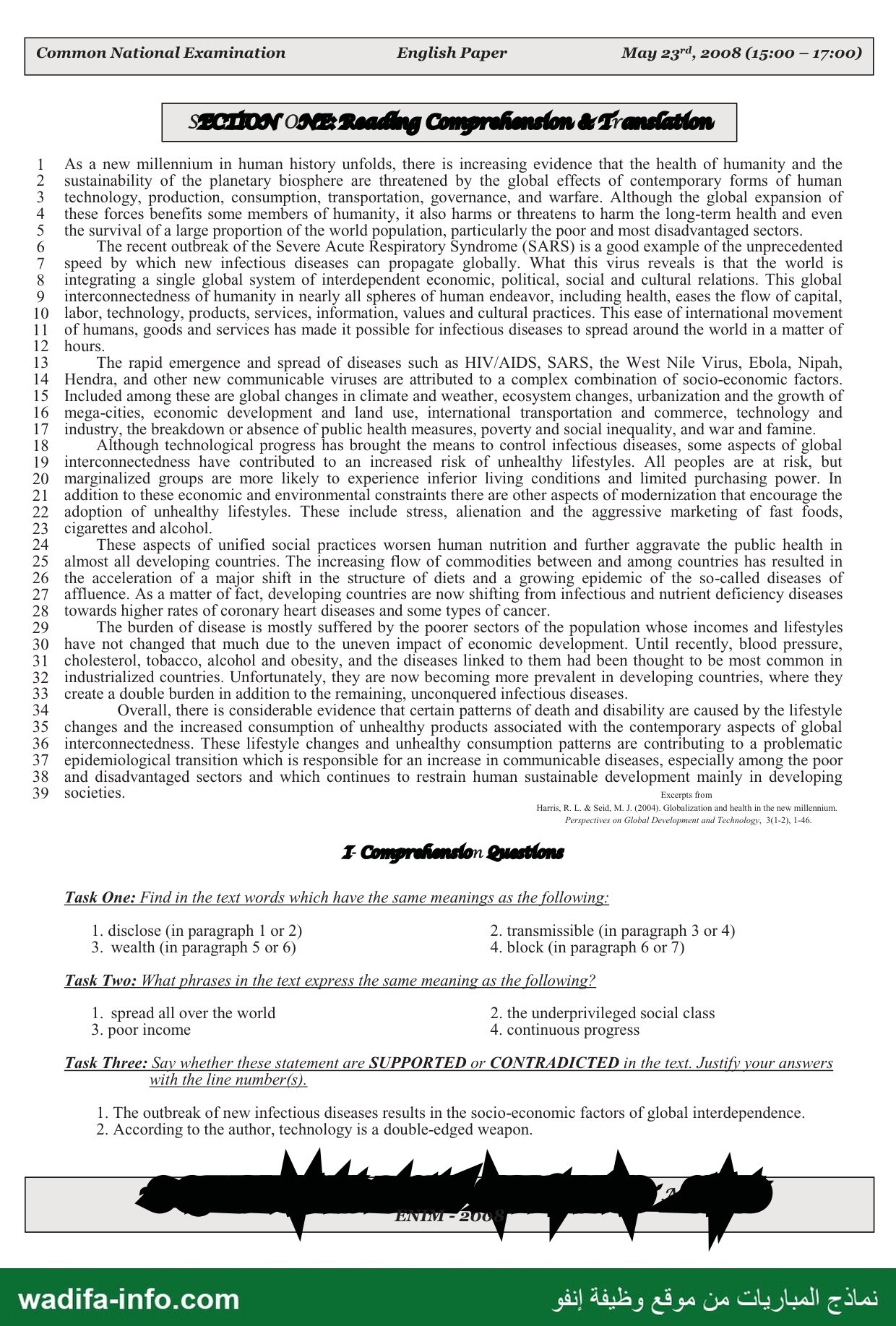
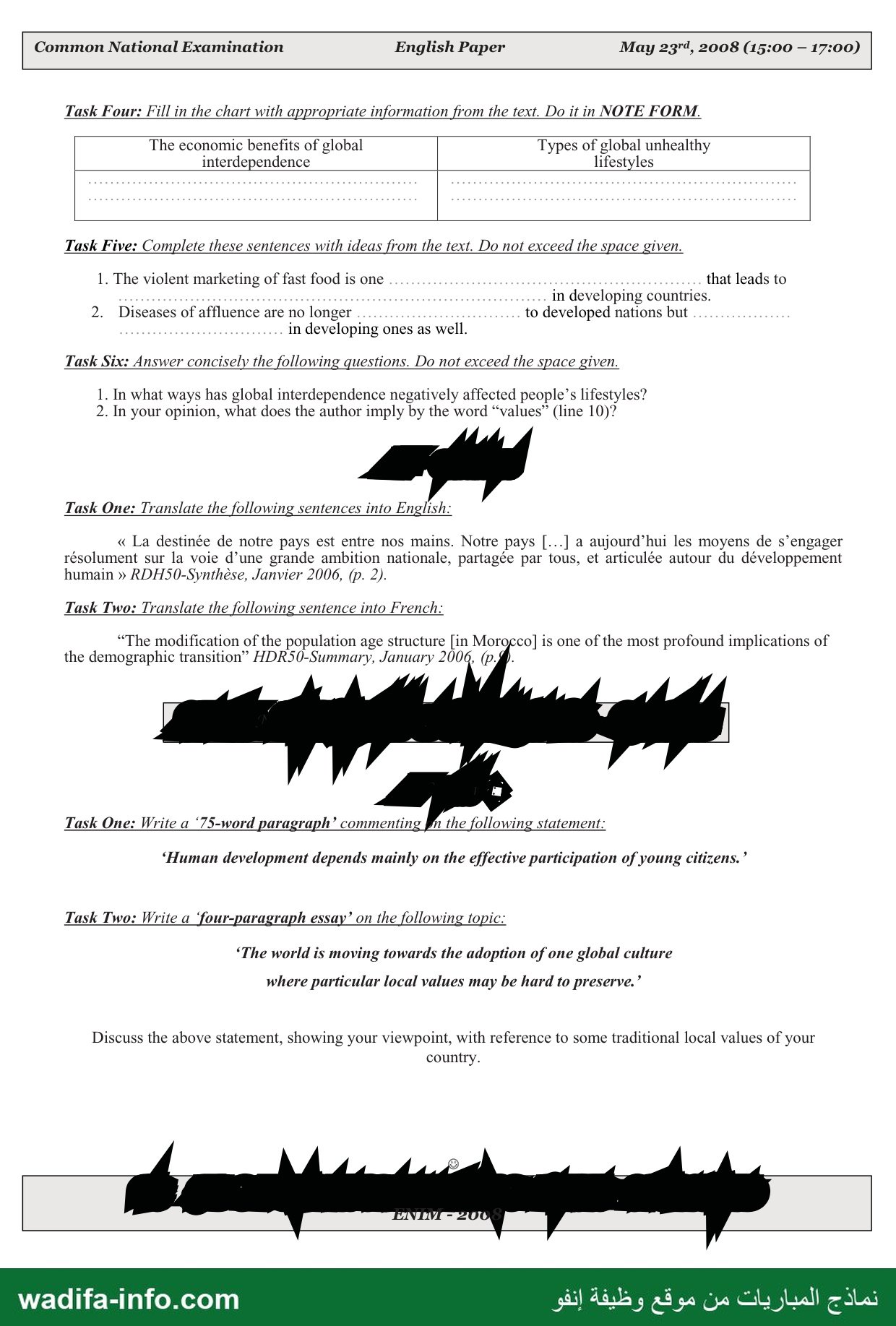
SECTION CNE Reading Comprefiension & T'anslation 1 As a new millennium in human history unfolds, there is increasing evidence that the health of humanity and the 2 sustainability of the planetary biosphere are threatened by the global effects of contemporary forms of human 3 technology, production, consumption, transportation, governance, and warfare. Although the global expansion of 4 these forces benefits some members of humanity, it also harms or threatens to harm the long-term health and even 5 the survival of a large proportion of the world population, particularly the poor and most disadvantaged sectors. 6 The recent outbreak of the Severe Acute Respiratory Syndrome (SARS) is a good example of the unprecedented 7 speed by which new infectious diseases can propagate globally. What this virus reveals is that the world is 8 integrating a single global system of interdependent economic, political, social and cultural relations. This global 9 interconnectedness of humanity in nearly all spheres of human endeavor, including health, eases the flow of capital, 10 labor, technology, products, services, information, values and cultural practices. This ease of international movement 11 of humans, goods and services has made it possible for infectious diseases to spread around the world in a matter of 12 hours. 13 The rapid emergence and spread of diseases such as HIV/AIDS, SARS, the West Nile Virus, Ebola, Nipah, 14 Hendra, and other new communicable viruses are attributed to a complex combination of socio-economic factors. 15 110101060 among these are global changes in climate and weather, ecosystem changes, urbanization and the growth of 16 mega-cities, economic development and land use, international transportation and commerce, technology and 17 industry, the breakdown or absence of public health measures, poverty and social inequality, and war and famine. 18 Although technological progress has brought the means to control infectious diseases, some aspects of global 19 interconnectedness have contributed to an increased risk of unhealthy lifestyles. للح peoples are at risk, but 20 marginalized groups are more likely to experience inferior living conditions and limited purchasing power. In 21 addition to these economic and environmental constraints there are other aspects of modernization that encourage the 22 adoption of unhealthy lifestyles. These include stress, alienation and the aggressive marketing of fast foods, 23 cigarettes and alcohol. 24 These aspects of unified social practices worsen human nutrition and further aggravate the public health in 25 almost all developing countries. The increasing flow of commodities between and among countries has resulted in 26 the acceleration of a major shift in the structure of diets and a growing epidemic of the so-called diseases of 27 affluence. As a matter of fact, developing countries are now shifting from infectious and nutrient deficiency diseases 28 towards higher rates of coronary heart diseases and some types of cancer. 29 The burden of disease is mostly suffered by the poorer sectors of the population whose incomes and lifestyles 30 have not changed that much due to the uneven impact of economic development. Until recently, blood pressure, 31 cholesterol, tobacco, alcohol and obesity, and the diseases linked to them had been thought to be most common in 32 industrialized countries. Unfortunately, they are now becoming more prevalent in developing countries, where they 33 create a double burden in addition to the remaining, unconquered infectious diseases. 34 Overall, there is considerable evidence that certain patterns of death and disability are caused by the lifestyle 35 changes and the increased consumption of unhealthy products associated with the contemporary aspects of global 36 interconnectedness. These lifestyle changes and unhealthy consumption patterns are contributing to a problematic 37 epidemiological transition which is responsible for an increase in communicable diseases, especially among the poor 38 and disadvantaged sectors and which continues to restrain human sustainable development mainly in developing 39 societies 8 Excerpts from Harris, R. L. & Seid, M. J. (2004). Globalization and health in the new millennium. Perspectives on Global Development and Technology, 3(1-2), 1-46. 2 Comprefienslor. Questions Task One: Find in the text words which have the same meanings as the following: 1. disclose (in paragraph 1 or 2) 2. transmissible (in paragraph 3 or 4) 3. wealth (in paragraph 5 or 6) 4. block (in paragraph 6 or 7) Task Two: What phrases in the text express the same meaning as the following? 1. spread all over the world 2. the underprivileged social class 3. poor income 4. continuous progress Task Three: Say whether these statement are SUPPORTED or CONTRADICTED in the text. Justifÿ vour answers with the line number(s). 1. The outbreak of new infectious diseases results in the socio-economic factors of global interdependence. 2. According to the author, technology is a double-edged weapon. wadifa-info.com نماذج المباريات من موقع وظيفة إنفو Common National Examination English Paper May 23"'d, 2008 (15:00 — 17:00) Task Four: Fill in the chart with appropriate information from the text. Do it in NOTE FORM. The economic benefits of global Types of global unhealthy interdependence lifestyles Task Five: Complete these sentences with ideas from the text. Do not exceed the space given. l: The Violent marketins of "fast food is One م اد م مه مد د م that leads )0 يت اواو تاتالا ااا Renan developing COUNTIES: 2. Diseases of affluence are no longer ..............................t0 developed nations but .................. in developing ones as well. Task Six: Answer concisely the following questions. Do not exceed the space given. 1. In what ways has global interdependence negatively affected people’s Lifestyles? 2. In your opinion, what does the author imply by the word “values” (line 10)? Task One: Translate the following sentences into English: « La destinée de notre pays est entre nos mains. Notre pays [...] a aujourd’hui les moyens de s’engager résolument sur la voie d’une grande ambition nationale, partagée par tous, et articulée autour du développement humain » RDH50-Synthèse, Janvier 2006, (p. 2). Task Two: Translate the following sentence into French: “The modification of the population age structure [in Morocco] is one of the most profound implications of the demographic transition” HDRS0-Summary, January 2006, قح Task One: Write a ‘75-word paragraph” commenting 07 the following statement: ‘Human development depends mainly on the effective participation of young citizens.” Task Two: Write a ‘four-paragraph essay” on the following topic: ‘The world is moving towards the adoption of one global culture where particular local values may be hard to preserve.”? Discuss the above statement, showing your viewpoint, with reference to some traditional local values of your country. wadifa-info.com نماذج المباريات من موقع وظيفة إنفو Common National Examination English Paper May 23:0, 2008 (15:00 — 17:00) 1. “Science never solves a problem without creating ten ................ | و Bernard Shaw a. too b. also c. more d. other 2. “Thinking is the hardest work there is, ............... 18 probably the reason why so few engage in it.” Henry Ford a. this b. that c. which d. what 3. “It is nobler to declare oneself wrong than to insist ............... right - especially when one is right.” Friedrich Nietzsche a. in being b. on being c. of being d. at be 4. “What you do not want .................. to yourself, do not ............... to others.” Confucius a. to make / do b. to do / make c. made / make d. done / do 5. “If you reveal your secrets to the wind you ............... blame the wind for revealing them to the trees.” Kahlil Gibran a. need not b. ought not ©. should not d. could not 6. “The good neighbour looks beyond the external accidents and discerns those inner qualities that make all men human and, ..............., brothers.” Martin Luther King Jr. (7929 - 1968) a. therefore b. so c. also d. though 7. “It is not the strongest of the species that survives, ............... the most intelligent, but the one most responsive to change.” Charles Darwin a. and b. or c. not d. nor 8. “A wise man should consider that health is ............... of human blessings, and learn how by his own thought to derive benefit from his illnesses.” Hippocrates (460 BC - 377 BC) a. greatest b. greater c. the greater d. the greatest 9.01 ............... suffer from excessive pride. Well, I got over that one.” Francesca Annis a. am used to b. use to c. used to d. was used to 10. “If 1 had my life to live over again, 1 ............... a rule to read some poetry and listen to some music at least once a week.” Charles Darwin a. will make b. would make c. would be making d. would have made 11. “Nothing will benefit human health and increase the chances for survival of life on Earth ................. عط evolution to a vegetarian diet.” Albert Einstein a. as long as b. as far as .ع as much as d. as many as 12. “If I have seen farther than others, it is because 1 ............... on the shoulders of giants.” Isaac Newton a. stood b. had stood c. had been standing d. was standing 13 . “A man does what he must - ............... personal consequences, obstacles, dangers and pressures - and that is the basis of all human morality.” John F. Kennedy a. however b. in spite of c. nevertheless d. although 14. “.................. people are capable of expressing with equanimity opinions which differ from the prejudices of their social environment. ............... people are even incapable of forming such opinions.” Albert Einstein a. Few / Most b. Few of/ Most of c. The few / The most d. A few / Most of 15. “You had better ............... for what you are than ............... for what you are not.” Andre Gide (1869 - 1951) a. be hated / be loved b. to be hated / be loved c. be hated / to be loved d. being hated / being loved 16. “I wish people would love everybody else the way they love me. It ............... a better world.” Muhammad Ali a. would have been b. would be .ع will be 0.15 going to be RL. الى سم جح سس wadifa-info.com نماذج المباريات من موقع وظيفة إنفو Common National Examination : 49 مور مها May 23 4, 2008 (2Hours : 15 :00 - 17 :00) candidat a Li Partie à remplir par le candidat Ù] EPREUVE D'ANGLAIS DUREE : 02H | : n'a droit qu'à we seule esple de وتان fouille de compocllion ‘Ansues-choe/. Pour هل valider, le di dépinié LE a قوت lai nt soute dr AVE 1 de cette page. Answer-sheet Mu/tt-le Cholce Questions No answer, wrong or more than one answer = 00 mark Use a Ball pen (‘Stylo à bille’) صر 7 Put a cross (X) on the letter corresponding to the option that you think correct. Do as shown in the following example: 00. “I [don’t know] with what weapons World War 111 ...... fought, but World War IV with sticks and stones.” Albert Einstein A. shall be B. will be C. should be D. must be 00 a [XI] زم إل 01.2) 66.) OLA BA) لاك الغالغ).14 [م ALI اك الغااغاك)-06 ماك الم اع ).02 لماك الغالغا.15 ماك الهاك11.4 هاك إهغالها7 هالت ال الك ).03 لال الغالما.16 لهغالالتغأله ).12 لماك الغالهما.08 لماك الهغال .04 نماذج المباريات من موقع وظيفة إنفو wadifa-info.com Common National Examination English Paper May 23", 2008 (2Hours : 15 :00 - 17 :00) DO NOZ 5 ABOME 775 7 7 | > 7 Fr ج- مح 4 TASK ONE: Find in the text words which Pad Poe sd e meanings as the following: “ disclose” in paragraph 1 or 2 : “transmissible” in paragraph 3 or 4 : “wealth” in paragraph 5 or 6 : 14 | “block” in paragraph 6 or 7 : TASK TWO: What phrases in the text express almost the same meaning as the ollowing: “spread all over the world” : 2. “the underprivileged social class” : TASK THREE: Say whether these statement are SUPPORTED or CONTRADICTED in the text. 115117 your answers w1l e ine n er (8). متسس 1666] اممستس تسا ا A ...سسا TASK FOUR: Fill in the chart with information from the text. Do it in note form. The economic benefits of global Types of global unhealthy interdependence lifestyle Pa 5 TASK FIVE: Complete these sentences with ideas from the text. Mind grammar. 1. The violent marketing of fast food is one that leads to in developing countries. 2. Diseases of affluence are no longer to developed nations but have become in developing ones as well. ONIM = RAEAT CNC 200€ جع عله wadifa-info.com نماذج المباريات من موقع وظيفة إنفو Common National Examination English Paper May 239 , 2008 (2Hours : 15 :00 - 17 :00) DO NOT WRITE ABOVE THIS LINE TASK SIX: Answer concisely the following questions. Do not exceed the space given. Ld dd TASK ONE: Translate into Englistff® 4 TASK TWO: Translate into French SECTION TWO: Wriitrg G Chotce Que:tlons TASK ONE: Paragraph writing ONIM - RABAT مم+هالهي #ومد عيب wadifa-info.com نماذج المباريات من موقع وظيفة إنفو Common National Examination English Paper May 23 , 2008 (2Hours : 15 :00 -17 :00) DO NOT WRITE ABOVE THIS LINE TASK TWO: Essay writing wadifa-info.com نماذج المباريات من موقع وظيفة إنفو
Correction proposée
Il s'agit d'une correction proposée, rédigée par l'équipe wadifa-info pour vous aider à comprendre la méthode — ce n'est pas un corrigé officiel de l'administration organisatrice.
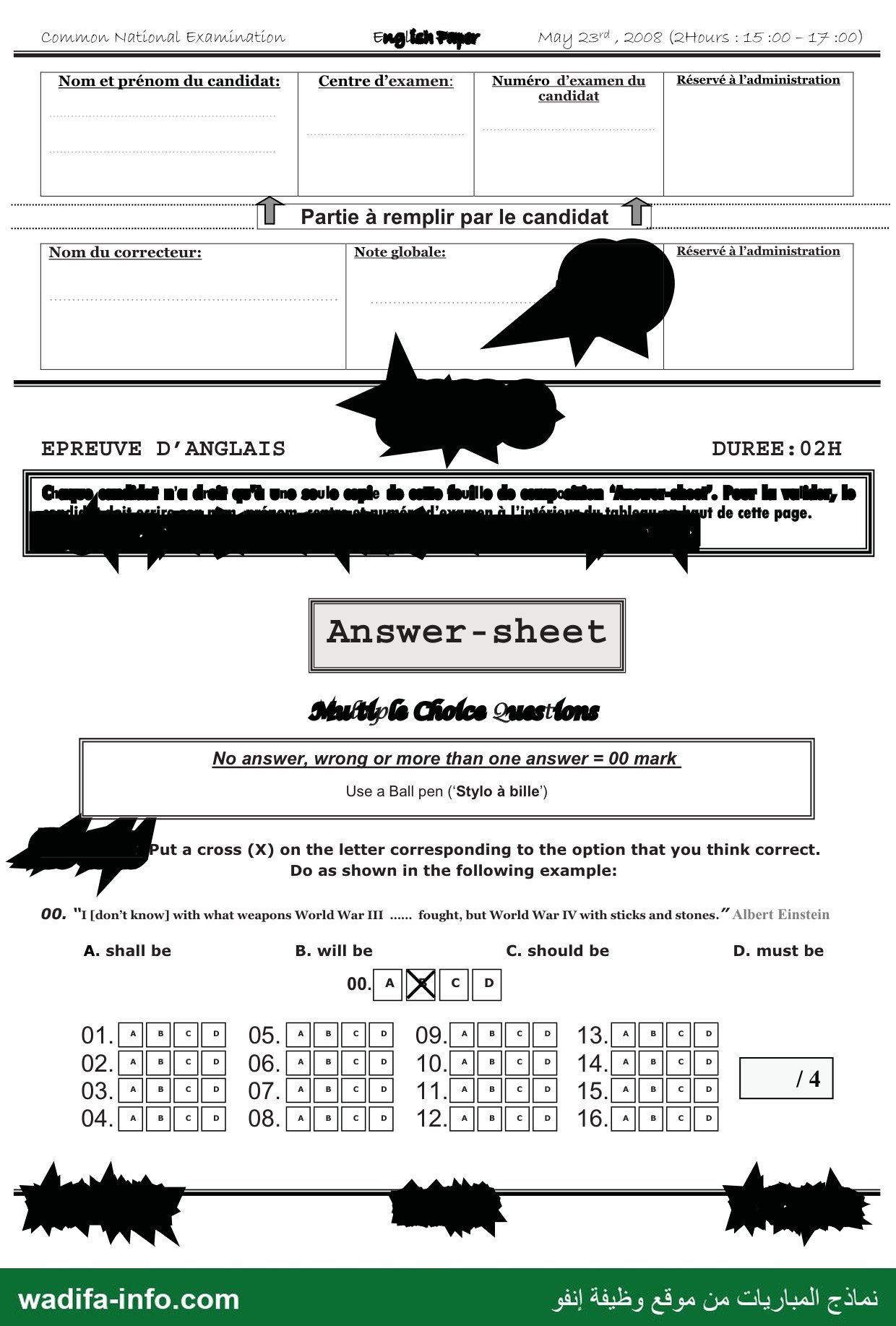
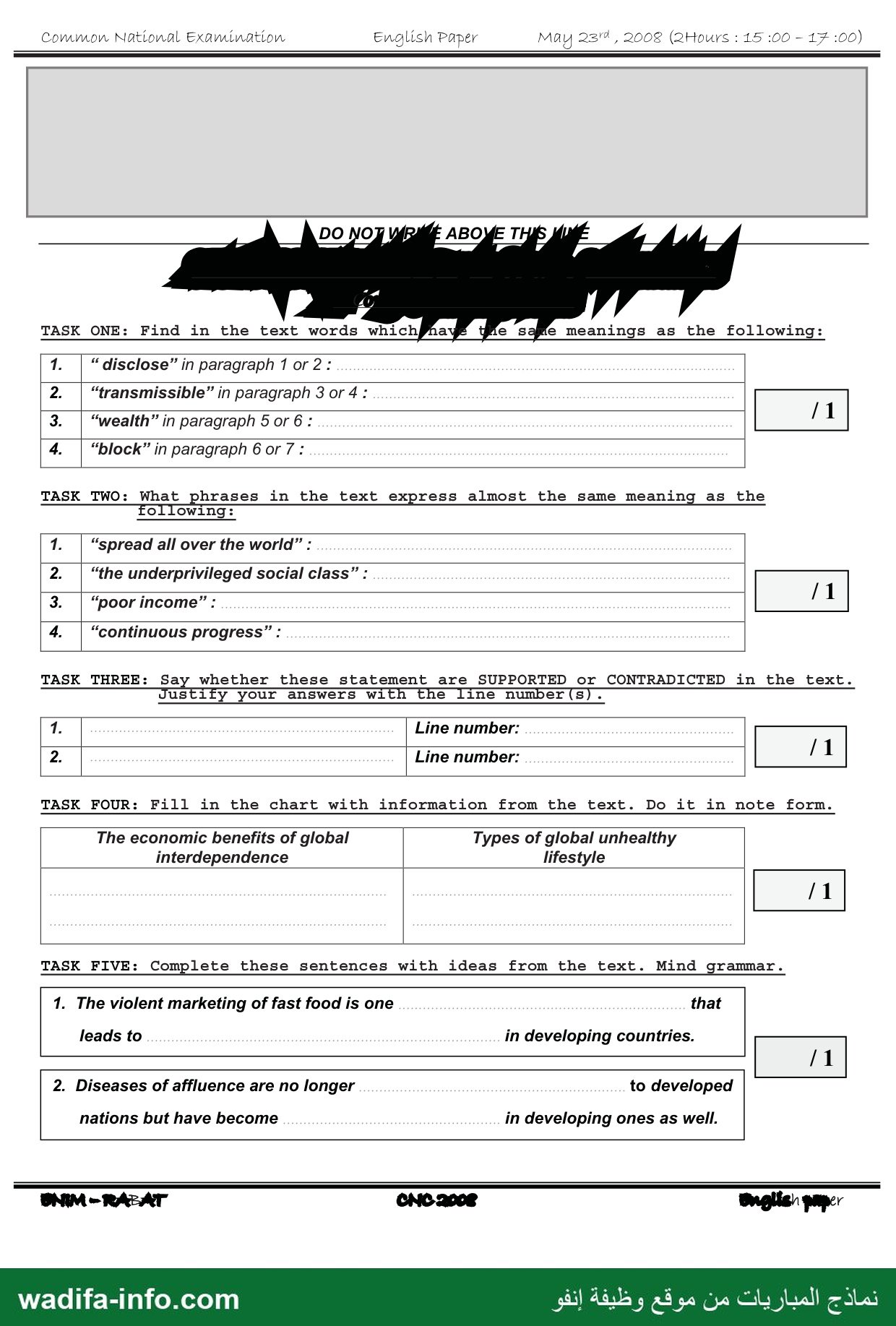
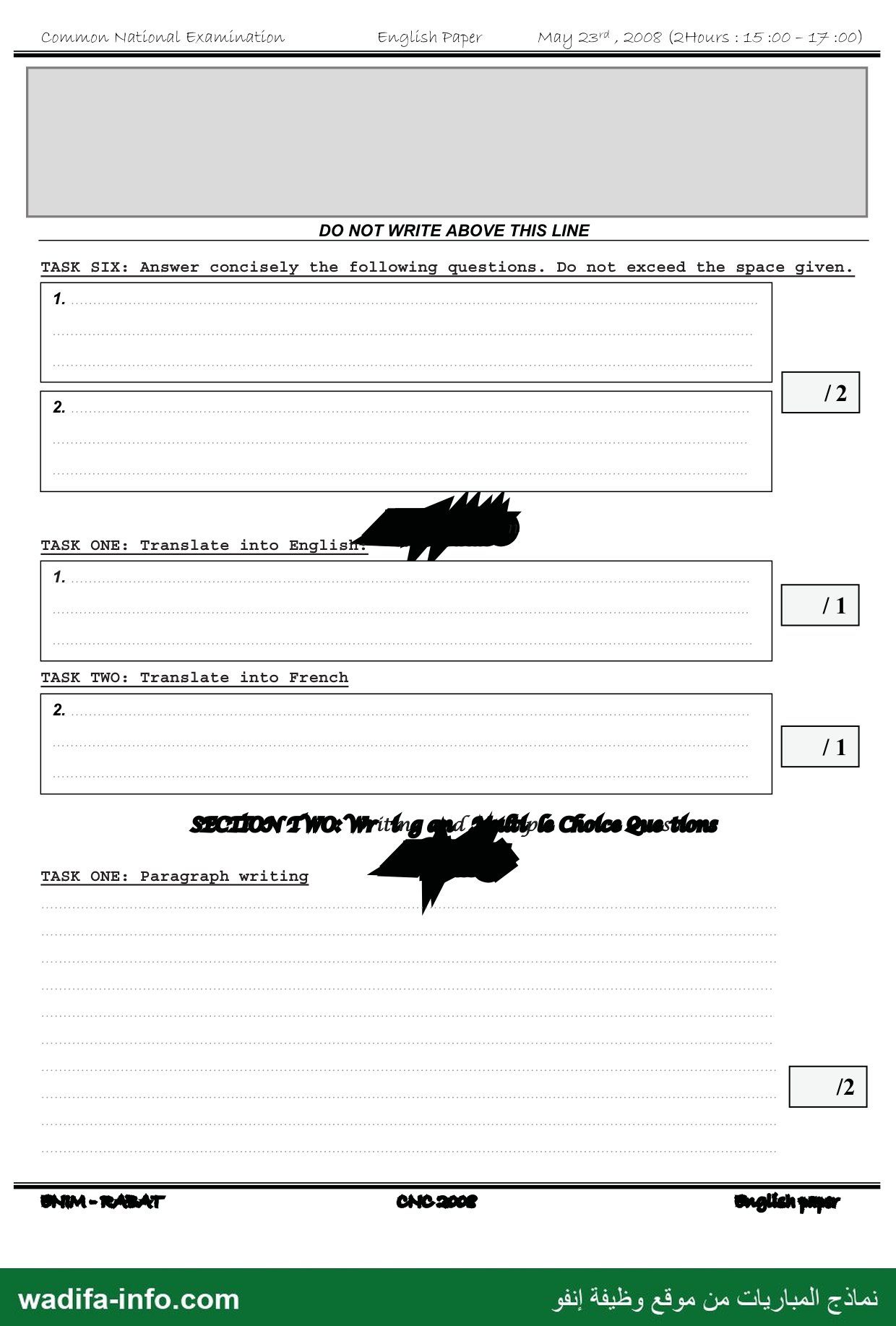
Ce modèle est l'épreuve d'anglais du Concours National Commun (CNC) 2008 d'admission aux écoles d'ingénieurs (filières MP/PSI/TSI/BCPST), session du 23 mai 2008, 15 h 00 - 17 h 00 (2 heures). L'épreuve comprend : Section One — compréhension d'un texte sur la mondialisation et la santé (Harris & Seid, 2004 ; Tasks One à Six) puis traduction (français → anglais et anglais → français) ; Section Two — expression écrite (paragraphe de 75 mots et essai de quatre paragraphes) ; et un QCM de 16 citations célèbres à compléter. Le scan comporte des taches noires sur certains titres et pieds de page, mais toutes les consignes et questions restent lisibles ; les pages 4 à 7 sont la feuille-réponse vierge. Réponses modèles en anglais, explications en français.
💡 Dans le QCM, chaque phrase est une citation authentique : si vous la reconnaissez, c'est un indice, mais la grammaire suffit à trouver la réponse dans presque tous les cas.
Section One — Reading Comprehension
Task One — Synonyms
- disclose = reveals (line 7).
- transmissible = communicable (line 14).
- wealth = affluence (line 27).
- block = restrain (line 38).
Task Two — Equivalent phrases
- spread all over the world = propagate globally (line 7) — aussi « spread around the world » (l. 11).
- the underprivileged social class = the poor and most disadvantaged sectors (line 5) — ou « marginalized groups » (l. 20), « the poorer sectors of the population » (l. 29).
- poor income = limited purchasing power (line 20).
- continuous progress = sustainable development (line 38).
Task Three — Supported or contradicted?
- Contradicted (lines 13-14) : the relation is the other way round — the emergence and spread of new diseases are attributed to socio-economic factors of global interdependence; diseases do not produce these factors.
- Supported (lines 1-3 and 18-19) : technology threatens the health of humanity and the biosphere, yet technological progress has also brought the means to control infectious diseases.
Task Four — Chart (note form)
| Economic benefits of global interdependence | Types of global unhealthy lifestyles |
|---|---|
| easier flow of capital, labour, technology, products and services; free movement of people and goods; benefits for some members of humanity | stress; alienation; fast food; cigarettes; alcohol; unhealthy diets (diseases of affluence) |
Task Five — Completion
- The violent marketing of fast food is one aspect of modernization that leads to the adoption of unhealthy lifestyles and poorer nutrition in developing countries.
- Diseases of affluence are no longer restricted to developed nations but have become increasingly common in developing ones as well.
Task Six — Short answers
- Global interdependence has spread stress, alienation and the aggressive marketing of fast food, cigarettes and alcohol. Diets have changed, and people in developing countries now suffer from heart disease, obesity and some cancers in addition to infectious diseases.
- By "values", the author probably means the beliefs, norms and ways of life, mostly Western and consumerist, that travel with goods, media and people, and change local habits and cultures.
Translation
Task One — Into English
"The destiny of our country is in our hands. Our country […] today has the means to commit itself resolutely to the path of a great national ambition, shared by all and centred on human development."
Task Two — Into French
« La modification de la structure par âge de la population [au Maroc] est l'une des conséquences les plus profondes de la transition démographique. »
💡 s'engager sur la voie de → to embark on / commit itself to the path of ; articulée autour de → centred on / built around ; implications se rend mieux par « conséquences » ou « répercussions » ; population age structure = « structure par âge de la population ».
Section Two — Writing
Task One — 75-word paragraph: « Human development depends mainly on the effective participation of young citizens. »
I largely agree with this statement. Young people are the majority of the population in many developing countries, so no development plan can succeed without them. When they are educated, trained and listened to, they bring energy, new ideas and skills, create businesses and take part in associations and elections. Yet their participation requires real opportunities: jobs, quality education and a voice in decision-making. Otherwise, frustration leads to unemployment, emigration and disengagement.
Task Two — Four-paragraph essay: one global culture vs. local values
Introduction. Thanks to satellite television, the Internet and global trade, people all over the world now watch the same films, wear the same brands and eat the same fast food. Many fear that this global culture, largely Western and American, will erase local values. In my view, the danger is real, but local values can survive if they are consciously protected.
Paragraph 2. On the one hand, globalization clearly threatens some Moroccan traditions. Young people spend more time on social networks than with their families, and the extended family, with its respect for elders and solidarity, is weakening. Traditional dress, crafts and even local languages such as Amazigh and Darija lose ground to foreign models and words.
Paragraph 3. On the other hand, many values remain strong and even use global tools to spread. Hospitality, family gatherings during Ramadan and religious feasts, Moroccan cuisine and music are still alive, and the Internet now helps young Moroccans abroad to keep in touch with them. Moreover, Morocco has given official status to Amazigh and supports its crafts and heritage.
Conclusion. In conclusion, one global culture is not inevitable. If schools, families and the media teach young people to be open to the world while being proud of their identity, Morocco can take the best of globalization without losing its soul.
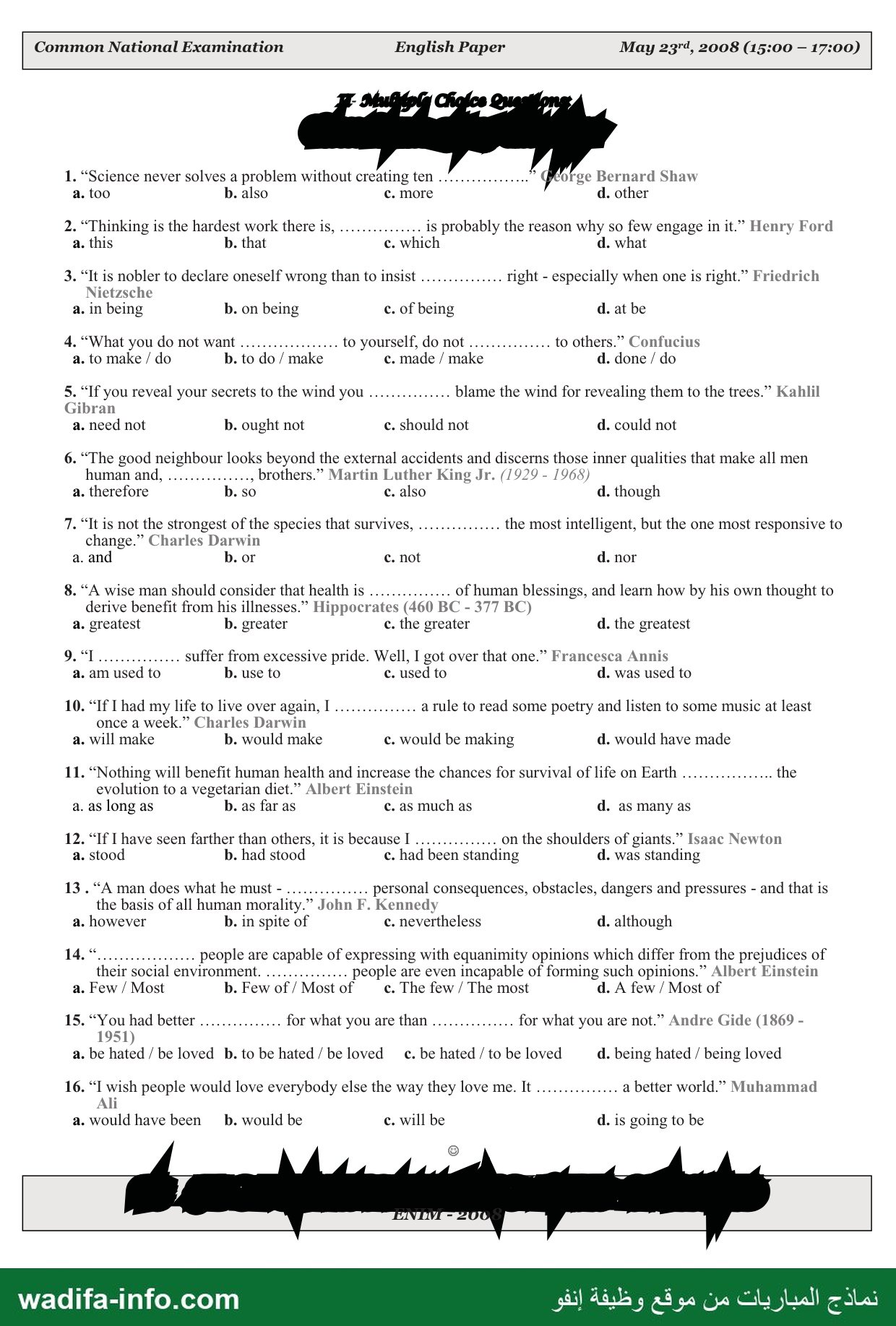
Multiple-Choice Questions (16 quotations)
- c. more — « … without creating ten more » (Shaw) : ten more = dix de plus.
- c. which — relative non déterminative reprenant toute la proposition précédente.
- b. on being — insist on + V-ing.
- d. done / do — want something done (participe passé, sens passif), puis impératif négatif do not do.
- c. should not — conseil / reproche : « tu ne devrais pas blâmer le vent ».
- a. therefore — conséquence : humains, donc frères.
- d. nor — reprise négative après It is not … , nor ….
- d. the greatest — superlatif suivi de of (le plus grand de tous les biens).
- c. used to — habitude passée révolue (I got over that one).
- d. would have made (réponse probable) — c'est la forme de la citation authentique de Darwin (regret portant sur une vie passée) ; la forme would make (b) serait elle aussi grammaticale avec If I had my life to live over again.
- c. as much as — comparaison d'égalité avec des verbes (benefit, increase) : as much as.
- d. was standing — action en cours dans le passé, cadre de have seen.
- b. in spite of — suivi de groupes nominaux ; although exigerait une proposition.
- a. Few / Most — few people (peu de gens), most people (la plupart des gens), sans of ni article devant un nom général.
- a. be hated / be loved — had better + base verbale, et le parallélisme than (be) ….
- b. would be — conséquence d'un souhait irréel (I wish people would…).
| 1 | 2 | 3 | 4 | 5 | 6 | 7 | 8 |
|---|---|---|---|---|---|---|---|
| c | c | b | d | c | a | d | d |
| 9 | 10 | 11 | 12 | 13 | 14 | 15 | 16 |
| c | d | c | d | b | a | a | b |
Questions fréquentes sur ce sujet
Ce sujet est-il téléchargeable gratuitement ?
Le corrigé est-il inclus ?
Quel organisme et quel grade concerne ce sujet ?
De quelle session s'agit-il et dans quelle langue ?
Où trouver d'autres sujets du même concours ?
Vous préparez ce concours ?
Modèles similaires
Organisme : Ministère de l'Enseignement Supérieur — Concours National Commun d'admission aux écoles d'ingénieurs · 23 mai 2008 — Copie issue de : archive de modèles de concours — document archivé tel que reçu ; l'avis officiel du concours fait foi.
}Citer cette page
Journaliste, blogueur, enseignant : copiez la référence ci-dessous et mettez un lien vers cette page.
Adresse permanente : https://www.wadifa-info.com/fr/modele-concours/2552/modele-du-concours-national-commun-cnc-2008-anglais-filieres-mp-psi-tsi-bcpst-ecoles-d-i