

Modèle du Concours National Commun (CNC) 2009 — Anglais — filières MP/PSI/TSI/BCPST (écoles d'ingénieurs)
⬇️ Télécharger le PDF Adresse permanente : wadifa-info.com/fr/modele-concours/2553
En bref
Ce document est une ancienne épreuve écrite du concours de Élève de CPGE scientifique organisé par Ministère de l'Enseignement Supérieur — Concours National Commun d'admission aux écoles d'ingénieurs (2009), publiée sur Wadifa Info en consultation et téléchargement PDF gratuits, avec une correction proposée.
- Organisme
- Ministère de l'Enseignement Supérieur — Concours National Commun d'admission aux écoles d'ingénieurs
- Grade
- Élève de CPGE scientifique
- Spécialité
- Anglais
- Année
- 2009
- Pages
- 8
- Langue des questions
- français
- Correction
- correction proposée disponible sur cette page

📝 Texte des questions (extrait automatiquement des pages scannées)
Ce texte est extrait automatiquement des images de l'épreuve et peut contenir des erreurs de lecture — les images ci-dessus font foi.
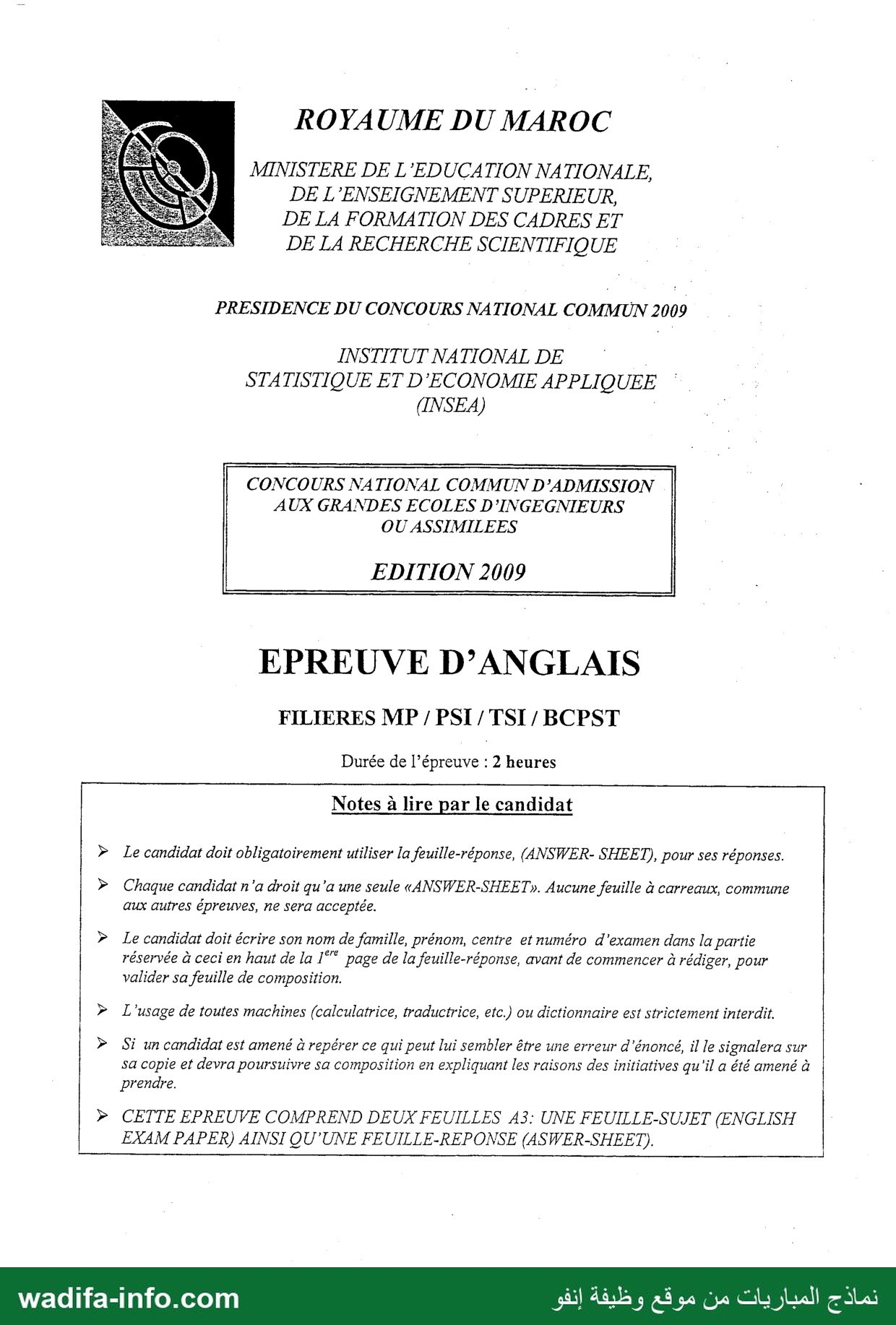
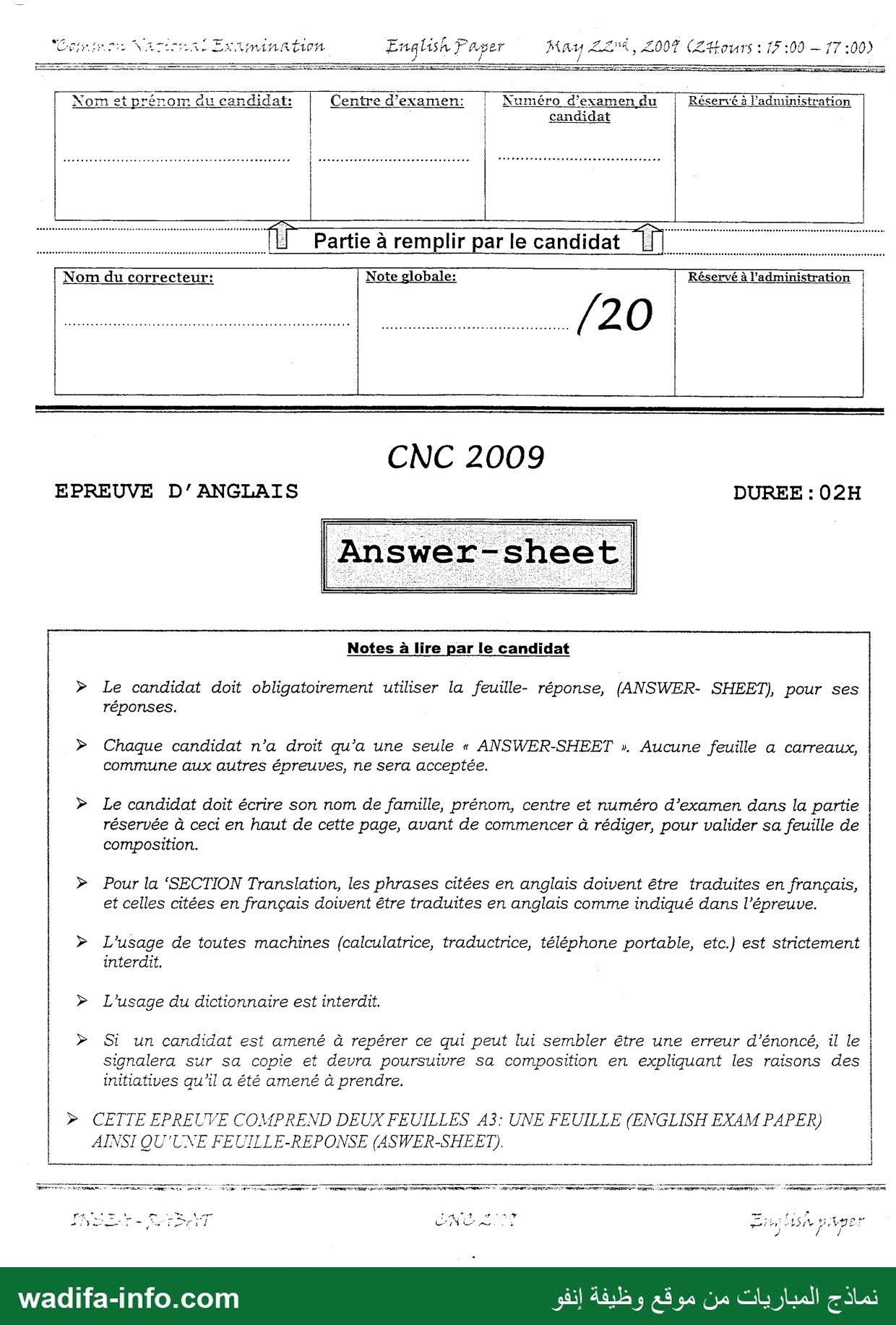
à — ROYAUME DU MAROC
A ا و0 MINISTERE DE L'EDUCATION NATIONALE,
AS KV DE L'ENSEIGNEMENT SUPERIEUR,
= NES DELA FORMATION DES CADRES ET
RSR RU DE LA RECHERCHE SCIENTIFIQUE
PRESIDENCE DU CONCOURS NATIONAL COMMUN 2 009 x À
INSTITUT NATIONAL DE
STATISTIQUE ET D'ECONOMIE APPLIQUEE
(AINSEA) * 00
CONCOURS NATIONAL COMMUN D'ADMISSION -. ١
AUX GRANDES ECOLES D'INGEGNIEURS
OU ASSIMILEES
EDITION 2009 |
EPREUVE D'ANGLAIS
FILIERES MP / PSI / TSI /BCPST
Durée de l’épreuve : 2 heures
Notes à lire par le candidat
> Le candidat doit obligatoirement utiliser la feuille-réponse, (ANSWER- SHEET), pour ses réponses.
> Chaque candidat n'a droit qu'a une seule «ANSWER-SHEET». Aucune feuille à carreaux, commune
aux autres épreuves, ne sera acceptée.
> 16 candidat doit écrire son nom de famille, prénom, centre et numéro d'examen dans la partie
réservée à ceci en haut de la 1°” page de la feuille-réponse, avant de commencer à rédiger, pour
valider sa feuille de composition.
> L'usage de toutes machines (calculatrice, traductrice, etc.) ou dictionnaire est strictement interdit.
> Si un candidat est amené à repérer ce qui peut lui sembler être une erreur d'énoncé, il le signalera sur
sa copie et devra poursuivre sa composition en expliquant les raisons des initiatives qu'il a été amené à
prendre.
> CETTE EPREUVE COMPREND DEUX FEUILLES A3: UNE FEUILLE-SUJET (ENGLISH
EXAM PAPER) AINSI QU'UNE FEUILLE-REPONSE (ASWER-SHEET).
wadifa-info.com نماذج المباريات من موقع وظيفة إنفو
Common National Evamination English Paper May 22nd, 2009 (2H= 15:00 - 17:00)
SECTION ONE: Reading Comprehension & Translation
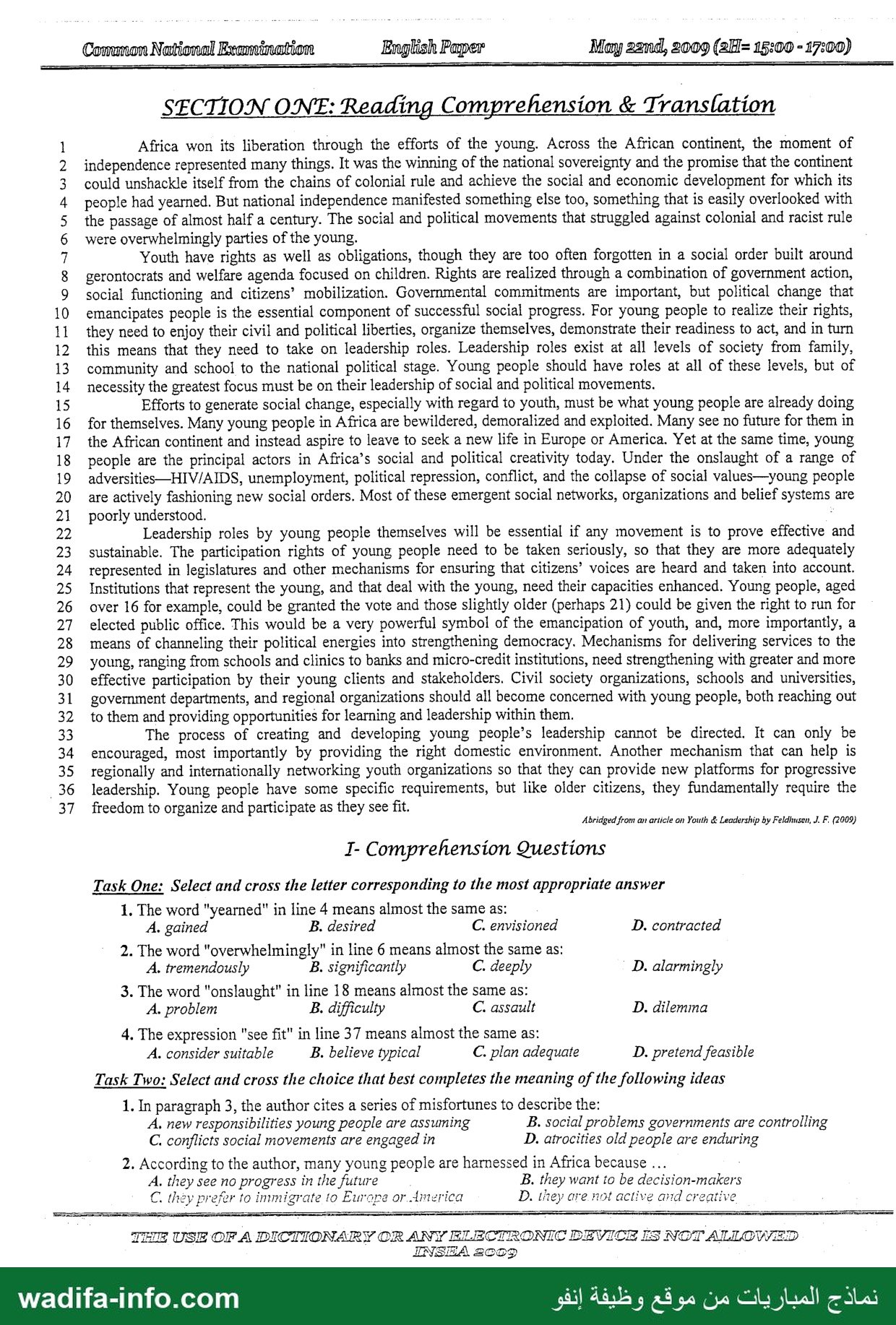
1 Africa won its liberation through the efforts of the young. Across the African continent, the moment of
2 independence represented many things. It was the winning of the national sovereignty and the promise that the continent
3 could unshackle itself from the chains of colonial rule and achieve the social and economic development for which its
4 people had yearned. But national independence manifested something else too, something that is easily overlooked with
5 the passage of almost half a century. The social and political movements that struggled against colonial and racist rule
6 were overwhelmingly parties of the young.
7 Youth have rights as well as obligations, though they are too often forgotten in a social order built around
8 gerontocrats and welfare agenda focused on children. Rights are realized through a combination of government action,
9 social functioning and citizens’ mobilization. Governmental commitments are important, but political change that
10 emancipates people is the essential component of successful social progress. For young people to realize their rights,
11 they need to enjoy their civil and political liberties, organize themselves, demonstrate their readiness to act, and in turn
12 this means that they need to take on leadership roles. Leadership roles exist at all levels of society from family,
13 community and school to the national political stage. Young people should have roles at all of these levels, but of
14 necessity the greatest focus must be on their leadership of social and political movements.
15 Efforts to generate social change, especially with regard to youth, must be what young people are already doing
16 for themselves. Many young people in Africa are bewildered, demoralized and exploited. Many see no future for them in
17 the African continent and instead aspire to leave to seek a new life in Europe or America. Yet at the same time, young
18 people are the principal actors in Africa’s social and political creativity today. Under the onslaught of a range of
19 adversities—HIV/AIDS, unemployment, political repression, conflict, and the collapse of social values—young people
20 are actively fashioning new social orders. Most of these emergent social networks, organizations and belief systems are
21 poorly understood.
22 Leadership roles by young people themselves will be essential if any movement is to prove effective and
23 sustainable. The participation rights of young people need to be taken seriously, so that they are more adequately
24 represented in legislatures and other mechanisms for ensuring that citizens’ voices are heard and taken into account.
25 Institutions that represent the young, and that deal with the young, need their capacities enhanced. Young people, aged
26 over 16 for example, could be granted the vote and those slightly older (perhaps 21) could be given the right to run for
27 elected public office. This would be a very powerful symbol of the emancipation of youth, and, more importantly, a
28 means of channeling their political energies into strengthening democracy. Mechanisms for delivering services to the
29 young, ranging from schools and clinics to banks and micro-credit institutions, need strengthening with greater and more
30 effective participation by their young clients and stakeholders. Civil society organizations, schools and universities,
31 government departments, and regional organizations should ail become concerned with young people, both reaching out
32 to them and providing opportunities for learning and leadership within them.
33 The process of creating and developing young people’s leadership cannot be directed. It can only be
34 encouraged, most importantly by providing the right domestic environment. Another mechanism that can help is
35 regionally and internationally networking youth organizations so that they can provide new platforms for progressive
_36 leadership. Young people have some specific requirements, but like older citizens, they fundamentally require the
37 freedom to organize and participate as they see fit.
Abridged from an article on Youth & Leadership by Feldhusen, J. F. (2009)
I- Comprehension Questions
Task One: Select and cross the letter corresponding to the most appropriate answer
1. The word "yearned" in line 4 means almost the same as:
À. gained B. desired C. envisioned D. contracted
2. The word "overwhelmingly" in line 6 means almost the same as:
À. tremendously B. significantly C. deeply D. alarmingly
3. The word "onslaught" in line 18 means almost the same as:
A. problem B. difficulty C. assault D. dilemma
4, The expression "see fit" in line 37 means almost the same as:
A. consider suitable B. believe typical C. plan adequate D. pretend feasible
Task Two: Select and cross the choice that best completes the meaning of the following ideas
1. In paragraph 3, the author cites a series of misfortunes to describe the:
À, new responsibilities young people are assuming B. social problems governments are controlling
C. conflicts social movements are engaged in D. atrocities old people are enduring
2. According to the author, many young people are harnessed in Africa because …
A. they see no progress in the future B. they want to be decision-makers
C. they prefèr to immigrate to Eurape or. America D. they are not active and creative
SSP + هس اصصصصبص:-هس-لسلبللك لسشسسسطس( -أأاتتسس_:أجل لس --سبب'أدا لست لسلس
INSEA 2م
wadifa-info.com نماذج المباريات من موقع وظيفة إنفو
Common National Evamination English Paper May 22nd, 2009 (2H= 15:00 - 17:00)
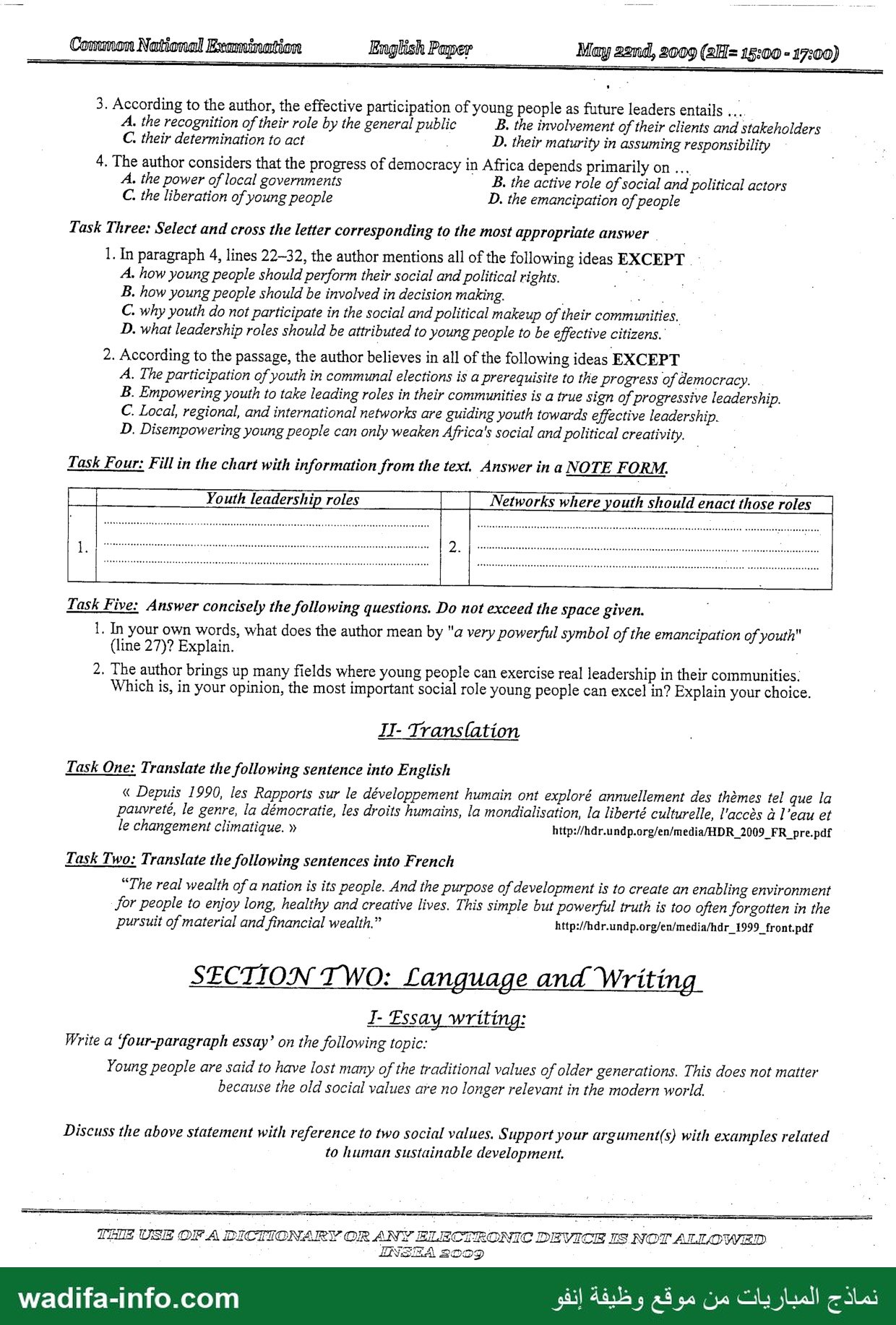
3. According to the author, the effective participation of young people as future leaders entails …
À. the recognition of their role by the general public B. the involvement of their clients and stakeholders
C. their determination to act . D. their maturity in assuming responsibility
4. The author considers that the progress of democracy in Africa depends primarily on … |
À. the power of local governments B. the active role of social and political actors
C. the liberation of young people D. the emancipation of people
Task Three: Select and cross the letter corresponding to the most appropriate answer |
1. In paragraph 4, lines 22-32, the author mentions all of the following ideas EXCEPT .
A, how young people should perform their social and political rights. Lo . |
B. how young people should be involved in decision making. | EE َي
C. why youth do not participate in the social and political makeup of their communities.
D. what leadership roles should be attributed to young people to be effective citizens.
2. According to the passage, the author believes in all of the following ideas EXCEPT
A. The participation of youth in communal elections is a prerequisite to the progress of democracy.
B. Empowering youth to take leading roles in their communities is a true sign of progressive leadership.
C. Local, regional, and international networks are guiïding youth towards effective leadership.
D. Disempowering young people can only weaken Africa's social and political creativity. |
Task Four: Fill in the chart with information from the text, Answer in a NOTE FORM.
| | Youth leadership roles [Networks where youth should enact those roles
Task Five: Answer concisely the following questions. Do not exceed the space given. |
1. In your own words, what does the author mean by "a very powerful symbol of the emancipation of youth"
(line 27)? Explain.
2. The author brings up many fields where young people can exercise real leadership in their communities.
Which is, in your opinion, the most important social role young people can excel in? Explain your choice. |
I- Translation
Task One: Translate the following sentence into English
» Depuis 1990, les Rapports sur le développement humain ont exploré annuellement des thèmes tel que la
pauvreté, le genre, la démocratie, les droits humains, la mondialisation, la liberté culturelle, l'accès à l'eau et
le changement climatique. » http://hdr.undp.org/en/media/HDR_2009_FR_pre.pdf
Task Two: Translate the following sentences into French
“The real wealth of a nation is its people. And the purpose of development is to create an enabling environment
for people to enjoy long, healthy and creative lives. This simple but powerful truth is too often forgotten in the
Pursuit of material and financial wealth.” http:/hdr.undp.org/en/media/hdr_1999_front.pdf
SECTION TWO: Language and Writing
1- Essay writing:
Write a ‘four-paragraph essay” on the following topic:
Young people are said to have lost many of the traditional values of older generations. This does not matter
because the old social values are no longer relevant in the modern world.
Discuss the above statement with reference to two social values. Support your argument(s) with examples related
to human sustainable development.
TAIE USE OF À DICTIONARY OR ANY ELECTRONIC DEVICE IS NOT AILIOWED .
INESEA 2009
- a Ce + . م ; . = | 7 ٠.
wadifa-info.com نماذج المباريات من موقع وظيفة إنفو
00111711011 National Examination English Paper May 22nd, 2009 (2H= 15:00 - 17:00)
: 11- Language: Multiple Choice Questions
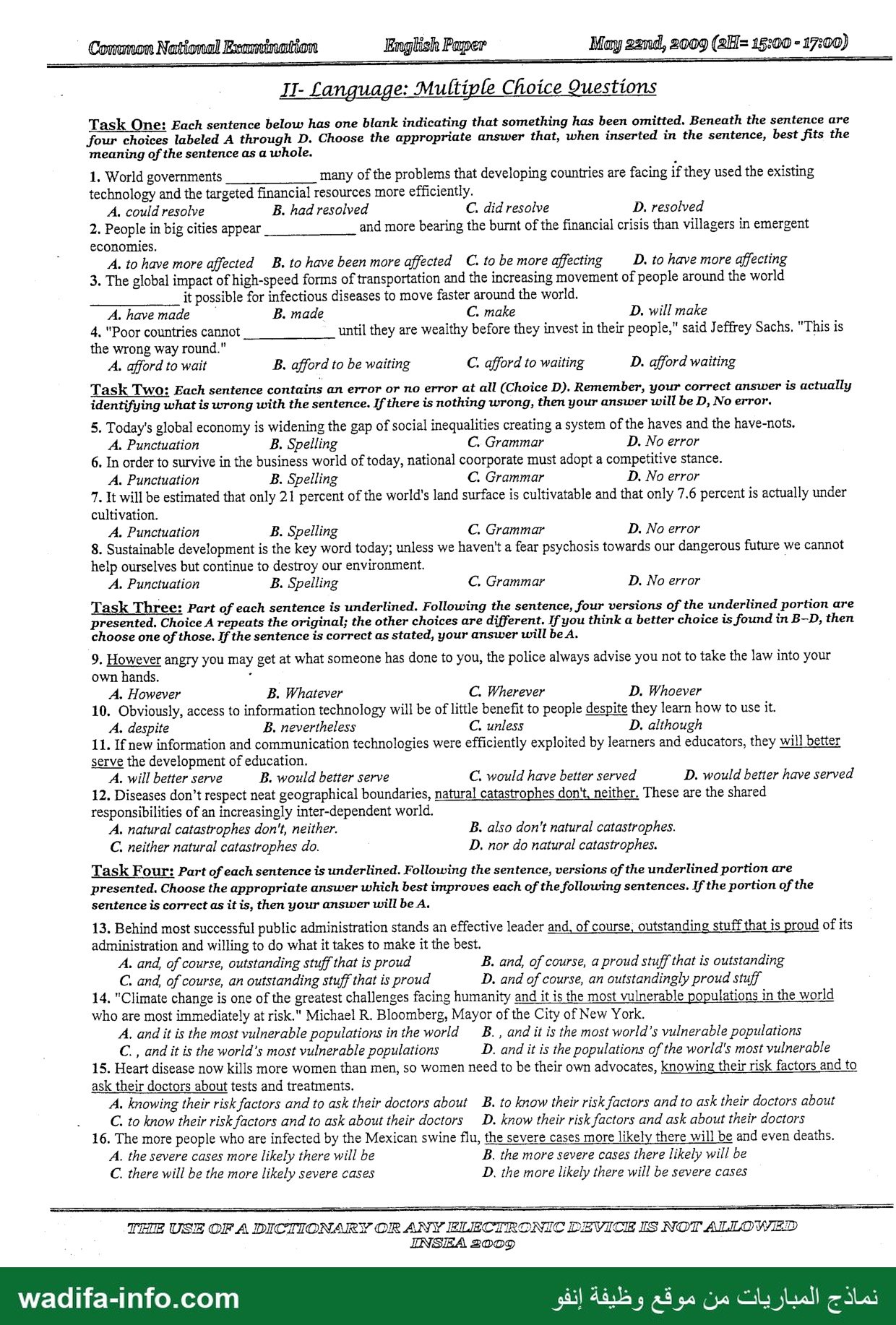
Task One: Each sentence below has one blank indicating that something has been omitted. Beneatkh the sentence are
four choiïces labeled À through D. Choose the appropriate answer that, when inserted in the sentence, best fits the
meaning of the sentence as a whole.
1. World governments many of the problems that developing countries are facing if they used the existing
technology and the targeted financial resources more efficiently.
A. could resolve B. had resolved C. did resolve D. resolved
2. People in big cities appear and more bearing the burnt of the financial crisis than villagers in emergent
economies.
| À. to have more affected B. to have been more affected C: to be more affecting عا to have more affecting
3. The global impact of high-speed forms of transportation and the increasing movement of people around the world
it possible for infectious diseases to move faster around the world.
A. have made B. made C. make D. will make
4, "Poor countries cannot until they are wealthy before they invest in their people," said Jeffrey Sachs. "This is
the wrong way round."
A. afford to 7 B. afford to be waiting C. afford to waiting D. afford waiting
Task Two: Each sentence contains an error or no error at all (Choice D). Remember, your correct answer is actually
identifying what is wrong with the sentence. If there is nothing wrong, then your answer will be D, No error.
5. Today's global economy is widening the gap of social inequalities creating a system of the haves and the have-nots.
A, Punctuation B. Spelling C. Grammar D. No error
6. In order to survive in the business world of today, national coorporate must adopt a competitive stance.
A. Punctuation B. Spelling C. Grammar D. No error
7. It will be estimated that only 21 percent of the world's land surface is cultivatable and that only 7.6 percent is actually under
cultivation.
A, Punctuation B. Spelling C. Grammar D. No error
8. Sustainable development is the key word today; unless we haven't a fear psychosis towards our dangerous future we cannot
help ourselves but continue to destroy our environment. |
A. Punctuation B. Spelling C, Grammar D. No error
Task Three: Part of each sentence is underlined. Following the sentence, four versions of the underlined portion are
presented. Choice À repeats the original; the other choïces are different. If you think a better choice is found in B-D, then
choose one of those. If the sentence is correct as stated, your answer will be À.
9. However angry you may get at what someone has done to you, the police always advise you not to take the law into your
own hands. ١
A. However B. Whatever C. Wherever D. Whoever
10. Obviously, access to information technology will be of little benefit to people despite they learn how to use it.
A. despite B. nevertheless C. unless D. although
11. If new information and communication technologies were efficiently exploited by learners and educators, they will better
serve the development of education.
A. will better serve B. would better serve C. would have better served D. would better have served
12. Diseases don’t respect neat geographical boundaries, natural catastrophes don't, neither. These are the shared
responsibilities of an increasingly inter-dependent world.
A, natural catastrophes don't, neïther. B. also don't natural catastrophes.
C. neither natural catastrophes do. D. nor do natural catastrophes.
Task Four: Part of each sentence is underlined. Following the sentence, versions of the underlined portion are
presented, Choose the appropriate answer which best improves each of the following sentences. Ifthe portion of the
sentence is correct as 11 is, then your answer will be A.
13. Behind most successful public administration stands an effective leader and, of course, outstanding stuff that is proud of its
administration and willing to do what it takes to make it the best.
A. and, of course, outstanding stuff that is proud B. and, of course, a proud stuff that is outstanding
C. and, of course, an outstanding stuff that is proud D. and of course, an outstandingly proud stuff
14. "Climate change is one of the greatest challenges facing humanity and it is the most vulnerable populations in the world
who are most immediately at risk." Michael R. Bloomberg, Mayor of the City of New York.
À. and it is the most vulnerable populations in the world B., and it is the most world's vulnerable populations
C., and it is the world's most vulnerable populations D. and it is the populations of the world's most vulnerable
15. Heart disease now kills more women than men, so women need to be their own advocates, knowing their risk factors and to
ask their doctors about tests and treatments.
A. knowing their risk factors and to ask their doctors about 2. to know their risk factors and to ask their doctors about
s © to know their risk factors and to ask about their doctors D. know their risk factors and ask about their doctors
16. The more people who are infected by the Mexican swine flu, the severe cases more likely there will be and even deaths.
A. the severe cases more likely there will be B. the more severe cases there likely will be
C. there will be the more likely severe cases D. the more likely there will be severe cases
——————_—_—_—_————_—_—_—_—_—__ EEE EEE EEE nt
TELE USE OF À DICTIONARY OR ANY ELECTRONIC DEVICE IS NOT ALLOWIED
| INSEA 2009
wadifa-info.com نماذج المباريات من موقع وظيفة إنفو
Z007 (ZHtours : 15:00 — 77 :00) الست English Fager Kay ل ا ال ل دا نا
Nom et prénom du candidat: Centre d'examen: | Numéro d'examen du RASE
candidat |
١ل DUT UT Partie à remplir parle candidat
ل 0 ة
222
EPREUVE D'ANGLAIS DUREE : 02H
Answer-sSheet
Notes à lire par le candidat
Le candidat doit obligatoirement utiliser la feuille- réponse, (ANSWER- SHEET), pour ses >
réponses.
Chaque candidat n'a droit qu'a une seule « ANSWER-SHEET ». Aucune feuille a carreaux, >
commune aux autres épreuves, ne sera acceptée.
Le candidat doit écrire son nom de famille, prénom, centre et numéro d'examen dans la partie >
réservée à ceci en haut de cette page, avant de commencer à rédiger, pour valider sa feuille de
composition.
Pour la ‘SECTION Translation, les phrases citées en anglais doivent être traduites en français, >
et celles citées en français doivent être traduites en anglais comme indiqué dans l'épreuve.
L'usage de toutes machines (calculatrice, traductrice, téléphone portable, etc.) est strictement >
interdit.
L'usage du dictionnaire est interdit. >
Si un candidat est amené à repérer ce qui peut lui sembler être une erreur d’'énoncé, il le >
signalera sur sa copie et devra poursuivre sa composition en expliquant les raisons des
initiatives qu’il a été amené à prendre.
CETIE EPREUVE COMPREND DEUX FEUILLES A3: UNE FEUILLE (ENGLISH EXAM PAPER) >
AINSI QU'UNE FEUILLE-REPONSE (ASWER-SHEET). |
نماذج المباريات من موقع وظيفة إنفو wadifa-info.com
Common National Exnmination Erialish FAÿer Ma LL, Z097 (ZHorars : 7:00 — 17 200:
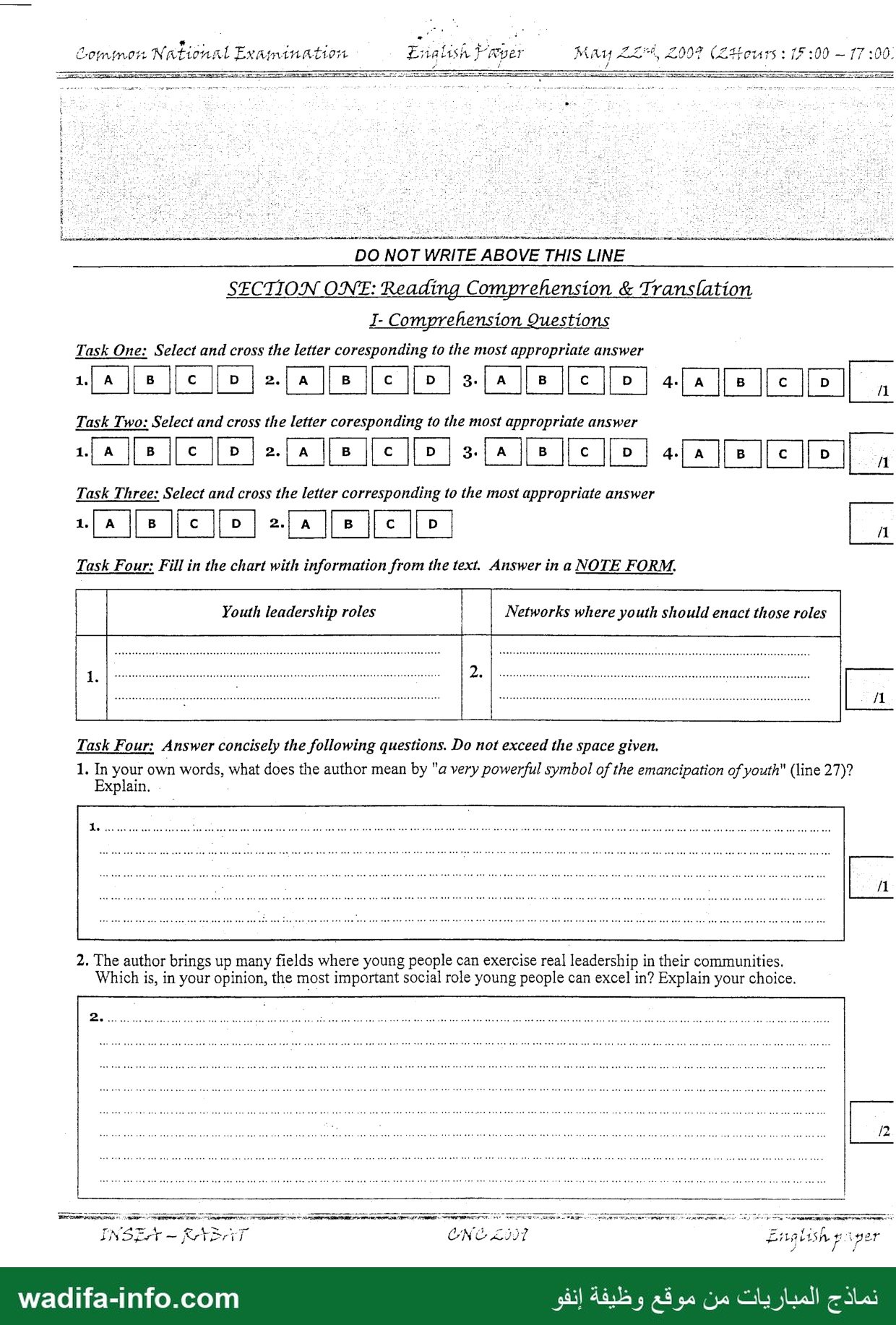
DO NOT WRITE ABOVE THIS LINE
SECTION ONE: Reading Comprehension & Translation
I- Comprehension Questions
Task One: Select and cross the letter coresponding to the most appropriate answer
| نمال القالتماء لما لمان نه م af] و ألما
Task Two: Select and cross the letter coresponding to the most appropriate answer
1 [a | لقال الفالماء لم] 200 +R CIC 4
Task Three: Select and cross the letter corresponding to the most appropriate answer
L[a Je Je olefa fe Ier] HE
Task Four: Fill in the chart with information from the text. Answer in a NOTE FORM.
| Youth leadership roles Networks where youth should enact those roles
Task Four: Answer concisely the following questions. Do not exceed the space given.
1. In your own words, what does the author mean by "a very powerful symbol of the emancipation of youth" (line 27)?
Explain.
2. The author brings up many fields where young people can exercise real leadership in their communities.
Which is, in your opinion, the most important social role young people can excel in? Explain your choice.
INSEX = RABAT GNÈ Lit Et 5 اك sper
نماذج المباريات من موقع وظيفة إنفو wadifa-info.com
Cominpist Nation LExamination Enalish Paper {AY محمد 2007 (ZHours : 77 :00 — 17 :00(
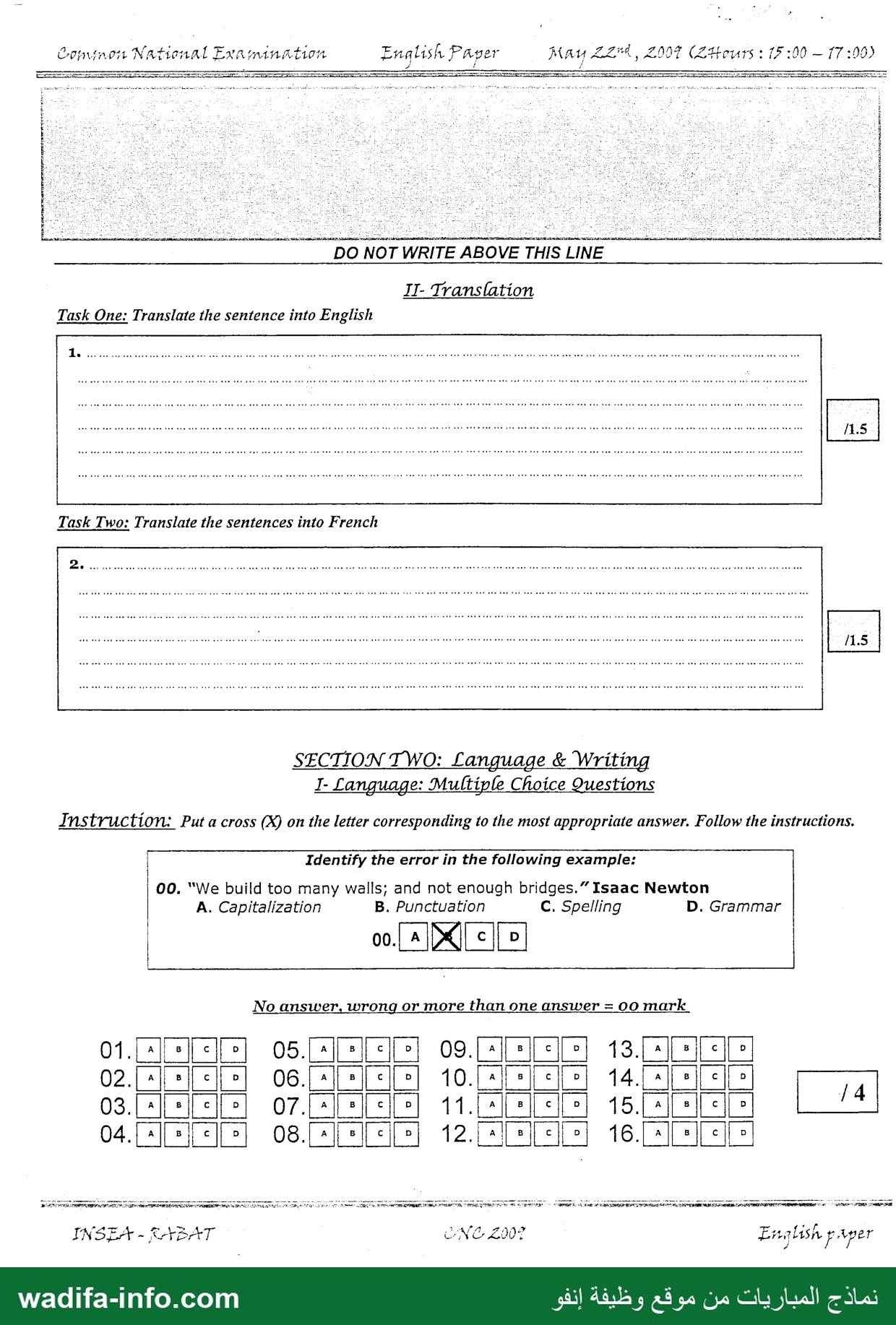
DO NOT WRITE ABOVE THIS LINE
II- Translation
Task One: Translate the sentence into English
Task Two: Translate the sentences into French
SECTION TWO: Language & Writing
1- Language: Multiple Choice Questions
Instruction: Put a cross (X) on the letter corresponding to the most appropriate answer. Follow the instructions.
Identify the error in the following example:
00. “We build too many walls; and not enough bridges.” Isaac Newton
A. Capitalization B. Punctuation C. Spelling D. Grammar
| .هه à DO زمالء
No answer, wrong or more than one answer = 00 mark.
01.6 لم الع الغ الع .13 ص الال .09 لعا ال الم .05 ع الال
02. أع ال o6.LJefefe] 10.9) 14. ىال الم
03. ع ال ال اله 07.0) 1120) 150000)
04.1! أمالغالقاك ).12 هفاك اقاك6ا.08 اغاهأهاك 160%)
INSEA - RABAT CNE ZI0? Enalish fper
wadifa-info.com نماذج المباريات من موقع وظيفة إنفو
Common National ا Enalish Paper Mau رامسم Z007 (ZHovrs : 15 :09 — 17 :007
DO NOT WRITE ABOVE THIS LINE
11. و يا
Write a ‘four-paragraph essay’
wadifa-info.com نماذج المباريات من موقع وظيفة إنفو
Correction proposée
Il s'agit d'une correction proposée, rédigée par l'équipe wadifa-info pour vous aider à comprendre la méthode — ce n'est pas un corrigé officiel de l'administration organisatrice.
Ce modèle est l'épreuve d'anglais du Concours National Commun (CNC) 2009 d'admission aux grandes écoles d'ingénieurs ou assimilées, filières MP / PSI / TSI / BCPST, présidence INSEA, session du 22 mai 2009, 15 h 00 - 17 h 00 (2 heures), dictionnaire et machines interdits. Section One : compréhension d'un texte sur la jeunesse africaine et le leadership (Tasks One à Five) et traduction ; Section Two : 16 QCM de langue et un essai de quatre paragraphes. Le scan contient aussi la page de garde et la feuille-réponse vierge. Réponses modèles en anglais, explications en français.
💡 Les questions « EXCEPT » sont les plus piégeuses : vérifiez chaque option dans le texte et éliminez celles qui y figurent. La bonne réponse est celle que le texte ne dit pas ou contredit.
Section One — I. Comprehension
Task One — Vocabulary
- B. desired — to yearn for = désirer ardemment.
- A. tremendously — overwhelmingly = dans une écrasante mesure ; les autres options ne rendent pas cette idée d'intensité maximale.
- C. assault — onslaught = attaque violente, assaut.
- A. consider suitable — as they see fit = comme ils le jugent bon.
Task Two — Best completion
- A. new responsibilities young people are assuming — les fléaux énumérés (VIH/sida, chômage, répression, conflits) servent de cadre à l'idée que les jeunes « façonnent activement de nouveaux ordres sociaux » (l. 18-20).
- A. they see no progress in the future — « Many see no future for them in the African continent » (l. 16-17). (Le verbe « harnessed » de l'énoncé semble mis pour « harassed / exploited ».)
- C. their determination to act (réponse probable) — l. 10-12 : pour réaliser leurs droits, les jeunes doivent s'organiser et demonstrate their readiness to act, ce qui implique d'assumer des rôles de leadership.
- C. the liberation of young people (réponse probable) — l. 26-28 : le droit de vote dès 16 ans serait un symbole de l'émancipation de la jeunesse et un moyen de canaliser son énergie politique vers le renforcement de la démocratie. L'option D (« emancipation of people ») reprend la l. 10, qui parle du progrès social en général et non de la démocratie.
Task Three — EXCEPT
- C. why youth do not participate… — le paragraphe 4 dit comment les jeunes devraient voter, être représentés et occuper des responsabilités, mais n'explique jamais pourquoi ils ne participent pas.
- C. Local, regional, and international networks are guiding youth… (réponse probable) — l'auteur affirme au contraire que le leadership des jeunes « cannot be directed. It can only be encouraged » (l. 33-34) ; les réseaux sont une aide possible (« can help »), pas une direction déjà à l'œuvre.
Task Four — Chart (note form)
| Youth leadership roles | Networks where youth should enact those roles |
|---|---|
| leading social and political movements; voting from 16; running for elected office (about 21); representation in legislatures; participation in service institutions | family, community, school, national political stage; civil society organizations, universities, government departments, regional organizations; regional and international networks of youth organizations |
Task Five — Short answers
- The author means that giving young people the right to vote at 16 and to stand for election would publicly show that society treats them as full, responsible citizens. It would mark their passage from passive subjects to active actors and, beyond the symbol, channel their energy into democratic institutions instead of frustration.
- In my opinion, the most important role is leadership in civil society associations. There, young people can act at once, without waiting for elections: they organize literacy classes, environmental campaigns or support for the poor. This experience trains them in responsibility and teamwork, and prepares future political and economic leaders.
II. Translation
Task One — Into English
"Since 1990, the Human Development Reports have explored, every year, themes such as poverty, gender, democracy, human rights, globalization, cultural liberty, access to water and climate change."
Task Two — Into French
« La véritable richesse d'une nation, ce sont ses habitants. Et le but du développement est de créer un environnement favorable qui permette à chacun de vivre longtemps, en bonne santé et de façon créative. Cette vérité simple mais forte est trop souvent oubliée dans la course à la richesse matérielle et financière. »
💡 an enabling environment = « un environnement favorable / propice » ; people au sens de « la population » se traduit par « ses habitants » ou « sa population », pas par « son peuple » ; pursuit = « quête / recherche ».
Section Two — I. Language: Multiple Choice Questions
Task One
- A. could resolve — conditionnel irréel du présent : if they used … they could resolve.
- B. to have been more affected — infinitif passé passif : les citadins semblent avoir été plus touchés.
- A. have made — sujet composé (impact + movement) donc pluriel ; le present perfect relie ce changement à la situation actuelle.
- A. afford to wait — cannot afford to + base verbale.
Task Two — Identify the error
- A. Punctuation (réponse probable) — il manque une virgule avant la proposition participiale creating a system… (« …the gap of social inequalities, creating… »).
- B. Spelling — coorporate s'écrit corporate (et l'on attendrait corporations).
- C. Grammar — It will be estimated → It is estimated (il s'agit d'une estimation déjà faite).
- C. Grammar — unless contient déjà la négation : unless we have, et non unless we haven't.
Task Three — Underlined portion
- A. However — However + adjectif = « aussi … que vous soyez ».
- C. unless — « peu utile à moins qu'ils n'apprennent à s'en servir » ; despite ne peut pas introduire une proposition.
- B. would better serve — If … were exploited appelle would (conditionnel présent).
- D. nor do natural catastrophes — reprise négative avec inversion ; don't, neither est incorrect.
Task Four — Best version
- C. and, of course, an outstanding stuff that is proud (réponse probable) — parallélisme avec an effective leader et place normale de l'adjectif ; le mot voulu est manifestement staff (le personnel), imprimé « stuff » dans toutes les options.
- C. , and it is the world's most vulnerable populations — virgule devant and reliant deux propositions, génitif the world's placé avant le superlatif.
- B. to know their risk factors and to ask their doctors about — parallélisme need … to know … and to ask ; l'option D change le sens (ask about their doctors).
- B. the more severe cases there likely will be — structure corrélative The more …, the more ….
| 1 | 2 | 3 | 4 | 5 | 6 | 7 | 8 |
|---|---|---|---|---|---|---|---|
| A | B | A | A | A | B | C | C |
| 9 | 10 | 11 | 12 | 13 | 14 | 15 | 16 |
| A | C | B | D | C | C | B | B |
Section Two — Essay writing (four paragraphs)
Sujet : « Young people are said to have lost many of the traditional values of older generations. This does not matter because the old social values are no longer relevant in the modern world. » — à discuter avec deux valeurs sociales et des exemples liés au développement humain durable.
Introduction. It is often said that young people have abandoned the values of their parents and grandparents, and that this is no loss because those values belong to the past. I disagree: some customs may be outdated, but core social values such as solidarity and moderation are more relevant than ever to sustainable human development.
Paragraph 2 — Solidarity. Solidarity is the first example. In traditional Moroccan society, families and neighbours helped one another through practices such as "touiza", collective work in the fields, and support for the old, the sick and the poor. Today, when unemployment and urban isolation leave many people vulnerable, this value is the basis of associations, cooperatives and volunteering. Women's argan cooperatives, for instance, combine income, dignity and the protection of a fragile forest.
Paragraph 3 — Moderation. Moderation is the second. Older generations repaired objects, wasted little food and used water carefully because resources were scarce. Modern consumer culture encourages the opposite: fast fashion, disposable plastic and waste. Yet climate change and water stress show that sustainable development depends precisely on this old habit of consuming less and wasting nothing.
Conclusion. In conclusion, traditional values should not be kept simply because they are old, nor rejected because they are old. Values like solidarity and moderation are not obstacles to modern life; they are tools for a fairer and more sustainable future, and young people can give them new forms.
💡 La consigne impose deux valeurs et des exemples de développement durable : un paragraphe par valeur, chacun avec un exemple concret, est la structure la plus sûre pour quatre paragraphes.
Questions fréquentes sur ce sujet
Ce sujet est-il téléchargeable gratuitement ?
Le corrigé est-il inclus ?
Quel organisme et quel grade concerne ce sujet ?
De quelle session s'agit-il et dans quelle langue ?
Où trouver d'autres sujets du même concours ?
Vous préparez ce concours ?
Modèles similaires
Organisme : Ministère de l'Enseignement Supérieur — Concours National Commun d'admission aux écoles d'ingénieurs · 2009 — Copie issue de : archive de modèles de concours — document archivé tel que reçu ; l'avis officiel du concours fait foi.
}Citer cette page
Journaliste, blogueur, enseignant : copiez la référence ci-dessous et mettez un lien vers cette page.
Adresse permanente : https://www.wadifa-info.com/fr/modele-concours/2553/modele-du-concours-national-commun-cnc-2009-anglais-filieres-mp-psi-tsi-bcpst-ecoles-d-i