
Modèle d'examen d'aptitude professionnelle : professeur du secondaire qualifiant, 1er grade — sciences de l'éducation et didactique de la spécialité (anglais) — session 2023
En bref
Ce document est une ancienne épreuve écrite du concours de Professeur du secondaire qualifiant - 1er grade organisé par Ministère de l'Éducation nationale, du Préscolaire et des Sports - Centre national de l'évaluation et des examens (CNEE) (2023), publiée sur Wadifa Info en consultation et téléchargement PDF gratuits, avec une correction proposée.
- Organisme
- Ministère de l'Éducation nationale, du Préscolaire et des Sports - Centre national de l'évaluation et des examens (CNEE)
- Grade
- Professeur du secondaire qualifiant - 1er grade
- Spécialité
- anglais
- Année
- 2023
- Pages
- 15
- Langue des questions
- français
- Correction
- correction proposée disponible sur cette page
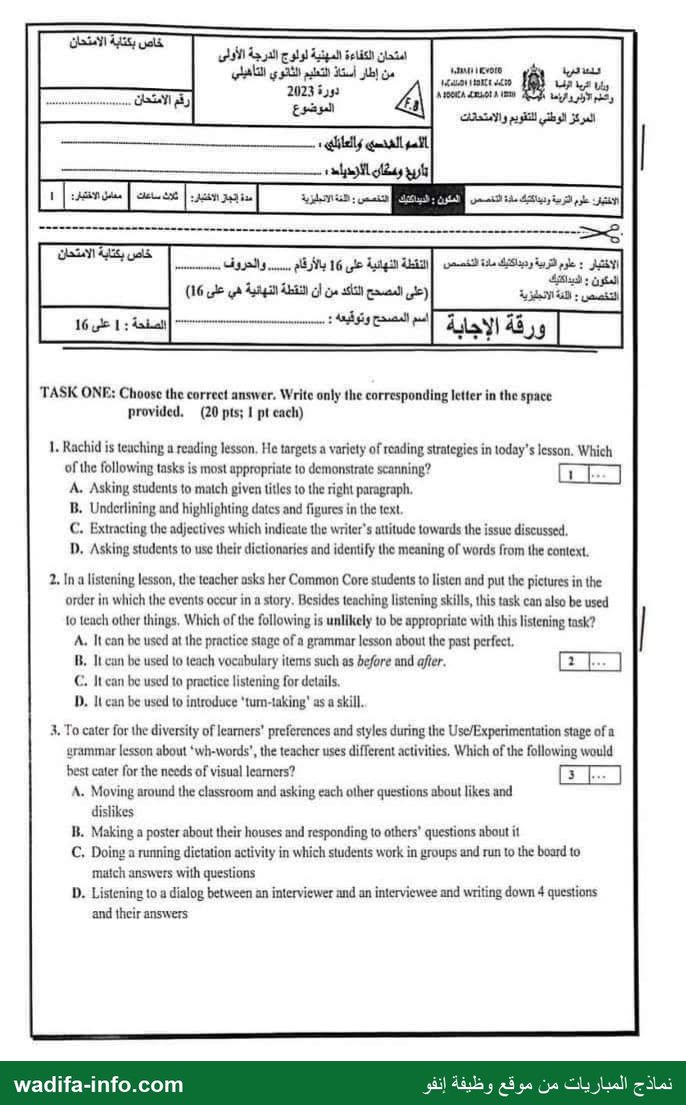
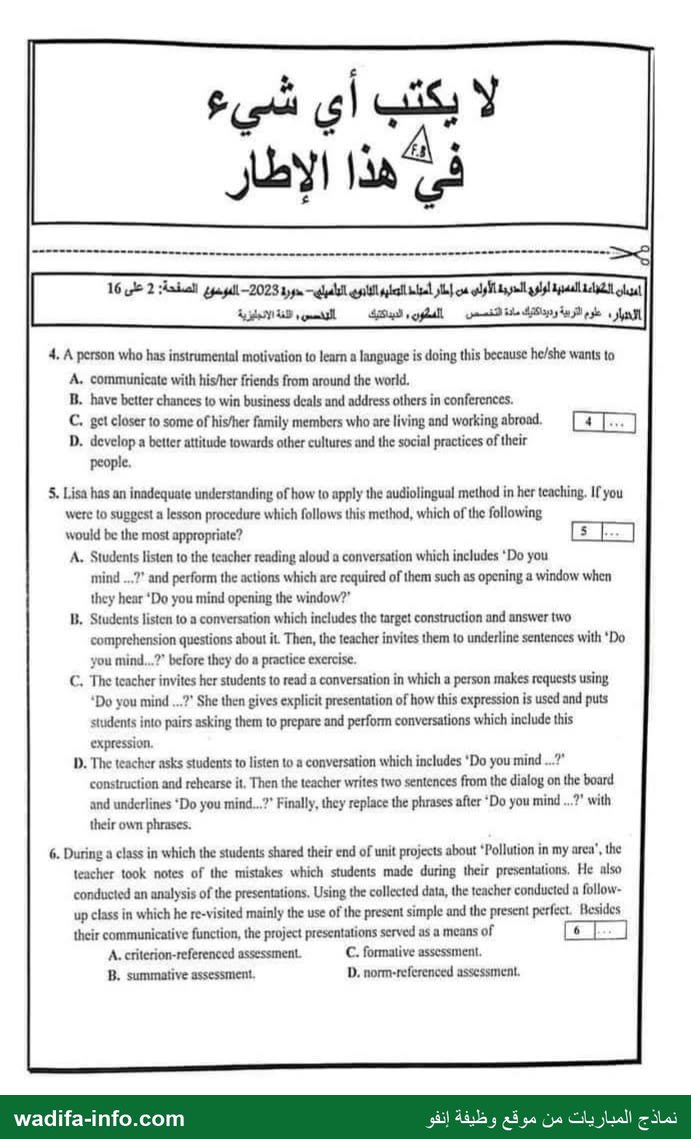
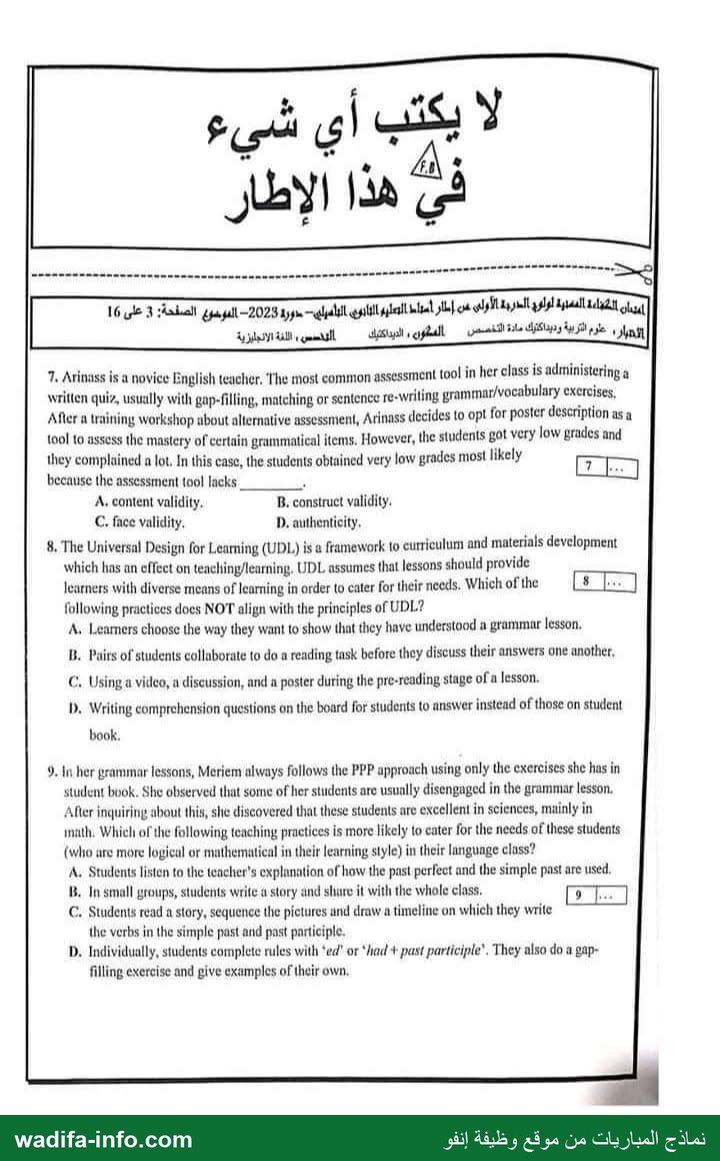
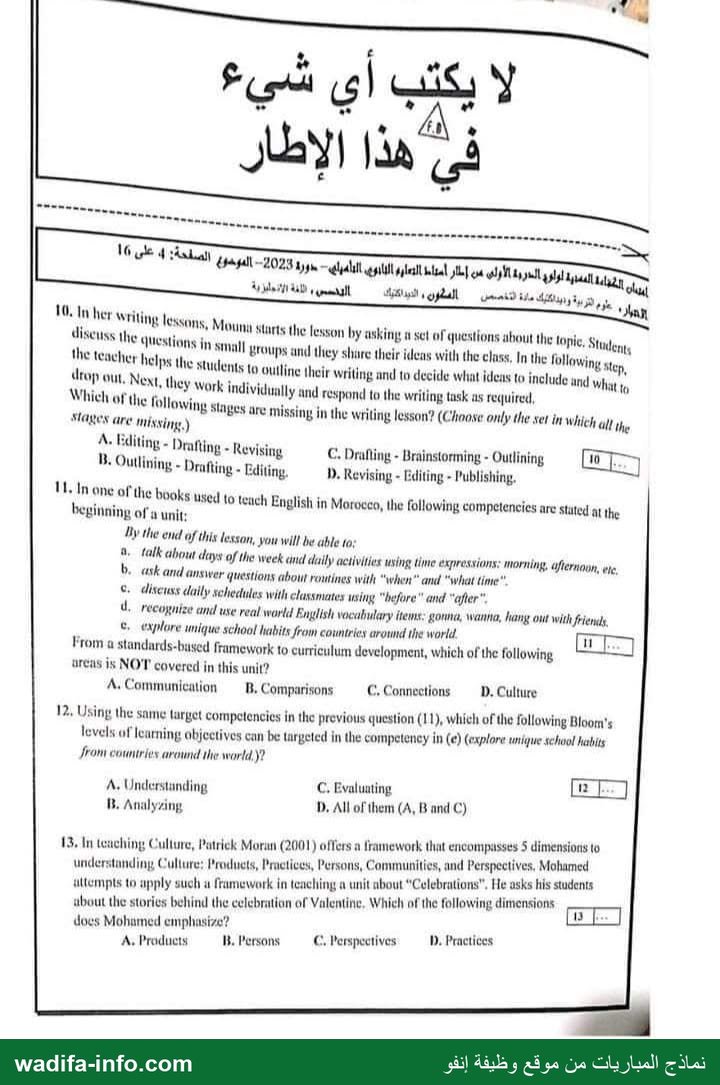
📝 Texte des questions (extrait automatiquement des pages scannées)
Ce texte est extrait automatiquement des images de l'épreuve et peut contenir des erreurs de lecture — les images ci-dessus font foi.
امتحان الكقاءة المبنية لولوج الدرجة الأولى
Se ا pr جب من إطار أستاذ التعليم الثانوي التأهيلي
CR pee
36 الوطني للتقويم والامتخانات €
| الم il ga ...ايت تت
الإختيار : علوم التربية و«بداكتيك مادة النخسص | النقطة النهائية على 16 بالأرقام ....... والحروفا mes خاص بكتاية الابتجان
المكون : الديداكتيك 1 ere
التخصص : اللفة الانجليزية (على المصحج التأكد من أن النقطة النهانية هي على 16)
LAS = 22 3777 ه.1144444ز1ززززززز0005 5
4 | 48,5 الإجابة ue الصفحة : 1 على 16
TASK ONE: Choose the correct answer. Write only the corresponding letter in the space
provided. (20 pts; ١ pt each)
1. Rachid is teaching a reading lesson. He targets a variety of reading strategies in today"s lesson. Which
of the following tasks is most appropriate ما demonstrate scanning? QG T:]
A. Asking students to match given titles to the right paragraph.
B. Underlining and highlighting dates and figures in the text.
©. Extracting the adjectives which indicate the writer's attitude towards the issuc discussed.
D, Asking students to use their dictionaries and identify the meaning of words from the context.
2. In a listening lesson, the teacher asks her Common Core students to listen and put the pictures in the
order in which the events occur in a story. Besides teaching listening skills, this task can also be used
10 teach other things, Which of the following is unlikely to be appropriate with this listening task?
A. It can be used at the practice stage of a grammar lesson about the past perfect.
B, Jean be used to teach vocubulury items such as before and after.
©. Ian be used to practice listening for details.
D, 1! can be used to introduce ‘tum-taking' as a skill.
3. To cater for the diversity of learners' preferences and styles during the Use/Experimentation stage of a
grammar lesson about ‘wh-words”, the teacher uses different activities, Which of the following would
best cater for the needs of visual learners?
A. Moving around the classroom and asking each other questions about likes and
dislikes
B. Making a poster about their houses and responding to others’ questions nbout it
©, Doing a running dictation activity in which students work in groups and run م the board to
match answers with questions
D. Listening to a dialog between an interviewer and an interviewee and writing down 4 questions
and their answers
wadifa-info.com نماذج المباريات من موقع وظيفة إنفو
لا يكتب أى شىء
فيهذا الإطا
al LE cl لولوع الدرية الأولى من إطار أسياط الصليو الادوي البأميلي- y 2023- البوموع الصفحة: 2 على 16
Jai + علوم التربية وديداكتيك مادة التنصسص fill ؛ الديباكتيك الزنحمسي؛ اللغة الانجليزية
4. À person who has instrumental motivation ما learn a language is doing this because he/she wants to
A. communicate with his/her friends from around the world.
B. have better chances ما win business deals and address others in conferences.
C. get closer 10 some of his/her family members who are living and working abroad.
D. develop a better attitude towards other cultures and the social practices af their
people.
5. Lisa has an inadequate understanding of how ما apply the audiolingual method in her teaching. If you
were to suggest a lesson procedure which follows this method, which of the following
would be the most appropriate?
A. Students listen 10 the teacher reading aloud a conversation which includes ‘Do you
mind ...7' and perform the actions which are required of them such as opening a window when
they hear ‘Do you mind opening the window?"
B. Students listen to a conversation which includes the target construction and answer two
comprehension questions about it. Then, the teacher invites them ما underline sentences with *Do
you mind...?" before they do a practice exercise.
© The teacher invites her students ما read a conversation in which a person makes requests using
“Do vou mind ...7' She then gives explicit presentation of how this expression is used and puts
students into pairs asking them to prepare and perform conversations which include this
expression.
D. The teacher asks students to listen ما a conversation which includes ‘Do you mind '؟...
construction and rehearse it, Then the teacher rites two sentences from the dialog on the board
and underlines ‘Do you mind...?" Finally, they replace the phrases after ‘Do you mind .?" with
their own phrases.
6. During a class in which the students shared their end of unit projects about ‘Pollution in my area’, the
teacher took notes of the mistakes which students made during their presentations, He also
conducted an analysis of the presentations. Using the collected data, the teacher conducted a follow-
up class in which he re-visited mainly the use of the present simple and the present perfect. Besides
their communicative function, the project presentations served as a means of نلعا
A. criterion-referenced assessment. C. formative assessment.
B. summative assessment. D. norm-referenced assessment.
لا يكتب kel
5 هذا | لإطار
إيييان al ati الارية الأولي من إطار mat العليو البادوي البأميلي.- ورد 2023- gap الصفحة: 3 على 16
diurne nn مادة التخصسس __ المثون , الديناكتيك - الإنسس؛ اللفة الانجليزية
7, Arinass is a novice English teacher, The most common assessment tool in her class is administering a
writien quiz, usually with gap-filling, matching or sentence re-writins grammar/vocabulary exercises,
Aer a training workshop about alternative assessment, Arinass decides to opt for poster description as a
tool 10 assess the mastery of certain grammatical items. However, the students got Very low grades and
they complained a lot, In this case, the students obtained very low grades most likely
because the assessment too! lacks ‘
A. content validity. 13. construct validity.
C, face validity. D. authenticity.
8, The Universal Design for Learning (UDL) is a framework to curriculum and materials development
which has an effect on teaching/learning, UDL assumes that lessons should provide
learners with diverse means of learning in order to cater for their needs, Which of the
following practices docs NOT align with the principles of UDL?
A, Learners choose the way they want ما show that they have understood a grammar lesson,
11. Pairs of students collaborate to do a reading task before they discuss their answers one another,
©. Using a video, a discussion, and a poster during the pre-reading stage of a lesson.
D, Writing comprehension questions on the board for students to answer instead of those on student
book.
9, fn her grammar lessons, Meriem always follows the PPP approuch using only the exercises she has in
student book. She observed that some of her students are usually disengaged in the grammar lesson,
Afer inquiring about this, she discovered that these students are excellent in sciences, mainly in
math, Which of the following teaching practices is more likely to cater for the needs of these students
{who are more logicul or mathematical in their learning, style) in their language class?
A, Students listen ta the teacher’s explanation of how the past perfect and the simple past are used.
BB. 10 small groups, students write a story and sliure it with the whole class.
©, Students read a story, sequence the pictures and draw a timeline on which they write
the verbs in the simple past and past participle.
D. Individually, students complete rules with ‘ed' or ‘had + past participle", They also do a gap-
filling exercise and give examples of their own.
wadifa-info.com نماذج المباريات من موقع وظيفة إنفو
<< #اا م
لا بكتب اى شىء
يحبب أي سني
هذا الاطا à
16 بدا لصفحة: 4 على
لولج 13 الأرتي من إطار أمياط المار الناائي» البأمرلي- بدورة 2023- المودع ju رقباءة
ALIEN OPEN | AA الفثون ؛ nid مادة dy, و التربية chu
tre
10 In her Writing lessons, Mou ; LS
diseuss he M rem 0 M Murts the lesson by براق a st of questions about th lopic, Studer
the ténchos ht ii 4 ee Broups and ttes shüre their ideas with the class, In the following ste its
drop out, Next, hey work : ni Oülline their writing and to décide what ideas to include and ral
Which of ic Roi MdVidunlly and respond to the writing task as required,
NE Slages are missinu i و 8 9 6 7 7
اكز are née) ي11115511 ا in علا writing lesson? (Choose only the ser in Wie alt the
A: Editing - دا dyigi :
dc ا - Drafling - Revising ©. Drafing - Brainstorming - Outlining
٠ Outlining - Drafting - isi iditi ishi
£ ing D. Revising - Éditing - Publishing.
1, In تمع
1e books used to tench English i أ ل
er S Englis J : 0
يرا 00 glish in Morocco, the following compelencies are stuted at the
By the end of this lesson, pou will be able to:
1 falk about days of the week oct daily activities using time expressions: morning, cfiernoun, ete,
ask and answer questions about routines with “when” and “what time“. 99
©. discuss daily schedules with classmates using "hefore" and “afier”.
d. récogniee and use real world English Vocabulary items: gonna, wanna, lang out with friends.
| €, explore unique school habits from countries around the world نسلا
From a Standards-bused framework to curriculum development, which of the following
areas is NOT covered in this unit?
A. Communication B, Comparisons ©. Connections D. Culture
12, Using the same turget competencies in the previous question (11), which of the following Bloom's
levels of learning objectives can be targeted in the competency in (e) (explore unique sehoo! habits
front countries around the world }?
A: Understinding ©. Evaluating GT]
ال١ Anulyzing D, All of them (A, Band C)
13, In teuching Culture, Patrick Moran (2001) offers a framework that encompasses 5 dimensions to
understanding Cullure: Products, Practices, Persons, Communities, and Perspectives, Mohamed
ultémpts to apply such à framework in teaching a unit about “Celebrations", He asks his students
about the stories behind the éelebration of Valentine, Which of the following dimensions
تعمل Mohümed emplhasize?
A. Products B. l'ersons €, Perspectives D, Practices
wadifa-info.com نماذج المباريات من موقع وظيفة إنفو
à vel لا بكنب
F سي Er
16 الموجوع الصفحة: 5 على -2023 29m hdi ران الشفاءة الممنية لولوم النرة الأولي من إطار أسباط الصليم البانوي
يار علوم التربية وديداكثيك مادة التخصص __ المأنون؛ الدبناكثيك.- الإفعيي؛ اللفة الانجليزية
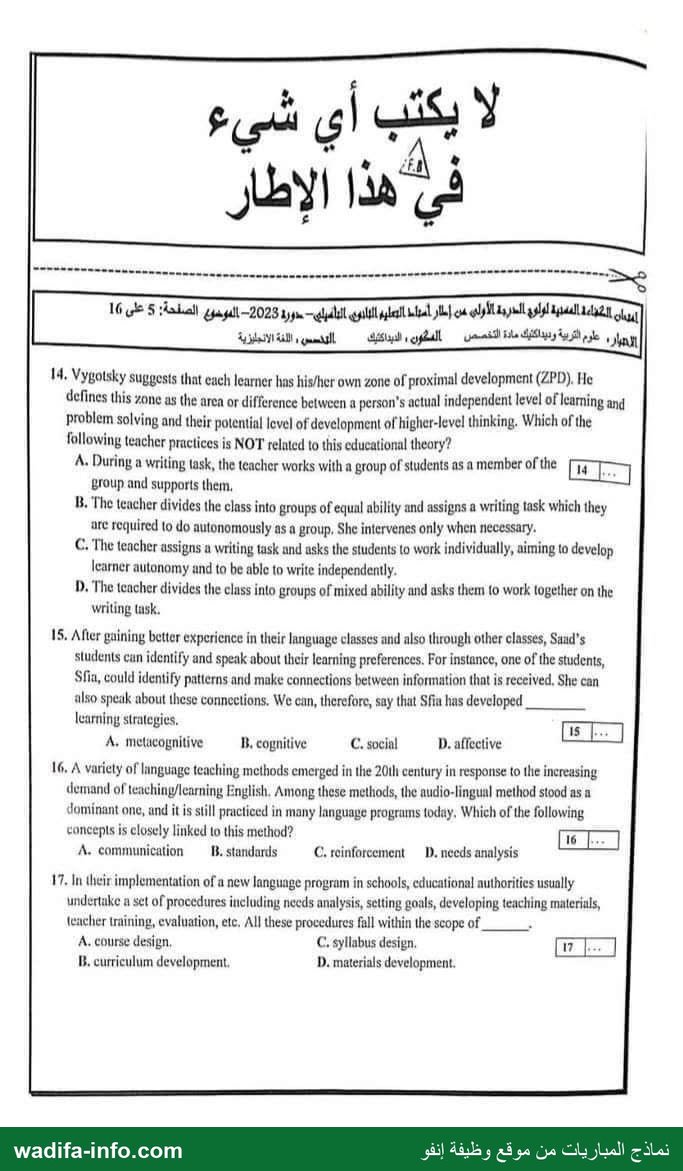
M, Vygotsky suggests that each learner has his/her own zone of proximal development (ZPD). He
defines this zone as the area or difference betwcen persons actual independent level of learning ang
problem solving and their potential level of development of higher-level thinking. Which of the
following teacher practices is NOT related to this educational theory?
À: During a writing task, the teacher works with a group of students as a member of the
group and supports them,
B, The معد divides the class into groups of equal ability and assigns a writing task which they
arc required 10 do autonomously as a group, She intervenes only When necessary.
©. The teacher assigns a writing task and asks the students ما work individually, aiming to develop
lcarner autonomy and to be able to write independently.
D, The teacher divides the cluss into groups of mixed ability and asks them (0 work together on the
writing task.
15, After gaining better experience in their language classes and also through other classes, Sand's
Students cun identify and speak about thcir learning preferences. For instance, one of the students,
Sfia, could identify patterns and make connections between information that is received. She can
also speak about موعلا connections. We can, therefore, say that Sfi has developed
learning strategies. HT]
A. melucognitive B, cognitive C. social D. affective
16, À variety of lnnguage teaching methods emerged in the 20ih century in response to the increasing
demand of teaching/lcarning English, Among these methods, the audio-lingul method stood as a
dominant one, and it is still practiced in many language programs today, Which of the following
concepis is closely linked to this method? De I]
A. communication B. standards C roinforéement 1. necds analysis
17. In their implementation of a new language program in schools, educational authorities usually
undertake a set of procédures including needs analysis, setting goals, developing teaching materials,
{échér training, evaluation, ete, للخ these procedures fall within the scope of à
A. course design, ©. syllabus design,
B. curriculum development. D. materials development.
wadifa-info.com نماذج المباريات من موقع وظيفة إنفو
0 { مي
Ç (eh (& = #
المعدية لولوج التدرية ال
16 الصفحة: 6 على ga -2028 pe at gp tal ,ريرم الشقامة المعدية لولوع العدرية الأولي من إطار أمياط
الودسمس؛ اللغة الانجليزية dé pal venin He, Jan
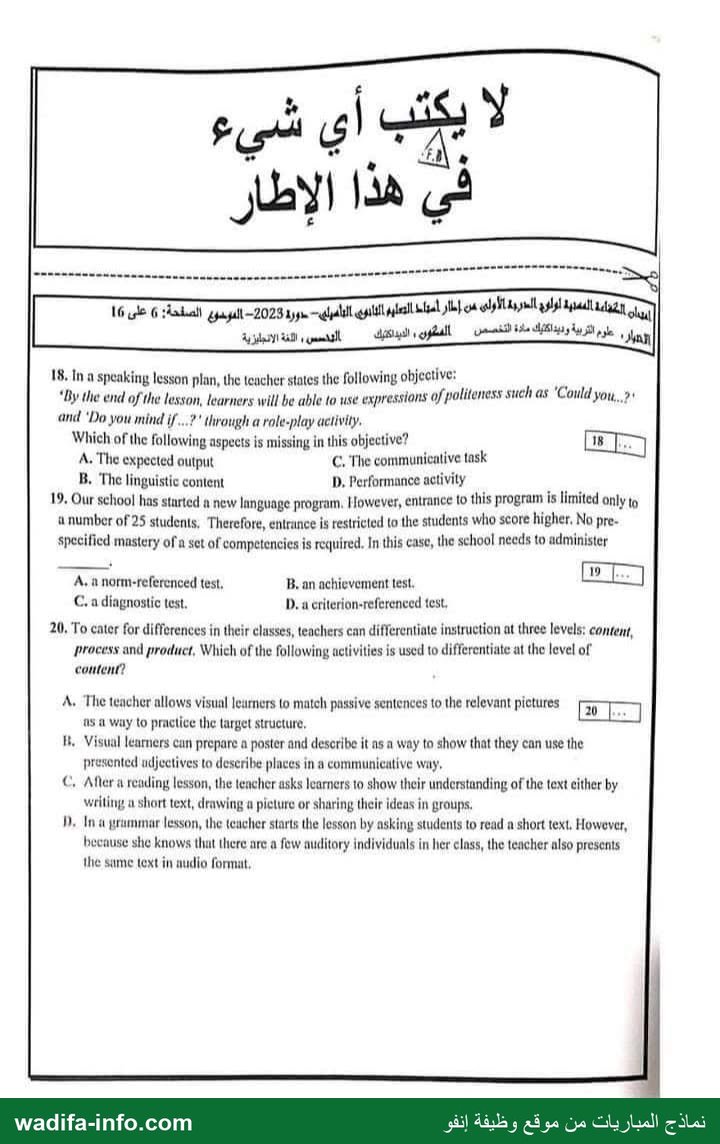
18, In a speaking lesson plan, the teacher states the following objective: | 0
“Bye end ofthe lesson, learners will be able to use expressions ofpoliteness such as "Could you, ?+
and ‘Do you mind ...زا through a role-play activity.
Which of the following aspects is missing in this objective?
A. The expected output C, The communicalive task
B, The linguistic content D, Performance activity —_—
19. Our school has started a new language program, However, entrance to this program is limited only to
a number of 25 students. Therefore, entrance is restricted ta the students who score higher, No pre-
specified mastery of a set of competencies is required. In this case, the school 08005 to administer
A. a norm-referenced test, 13. an achievement test. BE]
C, a diagnostic test. D. a criterion-referenced test.
20, To cater for differences in their classes, teachers can differentiate instruction at three levels: content,
process and produet, Which of the following activities is used ما differentiate at the level of
content?
A The téacher allows visual leurners ما match passive sentences to the relevant pictures
as a way to practice the target structure.
B, Visual léurners can prepare a poster and describe it as a way to show that they can use the
presented udjcetives to describe places in a communicative say,
©, معلل a reuding lesson, the tencher asks lcarners 10 show their understanding of the text cither by
Writing a short text, drawing a picture or sharing their ideas in groups.
D, 10 a grummar lesson, the teacher starts the lessan by asking students to read n short text, However,
because she knows that there are a few auditory individuals in her class, the tencher also presents
the same text in audio format,
wadifa-info.com نماذج المباريات من موقع وظيفة إنفو
kel لا بكتب
فى ذا الاطار
...أ en”
16 بي الشقامة المملية لولوع الدرجة الأولي من إطار أسباط الصليم اليانوي الباميلي. «دورة 2028- البوضوع الصفحة: 7 على
اللفة الانيليزية gel HS ol uit يلوم التربية وابداكتيك “an
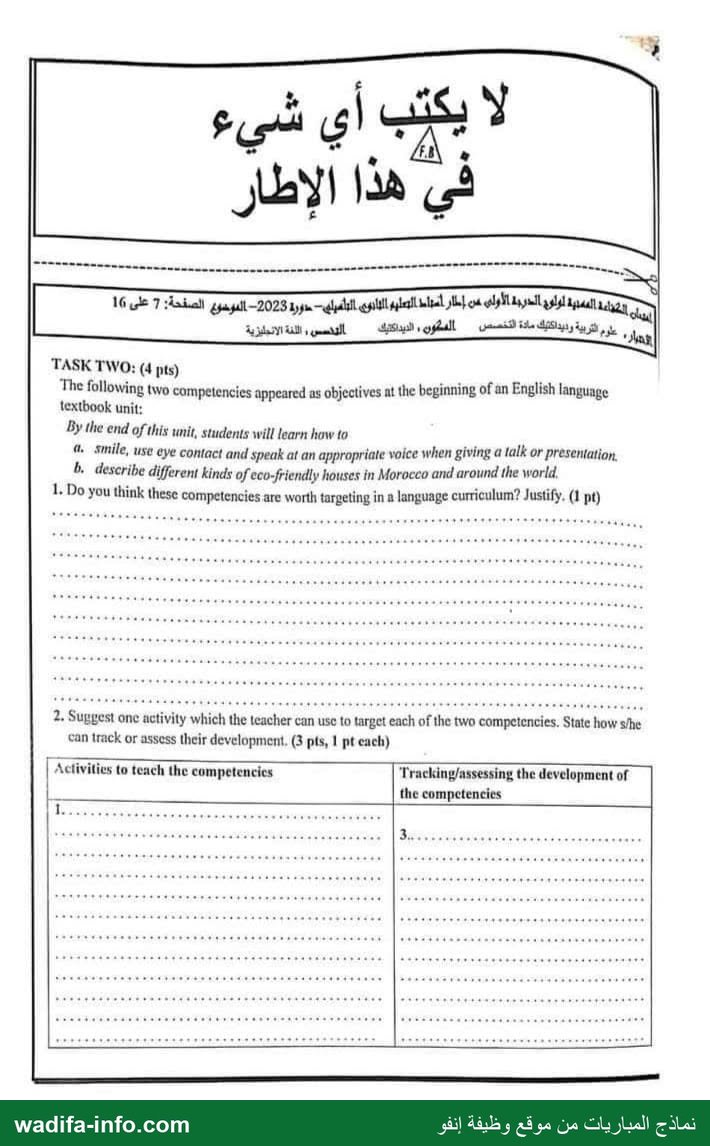
TASK TWO: (4 pts)
The following two competencies appeared as objectives at the beginning of an English language
textbook unit:
By the end Of this unit, students will learn how ما
© smile, use eye contact and speak at an appropriate voice when giving a talk or presentation.
b. describe different kinds ofeco-friendly houses in Morocco and around the world.
1. Do you think these competencies are worth targeting in a language curriculum? Justify, (1 pt)
2. Suggest one activity which the teacher can use to target each of the two competencies. State how she
can track or assess their development, (3 pts, 1 pt each)
[ Activities to teach the competencies Tracking/assessing the development of
| L the competencies
wadifa-info.com نماذج المباريات من موقع وظيفة إنفو
| لا يك
à 14)
HG TA
في هذا الإطا
SERRE TERRE dr :
Lee 0 RC RSS GE = =:
أمبلما الصلير الا tot جيم وما المنية لولوع الدرجة الأولي
16 الصفحة: 8 على gyagill -2023 رجز بلك عدورة ofl ,علوم الثربية وديداكثيك مادة التخصس Ja
gras gel
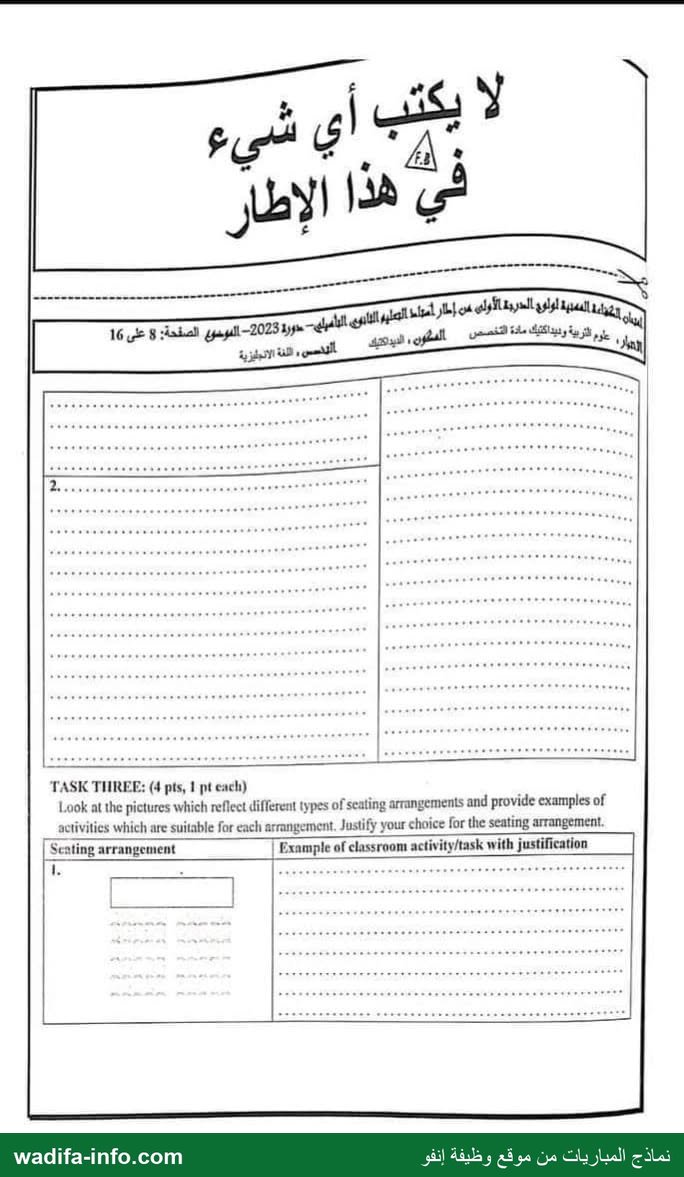
TASK THREE: (4 pts, ١ pt each} .
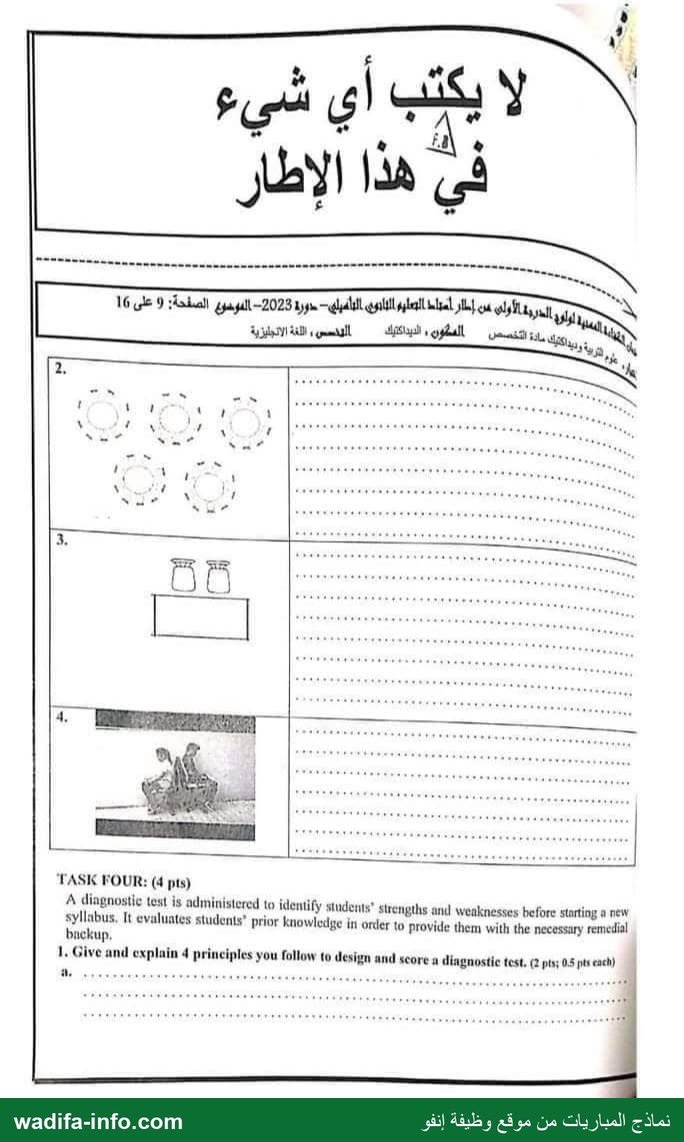
Look at the pictures which reflect différent types of seating arrangements and provide examples of
activities which are suitable far each arrangement. Justify your choice for the seating arrangement.
| Seating arrangement | Example of classroom activity/task with justification
wadifa-info.com نماذج المباريات من موقع وظيفة إنفو
نّ el لا بكب
F يِ الى 0 #
16 التوضوع الصفحة: 9 على -2023 Lg hd go من إطار أسباط الصليم MT بر à À
الوسمي؛ اللغة الاتجليزية Sal ؛ gygdall يا وبباكثيك مادة التسمد
2. ل Q
à ١ , ب 1 CES | الت
8 nn
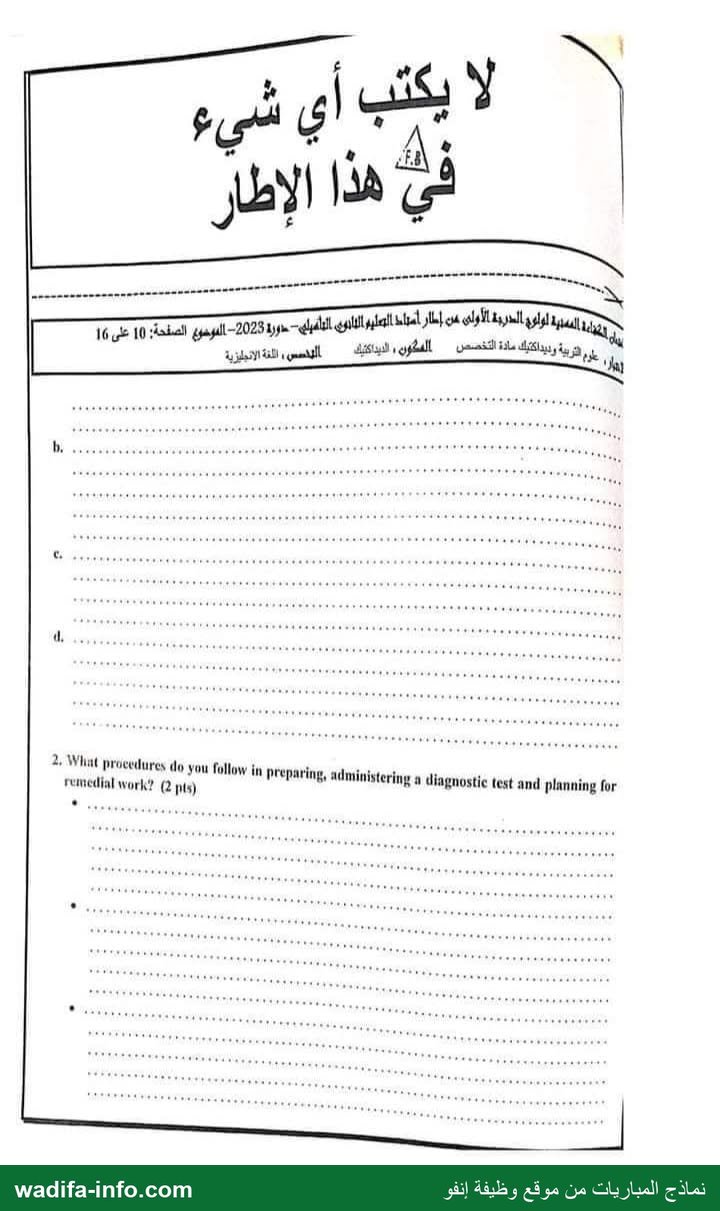
TASK FOUR: (4 pts)
A diagnostic test is administered to identify students" strengths and Wenknesses before starting a new
syllabus, It evaluntes students’ prior knowledge in order to provide them with the necessary remedial
backup,
1, Give and explain 4 principles you follow to design and score a dingnostic test, (2 pts; 0.5 pis each)
wadifa-info.com ج المباريات من موقع وظيفة إنفو
| لا يكتب
à أى
الى ع Er,"
ra ا * À +
هذا الإطار Gé
دا ست Ms lu
فا ولي من إطار أمباط الصليم
الصفحة: -2025 pe dl et sd ديداكتيك à
16 د اي :10 على ass ol vai الام
2, Wiiut procedures ول You follow in preparing, administeringe a diagnostic test and planning for
01016000 work? (2 pis)
نماذج المباريات من موقع وظيفة إن
wadifa-info.com دقو
h A 2 y * pe
م ç ي سي \ IIS à NY N.
فى هذا الاطًا
في إطار
لب |2028 an التعلين الثانوي الزأفيلي- tte لمتمان الحغاءة الممنية ثولوج الدرجة الاولى من إطار
| : 10 على 11 ms Ed 0 , er 48 الاتهاو؛ علوم التربية وديداكتيك مادة التخصسس المطون ؛ الديداكتيك
wadifa-info.com نماذج المباريات من موقع وظيفة إنفو
se“ أي TA"
7 | ٠ 4١ »*
الإطار JR CG
5600557 3 N
mr الأولئ من إطار ]متا sut S
16 الصفحة: 12 على gpagall-2023 ya دسي of pans, en
sa ل ل بات
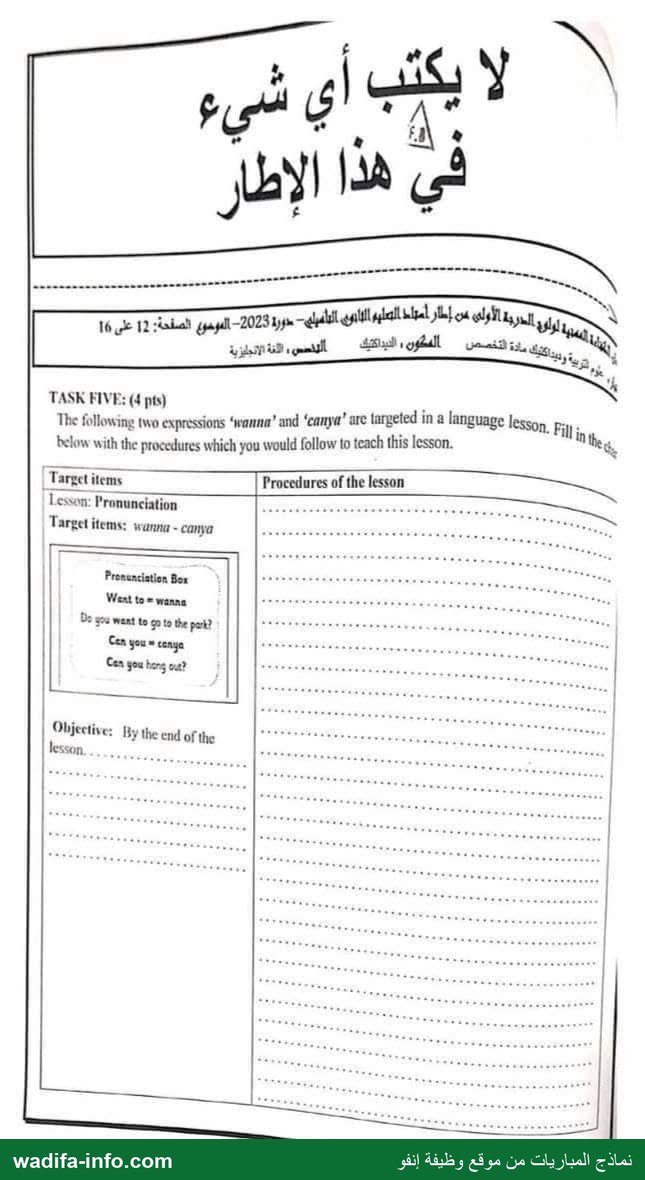
TASK FIVE: (4 pts) , تررم are tarveted in a language lesson /
The following two expressions 'مبيورية and ‘canpa' are sm ولاق" وا LT"
below with the procedures which you would follow ما teac ١ ١
Target items Procedures of the lesson
Target items: Wanna - canya معي etes ni,
مب عدا فلا RSS En MES M
| اسع |
| Objective: By the end of the ااا
wadifa-info.com ح قع وظيفة !نفو
لا بكتب أى شىء
فى هذا الاطا
16 بدوزة 2023- الموضوع الصفحة: 13 على all من إطار أسبلط التعليو التانوي tft put لواو aa امييان الواءة
اليديميس؛ اللفة الانجايزية HS A onde علوم التربية وديداكنيك à jun
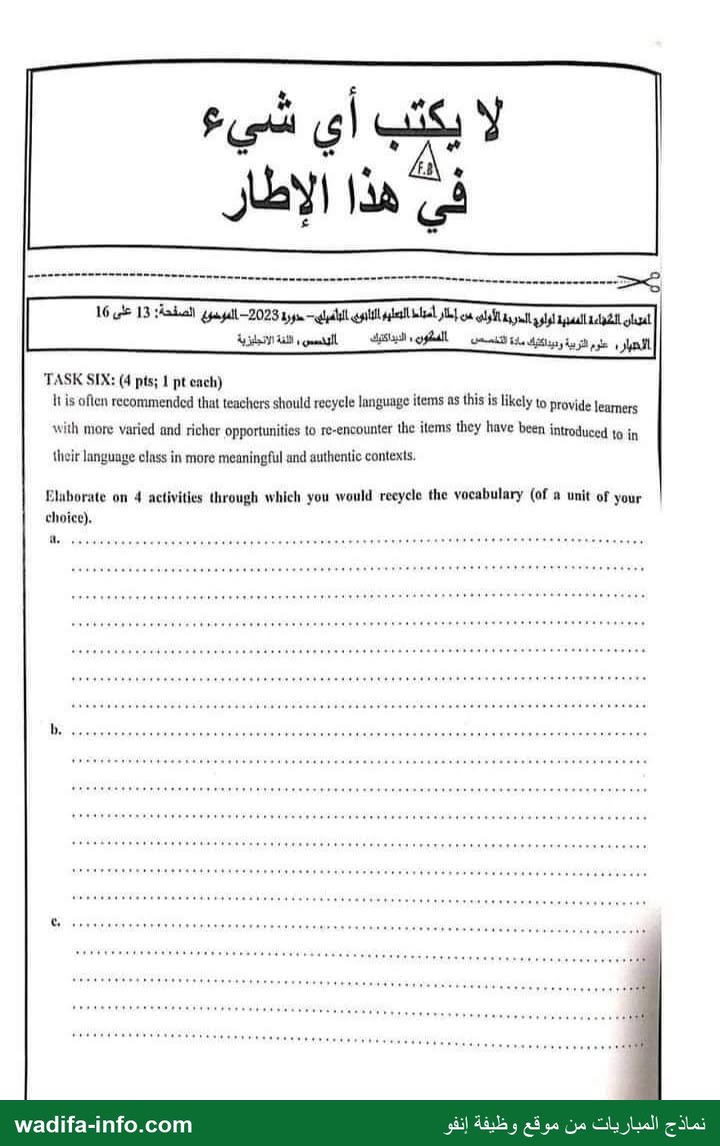
TASK SIX: (4 pts; 1 pt each) 2 M sn
lis ofien recommended that teachers should recycle language items as this is likely to 10110 65
with more varied and richer opportunities ما re-encounter the items they have been introduced م
تملا language class in more meaningfül and authentic contexts.
Eliborate on 4 activities through which you would recycle the vocabulary (of à unit of your
choice).
wadifa-info.com نماذج المباريات من موقع وظيفة إنفو
هيف
فى هذا ا لإطار
ةذ حب ب امب بال مي بطل لطا اه ل
16 عدورة 2028 المومئ الصفحة: 14 على ghatut حك إبلار أسباط العليم البااعف als pr Se
SN nl és لبون cdi, RQ
Dons ل >
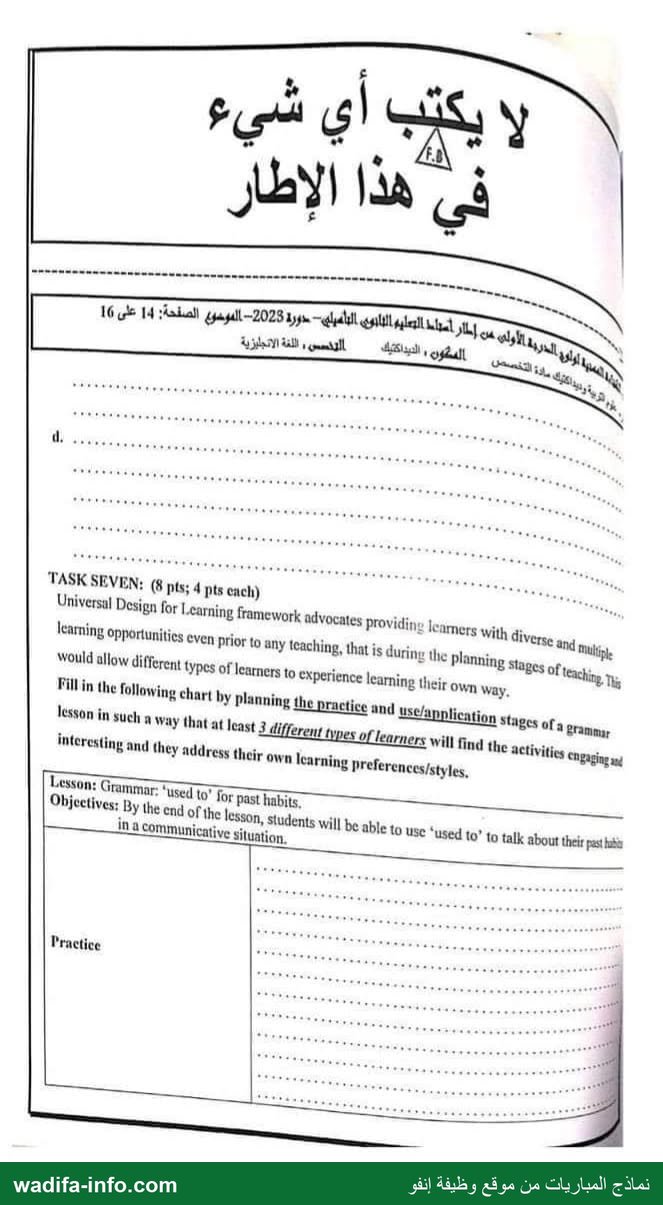
TASK SEVEN: (8 pts; 4 pts each) ie
Universal Design for Learning framework advocates Providing ممصت With diverse and main,
learning OPhorunities even prior to any (caching, that is during the Planning Stages Of teaching 1
Would allow different {pes of learners to experience learning their OWn Way,
Füll in the following chart by Planning the practice and use/application Stages of à Brammar
Iésson in such a Way (hat at Jeast 3 different types 0learners wi find the activities Chgaging بير
interesting and they address their own Icarning Preferences/styles.
Lesson: Grammar: ‘used Lo" for past habits.
Objectives: By the end ofthe lesson, Students will be able to use ‘used to’ 10 talk about their past tubes
ina Communicative Situation.
ج المباريات من موقع وظيفة إنفو
0٠ # & الى ع
ra ٠ F.8 ٠
S لإطار
RE - ال
ريا الشقامة الممنية لولوع الحربة الأولي من إطار tu = =
à Jan وم اقرع اتيك PRE, QU vdi الصفحة: 15 على 16
َس à اللقة الانيليزية
نماذج المباريات من موقع وظيفة إنفو wadifa-info.com
✅ Correction proposée
Il s'agit d'une correction proposée, rédigée par l'équipe wadifa-info pour vous aider à comprendre la méthode — ce n'est pas un corrigé officiel de l'administration organisatrice.
This paper is the subject-didactics test (English) of the professional aptitude examination for promotion to first grade, qualifying secondary school teachers — National Centre for Evaluation and Examinations, 2023 session. Time allowed: 3 hours; coefficient 1; final mark out of 16. It has seven tasks: Task One (20 multiple-choice items, 1 pt each), Task Two (competencies, 4 pts), Task Three (seating arrangements, 4 pts), Task Four (diagnostic testing, 4 pts), Task Five (pronunciation lesson, 4 pts), Task Six (recycling vocabulary, 4 pts) and Task Seven (UDL grammar lesson, 8 pts). Below is a suggested answer key.
How to use this key: Task One answers come with a one-line reason. Tasks Two to Seven are open: the answers are models, and other well-justified answers are acceptable. Items marked "probable answer" are those where two options can be defended; the reasoning is shown. References to the 5 Cs and to the writing process were checked in the English Language Guidelines for Secondary Schools (MEN, November 2007).
Task One — Multiple choice (20 pts)
| Item | Answer | Why |
|---|---|---|
| 1 | B | Scanning = searching quickly for specific information such as dates and figures. Matching titles to paragraphs (A) is skimming for gist. |
| 2 | D | Ordering pictures while listening to a story does not involve conversation, so it cannot introduce turn-taking. It does suit before/after (B), listening for details (C) and sequencing past events for the past perfect (A). |
| 3 | B | Making a poster is a visual task. A and C are kinaesthetic; D is auditory. |
| 4 | B | Instrumental motivation = learning for a practical gain (business, career). A, C and D are integrative (wish to communicate with or join a community). |
| 5 | D | Audio-lingual procedure: listen to a model dialogue, repeat/rehearse it, focus on the structure, then substitution drills. A is TPR; C is PPP/communicative. |
| 6 | C | The teacher collects data on mistakes to plan a follow-up (remedial) class: assessment for learning = formative. |
| 7 | B — probable answer | A poster description measures oral/written production and other abilities, not only the mastery of the grammatical items targeted, so the tool does not measure the intended construct. (Face validity, C, concerns how the test looks to students; their complaints are a sign, not the cause of low scores.) |
| 8 | D | Replacing book questions with board questions gives one single means of engagement and expression; UDL calls for multiple means. A, B and C offer choice or variety. |
| 9 | C — probable answer | Sequencing events and drawing a timeline is a logical-mathematical activity (order, patterns, relationships between tenses). D is close to the book exercises these students already disengage from. |
| 10 | D | The lesson has brainstorming (discussion), outlining and drafting (writing individually). Revising, editing and publishing are missing, as listed in the writing-process strategies of the 2007 Guidelines. |
| 11 | C | a–c = Communication, d = Communities (real-world English), e = Cultures/Comparisons. Nothing links English with other school subjects, which is what "Connections" means in the 5 Cs. |
| 12 | D — probable answer | "Explore unique school habits from other countries" requires understanding them, analysing/comparing them with one's own and judging them, so all three levels can be targeted. |
| 13 | C | The stories behind a celebration express the meanings, beliefs and values that underlie it = Perspectives (Products are artefacts; Practices are what people do). |
| 14 | C | The ZPD needs support (teacher or more capable peers). Working individually for autonomy, with no scaffolding, is not related to it. |
| 15 | B — probable answer | Identifying patterns and making connections between incoming information are cognitive strategies (analysing, reasoning). Talking about one's learning preferences would be metacognitive, but the item focuses on the patterns and connections. |
| 16 | C | The audio-lingual method is based on behaviourism: habit formation through repetition and reinforcement. |
| 17 | B | Needs analysis, goals, materials, teacher training and evaluation together form curriculum development; syllabus and materials design are only parts of it. |
| 18 | C — probable answer | The objective gives the linguistic content (polite expressions) and the activity (role-play) but not the communicative function or task (e.g., "to make polite requests in a shop"). |
| 19 | A | Selecting the top 25 by ranking candidates against each other, with no pre-set mastery level = norm-referenced test. |
| 20 | D | Offering the same text in audio form changes how the content is accessed = differentiation of content. A is process; B and C are product. |
Task Two — Competencies (4 pts)
1. Are these competencies worth targeting? (1 pt)
Yes. (a) Presentation skills (eye contact, voice, body language) are part of communicative competence, especially the presentational mode of communication, and they are needed in projects, in further studies and at work. (b) Describing eco-friendly houses links language to a real-world issue (sustainability) and to Cultures/Comparisons (Morocco and other countries), and it gives a meaningful context for the language of description. Both go beyond grammar and vocabulary, in line with a competency-based, standards-based curriculum.
2. One activity per competency and how to track it (3 pts)
| Competency | Activity | Tracking / assessing |
|---|---|---|
| (a) Smile, eye contact, appropriate voice in a talk | Watch a short model presentation and list "dos and don'ts"; then each group gives a 2-minute talk (e.g., presenting their dream house) in rounds, with peer feedback between rounds. | Observation checklist (eye contact, smile/posture, volume, pace, intonation) used by the teacher and by peers; video or audio recording for self-assessment; comparing the first and last round. |
| (b) Describe eco-friendly houses in Morocco and around the world | Jigsaw reading: each group reads about one house (a traditional earth house in the south of Morocco, a solar house in Europe, etc.), completes a chart (materials, energy, water, features), then shares; finally, each student writes or presents a description of one house. | Rubric for the description: content (features, comparison), target vocabulary, organisation, accuracy; the chart serves as a formative check; descriptions are kept in a portfolio. |
Task Three — Seating arrangements (4 pts)
| Arrangement | Suitable activity and justification |
|---|---|
| 1. Rows facing the board | Teacher-fronted presentation of a grammar point, a dictation or a test. Everyone faces the board and the teacher, and individual work and exam conditions are easy to keep. |
| 2. Small circles / clusters | Group work: jigsaw reading, project planning, discussions, brainstorming before writing. Students face each other, which helps cooperation and gives everyone more speaking time. |
| 3. Two chairs side by side at a desk | Pair work: peer editing of a draft, information-gap tasks, preparing a dialogue together. Partners can share one text or screen and support each other. |
| 4. Two students sitting back to back | Describe-and-draw or telephone role-play: one describes a picture, the other draws it or takes a message. Without eye contact or gestures, they must rely on clear language and clarification questions. |
Task Four — Diagnostic test (4 pts)
1. Four principles for designing and scoring a diagnostic test (2 pts)
- a. Alignment with the new syllabus prerequisites: test only the knowledge and skills the new course builds on (validity), not everything taught before.
- b. Item-level information: each item or section targets one specific skill or structure, so results show which areas are weak, not just a global score.
- c. Variety and fairness: several item types and the four skills where relevant, clear instructions, familiar formats, reasonable length, and no penalty or grade attached (low anxiety).
- d. Analytical, criterion-referenced scoring: score against clear criteria (answer key, rubric) and record results in a grid per student and per skill, so that strengths and weaknesses can be read at a glance.
2. Procedures: preparing, administering, planning remedial work (2 pts)
- Preparing: list the prerequisite objectives of the new syllabus, write items for each, prepare the key and a scoring grid, and pilot or proofread the test.
- Administering: explain the purpose (to help, not to grade), give clear instructions and enough time, and run it at the very start of the course in normal conditions.
- Planning remedial work: analyse results per objective (class grid), identify common and individual gaps, form needs-based groups, design targeted activities (re-teaching, practice, peer tutoring, extra materials), schedule them, and re-check progress with a short follow-up test.
Task Five — Pronunciation lesson: "wanna" and "canya" (4 pts)
Objective: By the end of the lesson, students will be able to recognise and produce the connected-speech forms wanna (want to) and canya (can you) in informal questions and answers.
- Warm-up / context: a short recorded dialogue between friends making plans ("Do you wanna go to the park?" — "Canya hang out on Saturday?"). Gist question: what are they planning?
- Noticing (listening for form): students listen again and fill in the gaps of the transcript; they discover that what they hear differs from the written full forms.
- Explanation: elicit the rule: in fast, informal speech, sounds link and reduce (want to → /ˈwɒnə/; can you → /ˈkænjə/). Point out the register: spoken and informal only, never in formal writing.
- Discrimination practice: students hear sentences in full or reduced form and decide which one they hear.
- Controlled production: choral and individual repetition (back-chaining, stress and rhythm), then a chain drill: "Do you wanna…?" / "Canya…?"
- Freer production: pairs role-play inviting a friend and making plans using the reduced forms naturally; a few pairs perform.
- Feedback / assessment: the teacher monitors and gives feedback on linking and intonation; a short self-check.
Task Six — Four activities to recycle vocabulary (4 pts)
Example: a unit on the environment (pollution, recycle, renewable energy, waste, emissions...). The 2007 Guidelines describe recycling as a "snowball" giving earlier vocabulary a second chance, not as mere repetition.
- a. Word wall and warm-up games: unit words stay on a wall or in a word bank; each lesson starts with a 5-minute game (Hot Seat, Taboo, Pictionary) using words from previous lessons.
- b. Vocabulary in new contexts: students meet the same words in a new text or listening (a news report on plastic waste) and do a task on it (complete a chart, find the word from its definition).
- c. Productive tasks with a word list: a writing or speaking task (an e-mail to the mayor about a local pollution problem, a short campaign speech) that must include at least eight unit words, checked by a peer.
- d. Personal vocabulary notebook and spaced review: students record words with collocations, an example sentence and a picture, and revisit them in quick quizzes after one week, one month and before the test (flashcards, online quizzes); words from this unit reappear in the next units.
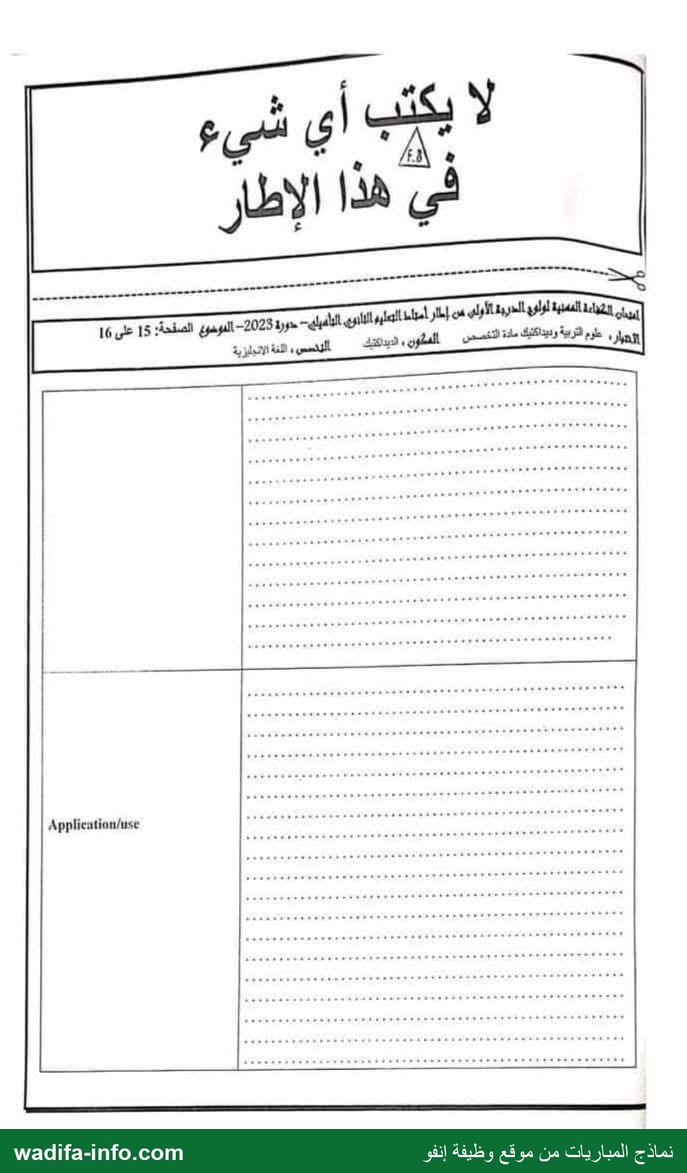
Task Seven — UDL grammar lesson: "used to" for past habits (8 pts)
Lesson: Grammar: used to for past habits. Objective: by the end of the lesson, students will be able to use used to to talk about their past habits in a communicative situation. The plan offers several means of engagement, representation and expression so that at least three types of learners (visual, auditory, kinaesthetic, plus logical and interpersonal) are catered for.
| Stage | Activities (learner type addressed) |
|---|---|
| Practice |
|
| Application / use |
Situation: "Our school magazine is preparing a page called When I was a child." Each student chooses how to show what they used to do:
Products are shared in a gallery walk or presentation; peers ask follow-up questions ("Did you use to…?"). Assessment uses one common checklist for all formats: correct form of used to, meaning (past habit, no longer true), at least five sentences or ideas, and fluency/clarity. |
Questions fréquentes sur ce sujet
Ce sujet est-il téléchargeable gratuitement ?
Le corrigé est-il inclus ?
Quel organisme et quel grade concerne ce sujet ?
De quelle session s'agit-il et dans quelle langue ?
Où trouver d'autres sujets du même concours ?
Vous préparez ce concours ?
Modèles similaires
Source : archive de modèles de concours — document archivé tel que reçu ; l'avis officiel du concours fait foi.
}