
Modèle : Épreuve de didactique de la spécialité - Anglais — Ministère de l'Éducation nationale - Centre national d'évaluation et des examens 2020
⬇️ Télécharger le PDF Adresse permanente : wadifa-info.com/fr/modele-concours/1473
En bref
Ce document est une ancienne épreuve écrite du concours de Épreuve de didactique de la spécialité - Anglais organisé par Ministère de l'Éducation nationale - Centre national d'évaluation et des examens (2020), publiée sur Wadifa Info en consultation et téléchargement PDF gratuits, avec une correction proposée.
- Organisme
- Ministère de l'Éducation nationale - Centre national d'évaluation et des examens
- Grade
- Épreuve de didactique de la spécialité - Anglais
- Spécialité
- اللغة الإنجليزية
- Année
- 2020
- Pages
- 12
- Langue des questions
- français
- Correction
- correction proposée disponible sur cette page
📝 Texte des questions (extrait automatiquement des pages scannées)
Ce texte est extrait automatiquement des images de l'épreuve et peut contenir des erreurs de lecture — les images ci-dessus font foi.
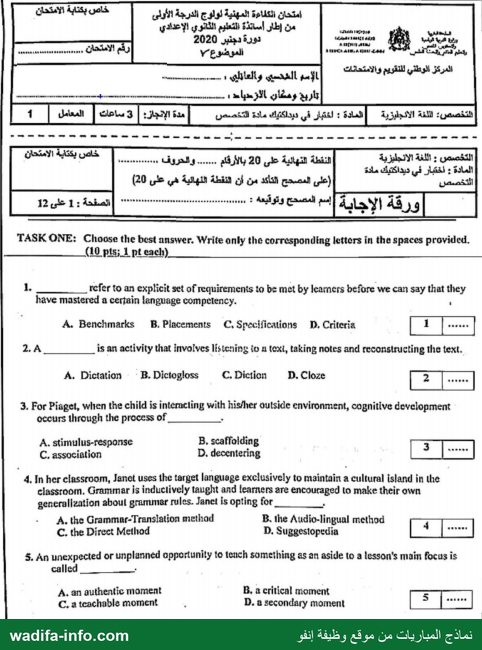
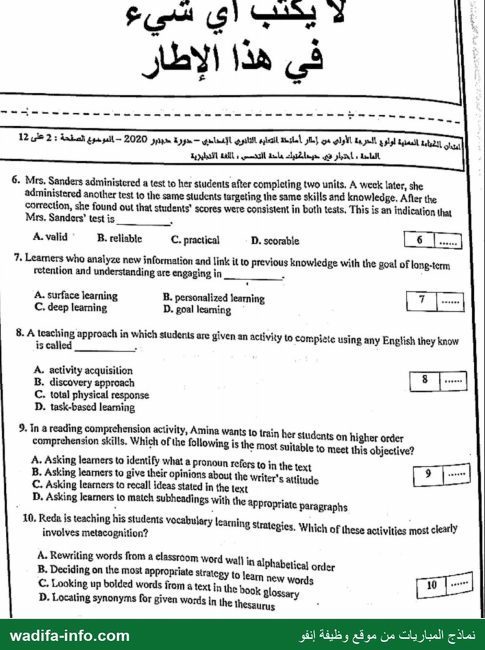
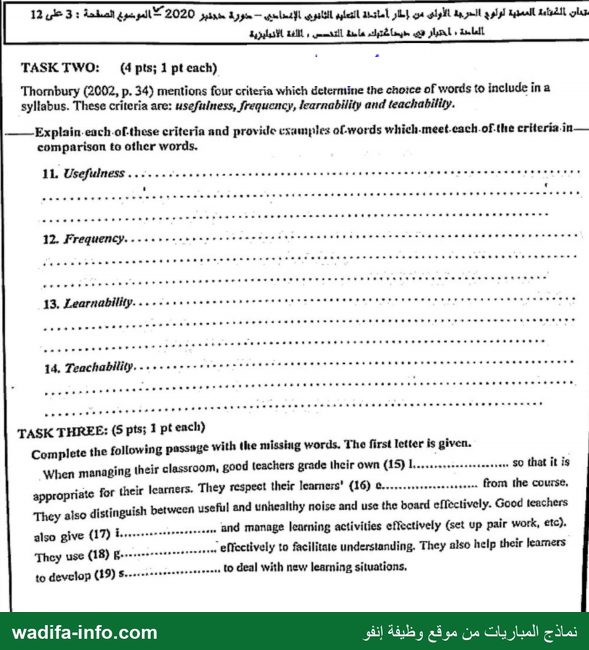
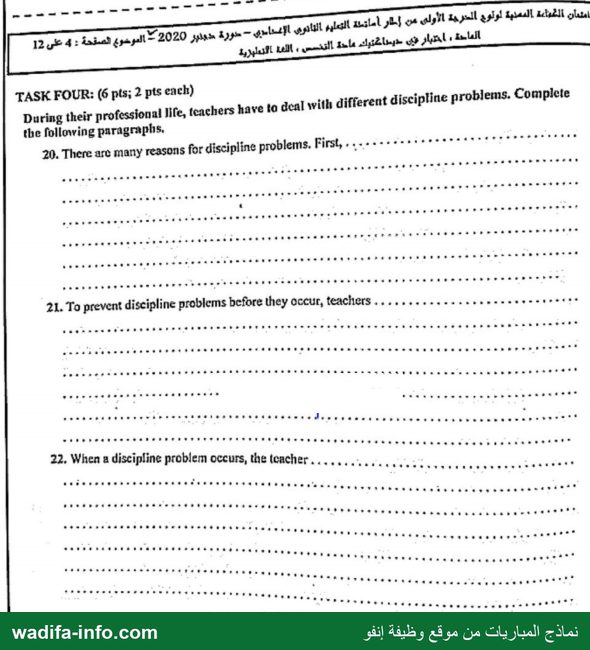
امتحان الكلاءة المهنية لولوج الدرجة الأولى خاص بكتابة الامتحان. مسب 0 se من إطار pa التعطيم Less الإعدادي aan ET دورة دجتبر rs EE PURES. D etai] USAGES نارية la الزيا + à ECO EST EEE مد | + | التخصص : اللغة الانجليزية النفطة النهائية على 20 بالأرقام Le dans. اخاص بكتابة الامتحان المادة : لختبار في ديداكتيك مادة التخصسص (على المصحح التأكد من أن النقطة النهائية هي على 20) TASKONE: Choose the best answer. Write any the corresponding letters in the spaces provided. ننس سدسم« الب ا 1١ 12110 an explicit set of requirements to be met by learners before we can say that they have mastered a certain lenguage competency. ٠ Specifications D, Criteria ا A. Benchmarks B. Placements 2.A is an activity that Involves listening to a text, taking notes and reconstructing the text. A. Dictation B. Dictogloss C.Diction D.Cloze For Piaget, when the child is intemcting with his/her outside environment, cognitive development .3 م ؟0 oceurs through the process A. stimulus-response B, scaffolding Cassocialion D. deceneing k 4, In her classroom, Janet uses the target languege exclusively to maintain a cultural island in the make their own ما inductively taught and learners are encouraged وا classroom. Grammar gencrallzation about gramumer rules. Janet is opting 0+ Grammar-Translation method B. the Audio-lingual method معطا يل + C. the Direct Method D. Suggestopedia An unexpected or unplanned opportunity to tench something as an aside to a lesson's moin focus is .5 called __ À. an authentic moment B, a critical moment C. a teachable moment 8 D. a secondary moment نماذج المباريات من موقع وظيفة إنفو wadifa-info.com n بحنب 3 فى هذا الإطار سات ات امات يات اتات دإ ES 12 الصفحة : 2 على gg pull 2020 pp حدورة es التادوي li أمائطة JL الأولي من La pal لولوج LUN oh التيليزية LAN اتبار في <ديداشتيك ماحدة التنسي ؛ + Lei 6. Mrs. Sanders sdministered a test to her students after completing two units. A weck Later, she adrinistered another test 10 1116 same students targeting 1he same skills and knowledge. بعالم the correction, she found out that students’ scores were consistent in both tests, This is an indication that Mrs. Sandors’ test is 0 A. valid B. reliable ©. practical D. scorable 7. Leamers who analyze new information and link it to previous knowledge with the goal of long-term retention and understanding are engaging in 8 A. surface learning B. penonalized learning ©. deep learning D. goal lesming 8. À leaching approach in which students arc given an activity ما compiete using any English they know is called 8 A. activity acquisition CT) B. discovery approach | نهل ©. total physical response D. task-based learning 9. In a reading compréhension activity, Amina wants ما train her students on higher order comprehension skills. Which of the following is the most suitable ما meet Be eee A. Asking leamers to identify what a pronoun refers to in the text B. Asking leamers to give their opinions about the Writer's attitude c. Asking lesmers to recall ideas stated in the text D. Asking lcamers Lo match subheadings with the appropriate paragraphs 10, Reda js teaching his students vocabulory learning 165, W! Sos وفيا Strategies, Which of these activities most clearly A. Rewriling words from 2 classroom word wall in alphabet; B. Deciding on the most appropriate Strategy lo learn سج بيعو 2 C. Looking up bolded words from a text in 1e book plossar "0 D. Localing synonyms for given words In the Thesaurus 2 wadifa-info.com نمادج المباريات من موقع وظيفة إنفو 12 الصفحة : 3 على gps pl 2020 pps الأولى من إطار أماتنة التعليم الثادوي الإمداسني - حدورة An pm تدان الشقامة الممدية لولوج العامة + احتباز في ديصاشتبك عامدة التدسس , اللفة الانبليزية TASK TWO: )4 pts; 1 pteach) | ١ Thornbury (2002, p. 34) mentions four criteria which determine the choice of words to include in a syllabus. These criteria are: usefuiness, frequency, learnability and teachability. —Explain-each.of.these criteria and provide examples o[-words which.meet-each-ofthe criteria in — comparison to other words. اا ااه م ا أ اي د وا tee ا ا د .12 عامجامام امي معام عام ع مع عاو ف وم ماقام ع وا م ورف زع قاعم عام ممه ل ماماماء عام ع ماع مالاماما افر .13 مرجمرم وريم ماهم عام هررم ماجرة اه عم عام م عام مامه عا واه وام عل عام لعواال ااا لاا 76/0 .14 TASK THREE: )5 pts; 1 pt ench) Complete the following passage with the missing words. The first letter is given. When managing their classroom, good teachers grade their own (15) يت بت 0 that it is appropriate for their learners. They respect their leamers' (16) تت م from the course, They also distinguish between useful and unhealthy noise and use the board effectively. Good teachers also give (17) متت سمي and manage learning activities effectively (set up pair work, etc). They use (18) Dress electively to facilitate understanding. They also help their leamers to develop (19) 8... to deal with news learning situations, نماذج المباريات من موقع وظيفة إنفو wadifa-info.com امتدان الشفامة الممدية لونوج الدرية إلا لاس ولي من JE أماتطة التعليم الزانوي ازين. = 7 أمري - عدورة يلير 2020 الصفحة : all احتبار في ديساشتيك gate التخسس ؛ + LA :الليزية ب قت sd TASK FOUR: (6 pts: 2 pts each) z deal with different discipline problems. Complete ما teachers have نالا During their professional tbe following paragraphs. مغر مزه عا بم اام الام اا There are many reasons for discipline problems. Pi sera .20 متت يت تت لب To prevent discipline problems before they oceur, teachers .21 When a discipline problem occurs, the teacher... .,.,.., = D .22 نماذج المباريات من موقع وظيفة إنفو ifa-info.com 12 5 : الصفحة -4 الصفحة : 5 على gpl 2020 التعليم الثادوي الإمحاميى - دورة «دجذبر Le JE امتدان الشناءة الممدية لولوج الحرجة الاولي من الانبليزية BAR العامة ؛ احترار في <ديداختيك مامدة التدمس ؛ TASK FIVE: )4 pts; 1 pt each) Maslows hirarchy ofneeds is a motivational theory in paychology comprising five levels of human needs. Attaining self-actualisation requires the satisfaction of these needs. Identify the unsatisfied need in each situation. : LR أ Unsatisfiea need Adil walks about 5 km ta reach 23 school. He oflen gets to class late and PEN SORTE tired. Anitas parents struggle every moming to take her to schoo!, She is often bullied by one of her classmates. | Sarah wants to participate in schoo! clubs but she is often discarded, This has created a permanent feeling of loneliness for her. Amine makes a lot of efforts in class, but the teacher rarely praises him عه recognizes his contributions. Consequently, he has developed a feeling of inferiority. . wadifa-info.com نماذج المباريات من موقع وظيفة إنفو امتمان الشيامة الممدية لولوج Le poil الأولي من JE أماتطة التعليه الثانوي الإماي — Loge حدجدير 2020 الموسوع الصفحة : 6 على 12 الماحة JURA à فى <يحاحشتبيك عاحدة التنسس BA à الأنيليزية TASK SIX: (7 pts) Study the following quote and answer قلا questions below. According to Larsen-Freeman and Anderson (2011), Communicative Language Teaching (CLT) aims broadly ٠م make communicative competence the goal of language teaching. Activities ere truly communicative when they have three features in common: information gap, choice, and feedback. a. Explain in your own words each of these three features of a communicative activity. )1 pt €ach) 27: 1011071 7 ا es ne SA لالس لا roma واه اس ين ا 29.1600: امومع عه مم اع مامالا الما اا اا sons eus مااع وأ اماه لامعا واه b. Use the following train schedule to design an information gap activity for your students. Cotation Tape [A LT Nue Pre Name RS He [GE | Tito | Same | CE 1 ا [ET 5 نماذج المباريات من موقع وظيفة إنفو wadifa-info.com 12 الموموع الصفحة : 7 على 2020 = Cat De أماتخة التعلين التانوي الإمدادي - حورة JL الممذبة لولوج الحرمة الأولي عن LH امتمان الاتبليزية LA à في ديداغتيك ماحة النحسي JUL à الماصة Information gap ssossosscnetr ا ل ا ee se es Gnts) وج ا TASK SEVEN: (4 pts; 1 pt each) Howard Gardner claims that individuals have at least cight distinet intelligences that can be developed over a Jifetime. His theory of multiple intelligences has been influential in language teaching and lesming. You want to teach your students the “Present Contiauous”. Provide examples of classroom activities which ean be more appropriate for lcarners with the following types of intelligences. wadifa-info. Nr , : fo.com sB AUD; 2550 Ce Ci judli æila أمتمان الفراءة المعدية à الدربة الأولى من DES أماتئة الصليم النادوي left - مدورة pains 2020 7اًالموحوع الصفحة : 8 على 12 الناسة ٠١ حبار في مديسداشتيك à Gym Ha اللغة اللنبليزية EN ENT ESS ED أ'تت'>بتتت تبلج اق انه عانم للمحتيمًا به لدعو دالا ni ares tien وال Las 7 المباريات من موقع وظيفة إنفو wadifa-info.com — صفحة 9 — 12 على 9 : Labo الموسوع 2020 pate الإنحاءبي - مدورة al امتدان الثشناءة الممدية لولوج الحرية الأولي من إطار !ماتطة التعاوو اللفة الأنبليزية à ملسضة الجنسس ct gts في USA الباحة ؛ TASK EIGHT: )4 pts; 1 pteach) Bloom has come up with his laxonomy of instructional objectives. This taxonomy ranges from lower 10 higher levels of cognitive thinking, It can be of great help to teachers in designing questions to target different levels of thinking. Using the following reading text, match each task to the appropriate thiaking level from Bloom’s taxonomy. ERA Tue led here ler live years now. | M yon wa cour, pou con go فا le curders, and wallong ص the streets really ععثلا I. ١ came here 10 work. monde sas sui ١ can also woich ls dangerous, but l've never seon There are lots of jobs in compulors Lee-Lociey quon اعبط ١ love. ما anytiung like that. 1 love ray door and technology 200 wages ناه Hscs, us great for sport here. The only للش house and no-one blgher than in my country. People probtess جا ١ work long hours, 20 1 hos over smolen anytiuag. As for here are very telased and open They don’ have uno 10 Lake 0006 cf heañhcare, well, st dopends ١! you ofien invite you to their nomes lora امسن بيلس have medical insurance, because | barbecue. Balore | came hote, | heard tresunant's exponrive. Lucialy, my | Lecstiy don't ملت asyUung crime فق bad and Mat وا were company pays for mine and l've + - | about my country. We dont 0370 problems wrdi besttheate, but ! Tound the lacitres fantaque > 7 ران _ wrinters here — is Haven't hoc any problems. Cenainly, efhcient. bosically worra all year round. But In فط big cities, there are à lot of Tige] [a . Classify the information which John provided about the new. 36.Comprehension 8 country from the most م the least important. 37, Analysis «| Based on the text, outline the main reasons which would push someone lo leave their country. fc. What was John told about the new countey before ع1 7 5 Using the ideas in the text, write an email ما a policy maker suggesting ways 10 make life better in your country. — صفحة 10 — 12 ا الموموع الصفحة : 10 على 2020 ppp حدورة - guet AA امتدان الشوامة المعتية لونوج الحردة الأولى من إطار أمائطة التعليم AD اللغة SR Lula الناسة ؛ ايتبار في <رضاختبك TASK NINE: (4 pts; 1 pt each) When students Make mistakes In speaking activities, teachers use different strategies to correct them. | Study the situations in the chart and provide an appropriate correction Strategy. Give a different strategy for each situation, | Student: My sister usually go to school on ARS عا TE Rare rues reed Sie Student: Thavo got a green shonts. nu men DU Students Amine 13 3000 but Ana كا og, يي و12 iii etienne TASK TEN: (6 pis; 2 كام each) The participants in à teacher training course were asked to leach à listening lesson. lesson wrote a commentary on what happened, . Ê - disent de Read the extracts from the commentaries and discuss them 8iving our opinion for or against the tcacher's practice, Deus Eten Mann resta ومح John: First, 1 played the listening |... CES COIN track. Then 1 asked the learners a few |....,,,,,.,... ess sooross 0 questions, Most of the students could | اي يتخ DU nel answer the questions, UT Z 5 a جل â ‘a نماذج المبار بات — صفحة 11 — 12 الموسوع الصفحة : 11 على 2020 jpg مدورة - gant Qu أساتسنة التعليم DES اعتدان الشفاءة الممذبة لولوج الحرمة الأولي من النحسي ؛ الآغة الأنيليزية Lula حبار في ديسا ترك à العامة CT RSR RCE Jan While the. students were| 6,4. sanenssssassssssceecnesccerecenres دياز 1 tied 10 help Bob اه ام لج ده وا ايه تاج جاع ع عو مع ع ترا explaining a few challenging words |. ممعا لاما ااا تا تت from the listening text. 9 Nan Ton TEE Naneys:T 11:31 told le :stiniénte (han ls اماع اوه اماه معام ماما لا ماو تاماه sets de they would listen to the track tWics, | ................eocvosesssssoessosesersssscseus but they found it quite difficull. So T ١ لاوم see ss sescocrosccssoneocsese ended up playing it three times. sonne اام مهرم ام امام متعرة هوه قاع رام مراع اماع عا اوري فاع اماع TASK ELEVEN: (6 pts; 1 pteach) COVID-19 pandemic has compelled teachers to opt for a combination of in-class teaching and home self-study. Which of the components of the following lesson types would you carry out in class, and Which ones should be left for students to do at home (self-study)? Justify your choice. CT [sus 7 — صفحة 12 — امتدان الشقاءة الممنية لولوج السنرية الأولي من إطار al التعليم النانوى الإمدادري - مدورة دجبو 2020 ا الموسو الصفحة : 12 على 12 , القاصة à اخبار في تيداعتبك Lila التخسس ؛ اللغة ADN م جاع تاه لك اا ME vues — لق has been adapted from différent sources معت كل The content of
Correction proposée
Il s'agit d'une correction proposée, rédigée par l'équipe wadifa-info pour vous aider à comprendre la méthode — ce n'est pas un corrigé officiel de l'administration organisatrice.
Ce sujet est l'épreuve de didactique de la matière de spécialité – anglais de l'examen d'aptitude professionnelle (امتحان الكفاءة المهنية) pour l'accès au 1er grade du cadre des professeurs de l'enseignement secondaire collégial, session de décembre 2020, préparée par le Centre national de l'évaluation et des examens (Ministère de l'Éducation nationale). Durée 3 heures, coefficient 1, note finale ramenée sur 20. Le sujet est rédigé en anglais et se présente comme une feuille-réponse de 12 pages en onze tâches : un QCM de 10 questions, puis des questions ouvertes (critères de choix du vocabulaire, gestion de classe, discipline, Maslow, approche communicative, intelligences multiples, taxonomie de Bloom, correction des erreurs, écoute, enseignement hybride). Type : mixte. Les explications ci-dessous sont en français ; les réponses modèles sont en anglais, car la copie doit être rédigée en anglais. Voici une correction méthodologique proposée.
💡 Avant de commencer : le barème total dépasse 60 points pour une note ramenée sur 20. Chaque réponse ouverte vaut 1 ou 2 points : le correcteur attend une définition précise, suivie d'un exemple concret de classe marocaine (collège, manuels, effectifs chargés). Soyez bref et précis. Gardez du temps pour les tâches 6 (7 pts) et 10–11 (6 pts chacune).
Task One – QCM (10 pts, 1 pt chacun)
- 1 – A. Benchmarks (réponse la plus probable). Les benchmarks sont des repères explicites de performance que l'élève doit atteindre avant qu'on considère une compétence comme maîtrisée. Les criteria servent à juger une production, pas à définir le niveau de maîtrise ; les specifications décrivent un test, et placement désigne le classement des élèves par niveau. Point à vérifier dans les Orientations pédagogiques d'anglais.
- 2 – B. Dictogloss : les élèves écoutent un texte lu à vitesse normale, prennent des notes puis le reconstruisent en groupe. Ce n'est pas une dictée mot à mot.
- 3 – D. decentering (décentration) : pour Piaget, l'enfant se développe en interagissant avec son environnement et dépasse son égocentrisme. Le scaffolding relève de Bruner/Vygotsky, et le couple stimulus-response du béhaviorisme.
- 4 – C. the Direct Method : usage exclusif de la langue cible et grammaire enseignée de façon inductive, les élèves formulant eux-mêmes les règles.
- 5 – C. a teachable moment : une occasion imprévue d'enseigner quelque chose en marge de l'objectif principal de la leçon.
- 6 – B. reliable : des résultats constants sur deux passations comparables indiquent la fiabilité (test-retest). La validité, elle, signifie que le test mesure bien ce qu'il doit mesurer.
- 7 – C. deep learning : analyser, relier au déjà-connu, viser la rétention à long terme. Le surface learning s'en tient à la mémorisation.
- 8 – D. task-based learning : l'élève accomplit une tâche en mobilisant tout l'anglais dont il dispose ; la priorité est au sens.
- 9 – B. Donner son opinion sur l'attitude de l'auteur relève de l'évaluation et de l'inférence, donc des compétences d'ordre supérieur. A, C et D restent du repérage littéral.
- 10 – B. Choisir la stratégie la plus adaptée pour apprendre de nouveaux mots, c'est planifier et réguler son propre apprentissage, donc de la métacognition. Les autres activités sont cognitives.
Task Two – Critères de Thornbury (2002) pour choisir le vocabulaire (4 pts)
- 11 – Usefulness : teach first the words learners need to express common meanings in their context. Exemple : classroom, homework, teacher passent avant blackboard duster. Les mots-outils et les mots des besoins de communication immédiats sont prioritaires.
- 12 – Frequency : the most frequent words in the language (according to corpus data) give the widest coverage of texts. Exemple : house ou big avant dwelling ou enormous ; get, make, go très tôt.
- 13 – Learnability : some words are easier to learn: concrete, short, regular, similar to L1/L2 (cognates) and easy to pronounce. Exemple : television, taxi (congénères du français/arabe) sont plus faciles que thorough ou although, difficiles à prononcer ou à épeler.
- 14 – Teachability : some words are easy to present and explain in class, par l'image, le mime ou la réalité : pen, window, run, jump. À l'inverse, honesty ou hope sont abstraits et demandent un contexte.
Task Three – Texte à compléter : le bon gestionnaire de classe (5 pts)
- 15 – language (grade their own language) : le professeur adapte sa propre langue au niveau des élèves.
- 16 – expectations (respect their learners' expectations from the course).
- 17 – instructions (give instructions claires, vérifiées, avant de lancer les activités).
- 18 – gestures (use gestures effectively to facilitate understanding).
- 19 – strategies (help learners develop strategies to deal with new learning situations).
Task Four – Les problèmes de discipline (6 pts, 2 pts par paragraphe)
20 – Causes
There are many reasons for discipline problems. First, some come from the learners themselves: boredom, lack of motivation, low self-esteem, problems at home or adolescence. Second, some come from the teacher: unclear rules, poorly planned or too difficult/easy activities, dead time, unclear instructions, inconsistency or unfair treatment. Finally, the context plays a role: large classes, noisy environment, time of the day.
21 – Prévention
To prevent discipline problems before they occur, teachers should establish clear rules and routines with the learners from the first session, plan varied and well-paced activities adapted to the level, give clear instructions, move around the class and keep eye contact, learn students' names, involve all learners and create a positive, respectful rapport.
22 – Réaction
When a discipline problem occurs, the teacher should act immediately but calmly, focus on the behaviour and not the person, use non-verbal signals first (eye contact, proximity), talk to the student privately after class rather than in public, apply the agreed rules consistently, and involve the administration or parents only when the problem persists. Humiliation and collective punishment must be avoided.
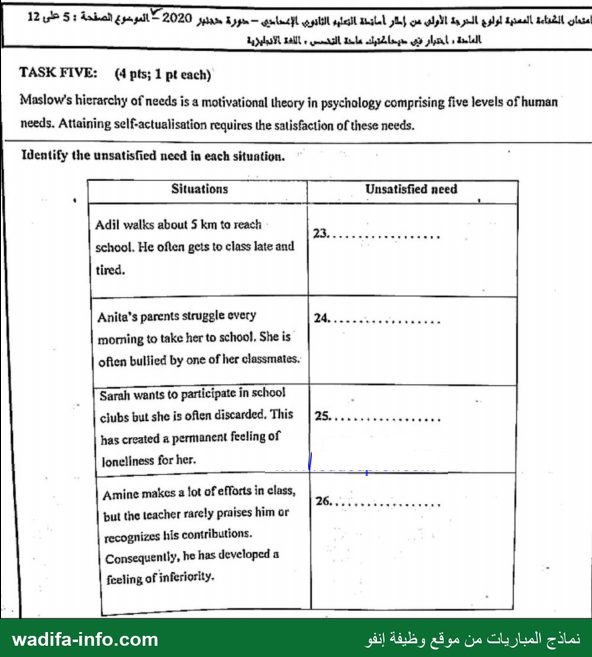
Task Five – Hiérarchie des besoins de Maslow (4 pts)
- 23 – Adil : physiological needs (repos, énergie physique) : il arrive fatigué après 5 km à pied.
- 24 – Anita : safety needs : elle est victime de harcèlement (bullying) et ne se sent pas en sécurité.
- 25 – Sarah : love and belonging needs : elle est exclue des clubs et se sent seule.
- 26 – Amine : esteem needs : ses efforts ne sont pas reconnus, d'où son sentiment d'infériorité.
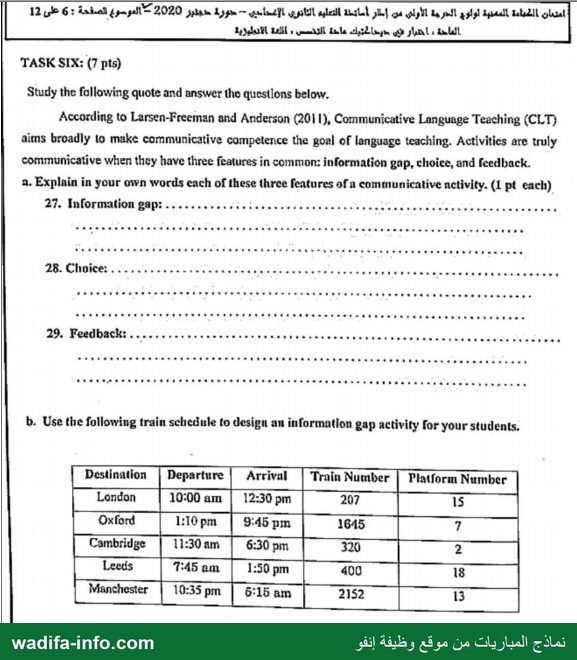
Task Six – Communicative Language Teaching (7 pts)
a. Les trois caractéristiques (Larsen-Freeman & Anderson, 2011)
- 27 – Information gap : one learner knows something the other does not, so there is a real reason to communicate. Asking a question whose answer everyone already knows is not communicative.
- 28 – Choice : the speaker chooses what to say and how to say it (language forms, content). If the answer is totally controlled, the exchange is not communicative.
- 29 – Feedback : the speaker receives a response from the listener and can check whether the purpose has been achieved, then adjust what he/she says.
b. Activité d'information gap à partir de l'horaire des trains
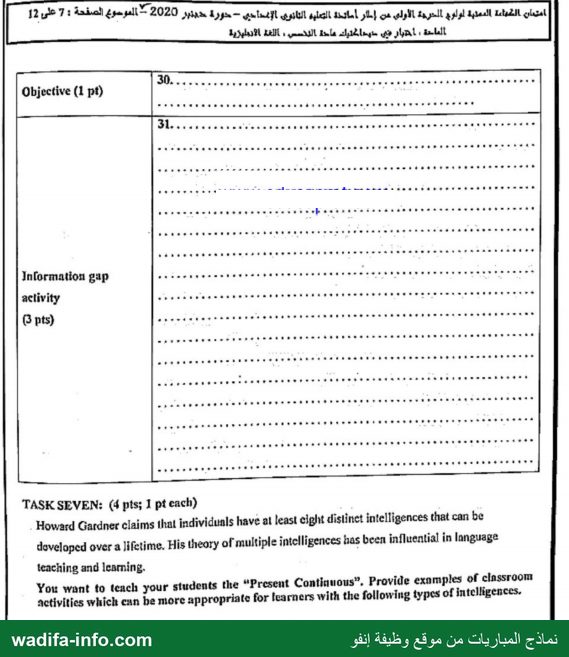
30 – Objectif : By the end of the activity, learners will be able to ask for and give information about train times using "What time does the train to … leave/arrive?", "Which platform…?" and telling the time.
31 – Démarche (modèle) :
- Pre-task: revise telling the time (10:00 am, 1:10 pm…) and model the questions with a volunteer.
- Pair work: Student A receives the timetable with the departure times and train numbers of London, Cambridge and Manchester but blanks for Oxford and Leeds; Student B has the opposite gaps (and platform numbers missing in A's card). They must not look at each other's card.
- Students ask and answer: "What time does the train to Oxford leave?" – "It leaves at 1:10 pm." – "Which platform?" – "Platform 7." They complete their tables.
- Feedback: pairs compare cards to check; the teacher asks a few pairs to report, then gives feedback on accuracy (times, prepositions "at", "from platform").
Exemple de données à répartir : Londres 10:00 am → 12:30 pm, train 207, quai 15 ; Oxford 1:10 pm → 9:45 pm, train 1645, quai 7 ; Cambridge 11:30 am → 6:30 pm, train 320, quai 2 ; Leeds 7:45 am → 1:50 pm, train 400, quai 18 ; Manchester 10:35 pm → 6:15 am, train 2152, quai 13.
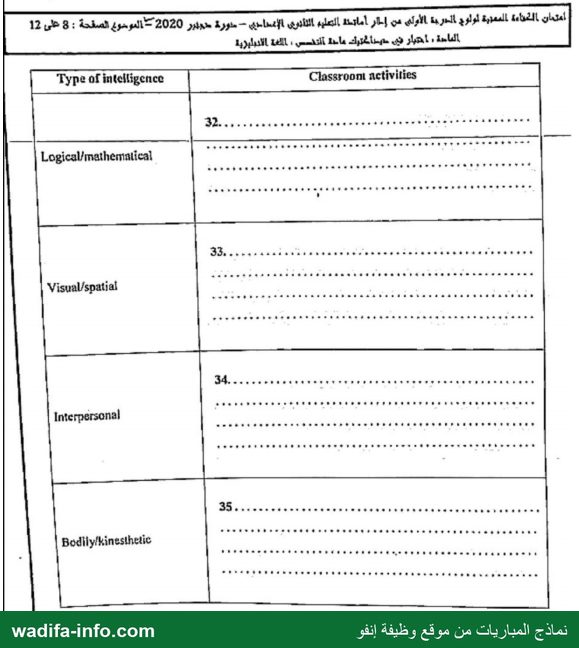
Task Seven – Intelligences multiples et Present Continuous (4 pts)
- 32 – Logical/mathematical : discover the rule inductively from example sentences (am/is/are + verb-ing), classify verbs by spelling rule (make → making, swim → swimming), sequencing or sorting puzzles.
- 33 – Visual/spatial : describe a picture or a video scene: "What are the people doing?"; spot-the-difference pictures; timelines and colour-coded charts of the form.
- 34 – Interpersonal : pair/group games: "Guess what I am doing", interviews, or phoning a classmate and describing what the family is doing right now.
- 35 – Bodily/kinesthetic : charades/miming: a student mimes an action and the class says "He is swimming"; TPR "Simon says" with actions in progress.
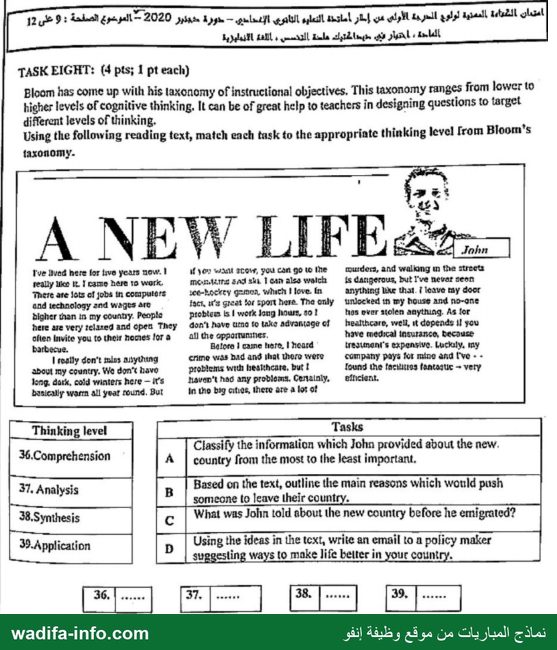
Task Eight – Taxonomie de Bloom (texte « A New Life ») (4 pts)
- 36 – Comprehension → C : « What was John told about the new country before he emigrated? ». L'information est explicite dans le texte : il suffit de la comprendre et de la reformuler.
- 37 – Analysis → A : classer les informations fournies par John de la plus importante à la moins importante, ce qui suppose de décomposer et de hiérarchiser.
- 38 – Synthesis → D : rédiger un e-mail à un décideur avec des propositions, c'est-à-dire produire quelque chose de nouveau à partir des idées du texte.
- 39 – Application → B : exposer les raisons qui pousseraient quelqu'un à quitter son pays, soit transférer les informations du texte à une situation générale.
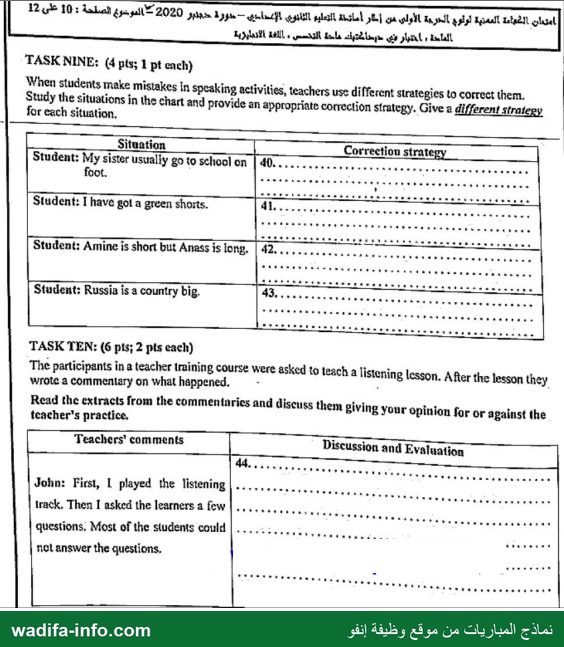
Task Nine – Stratégies de correction orale (4 pts, une stratégie différente par erreur)
- 40 – « My sister usually go… » (accord 3e personne) : recast. "Oh, your sister usually goes to school on foot?" Le professeur reformule correctement sans interrompre la communication.
- 41 – « I have got a green shorts » (article + nom pluriel) : elicitation / metalinguistic clue. "Shorts is plural. Can we say 'a shorts'?" L'élève se corrige lui-même (I have got green shorts / a pair of green shorts).
- 42 – « Amine is short but Anass is long » (mauvais choix lexical) : peer correction. "Who can help? Do we say 'long' for people?" Réponse attendue d'un camarade : tall.
- 43 – « Russia is a country big » (ordre adjectif-nom) : repetition with rising intonation / finger technique. Le professeur répète « a country big? » ou montre sur ses doigts les mots à inverser ; l'élève dit alors a big country.
Task Ten – Commentaires sur des leçons d'écoute (6 pts)
- 44 – John : pratique à critiquer. He skipped the pre-listening stage: no warm-up, no activation of schemata, no pre-teaching of key words, and the questions were not given before listening, so learners did not have a purpose for listening. He should set the context, pre-teach vocabulary, give the questions first (listening for gist, then for details) and only then play the track.
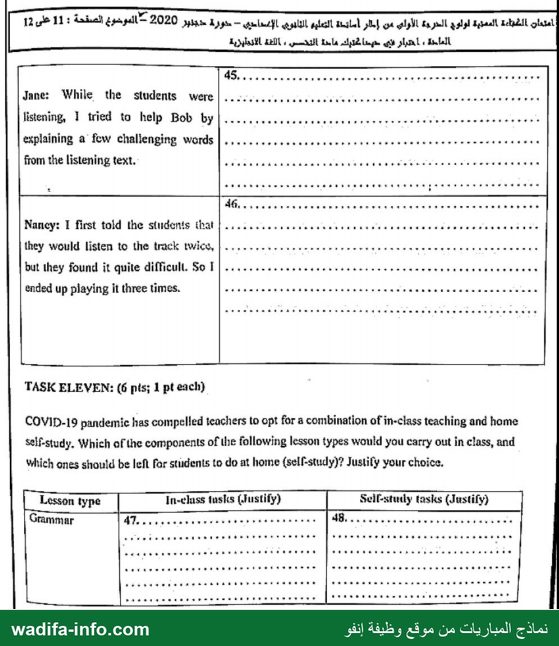
- 45 – Jane : pratique à critiquer. Explaining words while the recording is playing distracts Bob and the whole class; learners cannot listen and read/listen to the teacher at the same time. Challenging words should be pre-taught in the pre-listening stage, and individual help given after the listening.
- 46 – Nancy : pratique plutôt défendable, avec réserve. Being flexible and responding to learners' needs is positive: a third listening can help. But the difficulty shows that the text or tasks were not well chosen or prepared. She should check the level of the text, set easier gist tasks first, and pause or segment the recording instead of simply repeating it.
Task Eleven – Enseignement hybride (6 pts, 1 pt par case)
| Leçon | En classe (justification) | En autonomie à la maison (justification) |
|---|---|---|
| Grammar (47–48) | Presentation/discovery of the rule from context and controlled-to-free practice with teacher feedback, because learners need guidance to understand form, meaning and use. | Extra consolidation exercises (fill in the blanks, transformations) and revision of the rule, because they are mechanical and self-correctable with an answer key. |
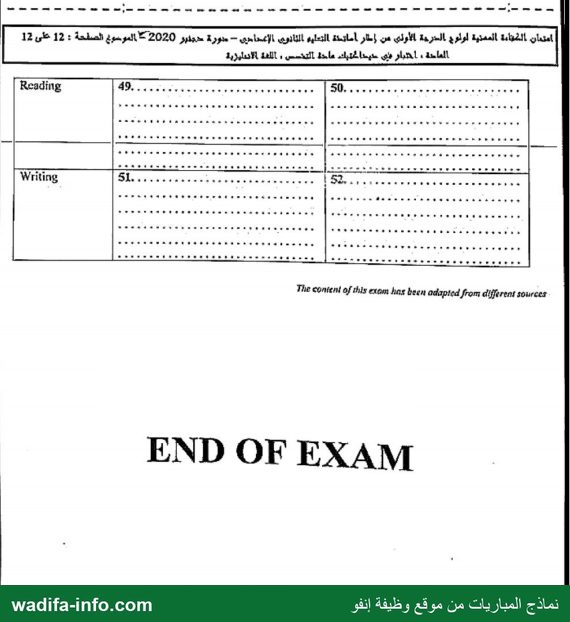
| Reading (49–50) | Pre-reading (schema activation, key vocabulary) and discussion of the post-reading questions, because they require interaction and guidance. | Reading the text and answering comprehension questions, vocabulary lists/glossary work, because learners can read at their own pace. |
| Writing (51–52) | Pre-writing (brainstorming, model text analysis, outline) and feedback on drafts, because they need the teacher and peers. | Drafting and rewriting the text, self-editing with a checklist, because writing is individual and time-consuming. |
💡 Grille du QCM (Task One) : 1 A · 2 B · 3 D · 4 C · 5 C · 6 B · 7 C · 8 D · 9 B · 10 B. Task Eight : 36 C · 37 A · 38 D · 39 B.
À réviser pour cet examen : les Orientations pédagogiques d'anglais du secondaire collégial (compétences, benchmarks, évaluation), les méthodes (Direct Method, Audio-lingual, CLT, TBL), les théories de l'apprentissage (Piaget, Vygotsky, Bloom, Gardner, Maslow), la didactique des quatre compétences (étapes pré-, pendant et post-écoute ou lecture, processus d'écriture), l'enseignement du vocabulaire (Thornbury), la gestion de classe et la discipline, les stratégies de correction orale (Lyster & Ranta : recast, elicitation, metalinguistic feedback…) et les qualités d'un test (validité, fiabilité, praticabilité).
Questions fréquentes sur ce sujet
Ce sujet est-il téléchargeable gratuitement ?
Le corrigé est-il inclus ?
Quel organisme et quel grade concerne ce sujet ?
De quelle session s'agit-il et dans quelle langue ?
Où trouver d'autres sujets du même concours ?
Vous préparez ce concours ?
Modèles similaires
Organisme : Ministère de l'Éducation nationale - Centre national d'évaluation et des examens · Session décembre 2020 — Copie issue de : sujets des sessions précédentes des concours de recrutement — document archivé tel que reçu ; l'avis officiel du concours fait foi.
}Citer cette page
Journaliste, blogueur, enseignant : copiez la référence ci-dessous et mettez un lien vers cette page.
Adresse permanente : https://www.wadifa-info.com/fr/modele-concours/1473/modele-epreuve-de-didactique-de-la-specialite-anglais-ministere-de-l-education-nationale-c