
Modèle du Concours National d'Accès aux Écoles de Management (CNAEM) 2019 — filières ECT et ECS — Anglais
En bref
Ce document est une ancienne épreuve écrite du concours de Élève de CPGE ECT/ECS (accès écoles de management) organisé par Ministère de l'Enseignement Supérieur — ENCG (Concours National d'Accès aux Écoles de Management, CNAEM) (2019), publiée sur Wadifa Info en consultation et téléchargement PDF gratuits, avec une correction proposée.
- Organisme
- Ministère de l'Enseignement Supérieur — ENCG (Concours National d'Accès aux Écoles de Management, CNAEM)
- Grade
- Élève de CPGE ECT/ECS (accès écoles de management)
- Spécialité
- Anglais (English Test)
- Année
- 2019
- Pages
- 3
- Langue des questions
- français
- Correction
- correction proposée disponible sur cette page
📝 Texte des questions (extrait automatiquement des pages scannées)
Ce texte est extrait automatiquement des images de l'épreuve et peut contenir des erreurs de lecture — les images ci-dessus font foi.
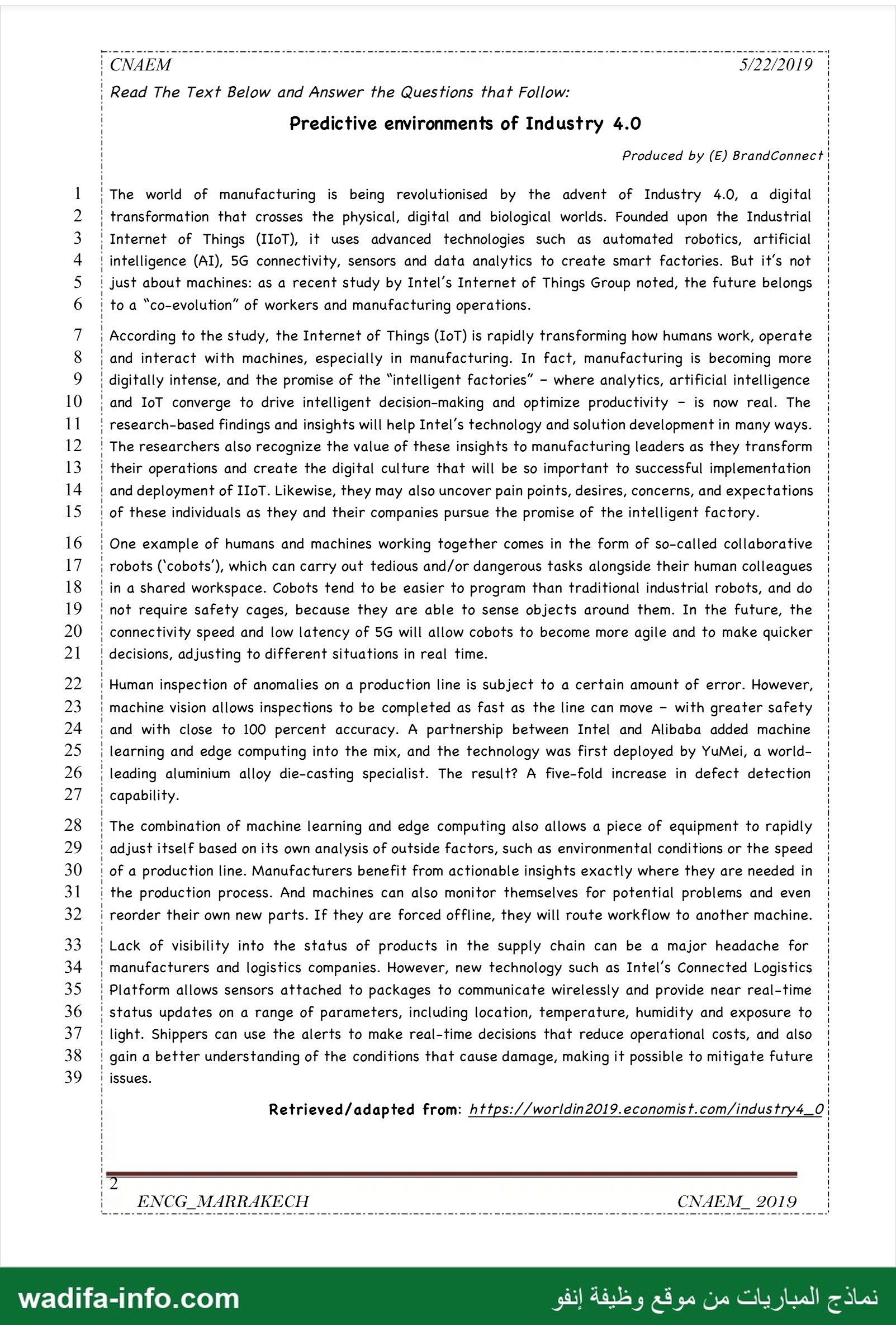
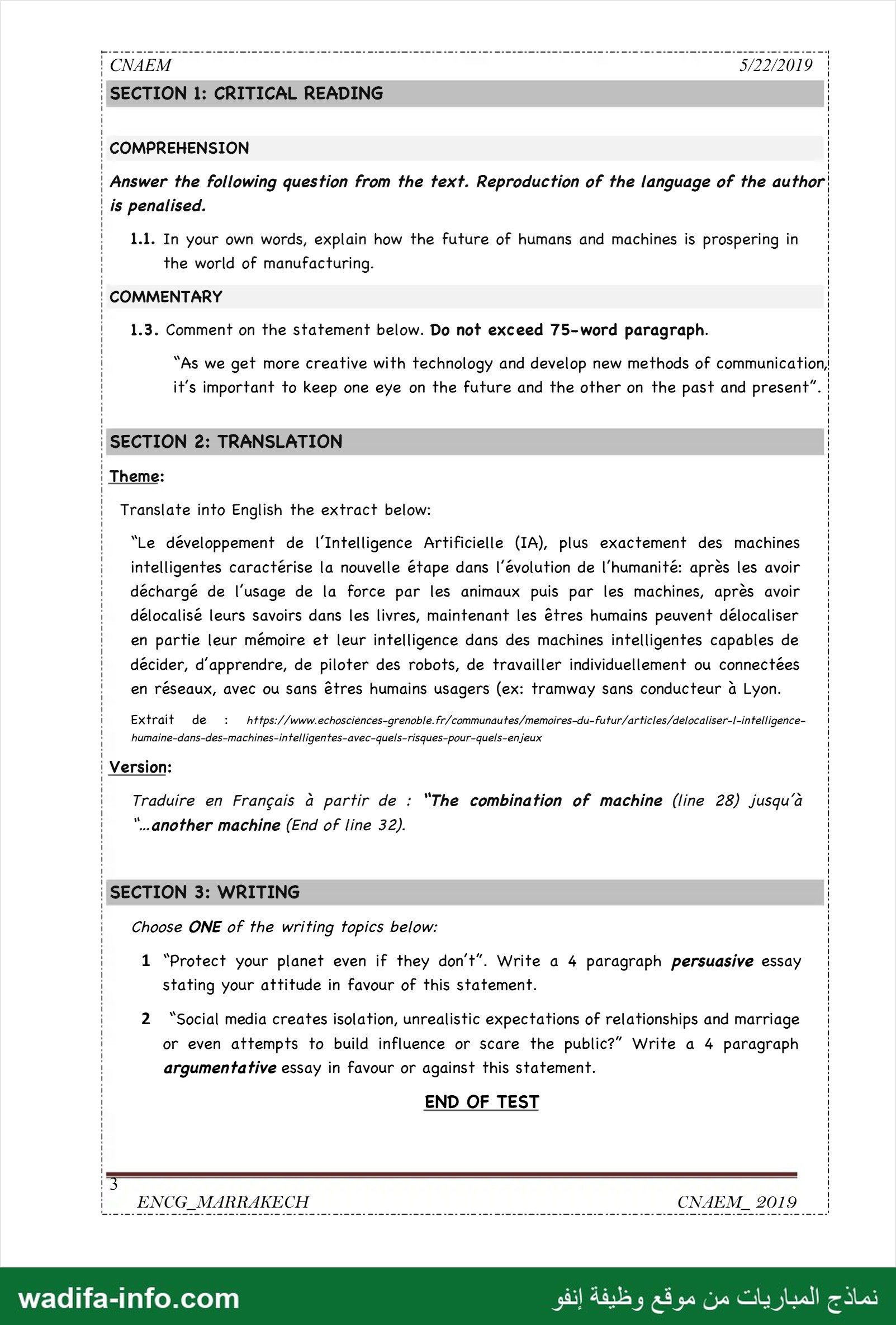
| 52220109 لمعيس Royaume du Maroc 'ْ Ministère de l'Éducation Nationale, de la Formation professionnelle, | ,ً de l'Enseignement Supérieur et de la Recherche Scientifique | Secrétariat d'État chargé de l'Enseignement Supérieur et de la Recherche Scientifique Présidence du Concours National d'Accès aux Écoles de Management ' ض Ecole Nationale de Commerce et de Gestion de Marrakech - ENCG 2019 ! Concours National d'Accès aux Ecoles de Management | CNAEM 9 | ْ i ENCG Marrakech English Test ض Duration: 2 hours | | EXAM INSTRUCTIONS | Before looking at the test questions, read the instructions carefully. F 'ً o The exam is divided into three sections: Section I: Critical Reading Section Il: Translation | Section III: Writing F o If you decide to change an answer, erase your old answer completely and write the | new one. Enough space is provided for the answers to each item. Do not exceed that space. ١ © | o Make sure your handwriting is clear. NB. You are not allowed to use any document, electronic device or communicate with anyone during the exam session. Evidence of cheating (during exam administration or : paper correction) will automatically disqualify the candidate. | أ 2019 ENCG_MARRAKECH CNAEM_ ْ نماذج المباريات من موقع وظيفة إنفو wadifa-info.com ! 4 3/22/2019 | | Read The Text Below and Answer the Questions that Follow: Predictive environments of Industry 4.0 Produced by (E) BrandConnect 1 The world of manufacturing is being revolutionised by the advent of Industry 4.0, a digital ; 2 ! transformation that crosses the physical, digital and biological worlds. Founded upon the Industrial : 3 | Internet of Things (IIoT), it uses advanced technologies such as automated robotics, artificial | + | intelligence (Al), 5G connectivity, sensors and data analytics to create smart factories. But it's not l 5 |! just about machines: as a recent study by Intel's Internet of Things Group noted, the future belongs 6 to a “co-evolution” of workers and manufacturing operations. 7 According to the study, the Internet of Things (IoT) is rapidly transforming how humans work, operate | 8 ! and interact with machines, especially in manufacturing. In fact, manufacturing is becoming more 9: digitally intense, and the promise of the “intelligent factories” - where analytics, artificial intelligence 10 : and IoT converge to drive intelligent decision-making and optimize productivity - is now real. The : 11 ! research-based findings and insights will help Intel's technology and solution development in many ways. : 12 The researchers also recognize the value of these insights to manufacturing leaders as they transform 13 their operations and create the digital culture that will be so important to successful implementation 14 | and deployment of IIoT. Likewise, they may also uncover pain points, desires, concerns, and expectations 15 of these individuals as they and their companies pursue the promise of the intelligent factory. 16 | One example of humans and machines working together comes in the form of so-called collaborative | 17 | robots (‘cobots’), which can carry out tedious and/or dangerous tasks alongside their human colleagues 18 ; in a shared workspace. Cobots tend to be easier to program than traditional industrial robots, and do أ 19 : not require safety cages, because they are able to sense objects around them. In the future, the : 20 | connectivity speed and low latency of 56 will allow cobots to become more agile and to make quicker : 21 | decisions, adjusting to different situations in real time. 22 | Human inspection of anomalies on a production line is subject to a certain amount of error. However, أ 23 : machine vision allows inspections to be completed as fast as the line can move - with greater safety : 24 ; and with close to 100 percent accuracy. À partnership between Intel and Alibaba added machine : 25 F learning and edge computing into the mix, and the technology was first deployed by YuMei, a world- 26 : leading aluminium alloy die-casting specialist. The result? A five-fold increase in defect detection 27 | capability. 28 The combination of machine learning and edge computing also allows a piece of equipment to rapidly 29 adjust itself based on its own analysis of outside factors, such as environmental conditions or the speed 30 : of a production line. Manufacturers benefit from actionable insights exactly where they are needed in 31 | the production process. And machines can also monitor themselves for potential problems and even : Il 1 32 | reorder their own new parts. If they are forced offline, they will route workflow to another machine. : 33 ; Lack of visibility into the status of products in the supply chain can be a major headache for ; 34 ١ manufacturers and logistics companies. However, new technology such as Intel's Connected Logistics ; 35 Platform allows sensors attached to packages to communicate wirelessly and provide near real-time : 36 | status updates on a range of parameters, including location, temperature, humidity and exposure to 37 | light. Shippers can use the alerts to make real-time decisions that reduce operational costs, and also 38 | gain a better understanding of the conditions that cause damage, making it possible to mitigate future 39 issues. Retrieved/adapted from: https://worldin2019.economist.com/industry4_0O ENCG_MARRAKECH CNAEM_ 2019 نماذج المباريات من موقع وظيفة إنفو wadifa-info.com | 5222019 تملس CRITICAL READING | :1 56061101 COMPREHENSION | Answer the following question from the text. Reproduction of the language of the author: | is penalised. : In your own words, explain how the future of humans and machines is prospering in | .1.1 ! the world of manufacturing. | COMMENTARY ! Comment on the statement below. Do not exceed 75-word paragraph. | .1.3 | ‘As we get more creative with technology and develop new methods of communication, ض it's important to Keep one eye on the future and the other on the past and present”. l | SECTION 2: TRANSLATION | Theme: | Translate into English the extract below: | ]| "Le développement de l'Intelligence Artificielle (IA), plus exactement des machines intelligentes caractérise la nouvelle étape dans l’évolution de l'humanité: après les avoir : ; أ déchargé de l'usage de la force par les animaux puis par les machines, après avoir : délocalisé leurs savoirs dans les livres, maintenant les êtres humains peuvent délocaliser !, | en partie leur mémoire et leur intelligence dans des machines intelligentes capables de ْ أ décider, d'apprendre, de piloter des robots, de travailler individuellement ou connectées : sans êtres humains usagers (ex: tramway sans conducteur à Lyon. ناه en réseaux, avec F Extrait de : hffps://www.echosciences-grenoble.fr/communautes/memoires-du-futur/articles/delocaliser-l-intelligence- humaine-dans-des-machines-intelligentes-avec-quels-risques-pour-quels-enjeux Version: | Traduire en Français à partir de : “The combination of machine (line 28) jusqu'à ; "another machine (End of line 32). | SECTION 3: WRITING | Choose ONE of the writing topics below: | | “Protect your planet even if they don't”. Write a 4 paragraph persuasive essay 1 | stating your attitude in favour of this statement. ! 2 ‘Social media creates isolation, unrealistic expectations of relationships and marriage or even attempts to build influence or scare the public?” Write a 4 paragraph أ | argumentative essay in favour or against this statement. ض END OF TEST …….ENCG_MARRAKECH ا 1 اب ل CNAEM 2019: نماذج المباريات من موقع وظيفة إنفو wadifa-info.com
✅ Correction proposée
Il s'agit d'une correction proposée, rédigée par l'équipe wadifa-info pour vous aider à comprendre la méthode — ce n'est pas un corrigé officiel de l'administration organisatrice.
Ce modèle est l'épreuve d'anglais (English Test) du CNAEM 2019, préparée par l'ENCG Marrakech (présidence du concours), datée du 22/05/2019. Durée : 2 heures. Trois sections : compréhension et commentaire d'un texte sur l'Industrie 4.0, traduction (thème français → anglais et version anglais → français), puis un essai au choix. Les réponses proposées ci-dessous sont des modèles : le jury pénalise la reprise des phrases du texte, il faut reformuler.
Section 1 — Critical Reading
1.1. Comprehension (model answer)
According to the article, the future of manufacturing is not machines replacing people but people and machines growing together. Connected devices, AI and fast networks are changing the way employees run and use equipment. Robots designed to share the workspace take over repetitive or risky jobs, while humans keep the tasks that need judgement. Cameras and learning software spot defects far better than the human eye, machines can check their own condition and order spare parts, and sensors on parcels let managers follow goods in real time. As a result, workers gain safer jobs and better information for their decisions.
💡 L'énoncé passe de 1.1 à 1.3 (pas de question 1.2 sur le sujet). Pour 1.1, citez au moins trois exemples du texte (cobots, contrôle qualité par vision artificielle, maintenance autonome, logistique connectée) en les reformulant.
1.3. Commentary (model paragraph, under 75 words)
Innovation should not mean forgetting where we come from. The past teaches us which inventions improved lives and which created new problems, while the present shows the real needs of people today. Looking only ahead can lead to technology that excludes older users or threatens jobs and privacy. Balanced progress therefore combines bold ideas with lessons from experience, so that new communication tools serve society instead of replacing human contact. (≈ 70 mots)
Section 2 — Translation
Thème (français → anglais) — traduction proposée
"The development of Artificial Intelligence (AI), more precisely of intelligent machines, marks a new stage in the evolution of humankind: after relieving themselves of the use of physical force, first through animals and then through machines, and after storing their knowledge outside themselves in books, human beings can now partly transfer their memory and intelligence to intelligent machines capable of deciding, learning and controlling robots, working individually or connected in networks, with or without human users (e.g. the driverless tram in Lyon)."
💡 Points délicats : « délocaliser leurs savoirs » se rend mieux par store / externalise their knowledge que par relocate ; « tramway sans conducteur » = driverless tram ; « piloter des robots » = control / operate robots.
Version (lignes 28 à 32, anglais → français) — traduction proposée
« L'association de l'apprentissage automatique et de l'informatique de périphérie (edge computing) permet également à un équipement de s'ajuster rapidement en fonction de sa propre analyse de facteurs extérieurs, tels que les conditions ambiantes ou la cadence d'une ligne de production. Les industriels disposent ainsi d'informations exploitables exactement là où elles sont nécessaires dans le processus de production. Les machines peuvent aussi surveiller elles-mêmes l'apparition de problèmes éventuels, et même commander elles-mêmes leurs nouvelles pièces. Si elles sont contraintes de s'arrêter, elles redirigent le flux de travail vers une autre machine. »
Section 3 — Writing (un sujet au choix, 4 paragraphes)
Sujet 1 — "Protect your planet even if they don't" (essai persuasif, POUR)
- §1 Introduction : constat (changement climatique, plastique, sécheresse au Maroc) et thèse claire : l'action individuelle compte même si les autres ne font rien.
- §2 Argument 1 — l'effet cumulé : des millions de petits gestes (économiser l'eau, trier, moins de plastique, transports en commun) font de grands résultats ; attendre les autres revient à ne rien faire.
- §3 Argument 2 — l'exemple et la responsabilité : le comportement est contagieux (famille, voisins, réseaux sociaux) ; nous devons la planète aux générations futures. Réfutez l'objection « mon geste est inutile si les grands pollueurs continuent ».
- §4 Conclusion : reformulez la thèse et terminez par un appel à l'action.
Outils utiles : Firstly, Moreover, Admittedly… however, Therefore, It is high time we…
Sujet 2 — Social media: isolation, unrealistic expectations, influence and fear (argumentatif, pour OU contre)
- §1 Introduction : place des réseaux sociaux chez les jeunes ; annoncez votre position (par exemple : « largement d'accord, mais l'usage fait la différence »).
- §2 Arguments pour l'énoncé : temps d'écran au détriment des relations réelles, comparaison avec des vies et des couples mis en scène, influenceurs, désinformation et contenus alarmistes.
- §3 Contre-arguments : lien avec la famille éloignée et la diaspora, communautés de soutien, information rapide, opportunités d'emploi et d'apprentissage.
- §4 Conclusion : tranchez nettement et proposez des solutions (éducation aux médias, limiter son temps d'écran, vérifier les sources).
💡 Le jury attend exactement 4 paragraphes, un registre formel, sans contractions (do not plutôt que don't), et une position claire.
Questions fréquentes sur ce sujet
Ce sujet est-il téléchargeable gratuitement ?
Le corrigé est-il inclus ?
Quel organisme et quel grade concerne ce sujet ?
De quelle session s'agit-il et dans quelle langue ?
Où trouver d'autres sujets du même concours ?
Vous préparez ce concours ?
Modèles similaires
Source : archive de modèles de concours — document archivé tel que reçu ; l'avis officiel du concours fait foi.
}