
Modèle : Concours enseignants déc. 2021 - Anglais - Didactique
⬇️ Télécharger le PDF Adresse permanente : wadifa-info.com/fr/modele-concours/1027
En bref
Ce document est une ancienne épreuve écrite du concours de recrutement organisé par Ministère de l'Éducation Nationale, du Préscolaire et des Sports — AREF (2021), publiée sur Wadifa Info en consultation et téléchargement PDF gratuits, avec une correction proposée.
- Organisme
- Ministère de l'Éducation Nationale, du Préscolaire et des Sports — AREF
- Grade
- Cadres AREF — ثانوي تأهيلي
- Spécialité
- اللغة الإنجليزية
- Année
- 2021
- Pages
- 9
- Langue des questions
- français
- Correction
- correction proposée disponible sur cette page
📝 Texte des questions (extrait automatiquement des pages scannées)
Ce texte est extrait automatiquement des images de l'épreuve et peut contenir des erreurs de lecture — les images ci-dessus font foi.
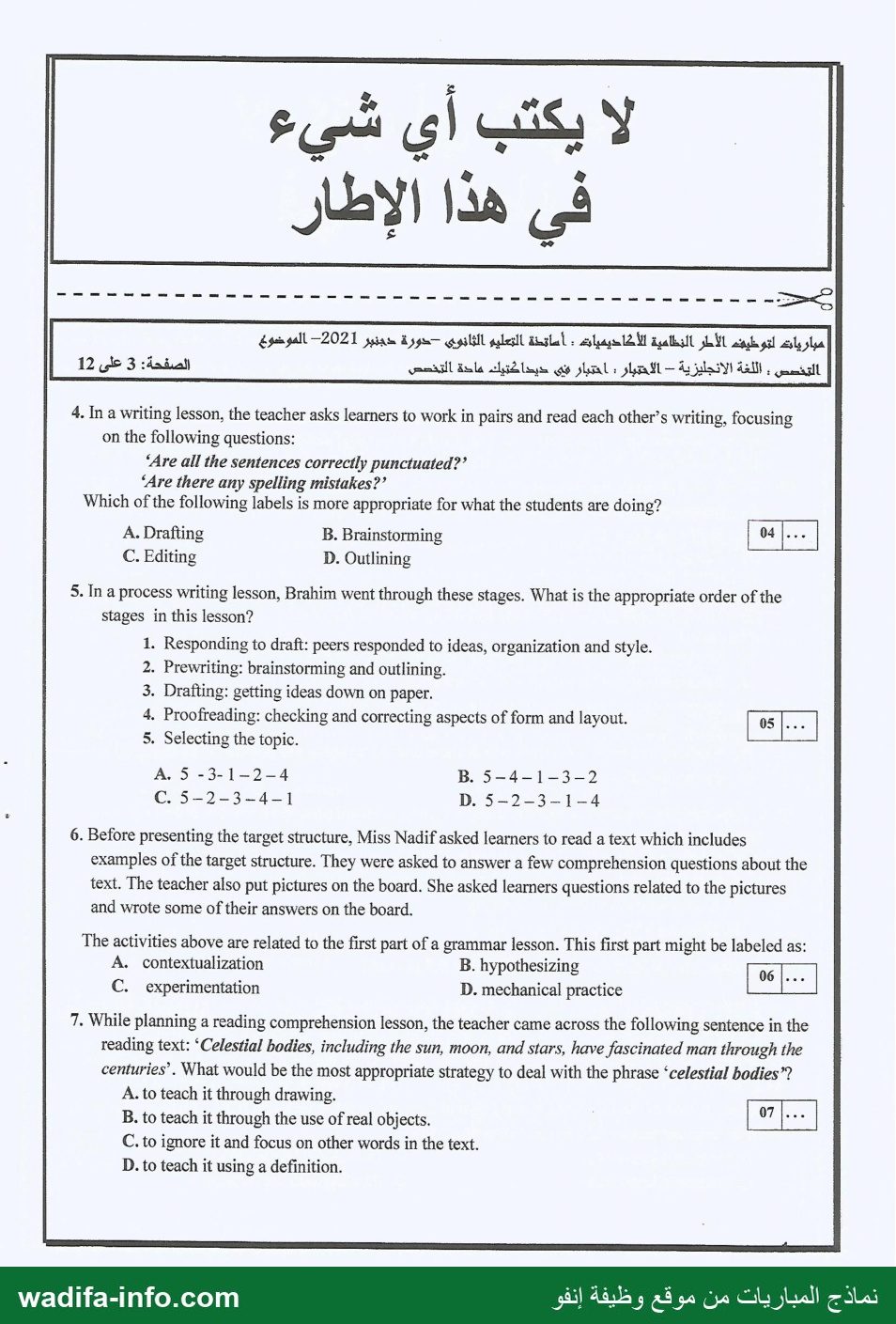
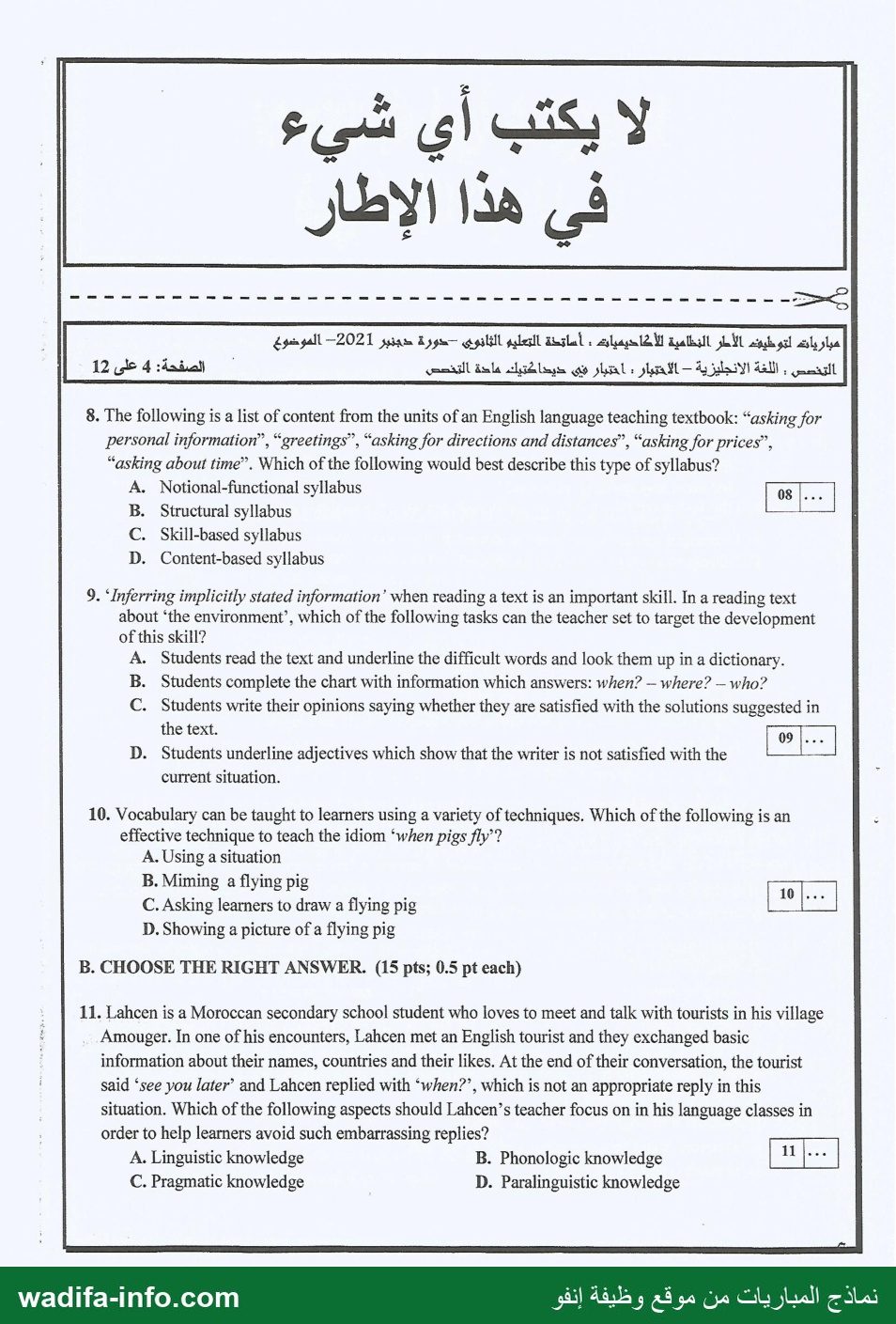
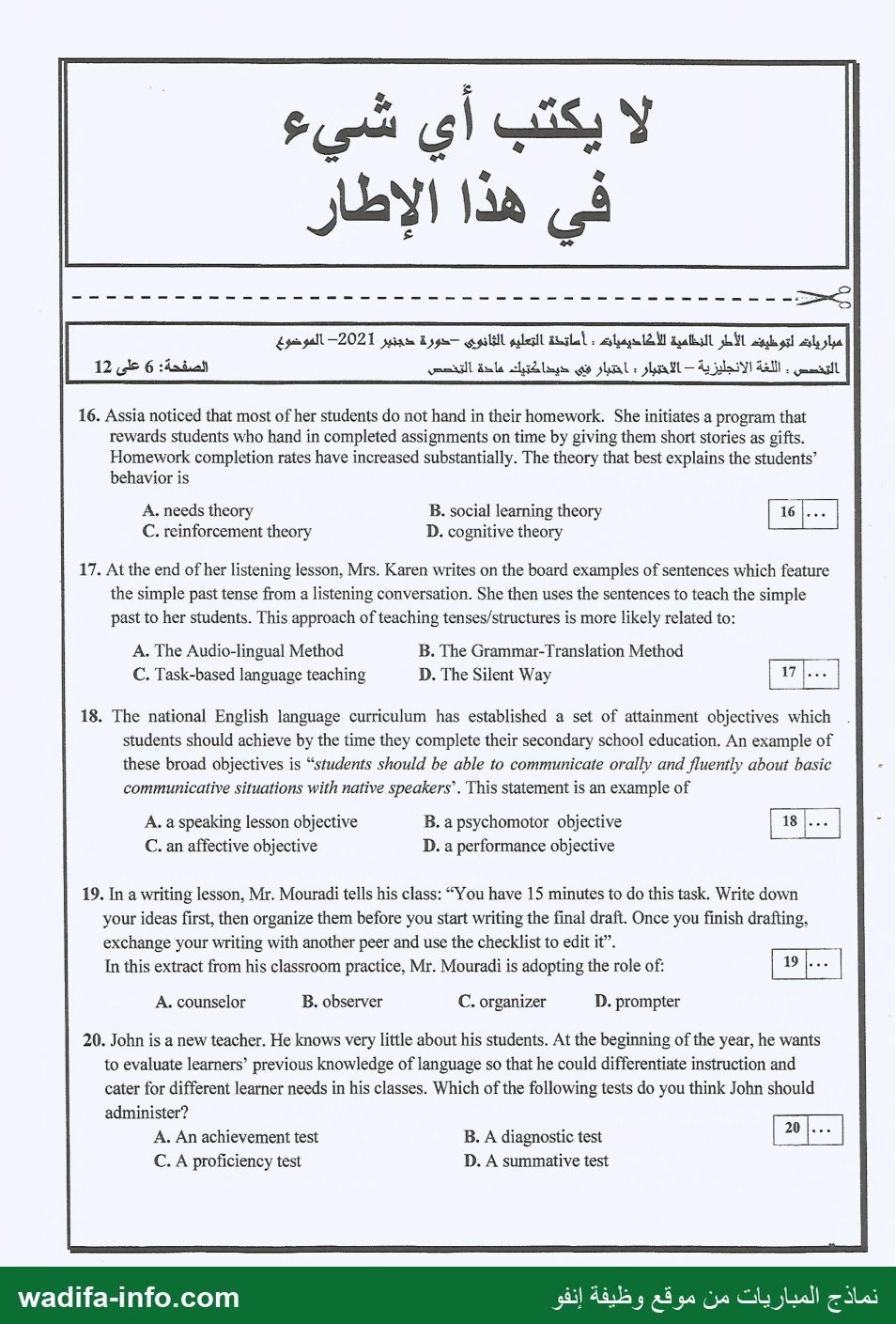
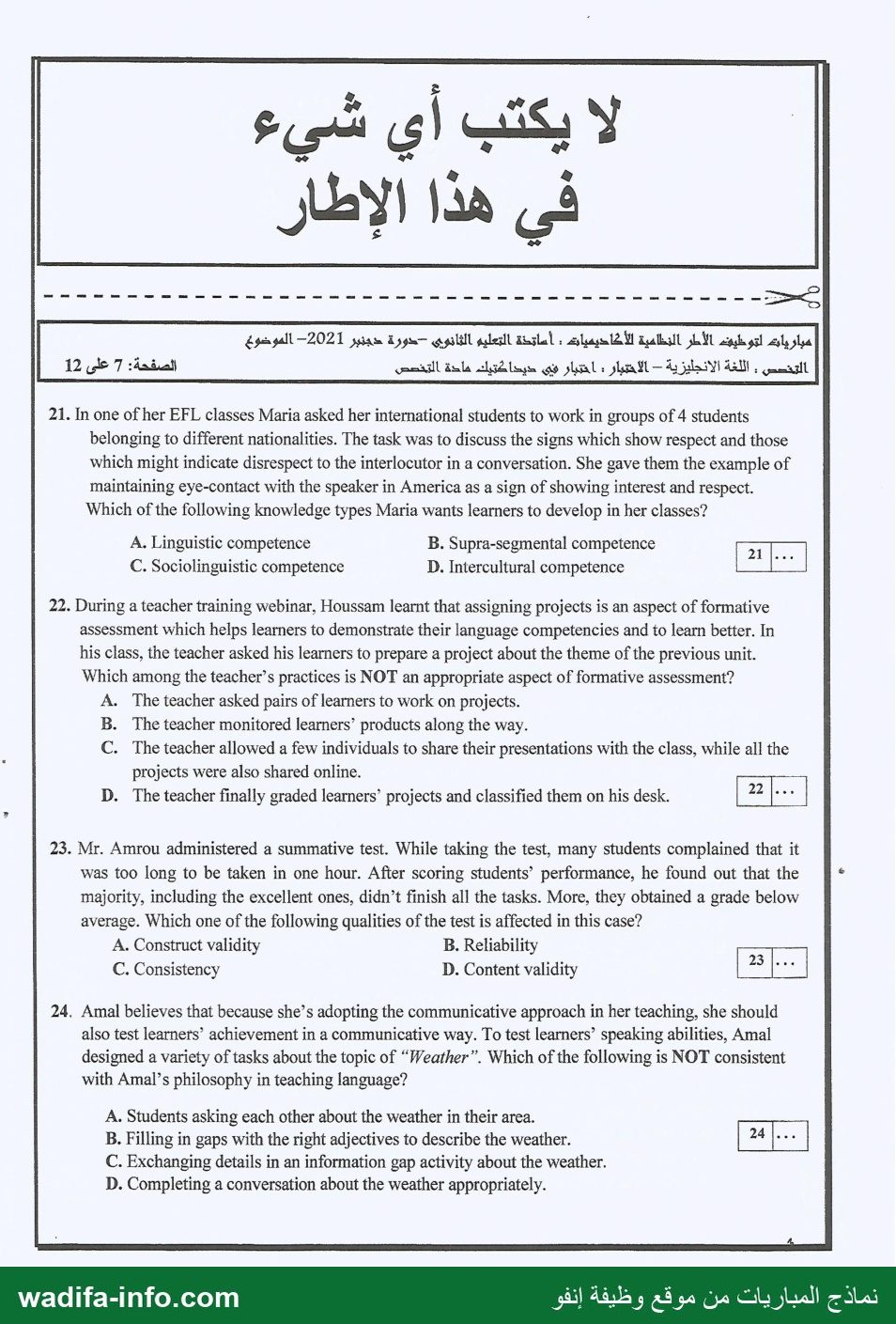
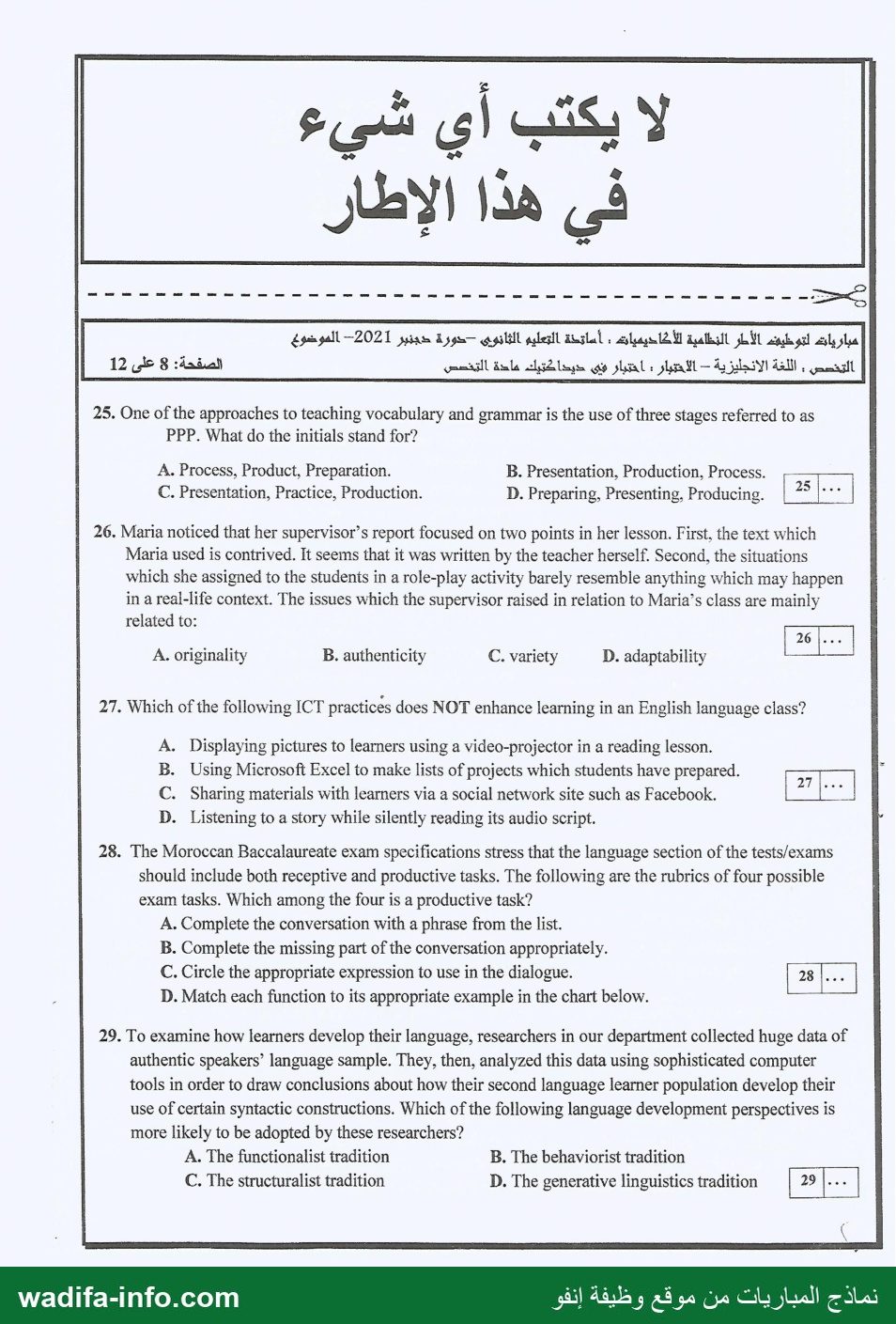
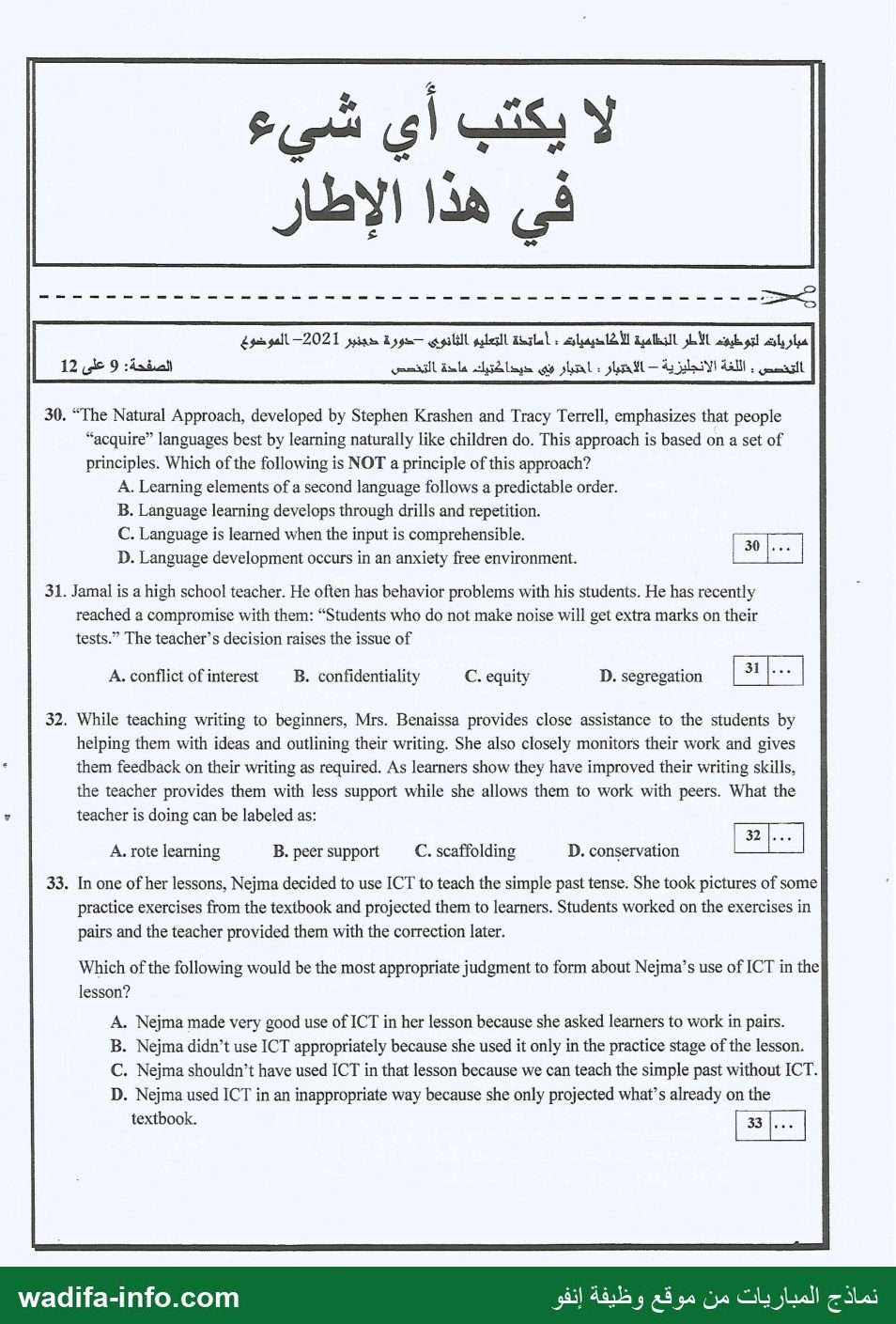
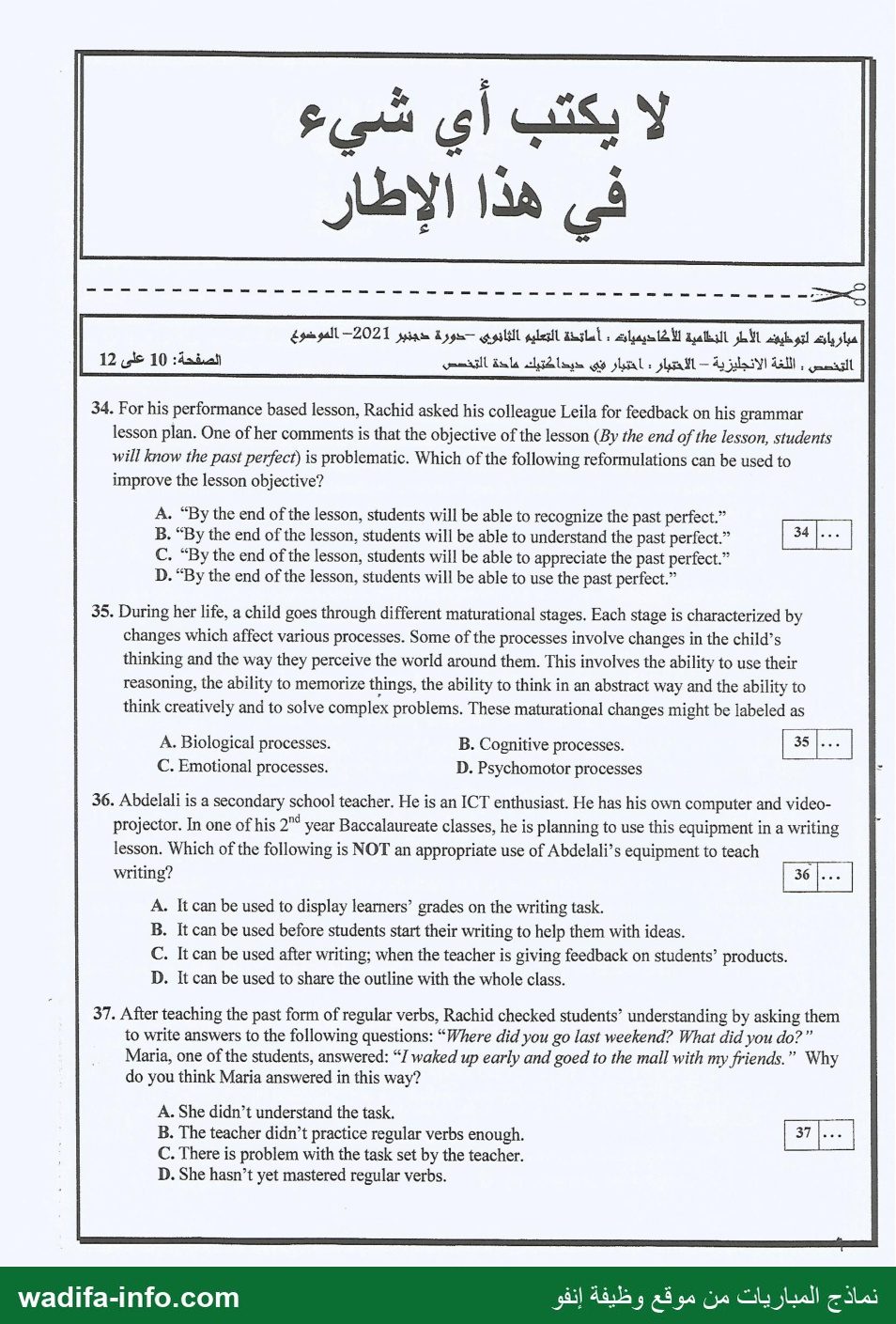
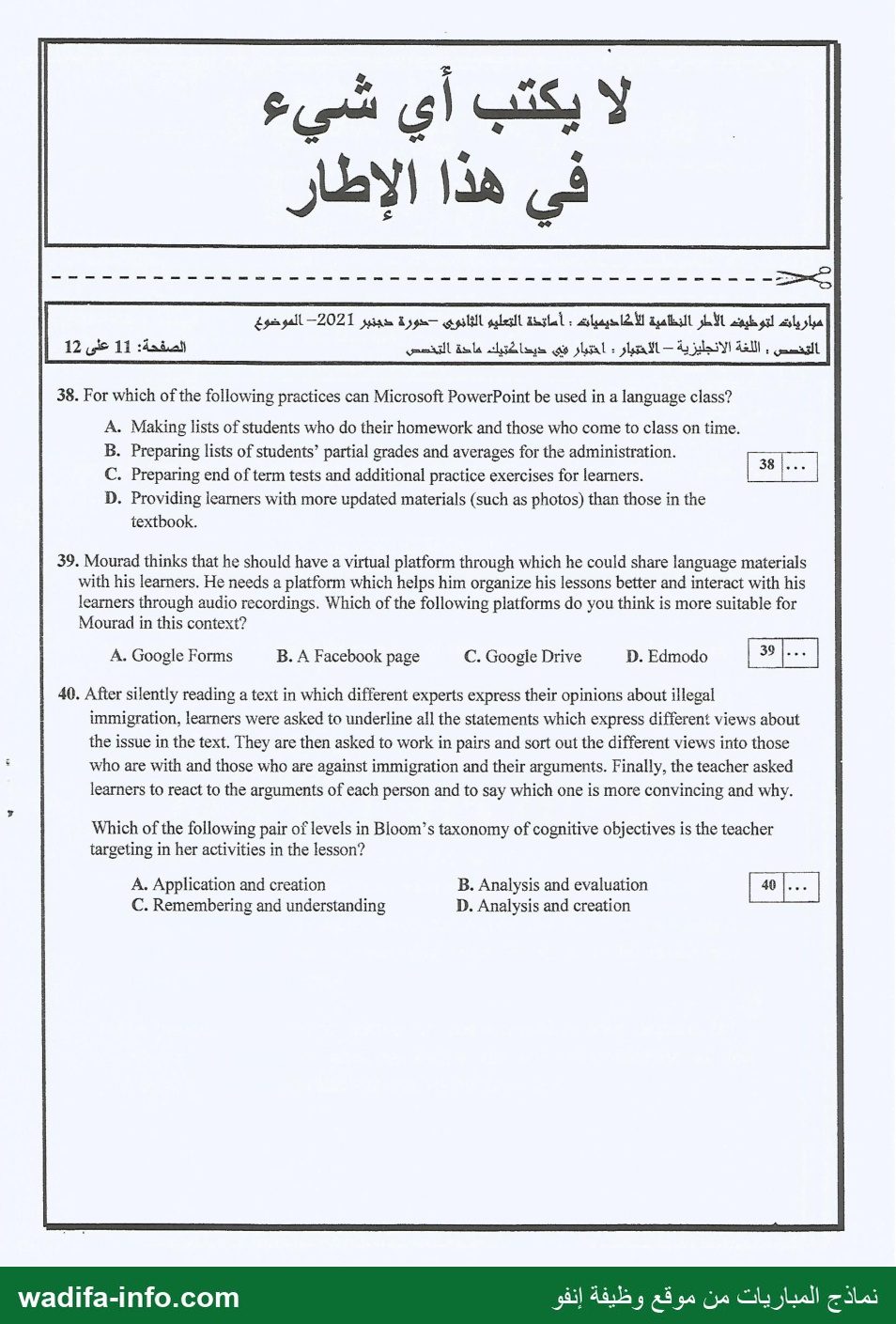
— صفحة 1 — خباريات لتوطيك الأطر النطامية الأخاديميات : أساذة التعليم الثابوي -دورة حجنبر 2021- الموضوع التخصص : اللغة الانجليزية - الأختبار : احتبار في ديصاكُتيك مادة التخحصس 4. In à writing lesson, the teacher asks learners to work in pairs and read each other’s writing, focusing on the following questions: “Are all the sentences correctly punctuated?” “Are there any spelling mistakes?” Which of the following labels is more appropriate for what the students are doing? À. Drafting B. Brainstorming C. Editing D. Outlining 5. In a process writing lesson, Brahim went through these stages. What is the appropriate order of the Stages in this lesson? . Responding to draft: peers responded to ideas, organization and style. . Prewriting: brainstorming and outlining. . Drafting: getting ideas down on paper. . Proofreading: checking and correcting aspects of form and layout. . Selecting the topic. - Before presenting the target structure, Miss Nadif asked learners to read a text which includes examples of the target structure. They were asked to answer a few comprehension questions about the text. The teacher also put pictures on the board. She asked learners questions related to the pictures and wrote some of their answers on the board. The activities above are related to the first part of a grammar lesson. This first part might be labeled as: A. contextualization B. hypothesizing C. experimentation D. mechanical practice 7. While planning a reading comprehension lesson, the teacher came across the following sentence in the reading text: ‘Celestial bodies, including the sun, moon, and stars, have fascinated man through the centuries’. What would be the most appropriate strategy to deal with the phrase ‘celestial bodies”? À. to teach it through drawing. B. to teach it through the use of real objects. 5 C. to ignore it and focus on other words in the text. D. to teach it using a definition. نماذج المباريات من موقع وظيفة إن wadifa-info.com — صفحة 2 — عباريات لتوحطيك الأطر النظامية الأكاحديميات : أسائحة التعليو الثانوي -دورة دجنبر 2021- الموضوع التخصص : اللغة الانجليزية - الأختبار : احتبار في ديصاحتيك مادة التنحصس 8. The following is a list of content from the units of an English language teaching textbook: “asking for personal information”, “greetings”, “asking for directions and distances”, “asking for prices”, “asking about time”. Which of the following would best describe this type of syllabus? A. Notional-functional syllabus 08 B. Structural syllabus Lies C. Skill-based syllabus D. Content-based syllabus 9. “Inferring implicitly stated information’ when reading a text is an important skill. In a reading text about “the environment’, which of the following tasks can the teacher set to target the development of this skill? . Students read the text and underline the difficult words and look them up in a dictionary. Students complete the chart with information which answers: when? — where? — who? . Students write their opinions saying whether they are satisfied with the solutions suggested in the text. . Students underline adjectives which show that the writer is not satisfied with the current situation. 10. Vocabulary can be taught to learners using a variety of techniques. Which of the following is an effective technique to teach the idiom ‘when pigs f1y°? A. Using a situation B. Miming a flying pig 10 C. Asking learners to draw a flying pig | 1e |--- | D. Showing a picture of a flying pig B. CHOOSE THE RIGHT ANSWER. (15 pts; 0.5 pt each) 11. Lahcen is a Moroccan secondary school student who loves to meet and talk with tourists in his village Amouger. In one of his encounters, Lahcen met an English tourist and they exchanged basic information about their names, countries and their likes. At the end of their conversation, the tourist said “see you later’ and Lahcen replied with ‘when?’, which is not an appropriate reply in this situation. Which of the following aspects should Lahcen’s teacher focus on in his language classes in order to help learners avoid such embarrassing replies? A. Linguistic knowledge B. Phonologic knowledge C. Pragmatic knowledge D. Paralinguistic knowledge نماذج المباريات من موقع وظيفة إنفو wadifa-info.com — صفحة 3 — خباريات must pal الأطر البظامية الأكاديميات : أساتطة التعليم الثانوي -دورة دجنبر 2021- الموضوع التخصى . اللغة الانجليزية - الأختبار : احتبار في ديصاحتيك فادة التنحس 16. Assia noticed that most of her students do not hand in their homework. She initiates a program that rewards students who hand in completed assignments on time by giving them short stories as gifts. Homework completion rates have increased substantially. The theory that best explains the students’ behavior is A. needs theory B. social learning theory [16 |--- | C. reinforcement theory D. cognitive theory 17. At the end of her listening lesson, Mrs. Karen writes on the board examples of sentences which feature the simple past tense from a listening conversation. She then uses the sentences to teach the simple past to her students. This approach of teaching tenses/structures is more likely related to: A. The Audio-lingual Method B. The Grammar-Translation Method C. Task-based language teaching D. The Silent Way 17 |. | 18. The national English language curriculum has established a set of attainment objectives which students should achieve by the time they complete their secondary school education. An example of these broad objectives is “students should be able to communicate orally and fluently about basic communicative situations with native speakers’. This statement is an example of A. a speaking lesson objective B. a psychomotor objective C. an affective objective D. a performance objective 19. In a writing lesson, Mr. Mouradi tells his class: “You have 15 minutes to do this task. Write down your ideas first, then organize them before you start writing the final draft. Once you finish drafting, exchange your writing with another peer and use the checklist to edit it”. : In this extract from his classroom practice, Mr. Mouradi is adopting the role of: A. counselor B. observer C. organizer D. prompter 20. John is a new teacher. He knows very little about his students. At the beginning of the year, he wants to evaluate learners’ previous knowledge of language so that he could differentiate instruction and cater for different learner needs in his classes. Which of the following tests do you think John should administer? A. An achievement test B. A diagnostic test قات C. A proficiency test D. A summative test نماذج المباريات من موقع وظيفة إنفو wadifa-info.com — صفحة 4 — عباريات لوطي LME النظامية الأخاديميات : أساتطة التعليو الثانوي -دورة دجنير 2021- الموضوع التنصس , اللغة الانجليزية - الاحتبار + اختبار في صيصاحختيك ماصة التخحس 21. In one of her EFL classes Maria asked her international students to work in groups of 4 students belonging to different nationalities. The task was to discuss the signs which show respect and those which might indicate disrespect to the interlocutor in a conversation. She gave them the example of maintaining eye-contact with the speaker in America as a sign of showing interest and respect. Which of the following knowledge types Maria wants learners to develop in her classes? A. Linguistic competence B. Supra-segmental competence Ce C. Sociolinguistic competence D. Intercultural competence 22. During a teacher training webinar, Houssam learnt that assigning projects is an aspect of formative assessment which helps learners to demonstrate their language competencies and to learn better. In his class, the teacher asked his learners to prepare a project about the theme of the previous unit. Which among the teacher’s practices is NOT an appropriate aspect of formative assessment? . The teacher asked pairs of learners to work on projects. The teacher monitored learners’ products along the way. . The teacher allowed a few individuals to share their presentations with the class, while all the projects were also shared online. . The teacher finally graded learners’ projects and classified them on his desk. 23. Mr. Amrou administered a summative test. While taking the test, many students complained that it was too long to be taken in one hour. After scoring students’ performance, he found out that the majority, including the excellent ones, didn’t finish all the tasks. More, they obtained a grade below average. Which one of the following qualities of the test is affected in this case? A. Construct validity B. Reliability C. Consistency D. Content validity 23... . Amal believes that because she’s adopting the communicative approach in her teaching, she should also test learners’ achievement in a communicative way. To test learners’ speaking abilities, Amal designed a variety of tasks about the topic of “Weather”. Which of the following is NOT consistent with Amal’s philosophy in teaching language? A. Students asking each other about the weather in their area. B. Filling in gaps with the right adjectives to describe the weather. C. Exchanging details in an information gap activity about the weather. D. Completing a conversation about the weather appropriately. نماذج المباريات من موقع وظيفة إن wadifa-info.com — صفحة 5 — عباريات لتوطيت الأطر النظامية الأخاديميات : أسائطة التعليم الثانويى -دورة حجنبر 2021- الموضوع التخصص , اللغة الانجليزية - الاختبار ؛ اختبار في ديصاكتيك مادة التخصسس 25. One of the approaches to teaching vocabulary and grammar is the use of three stages referred to as PPP. What do the initials stand for? A. Process, Product, Preparation. B. Presentation, Production, Process. C. Presentation, Practice, Production. D. Preparing, Presenting, Producing. | as fr ل 26. Maria noticed that her 5177150173 report focused on two points in her lesson. First, the text which Maria used is contrived. It seems that it was written by the teacher herself. Second, the situations which she assigned to the students in a role-play activity barely resemble anything which may happen in a real-life context. The issues which the supervisor raised in relation to Maria’s class are mainly related to: A. originality B. authenticity C. variety D. adaptability a 27. Which of the following ICT practices does NOT enhance learning in an English language class? A. Displaying pictures to learners using a video-projector in a reading lesson. B. Using Microsoft Excel to make lists of projects which students have prepared. C. Sharing materials with learners via a social network site such as Facebook. D. Listening to a story while silently reading its audio script. 28. The Moroccan Baccalaureate exam specifications stress that the language section of the tests/exams should include both receptive and productive tasks. The following are the rubrics of four possible exam tasks. Which among the four is a productive task? A. Complete the conversation with a phrase from the list. B. Complete the missing part of the conversation appropriately. C. Circle the appropriate expression to use in the dialogue. D. Match each function to its appropriate example in the chart below. La 29. To examine how learners develop their language, researchers in our department collected huge data of authentic speakers’ language sample. They, then, analyzed this data using sophisticated computer tools in order to draw conclusions about how their second language learner population develop their use of certain syntactic constructions. Which of the following language development perspectives is more likely to be adopted by these researchers? A. The functionalist tradition B. The behaviorist tradition C. The structuralist tradition D. The generative linguistics tradition ES 1 wadifa-info.com نماذج المباريات من موقع وذ — صفحة 6 — 30. “The Natural Approach, developed by Stephen Krashen and Tracy Terrell, emphasizes that people “acquire” languages best by learning naturally like children do. This approach is based on a set of principles. Which of the following is NOT a principle of this approach? À. Learning elements of a second language follows a predictable order. B. Language learning develops through drills and repetition. C. Language is learned when the input is comprehensible. 1% D. Language development occurs in an anxiety free environment. أ 31. Jamal is a high school teacher. He often has behavior problems with his students. He has recently reached a compromise with them: “Students who do not make noise will get extra marks on their tests.” The teacher’s decision raises the issue of A. conflict of interest B. confidentiality C. equity D. segregation 32. While teaching writing to beginners, Mrs. Benaissa provides close assistance to the students by helping them with ideas and outlining their writing. She also closely monitors their work and gives them feedback on their writing as required. As learners show they have improved their writing skills, the teacher provides them with less support while she allows them to work with peers. What the teacher is doing can be labeled as: مط rote leaming B.peersupport C. scaffolding D. conservation Le . In one of her lessons, Nejma decided to use ICT to teach the simple past tense. She took pictures of some practice exercises from the textbook and projected them to learners. Students worked on the exercises in pairs and the teacher provided them with the correction later. Which of the following would be the most appropriate judgment to form about Nejma’s use of ICT in the lesson? A. Nejma made very good use of ICT in her lesson because she asked learners to work in pairs. B. Nejma didn’t use ICT appropriately because she used it only in the practice stage of the lesson. C. Nejma shouldn’t have used ICT in that lesson because we can teach the simple past without ICT. D. Nejma used ICT in an inappropriate way because she only projected what°s already on the textbook. نماذج المباريات من موقع وظيفة إنفو wadifa-info.com — صفحة 7 — خباريات لتوظيك الأطر النظامية الأكاديميات : أسائضة التعليم الثانوي -دورة صدجنير 2021- الموضوع التخصص : اللغة الانجليزية - الاحتبار : احتبار في ديصاحتيك Ale التخصصس 34. For his performance based lesson, Rachid asked his colleague Leila for feedback on his grammar lesson plan. One of her comments is that the objective of the lesson (By the end of the lesson, students will know the past perfect) is problematic. Which of the following reformulations can be used to improve the lesson objective? A. “By the end of the lesson, students will be able to recognize the past perfect.” B. “By the end of the lesson, students will be able to understand the past perfect.” | 34 |. C. “By the end of the lesson, students will be able to appreciate the past perfect.” D. “By the end of the lesson, students will be able to use the past perfect.” 35. During her life, a child goes through different maturational stages. Each stage is characterized by changes which affect various processes. Some of the processes involve changes in the child’s thinking and the way they perceive the world around them. This involves the ability to use their reasoning, the ability to memorize things, the ability to think in an abstract way and the ability to think creatively and to solve complex problems. These maturational changes might be labeled as A. Biological processes. B. Cognitive processes. | 35 |. | C. Emotional processes. D. Psychomotor processes 36. Abdelali is a secondary school teacher. He is an ICT enthusiast. He has his own computer and video- projector. In one of his 29 year Baccalaureate classes, he is planning to use this equipment in a writing lesson. Which of the following is NOT an appropriate use of Abdelali’s equipment to teach writing? A. It can be used to display learners’ grades on the writing task. B. It can be used before students start their writing to help them with ideas. C. It can be used after writing; when the teacher is giving feedback on students’ products. D. It can be used to share the outline with the whole class. 37. After teaching the past form of regular verbs, Rachid checked students’ understanding by asking them to write answers to the following questions: “Where did you go last weekend? What did you do? ” Maria, one of the students, answered: [ waked up early and goed to the mall with my friends.” Why do you think Maria answered in this way? A. She didn’t understand the task. B. The teacher didn’t practice regular verbs enough. معام C. There is problem with the task set by the teacher. D. She hasn°t yet mastered regular verbs. نماذج المباريات من موقع وظيفة إنفو wadifa-info.com — صفحة 8 — رت لتوظطيت الأطر النطامية الأخاديميات : أسائنة التعليو الثانوي -صورة ضجنير 2021- الموضوع القخصص ؛ اللغة الانجليزية - الأختبار : احتبار في ديصاعتيك مادة oil الصفحة: 11 على 12 38. For which of the following practices can Microsoft PowerPoint be used in a language class? A. Making lists of students who do their homework and those who come to class on time. B. Preparing lists of students’ partial grades and averages for the administration. اكات C. Preparing end of term tests and additional practice exercises for learners. D. Providing learners with more updated materials (such as photos) than those in the textbook. 39. Mourad thinks that he should have a virtual platform through which he could share language materials with his learners. He needs a platform which helps him organize his lessons better and interact with his learners through audio recordings. Which of the following platforms do you think is more suitable for Mourad in this context? A. Google Forms | B.AFacebookpage | C.GoogleDrive | D.Edmodo | °|--- | 40. After silently reading a text in which different experts express their opinions about illegal immigration, learners were asked to underline all the statements which express different views about the issue in the text. They are then asked to work in pairs and sort out the different views into those who are with and those who are against immigration and their arguments. Finally, the teacher asked learners to react to the arguments of each person and to say which one is more convincing and why. Which of the following pair of levels in Bloom°s taxonomy of cognitive objectives is the teacher targeting in her activities in the lesson? A. Application and creation B. Analysis and evaluation C. Remembering and understanding D. Analysis and creation نماذج المباريات من موقع وظيفة إنفو wadifa-info.com — صفحة 9 — خباريات لتوظيفم الأطر البطامية الأخاديميات : أساذة التعليم الثانوي -دورة جنير 2021- الموضوع التخصص : اللغة الإنجليزية - الاختبار : اختبار في ديصاحتيك مادة rail END OF EXAM نماذج المباريات من موقع وظيفة إنفو wadifa-info.com
Correction proposée
Il s'agit d'une correction proposée, rédigée par l'équipe wadifa-info pour vous aider à comprendre la méthode — ce n'est pas un corrigé officiel de l'administration organisatrice.
This paper is the English language didactics test (« اختبار في ديداكتيك مادة التخصص ») of the recruitment competition for secondary-school teachers — Regional Academies of Education and Training, December 2021 session. It is a multiple-choice paper of 40 items printed on 12 pages; section B is marked 0.5 pt per item. The copy available here contains items 4 to 11 and 16 to 40: the pages carrying items 1–3 and 12–15 are missing, so they are not corrected below. What follows is a proposed answer key with a short justification for each item.
💡 How to read these items: almost every question describes a classroom situation and asks you to name it. Underline the key verb of the situation (checking spelling, rewarding, grading, projecting the textbook…) before looking at the options: the right label is usually the one that matches that verb, not the most "advanced" term.
Section A (items 4 to 10)
4. Answer: C — Editing.
Learners read each other's texts to check punctuation and spelling. This is work on the surface accuracy of a finished draft,
i.e. the editing/proofreading stage. Drafting, brainstorming and outlining all come before a text exists.
5. Answer: D — 5 – 2 – 3 – 1 – 4.
Process writing runs: selecting the topic (5) → prewriting: brainstorming and outlining (2) → drafting (3) →
responding to the draft on ideas, organisation and style (1) → proofreading form and layout (4). Content is revised before form is polished.
6. Answer: A — contextualization.
Before presenting the structure, the teacher embeds it in a text and in pictures and works on meaning first.
She is creating a context in which the target structure appears naturally. Nothing is being hypothesized, tested or drilled yet.
7. Probable answer: C — to ignore it and focus on other words in the text.
The sentence defines the phrase by itself: “celestial bodies, including the sun, moon, and stars”. The examples give the meaning,
so learners can infer it from context and no pre-teaching is needed; the teacher's time is better spent on words the text does not explain.
Drawing or realia (A, B) are unnecessary, and a definition (D) would only repeat what the text already provides.
D is the distractor to be careful with.
8. Answer: A — Notional-functional syllabus.
“Greetings”, “asking for directions”, “asking for prices”, “asking about time” are language functions and notions.
A structural syllabus would list grammar items, a skill-based one sub-skills, a content-based one subject-matter topics.
9. Answer: D — Students underline adjectives which show that the writer is not satisfied with the current situation.
The writer's dissatisfaction is not stated; learners have to deduce the attitude from word choice, which is inferring.
A is dictionary work, B is scanning for explicitly stated facts, C is personal response (evaluation), not inference from the text.
10. Answer: A — Using a situation.
An idiom is not the sum of its words: “when pigs fly” means “never”. Miming, drawing or showing a flying pig teaches the literal image
and misleads learners. A short situation (“Will he ever pay you back?” — “When pigs fly!”) conveys the real meaning.
Section B — Choose the right answer (0.5 pt each)
11. Answer: C — Pragmatic knowledge.
Lahcen's reply is grammatically correct but inappropriate: he took “see you later” literally instead of recognising it as a leave-taking formula.
Knowing what an utterance does in context is pragmatic competence.
12 to 15. These items are on a page that is missing from the available copy; they cannot be corrected.
16. Answer: C — reinforcement theory.
A desired behaviour (handing in homework) is followed by a reward and becomes more frequent: positive reinforcement (Skinner's operant conditioning).
17. Probable answer: C — Task-based language teaching.
The grammar point is not presented first and then practised; it is drawn from the language learners have just met while doing a
meaning-focused listening task, and studied afterwards. This “language focus after the task” is characteristic of task-based teaching.
The Audio-lingual method would drill patterns without explanation, Grammar-Translation would start from rules and translation,
and the Silent Way relies on rods and charts with minimal teacher talk.
18. Answer: D — a performance objective.
The statement describes what students should be able to do with the language at the end of the cycle (communicate orally and fluently).
It is too broad to be the objective of one speaking lesson, and it is neither affective (attitudes) nor psychomotor.
19. Answer: C — organizer.
The teacher gives instructions, sets the time limit, sequences the steps and arranges pair work. In Harmer's description of teacher roles
this is the organizer. A prompter nudges learners who are stuck; an observer watches without intervening.
20. Answer: B — A diagnostic test.
A test given at the start of the year to find out what learners already know and where their gaps are, in order to plan and differentiate teaching,
is diagnostic. Achievement and summative tests measure what has been learnt after instruction; a proficiency test measures general level
independently of any course.
21. Answer: D — Intercultural competence.
Students of different nationalities compare how respect and disrespect are signalled in their cultures (eye contact in America, etc.).
The aim is awareness of cultural differences in communication, which is intercultural competence. Sociolinguistic competence (C) concerns
choosing appropriate language forms (register, politeness) within a speech community.
22. Answer: D — The teacher finally graded learners' projects and classified them on his desk.
Formative assessment gives feedback that feeds further learning. Pair work, monitoring along the way and sharing presentations are formative;
simply putting a grade on the project and filing it is a summative act with no feedback for the learner.
23. Probable answer: A — Construct validity.
Because the test was too long for the time allowed, even excellent students could not finish: the scores now reflect working speed
rather than the language ability the test was meant to measure. A test that measures something other than its intended construct has a construct validity problem.
“Reliability” (B) and “consistency” (C) are two names for the same quality, so neither can be the single right answer,
and nothing in the situation says the content was not what had been taught (D). The quality most directly hurt in practice is practicality,
but it is not among the options.
24. Answer: B — Filling in gaps with the right adjectives to describe the weather.
Amal wants to test speaking communicatively. Asking each other, exchanging information in an information-gap activity and completing a
conversation appropriately all involve interaction. A gap-fill with adjectives is a discrete-point, written vocabulary exercise.
25. Answer: C — Presentation, Practice, Production.
The three classic stages: the teacher presents the item in context, learners practise it in a controlled way, then produce it freely.
26. Answer: B — authenticity.
A contrived text written by the teacher and role-play situations that do not resemble real life are both problems of authenticity
(of materials and of tasks).
27. Answer: B — Using Microsoft Excel to make lists of projects which students have prepared.
This is an administrative use of ICT for the teacher; it does not help learners learn English. The three other practices bring input or materials to the learners.
28. Answer: B — Complete the missing part of the conversation appropriately.
Here the candidate has to produce language of his or her own. In A, C and D the language is supplied and the candidate only selects,
circles or matches: these are recognition (receptive) tasks.
29. Probable answer: A — The functionalist tradition.
The researchers collect large samples of authentic language use and analyse them with computer tools to see how constructions emerge:
this is a corpus-based, usage-oriented approach, typical of functionalist (usage-based) research. The generative tradition works from
native-speaker intuitions about an innate grammar, and behaviourism and structuralism predate computer corpus analysis of learner development.
30. Answer: B — Language learning develops through drills and repetition.
Drills and repetition belong to the Audio-lingual method. The other three options are Krashen's hypotheses:
natural order (A), comprehensible input (C) and the low affective filter (D).
31. Probable answer: C — equity.
Test marks are supposed to reflect achievement in English. Giving extra marks for keeping quiet means students are no longer assessed
on the same, relevant criterion, which raises a fairness (equity) issue in assessment. No private information is disclosed (confidentiality),
no group is separated (segregation), and the teacher has no competing personal interest in the strict sense.
32. Answer: C — scaffolding.
Strong support at the beginning (ideas, outline, close monitoring, feedback), then gradual withdrawal as learners become able to work
alone or with peers: this is the definition of scaffolding (Bruner, in line with Vygotsky's zone of proximal development).
33. Answer: D — Nejma used ICT in an inappropriate way because she only projected what's already on the textbook.
The technology added nothing: the same exercises were in the book. ICT is well used when it brings something the textbook cannot
(sound, video, interaction, up-to-date material). Pair work (A) is not an effect of ICT, and the stage of the lesson (B) is not the issue.
34. Answer: D — “By the end of the lesson, students will be able to use the past perfect.”
“Know”, “understand” and “appreciate” are not observable. A performance-based objective needs an observable, measurable action verb;
“use” is the one that shows the communicative performance expected. “Recognize” is observable but stops at reception.
35. Answer: B — Cognitive processes.
Reasoning, memory, abstract thinking, creativity and problem solving are all aspects of cognitive development (Piaget).
36. Answer: A — It can be used to display learners' grades on the writing task.
Showing grades publicly does not teach writing and exposes learners. The projector is useful before writing (generating ideas),
for sharing an outline, and after writing for collective feedback on sample productions.
37. Answer: C — There is a problem with the task set by the teacher.
The lesson was on regular verbs, but the questions “Where did you go? What did you do?” naturally call for irregular verbs
(go, wake up, do). Maria applied the -ed rule she had just learnt (“waked”, “goed”): this overgeneralization actually shows she has
understood the regular rule. The task does not test what was taught.
38. Answer: D — Providing learners with more updated materials (such as photos) than those in the textbook.
PowerPoint is a presentation tool: it serves to display visuals and content to the class. Lists of students or of grades (A, B) are
spreadsheet work, and tests and worksheets (C) are prepared with a word processor.
39. Answer: D — Edmodo.
Edmodo is a learning management platform designed for schools: virtual classes, organised lessons and assignments, and teacher–learner
interaction, including audio. Google Forms only builds questionnaires, Google Drive only stores files, and a Facebook page is not
structured for organising lessons.
40. Answer: B — Analysis and evaluation.
Sorting the views into “for” and “against” with their arguments is analysis; judging which argument is more convincing and saying why
is evaluation. Nothing new is created, and the tasks go well beyond remembering and understanding.
Answer key at a glance
| Item | Answer | Item | Answer | Item | Answer | Item | Answer |
|---|---|---|---|---|---|---|---|
| 4 | C | 16 | C | 24 | B | 32 | C |
| 5 | D | 17 | C (probable) | 25 | C | 33 | D |
| 6 | A | 18 | D | 26 | B | 34 | D |
| 7 | C (probable) | 19 | C | 27 | B | 35 | B |
| 8 | A | 20 | B | 28 | B | 36 | A |
| 9 | D | 21 | D | 29 | A (probable) | 37 | C |
| 10 | A | 22 | D | 30 | B | 38 | D |
| 11 | C | 23 | A (probable) | 31 | C (probable) | 39 | D |
| 40 | B |
Questions fréquentes sur ce sujet
Ce sujet est-il téléchargeable gratuitement ?
Le corrigé est-il inclus ?
Quel organisme et quel grade concerne ce sujet ?
De quelle session s'agit-il et dans quelle langue ?
Où trouver d'autres sujets du même concours ?
Vous préparez ce concours ?
Modèles similaires
Organisme : Ministère de l'Éducation Nationale, du Préscolaire et des Sports — AREF · 2021-12 — Copie issue de : concours des cadres des AREF — sujets du ministère de l'Éducation nationale — document archivé tel que reçu ; l'avis officiel du concours fait foi.
}Citer cette page
Journaliste, blogueur, enseignant : copiez la référence ci-dessous et mettez un lien vers cette page.
Adresse permanente : https://www.wadifa-info.com/fr/modele-concours/1027/modele-concours-enseignants-dec-2021-anglais-didactique