

Modèle de concours de recrutement des professeurs de l'enseignement secondaire (cadres des AREF) — Académies régionales d'éducation et de formation (AREF) — session décembre 2018 — épreuve de spécialité et didactique
⬇️ Télécharger le PDF Adresse permanente : wadifa-info.com/fr/modele-concours/4856
En bref
Ce document est une ancienne épreuve écrite du concours de Professeurs de l'enseignement secondaire (cadres des AREF) organisé par Académies régionales d'éducation et de formation (AREF) (2018), publiée sur Wadifa Info en consultation et téléchargement PDF gratuits.
- Organisme
- Académies régionales d'éducation et de formation (AREF)
- Grade
- Professeurs de l'enseignement secondaire (cadres des AREF)
- Spécialité
- Anglais
- Année
- 2018
- Pages
- 15
- Langue des questions
- français
- Correction
- pas encore disponible
Pages du modèle (15)
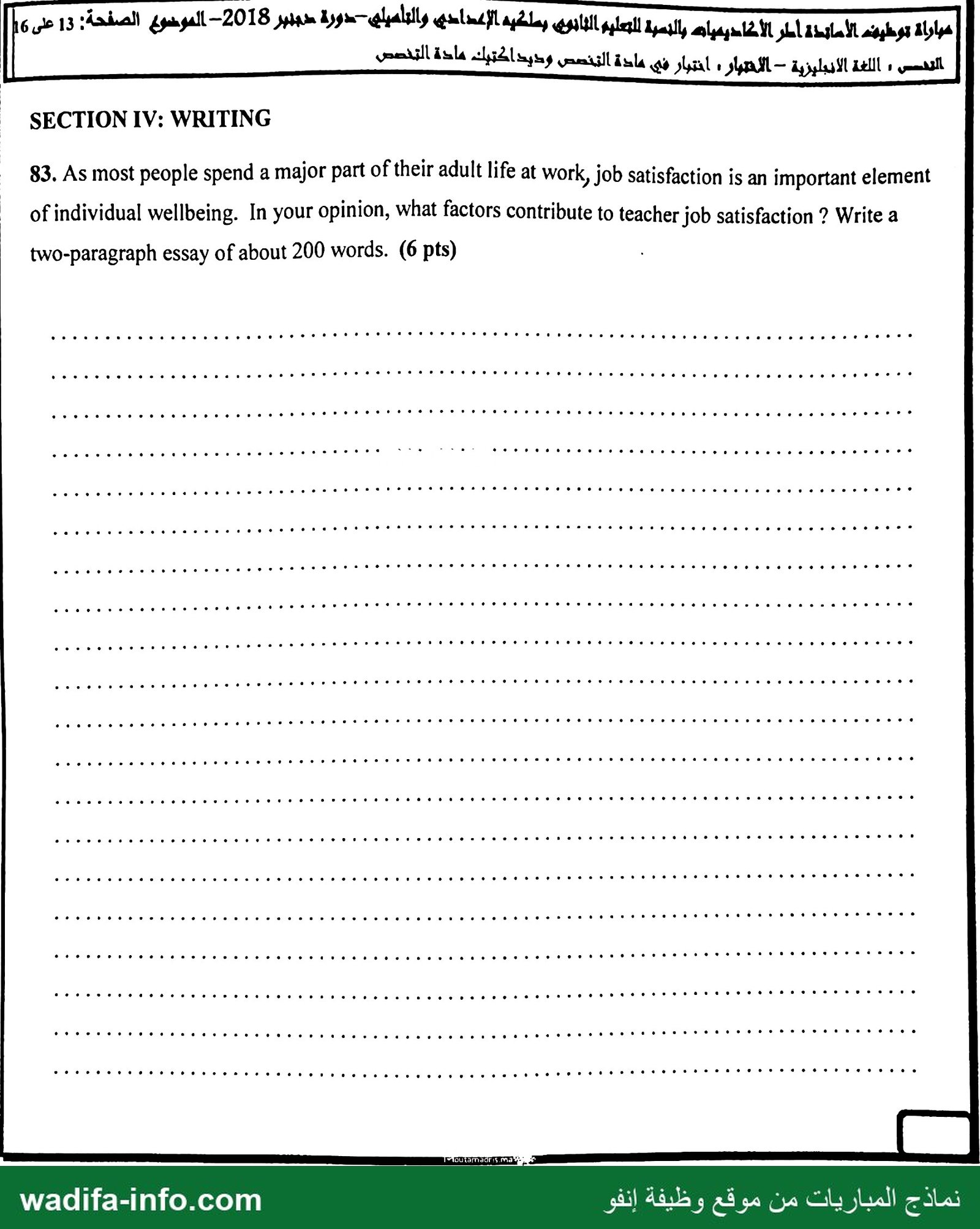
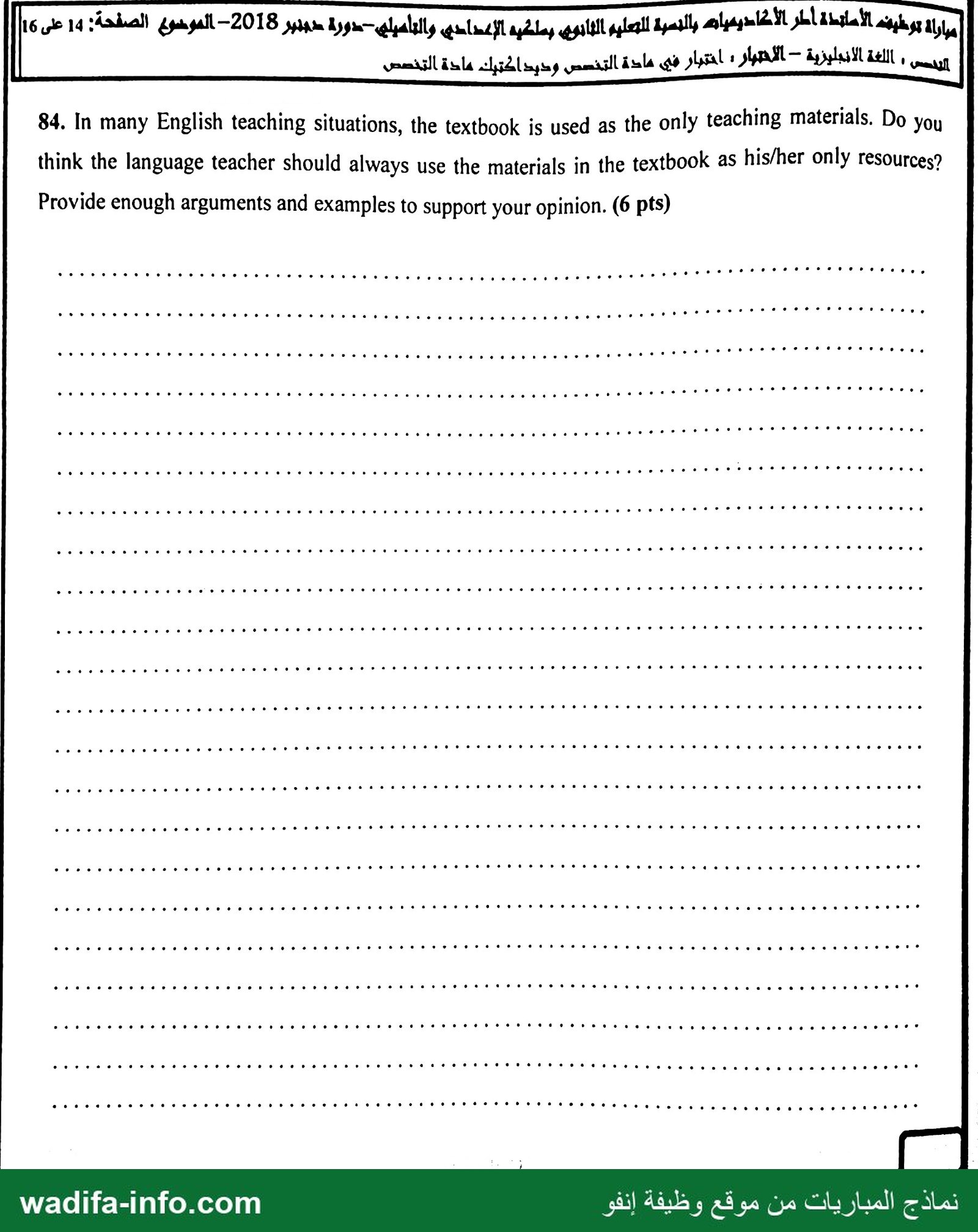
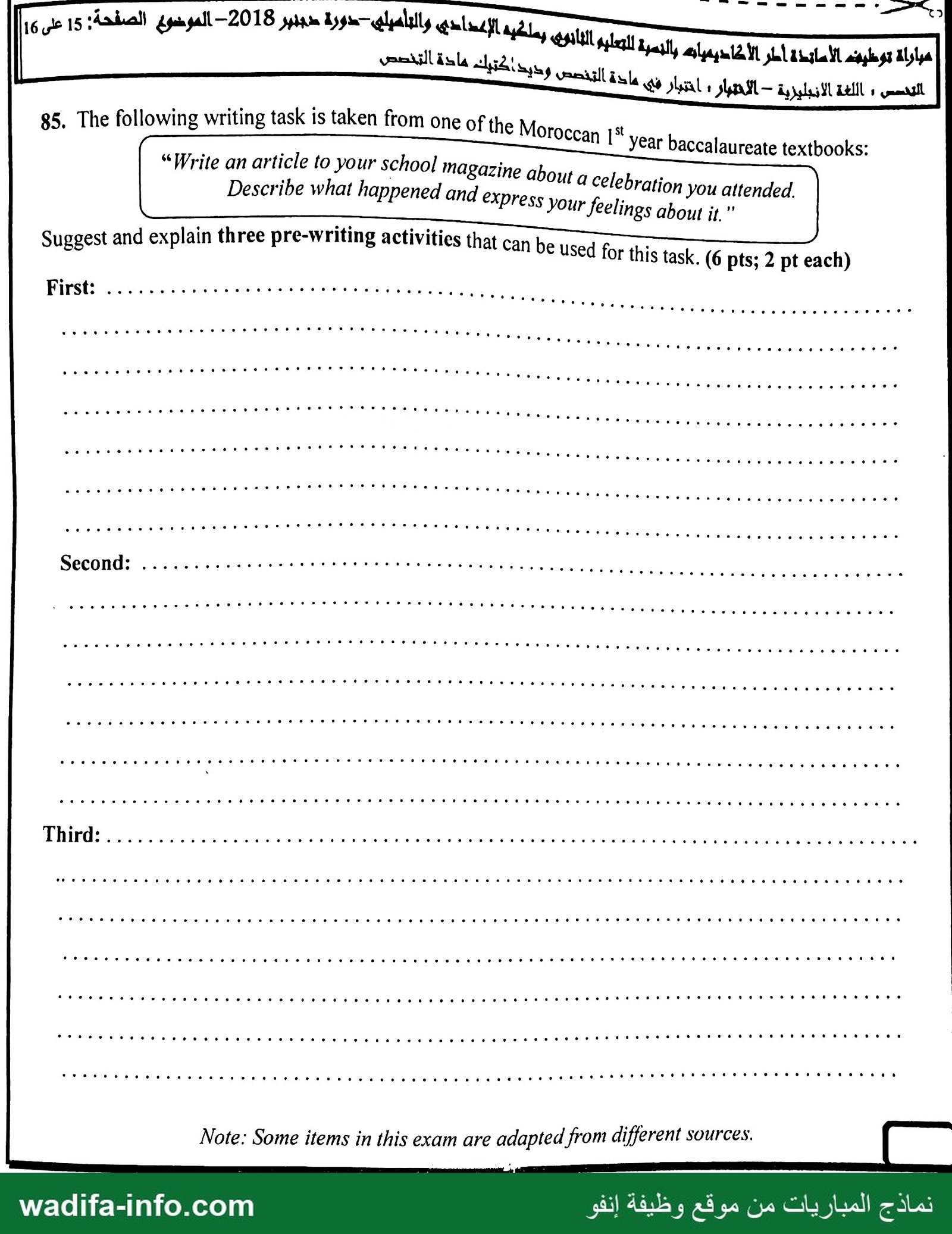
📝 Texte des questions (extrait automatiquement des pages scannées)
Ce texte est extrait automatiquement des images de l'épreuve et peut contenir des erreurs de lecture — les images ci-dessus font foi.
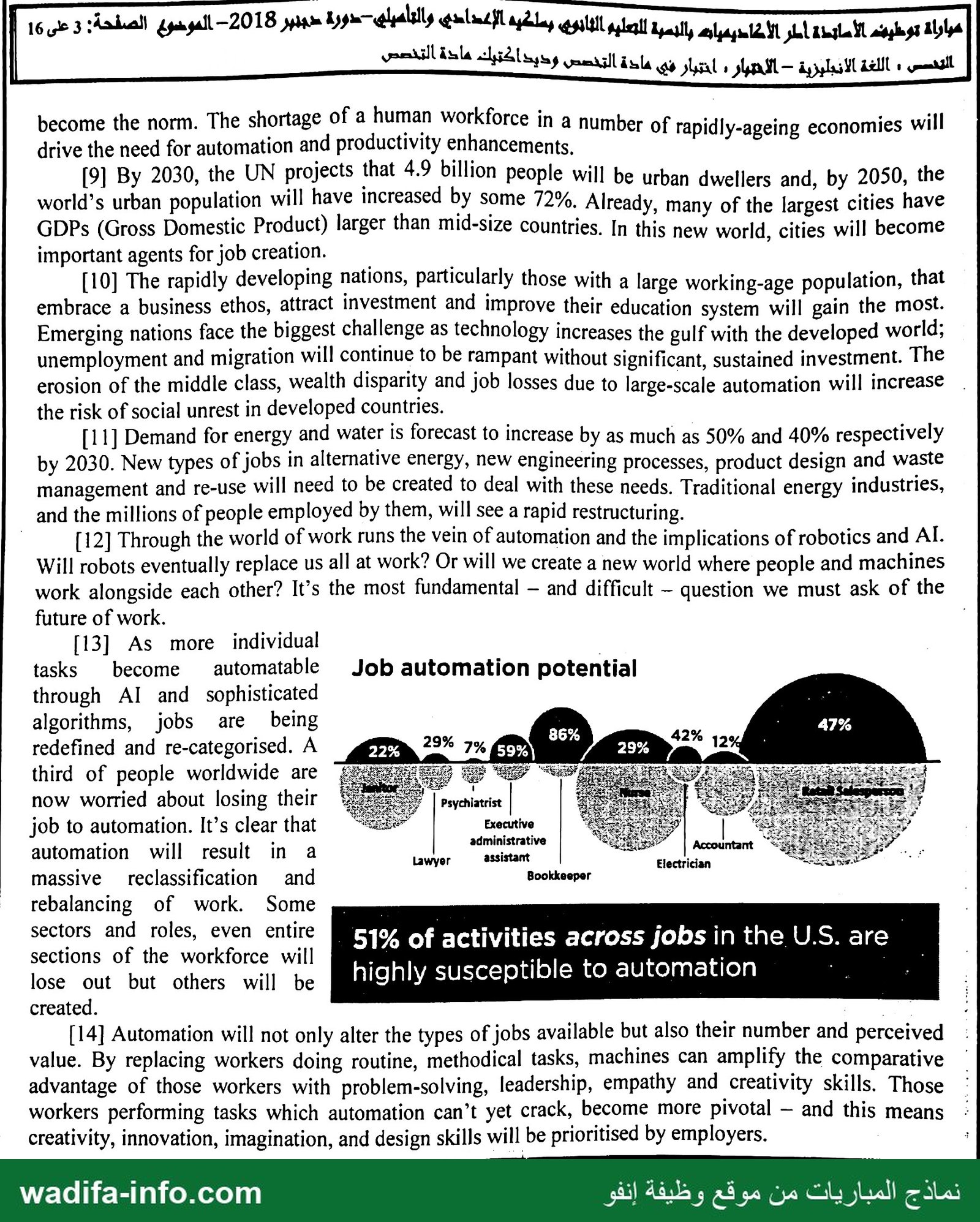
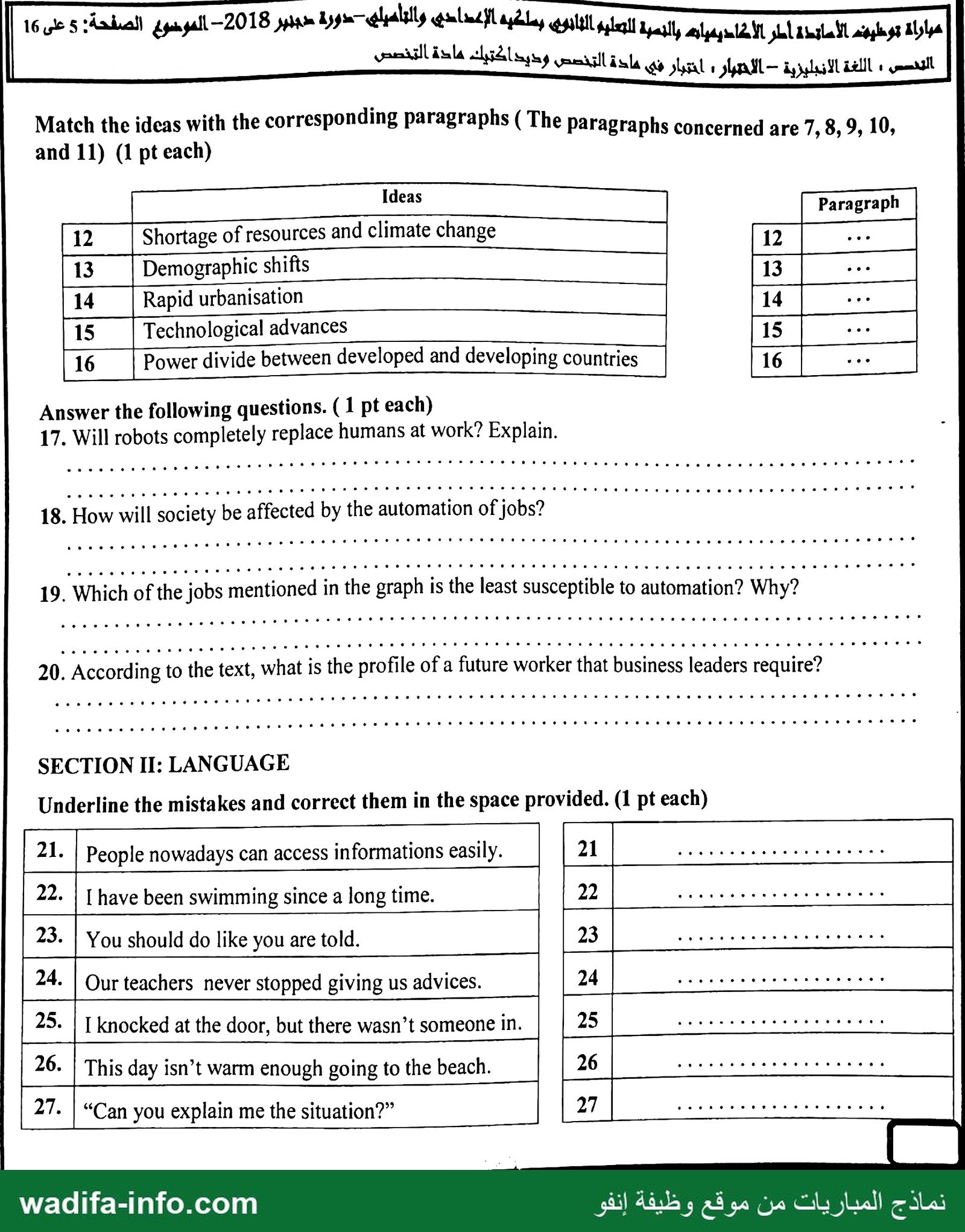
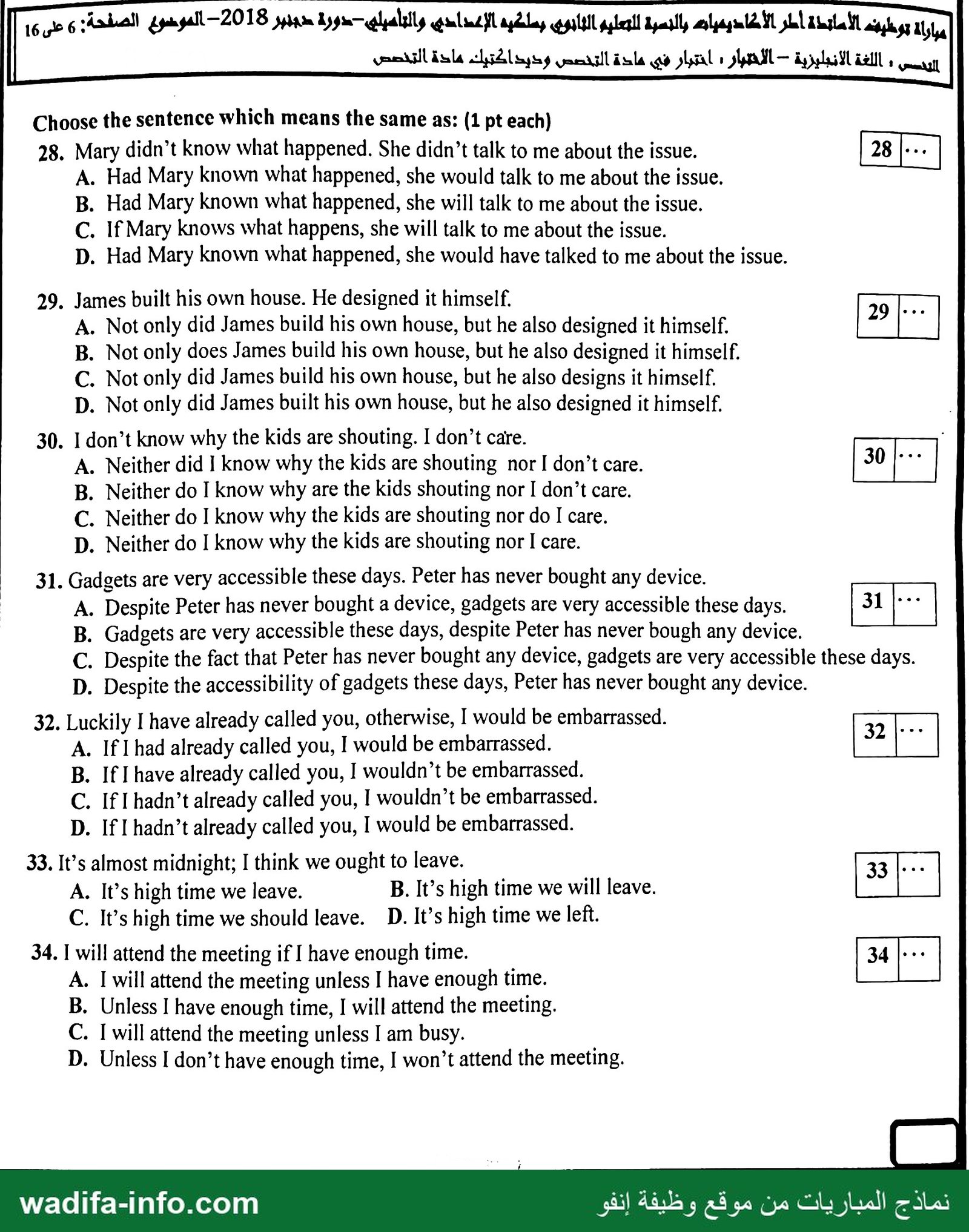
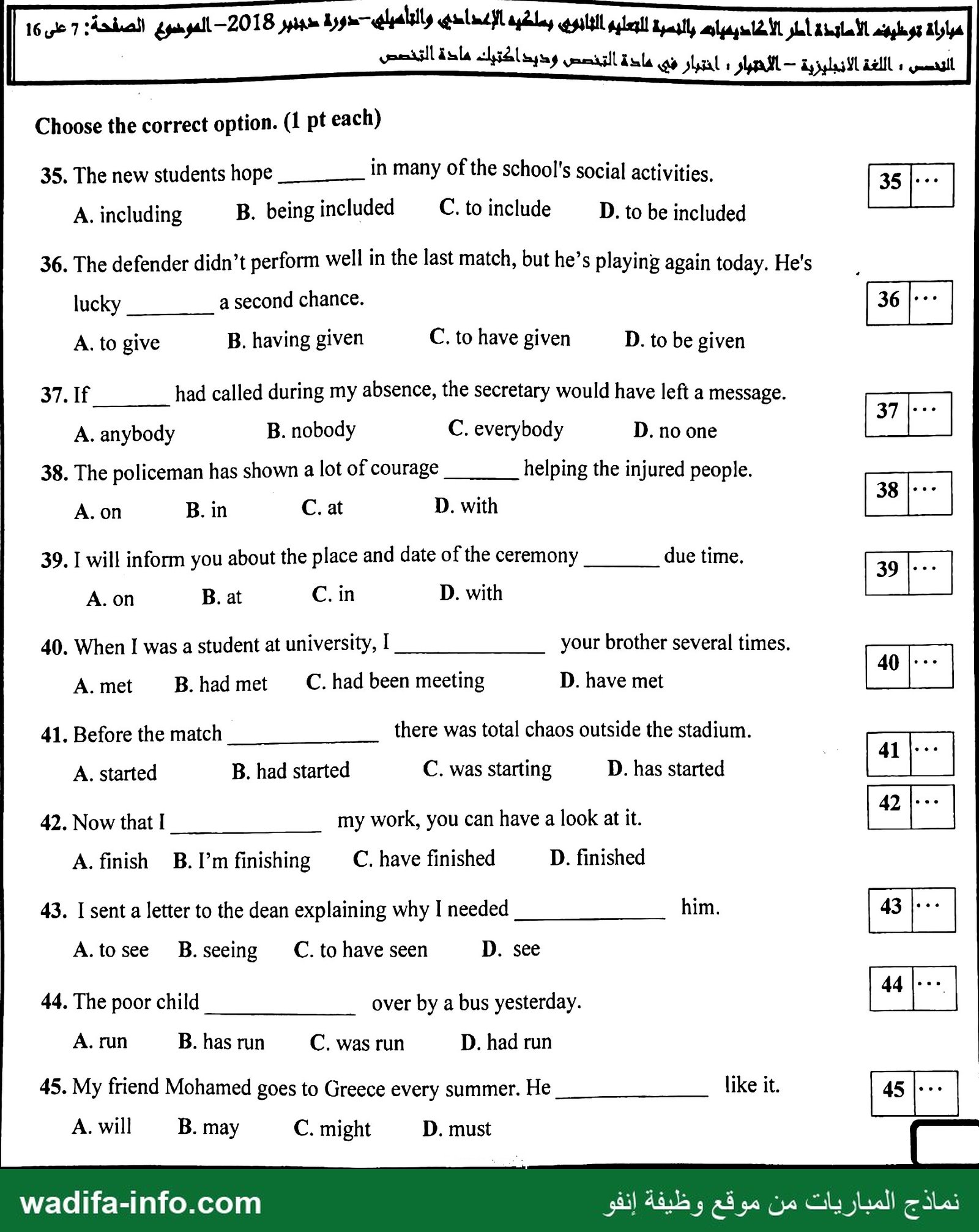
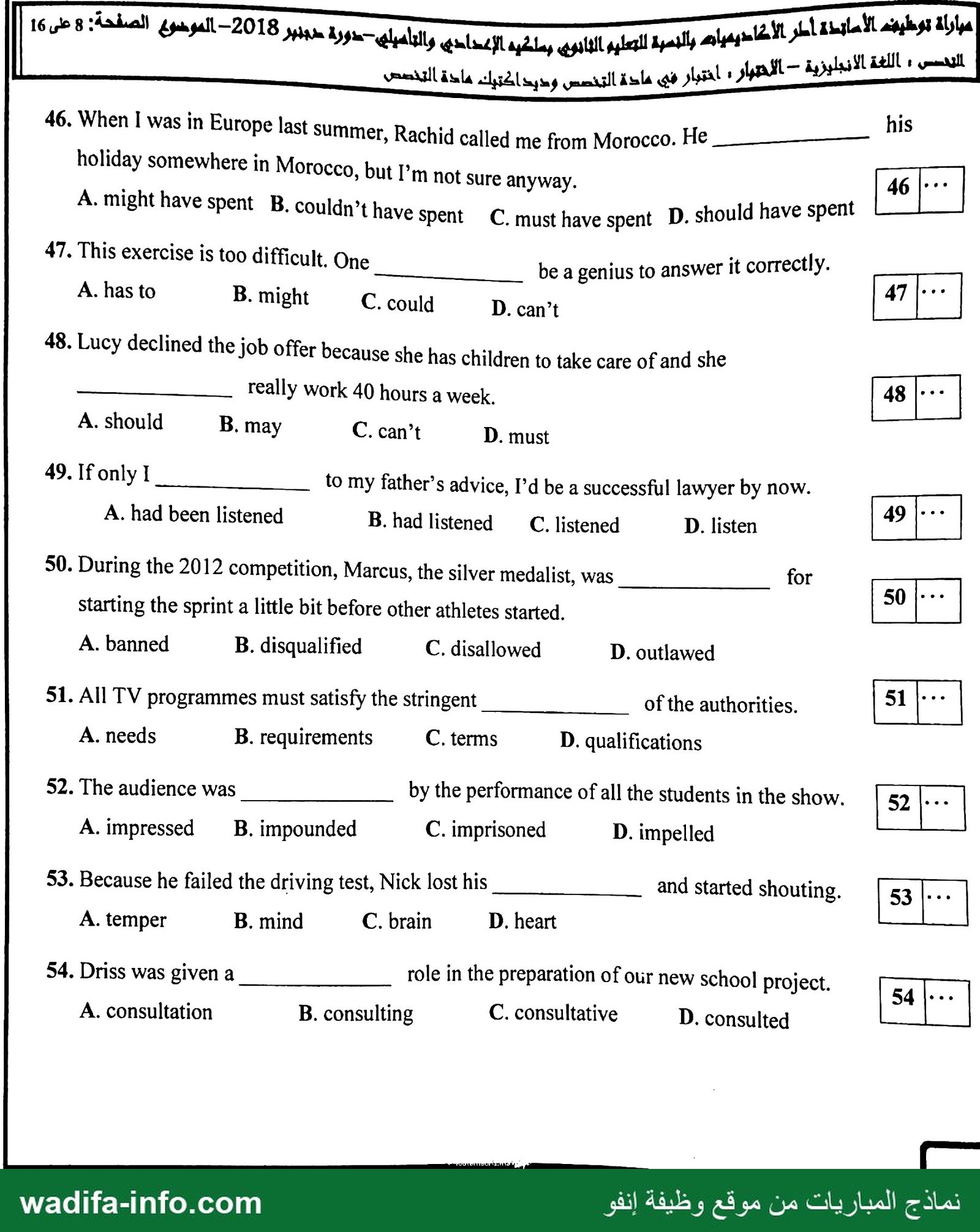
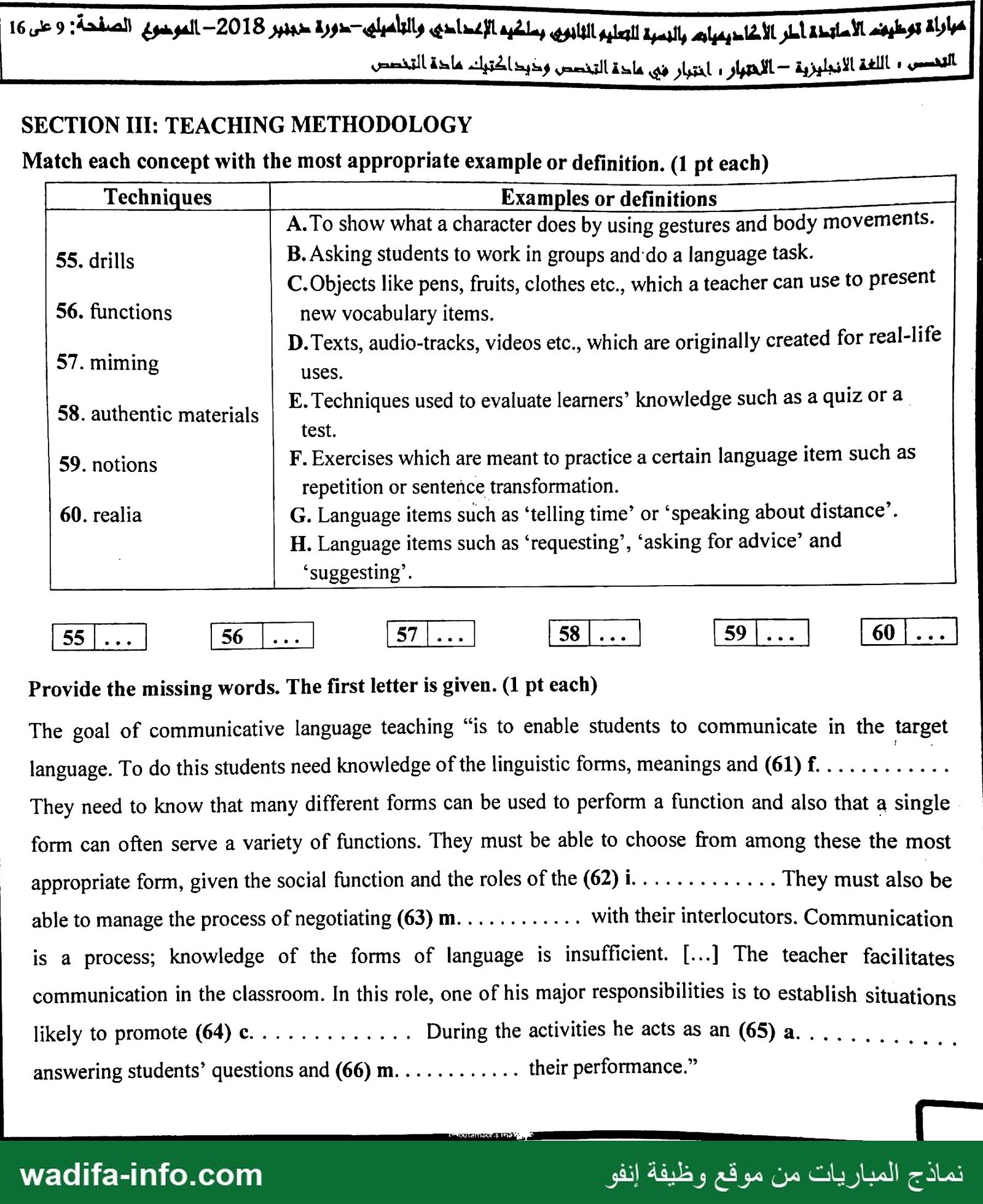
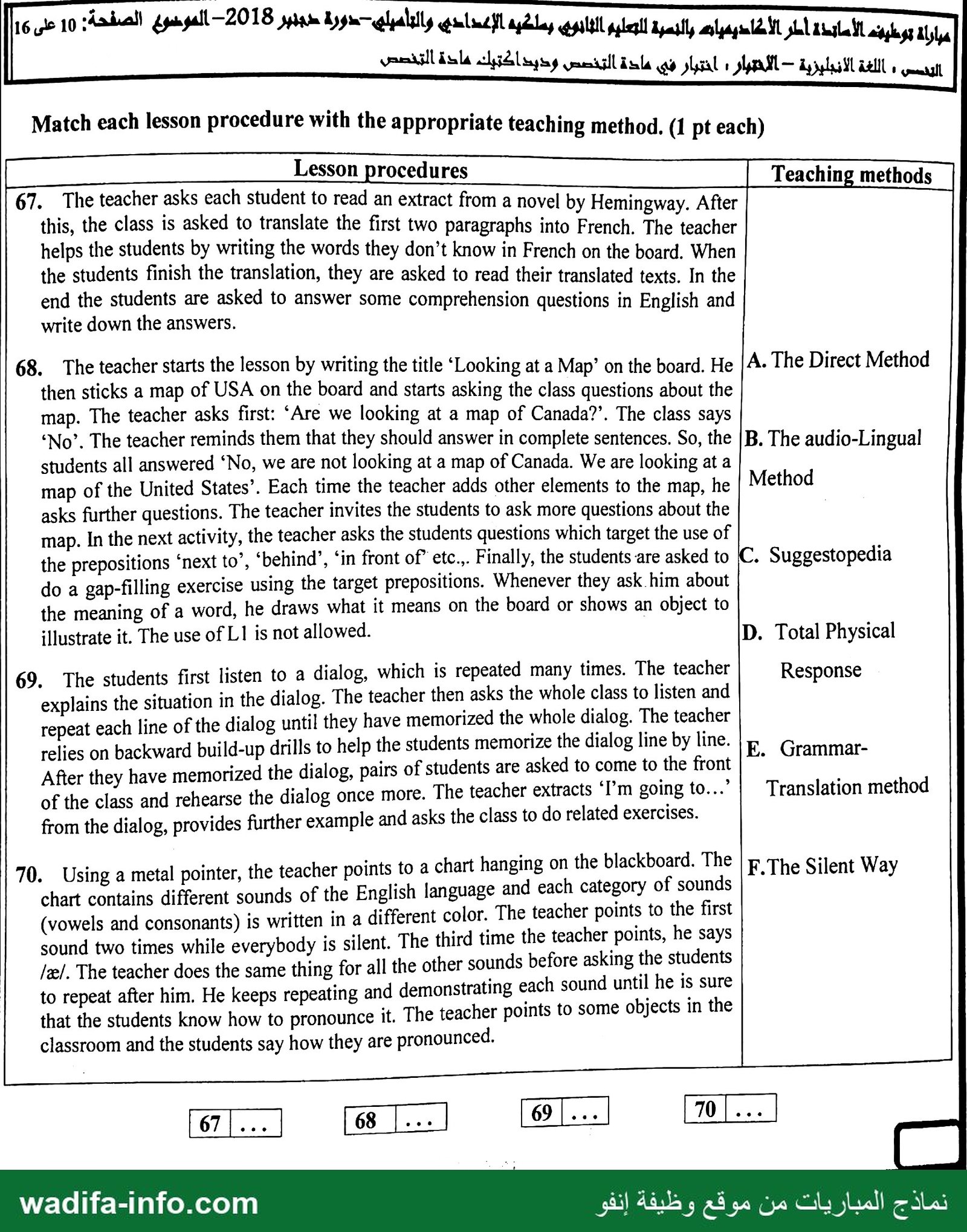
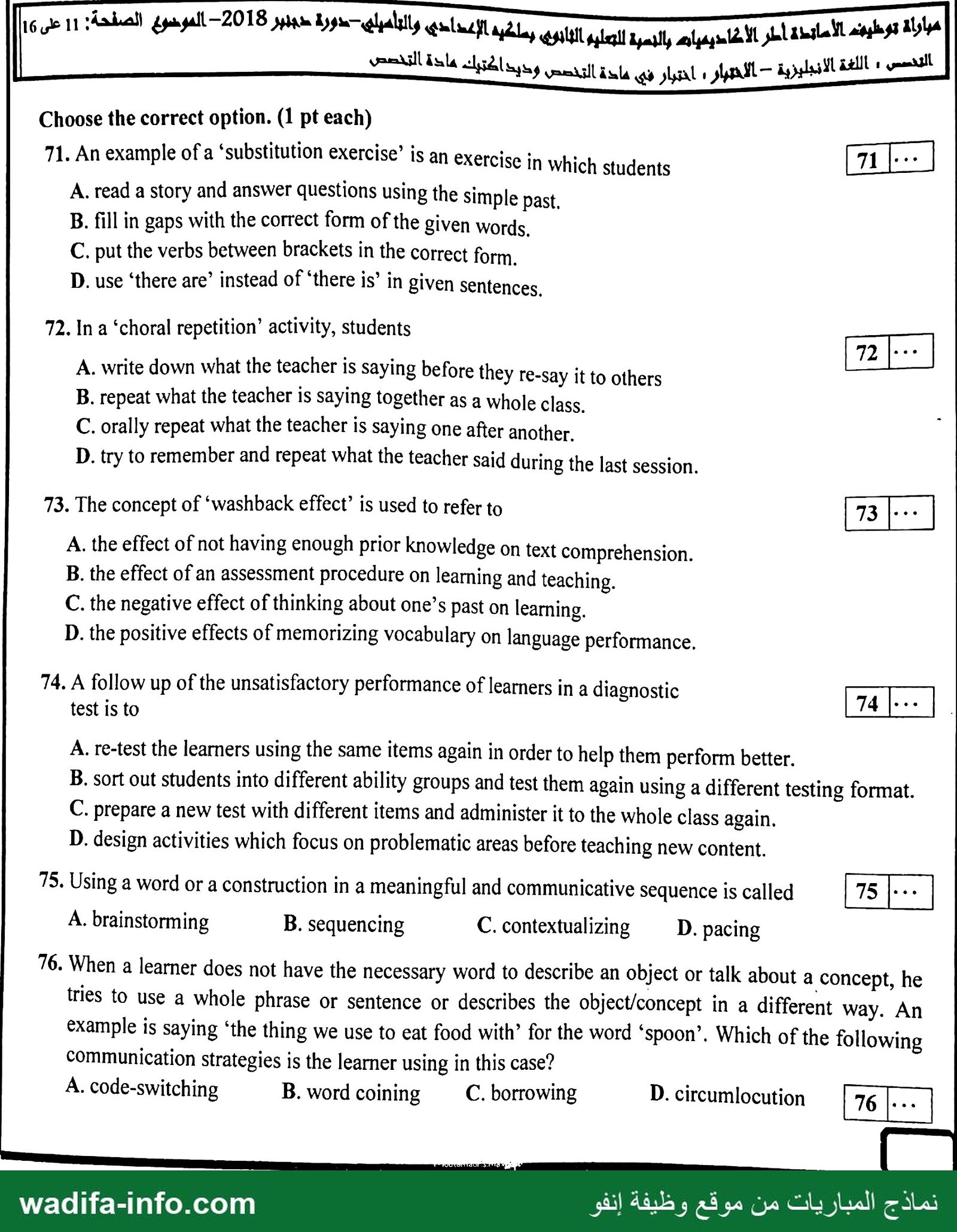
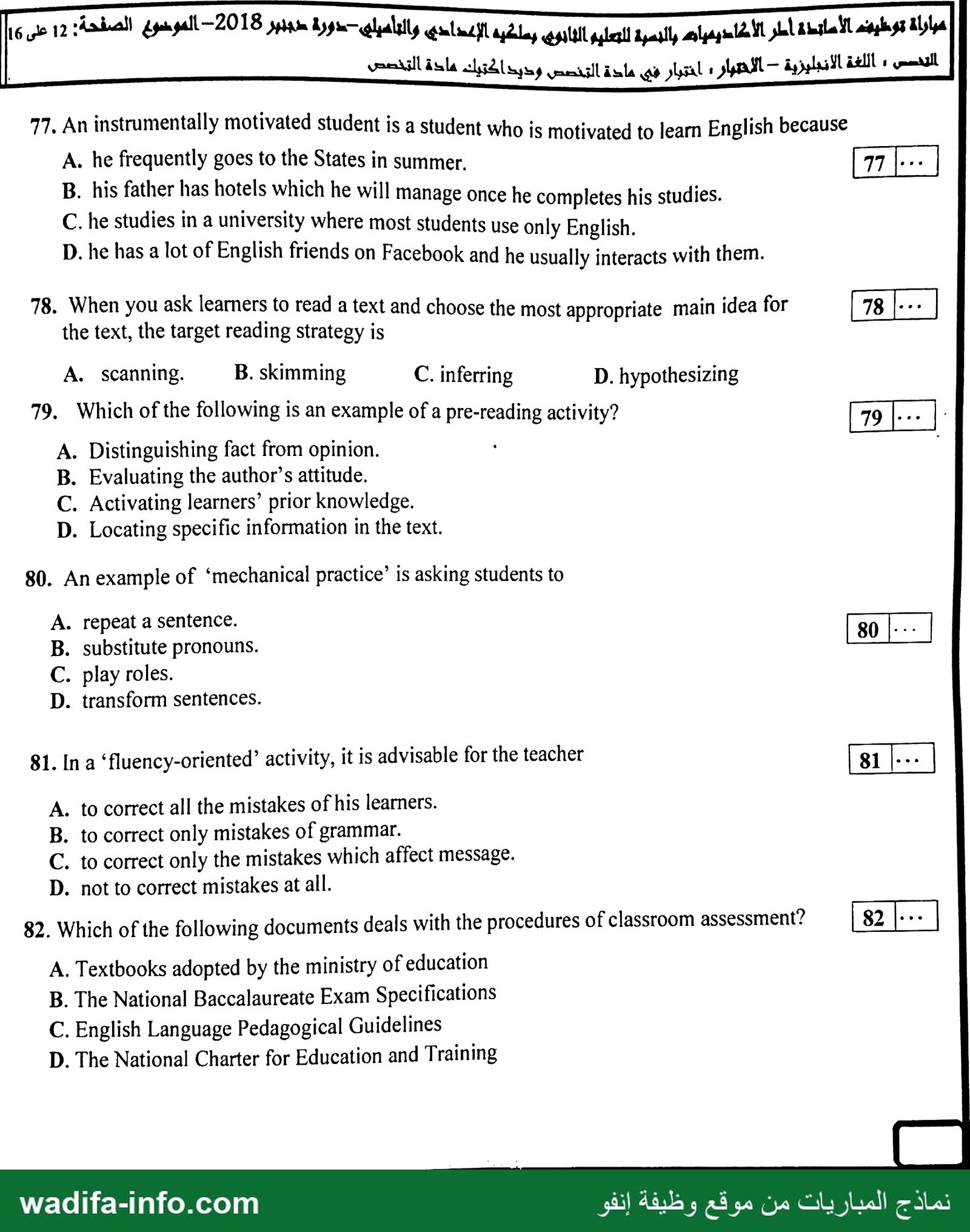
— صفحة 1 — مباراة توظيف الأساتذة أطر الأكاديميات خاص بكتابة المباراة بالنسبة للتعليم الثانوي بسلكيه الإعدادي والتاهيلي - دورة دجنبر 2018 ا الريا 010 انيثا LEFT دكا TEA ‘ ee a ul CAT) 9 ١ ٠ ره بللا 7 LL + Es a لتخصص : اللفة الانجليزية لنقطة النهائية على 20 بالأرقام خاص بكتابة المباراة A |] : الل جل الاختبار : اختبار في مادة التخصص (على المصحح التاكد من أن النقطة النهائية هي على 20( وديداكتيك مادة التخصص — 7 المصحح وتوقيعه : م مممةة مهم ع ممه تومه مويه مهو متي ورقة الإجابة| ' EXAM INSTRUCTIONS Read the following instructions carefully before you start the exam | = Make sure you get the right number of pages mentioned on the first page "The exam is divided into four independent sections: ° Section I: Reading Comprehension ° Section Il: Language ° Section 111: Teaching Methodology ه Section IV: Writing » Use the exam sheets carefully. Only ONE set of exam sheets will be provided. » For multiple-choice or matching questions, select the correct answer from the suggested choices and write the corresponding capital letter (A, B, ...( or number (1, 2, ...( in the space provided for each question. “ For “True, False or Not mentioned in the text” questions, write 1, F or N in the space provided. No justification is required. = ]f you have to change an answer, erase or cross out the incorrect letter and then write the correct one. = No other documents, electronic devices or communication with anyone is allowed during the exam session. Evidence of cheating during the test administration or test correction will automatically disqualify the candidate. — صفحة 2 — خباراة توطيوم الأماتة أطر الأكاديفياى بالسبة للتعليم الثابوي بملشية الإمسادي والتأسيلي-دورة spam 2018- الموضوع الصفحة: 2 على 16 التحصى ؛ اللغة الانبليزية - اللصبار à اختبار في tua التخصص وديداكتيك il التنحصصس SECTION I: READING COMPREHENSION READ THE FOLLOWING TEXT AND DO THE RELATED TASKS. | (ll We are living through a fundamental transformation in the way we work. Automation and “thinkine machines” are replacing human tasks and jobs, and changing the skills that organisations are looking for in their people. These momentous changes raise huge organisational, talent and HR (Human Resources) challenges — at a time when business leaders are already wrestling with unprecedented risks, disruption and political and societal upheaval. [2] The pace of change is accelerating. Competition for the right talent is fierce. And ‘talent’ no longer means the same as ten years ago; many of the roles, skills and job titles of tomorrow are unknown to us today. How can organisations prepare for a future that few of us can define? How will your talent needs change? How can you attract, keep and motivate the people you need? And what does all this mean for HR? [3] This isn’t a time to sit back and wait for events to unfold. To be prepared for the future you have to understand it. The future of work asks us to consider the biggest questions of our age. What influence will the continuing march of technology, automation and artificial intelligence (AI) have on where we work and how we work? Will we need to work at all? What is our place in an automated world? [4] Many commentators focus on technology and the role that automation is predicted to have on jobs and the workplace. We believe the real story is far more complicated. This is less about technological innovation and more about the manner in which humans decide to use that technology. [5] The shape that the workforce of the future takes will be the result of complex, changing and competing forces. Some of these forces are certain, but the speed at which they unfold can be hard to predict. Regulations and laws, the governments that impose them, broad trends in consumer, citizen and worker sentiment will all influence the transition toward an automated workplace. The outcome of this battle will determine the future of work in 2030. When so many complex forces are at play, linear predictions are too simplistic. Businesses, governments and individuals need to be prepared for a number of possible, even seemingly unlikely, outcomes. [6] The megatrends are the tremendous forces reshaping society and with it, the world of work: theeconomic shifts that are redistributing power, wealth, competition and opportunity around the globe; the disruptive innovations, radical thinking, new business models and resource scarcity that are impacting every sector. Businesses need a clear and meaningful purpose and mandate to attract and retain employees, customers and partners in the decade ahead. [7] Automation, robotics and AÏ are advancing quickly, dramatically changing the nature and number of jobs available. Technology has the power to improve our lives, raising productivity, living standards and average life span, and free people to focus on personal fulfilment. But it also brings the threat of social unrest and political upheaval if economic advantages are not shared equitably. [8] With a few regional exceptions the world’s population is ageing, putting pressure on business, social institutions and economies. Our longer life span will affect business models, talent ambitions and pension costs. Older workers will need to learn new skills and work for longer. ‘Re-tooling” will — صفحة 3 — خباراة توظيفم الأماجطة أطر الأكاديميات بالجعبة للتعلية الزايوي بملشية الإمسادي والتأميلي--دورة سجيبر 2018- القدصى ؛ اللغة الانبليزية - الأصبار ؛ اختبار في مادة التحصص وديد اتيك فادة التنحصس الموحوع الصفحة: 3 على 16 become the norm. The shortage ofa human workforce in a number of rapidly-ageing economies will drive the need for automation and productivity enhancements. [9] By 2030, the UN projects that 4.9 billion people will be urban dwellers and by 2050, the world’s urban population will have increased by some 72%. Already, many of the largest cities have GDPs (Gross Domestic Product) larger than mid-size countries. In this new world, cities will become important agents for job creation. ? [10] The rapidly developing nations, particularly those with a large working-age population, that embrace a business ethos, attract investment and improve their education system will gain the most. Emerging nations face the biggest challenge as technology increases the gulf with the developed world; unemployment and migration will continue to be rampant without significant, sustained investment. The erosion of the middle class, wealth disparity and job 105565 due to large-scale automation will increase the risk of social unrest in developed countries. [11] Demand for energy and water is forecast to increase by as much as 50% and 40% respectively by 2030. New types of jobs in alternative energy, new engineering processes, product design and waste management and re-use will need to be created to deal with these needs. Traditional energy industries, and the millions of people employed by them, will see a rapid restructuring. [12] Through the world of work runs the vein of automation and the implications of robotics andAI. Will robots eventually replace us all at work? Or will we create a new world where people and machines work alongside each other? It's the most fundamental — and difficult - question we must ask of the future of work. [13] As more individual tasks become automatable طول automation potential through لم and sophisticated algorithms, jobs are being حاص redefined and re-categorised. À TP» 2* 7% يون جع 2% 12° third of people worldwide are LE now worried about losing their Psychlatrist job to automation. It’s clear that Erecutive 2 automation will result in a سسب Accountant 1 H H lawver Electrician massive reclassification and Bookkesper rebalancing of work. Some sectors and roles, even entire sections of the workforce will lose out but others will be created. [14] Automation will not only alter the types of jobs available but also their number and perceived value. By replacing workers doing routine, methodical tasks, machines can amplify the comparative advantage of those workers with problem-solving, leadership, empathy and creativity skills. Those workers performing tasks which automation can’t yet crack, become more pivotal - and this means creativity, innovation, imagination, and design skills will be prioritised by employers. A لفسويرين — صفحة 4 — مباراة glass الأساتطة أطر الأحاديميام بالبسية للتعليو النابوي بملشية الإمساعدي والبأميلي-عدووة san 2018- الموضوع الصفحة: 4 على 16 التدسس à اللغة الانبليزية - ٠ plat أختبار في مادة التنخصص calage مادة التنخصصس ]15[ This view is supported by business leaders worldwide who responded to our most recent survey. While CEOs (Chief Executive Officer) are keen to maximise the benefits of automation — 52% told us that they’re already exploring the benefits of humans and machines working together and 39% are considering the impact Of AT on their future skills needs — the majority (52%) were also planning to increase headcount in the coming 12 months. Finding the skills they need has become the biggest threat to their business, they say, but the skills they’re looking for are particularly telling: problem-solving, adaptability, collaboration, leadership, creativity and innovation top the list. Adapted from: www.pwc.com Choose the correct option. (1 pt each) 01. The best title for the text is A. The future of technology B. Workforce of the future C. The future of Automation D. The issue of unemployment 02. “momentous changes” (paragraph 1) means changes that are A. temporary B. significant C. trivial D. brief 03. “wait for events to unfold” (paragraph 3) means wait for events A. to start B. to be told C. to happen D. to end 04. “linear predictions are too simplistic” (paragraph 5) implies that A. it becomes easy to make confident guesses B. it is naive to make plain guesses HAE C. it is preferable to make simple guesses D. step by step guesses are unproblematic 05. “Re-tooling” (paragraph 8) means A. recruiting younger workers B. dismissing older workers 0 C. updating workers’ skills D. constantly diagnosing the tools 06. The sentence “Through the world of work runs the vein of automation and the implications of robotics and AL” (paragraph 12) is an example of A. metaphor B. simile C. allusion D. personification Are the following statements true (T), false (F) or not mentioned (N) in the text? (1 pt each) | 07. [ For the writer, the focus should be on how to use technology rather than on technology itself. 08. | The graph shows that retail salesperson job in the USA is the most susceptible to automation. 09. | 51 % of workers in the world are afraid of becoming jobless due to automation. 10. | The economic performance of some cities may exceed that of a whole country. | 11. | The need for energy is estimated to exceed the need for water by 2030. 00... 08 |... — صفحة 5 — خبارلة توطيج Lt لاد يمام والبمبة للعليم gl وملشيه المدادي والاأميلي دورة حجدير 2018- الموحوع الصفحة: 5 على 16 التدصى ؛ اللغة الأنبليزية - الأحتبار؛ اختبار في يادة التخصص plages فادة التذ Match the ideas with the corresponding paragraphs (The paragraphs concerned are 7, 8,9, 10, 9%979 and 11) (1 pteach) Shortage of resources and climate change 13 Demographic shifts 14 Rapid urbanisation | 15 Technological advances [16 Power divide between developed and developing countries | Answer the following questions. (1 pt each) 17. Will robots completely replace humans at work? Explain. SECTION II: LANGUAGE Underline the mistakes and correct them in the space provided. (1 pt each) 21. | People nowadays can access informations easily. 21) ..............,..... 22. | [have been swimming since a long time. | 22/1 .................... 23. | vou should do like you are told. 23 .................... 24. | Our teachers never stopped giving us advices. 24 | ss... 25. | [ knocked at the door, but there wasn’t someone in. 25 | .................... 26. | This day isn°’t warm enough going to the beach. 26 | _.................... 27. | “Can you explain me the situation?” — صفحة 6 — مبارأة توظب الأماتطة أطر الأكاديفياج بالجسبة للتعليم الثانوي بملكية الإعصادي والتأميلي-دورة spam 2018— الموضع الصفحة: 6 على Choose the sentence which means the same as: (1 pt each) 28. Mary didn’t know what happened. She didn’t talk to me about the issue. 28] A. Had Mary known what happened, she would talk to me about the issue. B. Had Mary known what happened, she will talk to me about the issue. ©. 1 Mary knows what happens, she will talk to me about the issue. D. Had Mary known what happened, she would have talked to me about the issue. 29. James built his own house. He designed it himself. A. Not only did James build his own house, but he also designed it himself. 29] B. Not only does James build his own house, but he also designed it himself. C. Not only did James build his own house, but he also designs it himself. D. Not only did James built his own house, but he also designed it himself. A. Neither did I know why the kids are shouting nor I don’t care. B. Neither do I know why are the kids shouting nor I don’t care. C. Neither do I know why the kids are shouting nor do I care. D. Neither do I know why the kids are shouting nor I care. 30. 1 don't know why the kids are shouting. I don't care. . 307 31. Gadgets are very accessible these days. Peter has never bought any device. A. Despite Peter has never bought a device, gadgets are very accessible these days. ES B. Gadgets are very accessible these days, despite Peter has never bough any device. C. Despite the fact that Peter has never bought any device, gadgets are very accessible these days. D. Despite the accessibility of gadgets these days, Peter has never bought any device. 32. Luckily 1 have already called you, otherwise, I would be embarrassed. A. If1 had already called you, ] would be embarrassed. B. If] have already called you, I wouldn”’t be embarrassed. © IfI hadn’t already called you, 1 wouldn’t be embarrassed. D. IfI hadn’t already called you, 1 would be embarrassed. 33. It's almost midnight; I think we ought to leave. A. It's high time we leave. B. 11:5 high time we will leave. C. Is high time we should leave. D. It’s high time we left. 34. I will attend the meeting if [ have enough time. A. I will attend the meeting unless 1 have enough time. B. Unless I have enough time, I will attend the meeting. C. ['will attend the meeting unless ] am busy. D. Unless 1 don’t have enough time, 1 won't attend the meeting. ير ني يي سس — صفحة 7 — خباراة توطيف الأماتطة أطر الأكاديفياجى بالنمبة الصليم النانوى بملكية الإنصساسي والتأميلي-دورة pan 2018- الموسوع الصفحة: 7على 16 الندسي à اللغة الانبليزية - الأتبار à اختبار في مادة التنحصصسص وديد اتيك مادة التخصصس Choose the correct option. (1 pt each) 35. The new students hope in many of the school's social activities. A. including 3. beingincluded C. to include D. to be included 36. The defender didn’t perform well in the last match, but he’s playing again today. He's lucky a second chance. A. to give B. having given C. to have given D. to be given 37.1f had called during my absence, the secretary would have left a message. 37 A. anybody B. nobody C. everybody D. no one 38. The policeman has shown a lot of courage helping the injured people. Aon B.in C.at D. with 38 39. I will inform you about the place and date of the ceremony due time. 9 A. on B. at C.in D. with 40. When I was a student at university, 1 your brother several times. A.met B.hadmet C.had been meeting D. have met 41. Before the match there was total chaos outside the stadium. A. started B. had started C. was starting D. has started Le D 42. Now that I my work, you can have a look at it. A.finish B.lmfinishing C. have finished D. finished 43. I sent a letter to the dean explaining why I needed him. A.tosee B.seeing C.to have seen D. see 44. The poor child over by a bus yesterday. 44 A. run B. has run C. was run D. had run 45. My friend Mohamed goes to Greece every summer. .سب فلا likeit. 45 ع 8 888 8 83 388 1 A. will B. may C. might D. must | — صفحة 8 — الموضوع الصفحة: 8 على 16 46. When l'was in Europe last Summer, Rachid called me from Morocco. HE بس holiday somewhere in Morocco, but Im not sure anyway. A. might have spent B, couldn’t have spent C. must have spent D. should have spent 47. This exercise is too d ifficult, One be a genius to answer it correctly. A. has to B. might C. could D. can’t 48. Lucy declined the job offer because she has children to take care of and she really work 40 hours a week. A. should B. may C. can't D. must 49.IfonlyI to my father’s advice, l’d be a successful lawyer by now. A. had been listened B. had listened C. listened D. listen 50. During the 2012 competition, Marcus, the silver medalist, was Starting the sprint a little bit before other athletes started. for A. banned B. disqualified C. disallowed D. outlawed S1. AN TV programmes must satisfy the stringent of the authorities. A. needs B. requirements C. terms D. qualifications 52. The audience was by the performance of all the students in the show. A. impressed B. impounded C. imprisoned D. impelled 53. Because he failed the driving test, Nick lost his and started shouting. A. temper B. mind C. brain D. heart 54. Driss was given a role in the preparation of oùr new school project. & A. consultation B. consulting C. consultative D. consulted — صفحة 9 — خباياة توظيوم الأساطة أطر الأخاديميام بالجسية للتعليم gui بملشيه الإمساعديى والتأسيلي-دورة sax 2018- الموضوع الصفحة: وعلى 16 ٠ cuil اللغة الانبليزية - الأصبار ؛ اختبار في مادة التخصص وذيد اكتيك فادة التخصصس SECTION III: TEACHING METHODOLOGY Match each concept with the most appropriate example or definition. (1 pt each) [____ Techniques Examples or definitions A.To show what a character does by using gestures and body movements. 55. drills B. Asking students to work in groups and'do a language task. C.Objects like pens, fruits, clothes etc., which a teacher can use to present 56. functions new vocabulary items. 0" D. Texts, audio-tracks, videos etc., which are originally created for real-life 57. miming uses. 58. authentic materials E. Techniques used to evaluate learners’ knowledge such as a quiz 8 test. 59. notions F. Exercises which are meant to practice a certain language item such as repetition or sentence transformation. 60. realia ©. Language items such as ‘telling time” or ‘speaking about distance”. H. Language items such as ‘requesting’, ‘asking for advice’ and ‘suggesting’. ...591 ...]58 .. ب [...551] Provide the missing words. The first letter is given. (1 pt each) The goal of communicative language teaching “is to enable students to communicate in the target language. To do this students need knowledge of the linguistic forms, meanings and (61) f............ They need to know that many different forms can be used to perform a function and also that a single form can often serve a variety of functions. They must be able to choose from among these the most appropriate form, given the social function and the roles of the (62) i............. They must also be able to manage the process of negotiating (63) m............ with their interlocutors. Communication is a process; knowledge of the forms of language is insufficient. [...] The teacher facilitates communication in the classroom. In this role, one of his major responsibilities is to establish situations likely to promote (64) c............. During the activities he acts as an (65) a answering students’ questions and (66) m............ their performance.” — صفحة 10 — 16 الموضوع الصفحة: 10 على -2018 pan الأمائطة أطر الأحاديفيا بالنسية العليم الثانوي يسلشيه الإمساعدي والبأميلي-«دورةass il ١ ١ مبارأة بي ؛ اختبار في فادة التخصص وذبيط اكتيك فادة التنصص ANT الزتسس , اللغة الانبتيزية Match each lesson procedure with the appropriate teaching method. (1 pt each) Lesson proced fe ures 1 1 67. The teacher asks each student to read an extract from a novel by Hemingway. After FAURE methode this, the class is asked to translate the first two paragraphs into French De teacher helps the students by writing the words they don't know in French on the board. When the srudents fist the translation, they are asked to read their translated texts Inthe end the students are asked to answer some comprehensi ions i d nsion que write down the answers. ? questions in English and 68. The teacher starts the lesson by writing the title ‘Looking at a Map’ on the board. He |A. The Direct Method then sticks a map of USA on the board and starts asking the class questions about the map. The teacher asks first: ‘Are we looking at a map of Canada?. The class says No’. The teacher reminds them that they should answer in complete sentences. So, the |B. The audio-Li 1 students all answered ‘No, we are not looking at a map of Canada. We are looking at a ١ سس map of the United States’. Each time the teacher adds other elements to the map, he Method asks further questions. The teacher invites the students to ask more questions about the map. In the next activity, the teacher asks the students questions which target the use of the prepositions ‘next to”, ‘behind’, ‘in front of” etc... Finally, the students are asked to C. Suggestopedia do a gap-filling exercise using the target prepositions. Whenever they ask him about the meaning of a word, he draws what it means on the board or shows an object to illustrate it. The use of LI is not allowed. D. Total Physical 69. The students first listen to a dialog, which is repeated many times. The teacher Response n the dialog. The teacher then asks the whole class to listen and dialog until they have memorized the whole dialog. The teacher Id-up drills to help the students memorize the dialog line by line. | يج After they have memorized the dialog, pairs of students are asked to come to the front | ” rammar- of the class and rehearse the dialog once more. The teacher extracts ‘l’m going to...” | Translation method from the dialog, provides further example and asks the class to do related exercises. explains the situation i repeat each line of the relies on backward bui the teacher points to a chart hanging on the blackboard. The : f “he English language and each category of sounds F.The Silent Way a different color. The teacher points to the first sound two times while everybody is silent. The third time the teacher points, he says læl. The teacher does the same thing for all the other sounds before asking the students to repeat after him. He keeps repeating and demonstrating each sound until he is sure that the students know how to pronounce it. The teacher points to some objects in the classroom and the students say how they are pronounced. 70. Using a metal pointer, chart contains different sounds ه (vowels and consonants) is written in — صفحة 11 — مباولة توي الأمائطة أطر AM باليسية للصليو ei بماشية الإمداعدي pa las عنهدير BOIS الموحوع الصفحة: 11 على 16 Choose the correct option. (1 pt each) 71. An example of a ‘substitution exercise’ is an exercise in which students 71 : A. read a story and answer questions using the simple past, B. fill in gaps with the correct form of the given words. C. put the verbs between brackets in the correct form. D. use ‘there are’ instead of ‘there is’ in given sentences. 72. In a ‘choral repetition’ activity, students A. write down what the teacher is saying before they re-say it to others B. repeat what the teacher is saying together as a whole class. C. orally repeat what the teacher is saying one after another. D. try to remember and repeat what the teacher said during the last session. 73. The concept of ‘washback effect” is used to refer to [73 [--. | A. the effect of not having enough prior knowledge on text comprehension. B. the effect of an assessment procedure on learning and teaching. C. the negative effect of thinking about one’s paston learning. D. the positive effects of memorizing vocabulary on language performance. 74. A follow up of the unsatisfactory performance of learners in a diagnostic [al] test is to A. re-test the learners using the same items again in order to help them perform better. B. sort out students into different ability groups and test them again using a different testing format. C. prepare a new test with different items and administer it to the whole class again, D. design activities which focus on problematic areas before teaching new content. 75. Using a word or a construction in a meaningful and communicative sequence is called [75]. A. brainstorming B. sequencing C. contextualizing D. pacing 76. When a learer does not have the necessary word to describe an object or talk about a concept, he tries to use a whole phrase or sentence or describes the object/concept in a different way. An example is saying ‘the thing we use to eat food with’ for the word ‘spoon’. Which of the following communication strategies is the learner using in this case? A. code-switching B. word coining C.borrowing D. circumlocution 16 |.) — صفحة 12 — مرارأة توظيم الأمائطة أطر الأاديعياى باليسبة للتعليو الثانوي بملغية الإمدادي والبأميلي-دورة جنير 2018- الموضع الصفحة: 2؛ على 6 mul ؛ اللغة الأنبليزية - الأصبار ؛ اختبار في مادة التخصص وديدصاكتيك فادة التنحصس 77. An instrumentally motivated student is a student who is motivated to learn English because A. he frequently goes to the States in summer. [77 |. | B. his father has hotels which he will manage once he completes his studies. C. he studies in a university where most students use only English D. he has a lot of English friends on Facebook and he usually interacts with them. 78. When you ask learners to read a text and choose th Î ini [78 [-- the text, the target reading strategy is ملم رم بريه اقم main KE ِ . A. scanning. B. skimming C. inferring D. hypothesizing 79. Which of the following is an example of a i ivi pre-reading activity? [79 | , 79]... [ A. Distinguishing fact from opinion. B. Evaluating the author’s attitude. © Activating learners’ prior knowledge. D. Locating specific information in the text. 80. An example of ‘mechanical practice” is asking students to A. repeat a sentence. B. substitute pronouns. C. play roles. D. transform sentences. 81. In a ‘fluency-oriented” activity, it is advisable for the teacher A. to correct all the mistakes of his learners. B. to correct only mistakes of grammar. C. to correct only the mistakes which affect message. D. not to correct mistakes at all. 82. Which of the following documents deals with the procedures of classroom assessment? [82 [| A. Textbooks adopted by the ministry of education B. The National Baccalaureate Exam Specifications C. English Language Pedagogical Guidelines D. The National Charter for Education and Training — صفحة 13 — مبارأة توطيهم الاماجدة ار الأخاديمياى والجمية للعليم اليابوي بساخيه اللمدادي والتأميلي-دورة pan 2018 الموضوم الصفحة: 13 علىم a اللغة الانبليزية - الأيار؛ اختبار في فادة التخصص وديد اتيك فادة التخصصس SECTION IV: WRITING 83. As most people spend a major part of their adult life at Work, job satisfaction is an important element of individual wellbeing. In your opinion, what factors contribute to teacher job satisfaction ? Write a two-paragraph essay of about 200 words. (6 pts) — صفحة 14 — برارة a الأمائطة أطر الأشاديفياى بالنسية للتعليم pitt بملشيه الإمساحدي والتأميلي-عدورة عنجدير 2018- الموسوع الصفحة: 14 على 16 84. In many English teaching situations, the textbook is used as the only teaching materials. Do you think the language teacher should always use the materials in the textbook as his/her only resources? Provide enough arguments and examples to support your opinion. (6 pts) Done een RS ee Ten ÉTÉ RÉ ne ل nee ee den ns res com nr eme dés dusédes — صفحة 15 — خباراة توطي الأماجدة أطر الأحاسيفيارم بالجمية Ma القدسس à اللغة الانبليزية ait ؛ اختبار في يادة التخصص he following writing task is taken from one of the Moroccan 1 Year baccalaureate textbooks: 85. The fo “Write an article to your school mag azine about و Describe what happened and express your Celebration you attended. Jeelingsabout it.” d 1 re-writin 8 acti C ا rat can be used for this task. (6 pts; est and © xplain th ee 0 2 pt each) nos ST 1 different source. Note: Some items in this exam are adapted from diff ote: | f
Questions fréquentes sur ce sujet
Ce sujet est-il téléchargeable gratuitement ?
Le corrigé est-il inclus ?
Quel organisme et quel grade concerne ce sujet ?
De quelle session s'agit-il et dans quelle langue ?
Où trouver d'autres sujets du même concours ?
Vous préparez ce concours ?
Modèles similaires
Organisme : Académies régionales d'éducation et de formation (AREF) · décembre 2018 — Copie issue de : archive de modèles de concours — document archivé tel que reçu ; l'avis officiel du concours fait foi.
}Citer cette page
Journaliste, blogueur, enseignant : copiez la référence ci-dessous et mettez un lien vers cette page.
Adresse permanente : https://www.wadifa-info.com/fr/modele-concours/4856/modele-de-concours-de-recrutement-des-professeurs-de-l-enseignement-secondaire-cadres-des