
Modèle d'examen d'aptitude professionnelle pour l'accès au 1er grade des professeurs de l'enseignement secondaire qualifiant — Ministère de l'Éducation nationale 2023 — Éléments de réponse officiels — didactique : anglais
En bref
Ce document est une ancienne épreuve écrite du concours de Professeur de l'enseignement secondaire qualifiant, 1er grade organisé par Ministère de l'Éducation nationale — Centre national de l'évaluation et des examens (2023), publiée sur Wadifa Info en consultation et téléchargement PDF gratuits.
- Organisme
- Ministère de l'Éducation nationale — Centre national de l'évaluation et des examens
- Grade
- Professeur de l'enseignement secondaire qualifiant, 1er grade
- Spécialité
- anglais
- Année
- 2023
- Pages
- 4
- Langue des questions
- français
- Correction
- pas encore disponible
Éléments de réponse et barème officiels du CNEE pour l'examen d'aptitude professionnelle, session 2023 (anglais). Document numérique officiel de 4 page(s), complet ; le sujet lui-même n'est pas inclus.
📄 Pages du modèle (4)
📝 Texte des questions (extrait automatiquement des pages scannées)
Ce texte est extrait automatiquement des images de l'épreuve et peut contenir des erreurs de lecture — les images ci-dessus font foi.
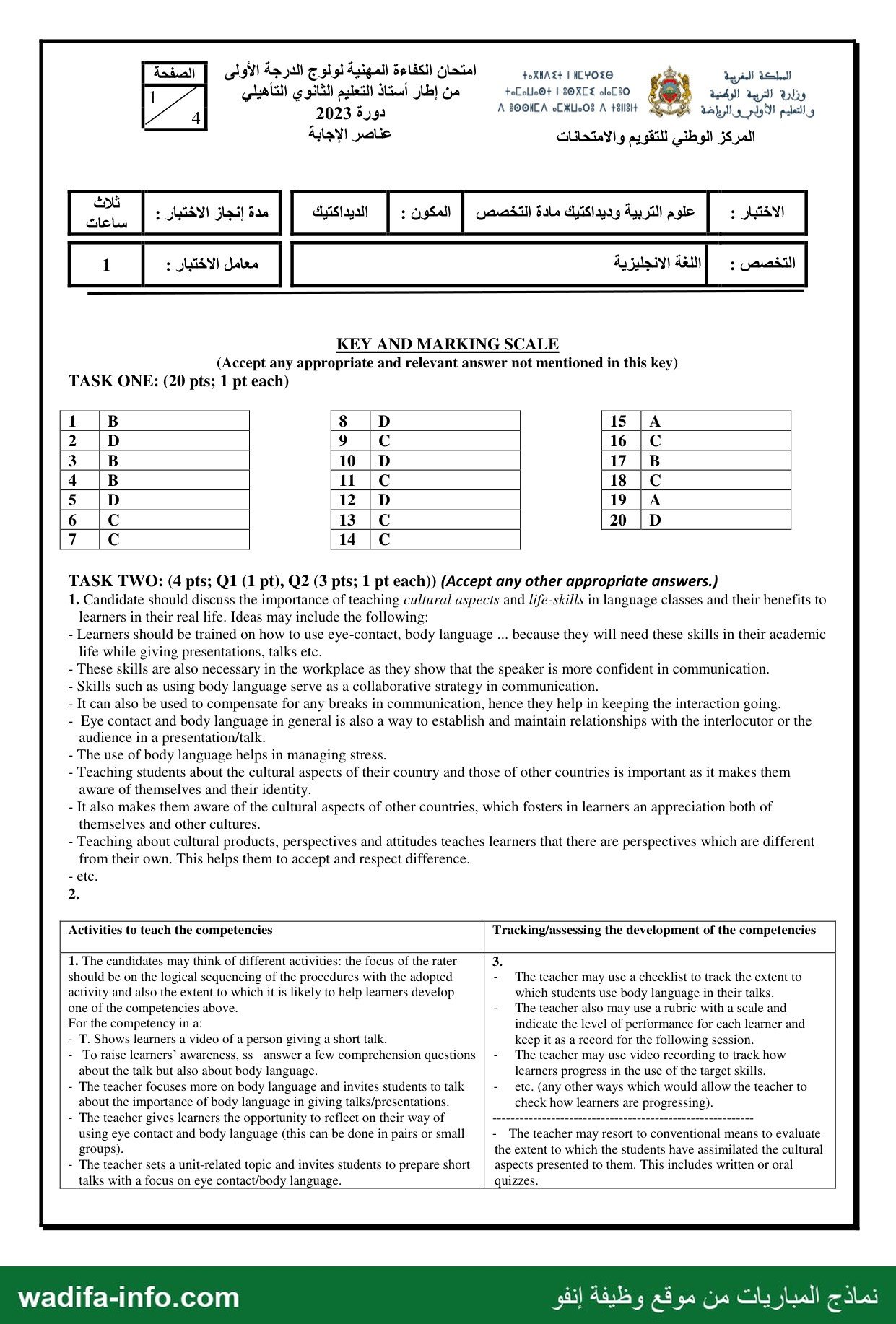
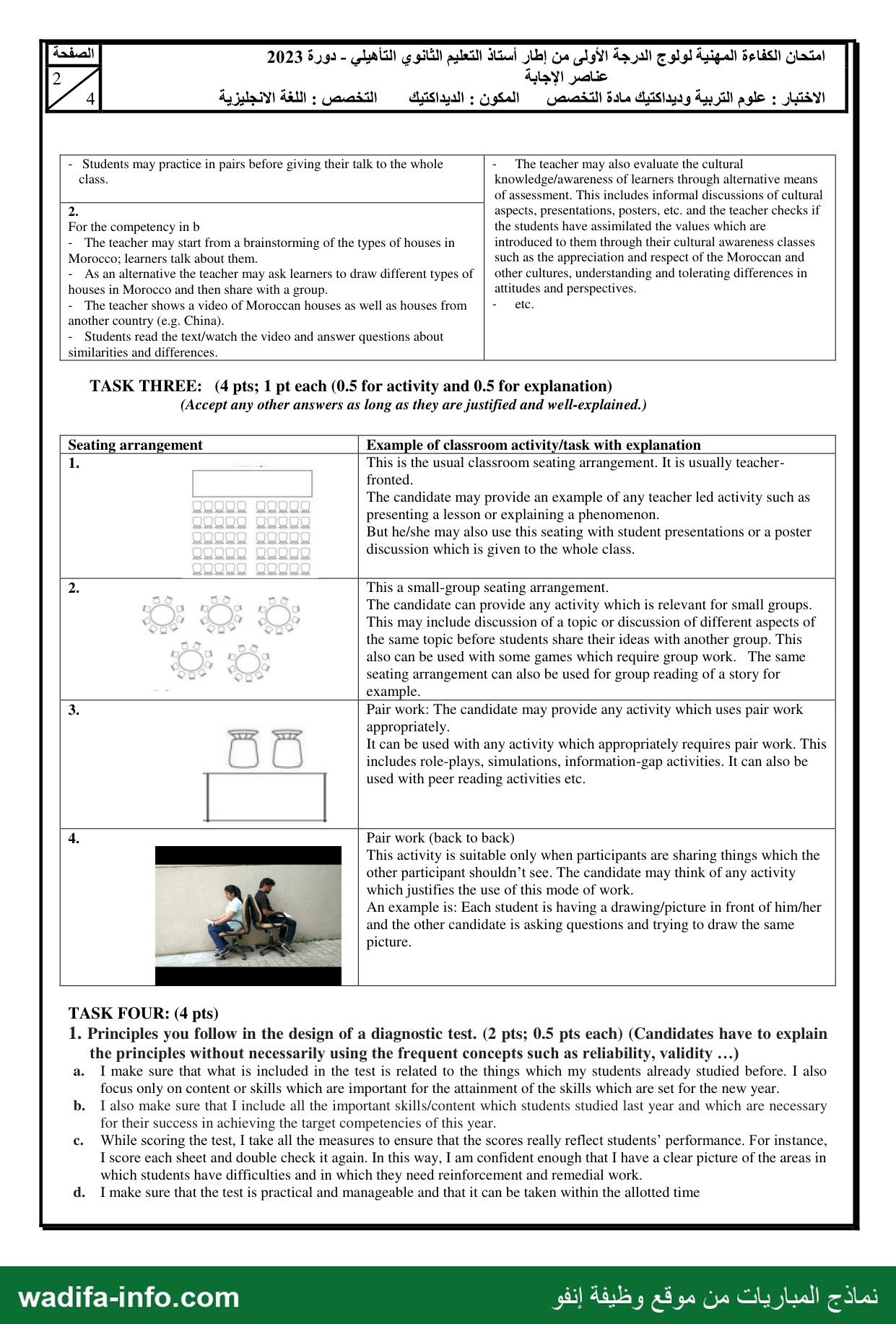
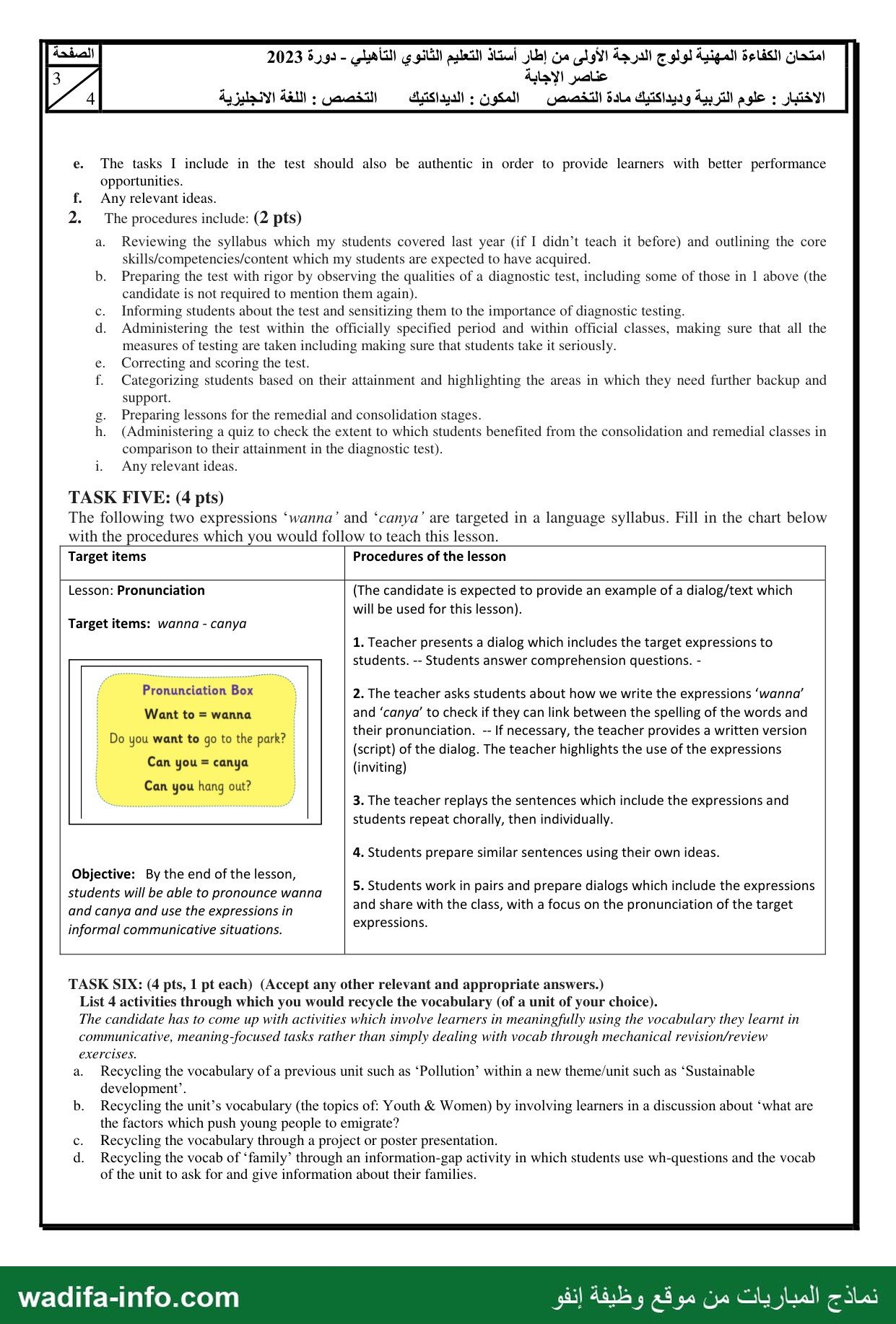
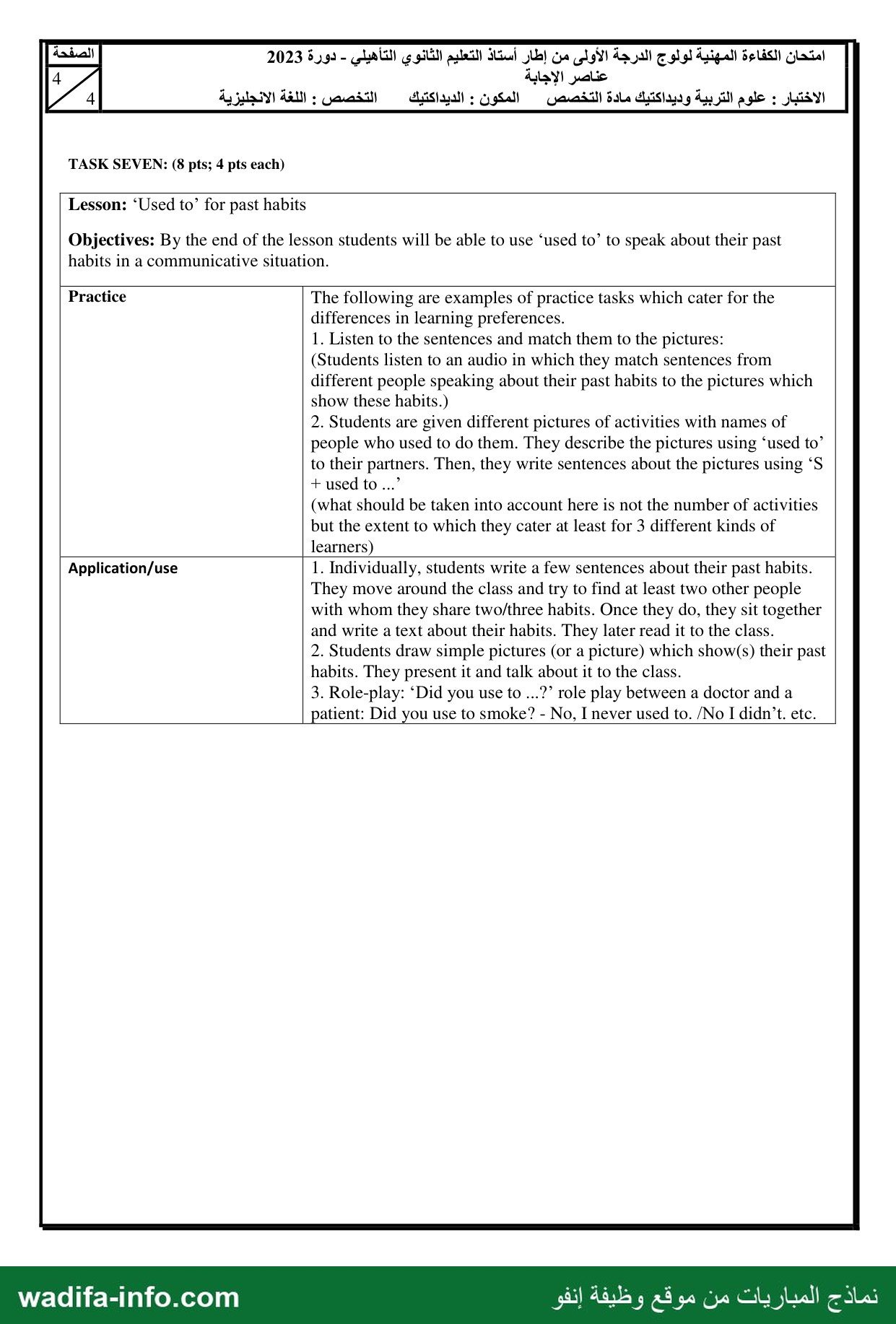
الصلكة Lei) ب وب +oXNA£+ امتحان الكفاءة المهنية لولوج الدرجة الأولى وزارة LAN de) ماه teCeLleO+ ١5075 من إطار أستاذ التعليم الثانوي التأهيلي 1 والتعليم الأولبر_ىالرياضة 4 ثم +ا815+ A 03ملاجاه À SOON A دورة 2023 4 المركز الوطني للتقويم والامتحانات عناصر الإجابه الاختبار : علوم التربية وديداكتيك مادة التخصص | المكون : الديداكتيك مدة إنجاز الاختبار * | ste KEY AND MARKING SCALE (Accept any appropriate and relevant answer not mentioned in this key) TASK ONE: (20 pts; 1 pt each) ها ق 1# ONCE ها 2 |B 7ل ها 10[ | B | 3[ © 2ل ا 5ق | 1[ 20[ |6 6 TASK TWO: (4 pts; 01 (1 pt), Q2 (3 pts; 1 pt each)) (Accept any other appropriate answers.) Candidate should discuss the importance of teaching cultural aspects and life-skills in language classes and their benefits to .1 learners in their real life. Ideas may include the following: Learners should be trained on how to use eye-contact, body language … because they will need these skills in their academic - life while giving presentations, talks etc. These skills are also necessary in the workplace as they show that the speaker is more confident in communication. - Skills such as using body language serve as a collaborative strategy in communication. - It can also be used to compensate for any breaks in communication, hence they help in Keeping the interaction going. - Eye contact and body language in general is also a way to establish and maintain relationships with the interlocutor or the - audience in a presentation/talk. The use of body language helps in managing stress. - Teaching students about the cultural aspects of their country and those of other countries is important as it makes them - aware of themselves and their identity. It also makes them aware of the cultural aspects of other countries, which fosters in learners an appreciation both of - themselves and other cultures. Teaching about cultural products, perspectives and attitudes teaches learners that there are perspectives which are different - from their own. This helps them to accept and respect difference. etc. - Activities to teach the competencies Tracking/assessing the development of the competencies The candidates may think of different activities: the focus of the rater 3. .1 should be on the logical sequencing of the procedures with the adopted - The teacher may use a checklist to track the extent to activity and also the extent to which it is likely to help learners develop which students use body language in their talks. one of the competencies above. - The teacher also may use a rubric with a scale and For the competency in a: indicate the level of performance for each learner and Shows learners a video of a person giving a short talk. keep it as a record for the following session. .1 - To raise learners’ awareness, ss answer a few comprehension questions | - The teacher may use video recording to track how - about the talk but also about body language. learners progress in the use of the target skills. The teacher focuses more on body language and invites students to talk - 616. (any other ways which would allow the teacher to - about the importance of body language in giving talks/presentations. check how learners are progressing). لالس The teacher gives learners the opportunity to reflect on their way of mere nn n nn nn e nee nee en eenn - using eye contact and body language (this can be done in pairs or small - 16 teacher may resort to conventional means to evaluate groups). the extent to which the students have assimilated the cultural The teacher sets a unit-related topic and invites students to prepare short aspects presented to them. This includes written or oral - talks with a focus on eye contact/body language. quizzes. نماذج المباريات من موقع وظيفة إنفو wadifa-info.com 2023 امتحان الكفاءة المهنية لولوج الدرجة الأولى من إطار أستاذ التعليم الثانوي التأهيلي - دورة عناصر الإجابة الاختبار : علوم التربية وديداكتيك مادة التخصص المكون : الديداكتيك | التخصص : اللغة الانجليزية الام - The teacher may also evaluate the cultural class. knowledge/awareness of learners through alternative means of assessment. This includes informal discussions of cultural 2. aspects, presentations, posters, etc. and the teacher checks if For the competency in b the students have assimilated the values which are - The teacher may start from a brainstorming of the types of houses in introduced to them through their cultural awareness classes Morocco; learners talk about them. such as the appreciation and respect of the Moroccan and - كذ an alternative the teacher may ask learners to draw different types of | other cultures, understanding and tolerating differences in houses in Morocco and then share with a group. attitudes and perspectives. - The teacher shows a video of Moroccan houses as well as houses from - etc. another country (e.g. China). - Students read the text/watch the video and answer questions about similarities and differences. TASK THREE: (4 pts; 1 pt each (0.5 for activity and 0.5 for explanation) (Accept any other answers as long as they are justified and well-explained.) 1. | 5 0 This is the usual classroom seating arrangement. It is usually teacher- | fronted. The candidate may provide an example of any teacher led activity such as oo Dom presenting a lesson or explaining a phenomenon. at: SO But he/she may also use this seating with student presentations or a poster discussion which is given to the whole class. 2: This à small-group seating arrangement. Pa eo قن The candidate can provide any activity which is relevant for small groups. 17 اما 1 This may include discussion of a topic or discussion of different aspects of ER ١ دين the same topic before students share their ideas with another group. This : e 4 also can be used with some games which require group work. The same CT Sao” seating arrangement can also be used for group reading of a story for example. 3. Pair work: The candidate may provide any activity which uses pair work حب appropriately. أ 8 81 م It can be used with any activity which appropriately requires pair work. This ليبا نيا includes role-plays, simulations, information-gap activities. It can also be ا used with peer reading activities etc. 4, Pair work (back to back) | This activity is suitable only when participants are sharing things which the ESS other participant shouldn’t see. The candidate may think of any activity 98 > which justifies the use of this mode of work. 7 1 … | صط example is: Each student is having a drawing/picture in front of him/her 7 4 } Ps. ل : : : : : باد ١ | and the other candidate is asking questions and trying to draw the same a ل | picture. TASK FOUR: (4 pts) 1. Principles you follow in the design of a diagnostic test. (2 pts; 0.5 pts each) (Candidates have to explain the principles without necessarily using the frequent concepts such as reliability, validity ...( a. 1 make sure that what is included in the test is related to the things which my students already studied before. I also focus only on content or skills which are important for the attainment of the skills which are set for the new year. b. I also make sure that I include all the important skills/content which students studied last year and which are necessary for their success in achieving the target competencies of this year. ©. While scoring the test, I take all the measures to ensure that the scores really reflect students’ performance. For instance, I score each sheet and double check it again. In this way, I am confident enough that T have a clear picture of the areas in which students have difficulties and in which they need reinforcement and remedial work. d. I make sure that the test is practical and manageable and that it can be taken within the allotted time wadifa-info.com نماذج المباريات من موقع وظيفة إنفو 2023 امتحان الكفاءة المهنية لولوج الدرجة الأولى من إطار أستاذ التعليم الثانوي التأهيلي - دورة عناصر الإجابة الاختبار : علوم التربية وديداكتيك مادة التخصص المكون : الديداكتيك | التخصص : اللغة الانجليزية يوسم e. The tasks I include in the test should also be authentic in order to provide learners with better performance opportunities. f. Any relevant ideas. 2. The procedures include: (2 pts) a. Reviewing the syllabus which my students covered last year (if 1 didn’t teach it before) and outlining the core skills/competencies/content which my students are expected to have acquired. b. Preparing the test with rigor by observing the qualities of a diagnostic test, including some of those in 1 above (the candidate is not required to mention them again). c. Informing students about the test and sensitizing them to the importance of diagnostic testing. d. Administering the test within the officially specified period and within official classes, making sure that all the measures of testing are taken including making sure that students take it seriously. e. Correcting and scoring the test. f. Categorizing students based on their attainment and highlighting the areas in which they need further backup and support. g. Preparing lessons for the remedial and consolidation stages. h. (Administering a quiz to check the extent to which students benefited from the consolidation and remedial classes in comparison to their attainment in the diagnostic test). 1. Any relevant ideas. TASK FIVE: (4 pts) The following two expressions ‘wanna’ and ‘canya' are targeted in a language syllabus. Fill in the chart below with the procedures which you would follow to teach this lesson. Lesson: Pronunciation (The candidate is expected to provide an example of a dialog/text which will be used for this lesson). Target items: wanna - canya 1. Teacher presents a dialog which includes the target expressions to students. -- Students answer comprehension questions. - Pronunciation Box 2. The teacher asks students about how we write the expressions ‘wanna’ E Want to = wanna and ‘canya’ to check if they can link between the spelling of the words and Do you want to go to the park? their 0000م - If necessary the teacher provides a write version (script) of the dialog. The teacher highlights the use of the expressions Can you = canya (inviting) Can you hang out? 3. The teacher replays the sentences which include the expressions and students repeat chorally, then individually. 4. Students prepare similar sentences using their own ideas. Objective: By the end of the lesson, . | | زم . students will be able to pronounce wanna 5. Students Work in pairs ana prepare dialogs which nglude the expressions and canya and use the expressions in and share with the class, with a focus on the pronunciation of the target informal communicative situations. هت TASK SIX: (4 pts, 1 pt each) (Accept any other relevant and appropriate answers.) List 4 activities through which you would recycle the vocabulary (of a unit of your choice). The candidate has to come up with activities which involve learners in meaningfully using the vocabulary they learnt in communicative, meaning-focused tasks rather than simply dealing with vocab through mechanical revision/review exercises. a. Recycling the vocabulary of a previous unit such as ‘Pollution’ within a new theme/unit such as ‘Sustainable development’. b. Recycling the unit’s vocabulary (the topics of: Youth & Women) by involving learners in a discussion about ‘what are the factors which push young people to emigrate? c. Recycling the vocabulary through a project or poster presentation. d. Recycling the vocab of ‘family’ through an information-gap activity in which students use wh-questions and the vocab of the unit to ask for and give information about their families. wadifa-info.com نماذج المباريات من موقع وظيفة إنفو امتحان الكفاءة المهنية لولوج الدرجة الأولى من إطار أستاذ التعليم الثانوي التأهيلي - دورة 2023 عناصر الإجابة 1 الاختبار : علوم التربية وديداكتيك مادة التخصص المكون : الديداكتيك | التخصص : اللغة الانجليزية ام TASK SEVEN: (8 pts; 4 pts each) Lesson: ‘Used to’ for past habits Objectives: By the end of the lesson students will be able to use ‘used to” to speak about their past habits in a communicative situation. Practice The following are examples of practice tasks which cater for the differences in learning preferences. 1. Listen to the sentences and match them to the pictures: (Students listen to an audio in which they match sentences from different people speaking about their past habits to the pictures which show these habits.) 2. Students are given different pictures of activities with names of people who used to do them. They describe the pictures using ‘used to? to their partners. Then, they write sentences about the pictures using ‘S + used to ….? (what should be taken into account here is not the number of activities but the extent to which they cater at least for 3 different kinds of learners) Application/use 1. Individually, students write a few sentences about their past habits. They move around the class and try to find at least two other people with whom they share two/three habits. Once they do, they sit together and write a text about their habits. They later read it to the class. 2. Students draw simple pictures (or a picture) which show(s) their past habits. They present it and talk about it to the class. 3. Role-play: ‘Did you use to ...?” role play between a doctor and a patient: Did you use to smoke? - No, I never used to. /No I didn't. etc. wadifa-info.com نماذج المباريات من موقع وظيفة إنفو
Questions fréquentes sur ce sujet
Ce sujet est-il téléchargeable gratuitement ?
Oui. La totalité du sujet (4 pages) est consultable et téléchargeable gratuitement, sans inscription ni compte.
Le corrigé est-il inclus ?
Pas encore. Cette page publie les questions telles qu'elles sont tombées ; le corrigé proposé est ajouté progressivement selon les sujets.
Quel organisme et quel grade concerne ce sujet ?
Ce sujet provient d'un concours organisé par Ministère de l'Éducation nationale — Centre national de l'évaluation et des examens. Il concerne le grade : Professeur de l'enseignement secondaire qualifiant, 1er grade.
De quelle session s'agit-il et dans quelle langue ?
Session : دورة 2023. Les questions sont en français.
Où trouver d'autres sujets du même concours ?
Tous nos sujets de la même famille sont regroupés sur la page Concours de l'enseignement : /fr/modeles-concours/concours-enseignement. Les sujets y sont classés par session, du plus récent au plus ancien.
Vous préparez ce concours ?
Modèles similaires
Modèle d'examen d'aptitude professionnelle : professeur de l'enseignement secondaire qualifiant (1er grade) — Ministère de l'Éducation nationale — didactique du français — session 2025
📅 Session 2025
Modèle d'examen d'aptitude professionnelle pour l'accès au 1er grade des professeurs de l'enseignement secondaire qualifiant — Ministère de l'Éducation nationale 2023 — épreuve de sciences de l'éducation et didactique de la discipline (informatique)
Modèle d'examen d'aptitude professionnelle pour l'accès au 1er grade des professeurs de l'enseignement secondaire qualifiant — Ministère de l'Éducation nationale 2023 — épreuve de sciences de l'éducation et didactique de la discipline (philosophie)
Modèle d'examen d'aptitude professionnelle pour l'accès au 1er grade des professeurs de l'enseignement secondaire qualifiant — Ministère de l'Éducation nationale 2023 — épreuve de sciences de l'éducation et didactique de la discipline (mathématiques)
Modèle d'examen d'aptitude professionnelle pour l'accès au 1er grade des professeurs de l'enseignement secondaire qualifiant — Ministère de l'Éducation nationale 2023 — Éléments de réponse officiels — didactique : éducation physique
📅 Session 2023
Modèle d'examen d'aptitude professionnelle pour l'accès au 1er grade des professeurs de l'enseignement secondaire qualifiant — Ministère de l'Éducation nationale 2023 — Éléments de réponse officiels — didactique : SVT
📅 Session 2023
Voir tous les modèles →
Source : archive de modèles de concours — document archivé tel que reçu ; l'avis officiel du concours fait foi.
}