

Modèle de concours : CNC 2012 Anglais (MP/PSI/TSI/BCPST) — Concours National Commun
⬇️ Télécharger le PDF Adresse permanente : wadifa-info.com/fr/modele-concours/3670
En bref
Ce document est une ancienne épreuve écrite du concours de Élève de CPGE (accès aux écoles d'ingénieurs) organisé par Concours National Commun (CNC) — classes préparatoires aux grandes écoles (2012), publiée sur Wadifa Info en consultation et téléchargement PDF gratuits.
- Organisme
- Concours National Commun (CNC) — classes préparatoires aux grandes écoles
- Grade
- Élève de CPGE (accès aux écoles d'ingénieurs)
- Spécialité
- Anglais
- Année
- 2012
- Pages
- 3
- Langue des questions
- français
- Correction
- pas encore disponible
Pages du modèle (3)
📝 Texte des questions (extrait automatiquement des pages scannées)
Ce texte est extrait automatiquement des images de l'épreuve et peut contenir des erreurs de lecture — les images ci-dessus font foi.
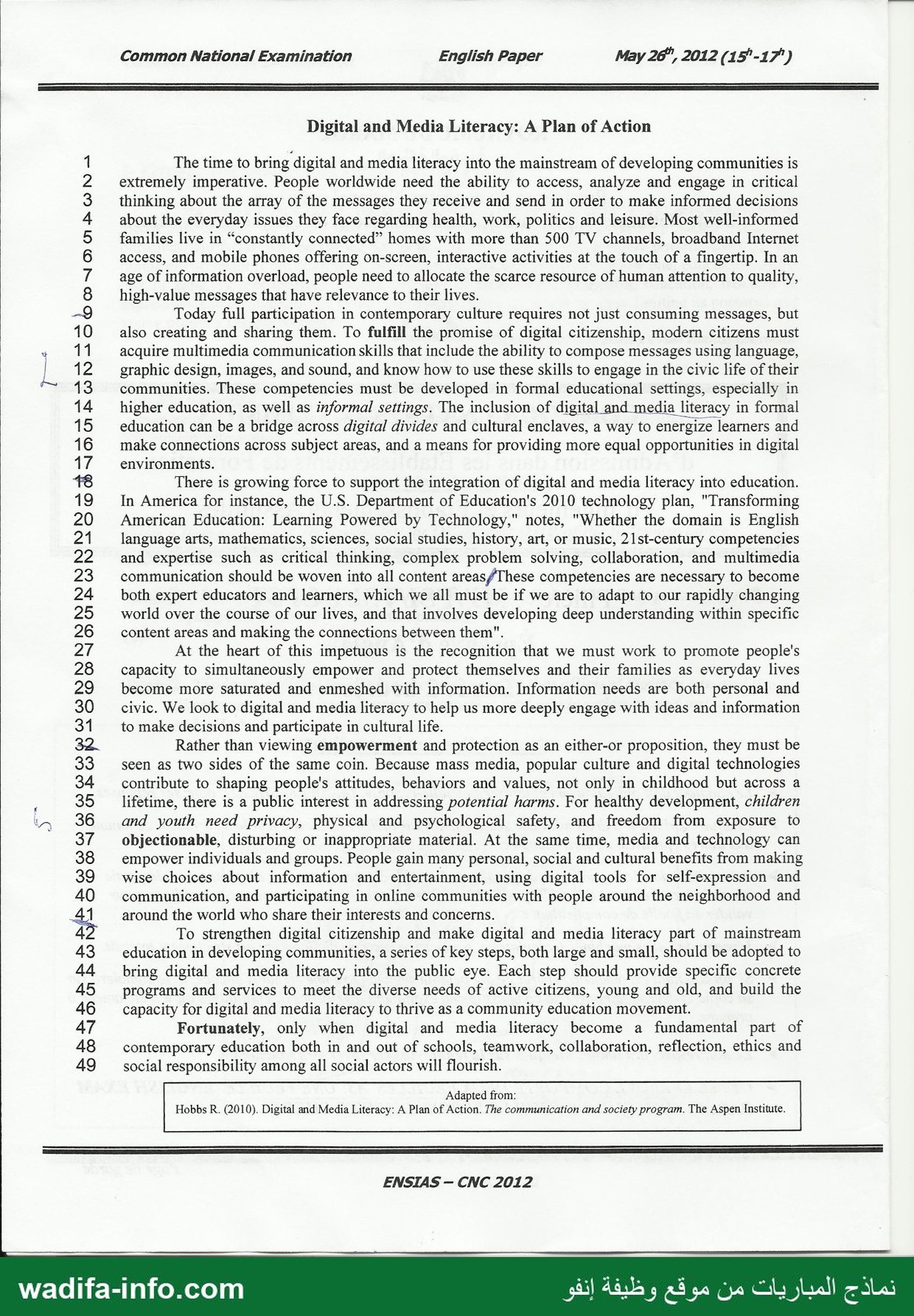
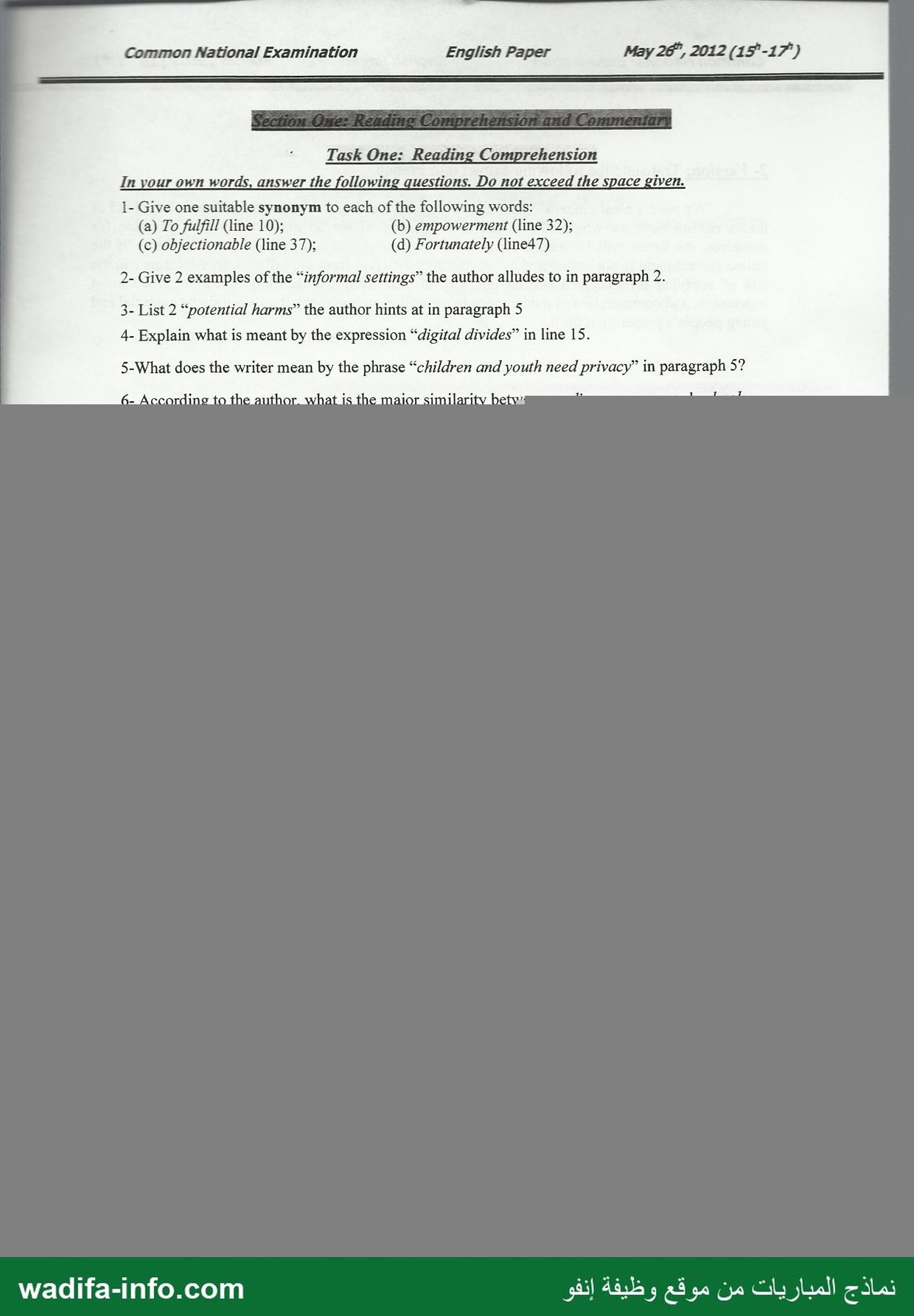
ROYAUME DU MAROC Présidence du concours National commun Ecole Nationale Supérieure de l’Informatique et d'Analyse des Systèmes CONCOURS NATIONAL COMMUN d’Admission dans les Etablissements de Formation d’Ingénieurs et Etablissements Assimilés Filières : MP/PSI/TSLBCPST Epreuve d’ Anglais | Durée 2 heures ]ٍ Notes à lire par le candidat ً , > Le candidat doit obligatoirement utiliser la feuille-réponse, (ANSWER- SHEET), pour ses réponses. ْ' ض ' > Chaque candidat n'a droit qu'a une seule «ANSWER-SHEET». Aucune feuille à carreaux, commune ]ِ إٍْ ض aux autres épreuves, ne sera acceptée. E ' > Le candidat doit écrire son nom de famille, prénom(s), centre et numéro d'examen dans la partie : réservée à ceci en haut de la 1° page de la feuille-réponse, avant de commencer à rédiger, pour إٍ ٍ valider sa feuille de composition. إٍْ .ِ > L'usage de toutes machines (calculatrice, traductrice, etc.) ou dictionnaire est strictement interdit. ]ٍ | > Si un candidat est amené à repérer ce qui peut lui sembler être une erreur d'énoncé, il le signalera sur ًِ ٍ sa copie et devra poursuivre sa composition en expliquant les raisons des initiatives qu'il a été amené à : إْ prendre. : : > Le non respect des limites indiques sur la feuille Answer sheet sera sanctionné. - ّ' > CETTE EPREUVE COMPORTE DEUX FEUILLES A3: UNE FEUILLE (ENGLISH EXAM ًٍ إٍْ PAPER) AINSI QU'UNE FEUILLE-REPONSE (ASWER SHEET). إٍ Page de garde wadifa-info.com نماذج المباريات من موقع وظيفة إنفو Common National Examination English Paper May 26”, 2012 (15/-17°) EEE | Digital and Media Literacy: A Plan of Action 1 The time to bring digital and media literacy into the mainstream of developing communities is 2 extremely imperative. People worldwide need the ability to access, analyze and engage in critical 3 thinking about the array of the messages they receive and send in order to make informed decisions 4 about the everyday issues they face regarding health, work, politics and leisure. Most well-informed 5 families live in “constantly connected” homes with more than 500 TV channels, broadband Internet 6 access, and mobile phones offering on-screen, interactive activities at the touch of a fingertip. In an 7 age of information overload, people need to allocate the scarce resource of human attention to quality, 8 high-value messages that have relevance to their lives. 9 Today full participation in contemporary culture requires not just consuming messages, but 10 also creating and sharing them. To fulfill the promise of digital citizenship, modern citizens must | 4 11 acquire multimedia communication skills that include the ability to compose messages using language, | | 12 graphic design, images, and sound, and know how to use these skills to engage in the civic life of their — 13 communities. These competencies must be developed in formal educational settings, especially in 14 higher education, as well as informal settings. The inclusion of digital and media literacy in formal 15 education can be a bridge across digital divides and cultural enclaves, a way to energize learners and 16 make connections across subject areas, and a means for providing more equal opportunities in digital 17 environments. 18 There is growing force to support the integration of digital and media literacy into education. 19 In America for instance, the U.S. Department of Education's 2010 technology plan, "Transforming 20 American Education: Learning Powered by Technology," notes, "Whether the domain is English 21 language arts, mathematics, sciences, social studies, history, art, or music, 21st-century competencies 22 and expertise such as critical thinking, complex problem solving, collaboration, and multimedia 23 communication should be woven into all content areas/These competencies are necessary to become 24 both expert educators and learners, which we all must be if we are to adapt to our rapidly changing 25 world over the course of our lives, and that involves developing deep understanding within specific 26 content areas and making the connections between them". 27 At the heart of this impetuous is the recognition that we must work to promote people's 28 capacity to simultaneously empower and protect themselves and their families as everyday lives 29 become more saturated and enmeshed with information. Information needs are both personal and 30 civic. We look to digital and media literacy to help us more deeply engage with ideas and information 31 to make decisions and participate in cultural life. 32. Rather than viewing empowerment and protection as an either-or proposition, they must be 33 seen as two sides of the same coin. Because mass media, popular culture and digital technologies 34 contribute to shaping people's attitudes, behaviors and values, not only in childhood but across a 1 35 lifetime, there is a public interest in addressing potential harms. For healthy development, children 7 36 and youth need privacy, physical and psychological safety, and freedom from exposure to 37 objectionable, disturbing or inappropriate material. At the same time, media and technology can 38 empower individuals and groups. People gain many personal, social and cultural benefits from making 39 wise choices about information and entertainment, using digital tools for self-expression and 40 communication, and participating in online communities with people around the neighborhood and $ around the world who share their interests and concerns. 4 To strengthen digital citizenship and make digital and media literacy part of mainstream 43 education in developing communities, a series of key steps, both large and small, should be adopted to 44 bring digital and media literacy into the public eye. Each step should provide specific concrete 45 programs and services to meet the diverse needs of active citizens, young and old, and build the 46 capacity for digital and media literacy to thrive as a community education movement. 47 Fortunately, only when digital and media literacy become a fundamental part of 48 contemporary education both in and out of schools, teamwork, collaboration, reflection, ethics and 49 social responsibility among all social actors will flourish. Hobbs R. (2010). Digital and Media Literacy: A Plan of Action. The communication and society program. The Aspen Institute. جرجج_ةج7ج7جججة7للللللل#بم77ج7ج77777777777777حححححح :<<< .ا ENSIAS - CNC 22 wadifa-info.com نماذج المباريات من موقع وظيفة إنفو Common National Examination English Paper May 26”,2012(15°-17°) 7ت كتل<ل>>ن>->->->-- تت LU Ÿ : Task One: Reading Comprehension In your own words, answer the following questions. Do not exceed the space given. 1- Give one suitable synonym to each of the following words: (a) To fulfill (line 10); (b) empowerment (line 32); (c) objectionable (line 37): (d) Fortunately (line47) 2- Give 2 examples of the “informal settings” the author alludes to in paragraph 2. 3- List 2 “potential harms” the author hints at in paragraph 5 4- Explain what is meant by the expression “digital divides” in line 15. 5-What does the writer mean by the phrase “children and youth need privacy” in paragraph 5? Ô-_À ordins to the autho vhat is the maior similarity bety: wadifa-info.com نماذج المباريات من موقع وظيفة إنفو
Questions fréquentes sur ce sujet
Ce sujet est-il téléchargeable gratuitement ?
Le corrigé est-il inclus ?
Quel organisme et quel grade concerne ce sujet ?
De quelle session s'agit-il et dans quelle langue ?
Où trouver d'autres sujets du même concours ?
Vous préparez ce concours ?
Modèles similaires
Organisme : Concours National Commun (CNC) — classes préparatoires aux grandes écoles · 28 mai 2012 — Copie issue de : archive de modèles de concours — document archivé tel que reçu ; l'avis officiel du concours fait foi.
}Citer cette page
Journaliste, blogueur, enseignant : copiez la référence ci-dessous et mettez un lien vers cette page.
Adresse permanente : https://www.wadifa-info.com/fr/modele-concours/3670/modele-de-concours-cnc-2012-anglais-mp-psi-tsi-bcpst-concours-national-commun