
Modèle : Épreuve de didactique de la spécialité - Anglais — Centre de formation des inspecteurs de l'enseignement (CFIE) 2020
⬇️ Télécharger le PDF Adresse permanente : wadifa-info.com/fr/modele-concours/1488
En bref
Ce document est une ancienne épreuve écrite du concours de Épreuve de didactique de la spécialité - Anglais organisé par Centre de formation des inspecteurs de l'enseignement (CFIE) (2020), publiée sur Wadifa Info en consultation et téléchargement PDF gratuits, avec une correction proposée.
- Organisme
- Centre de formation des inspecteurs de l'enseignement (CFIE)
- Grade
- Épreuve de didactique de la spécialité - Anglais
- Spécialité
- اللغة الإنجليزية
- Année
- 2020
- Pages
- 1
- Langue des questions
- français
- Correction
- correction proposée disponible sur cette page
- Ajouté au site
- 20/09/2026
Correction proposée : Modèle : Épreuve de didactique de la spécialité - Anglais — Centre de formation des inspecteurs de l'enseignement (CFIE) 2020
Il s'agit d'une correction proposée, rédigée par l'équipe wadifa-info pour vous aider à comprendre la méthode — ce n'est pas un corrigé officiel de l'administration organisatrice.
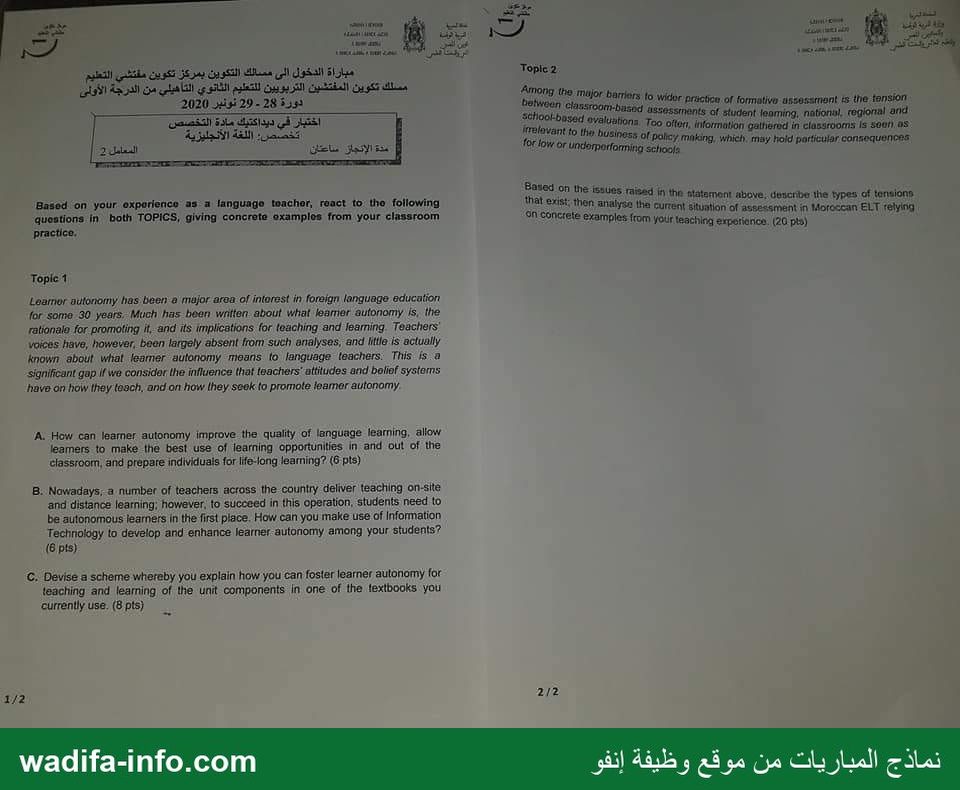
This paper is the didactics of the specialty test — English of the entrance exam to the Inspectors' Training Centre (CFIE), secondary qualifying inspectors track, session of 28–29 November 2020. Duration: 2 hours, coefficient 2. Candidates answer both topics: Topic 1 on learner autonomy (A: 6 pts, B: 6 pts, C: 8 pts) and Topic 2 on assessment (20 pts), drawing on their own classroom practice. What follows is a proposed model answer.
💡 What the jury rewards: a clear definition, a structured argument and concrete classroom examples (a unit, a task, a tool you actually used). Theory without examples, or anecdotes without theory, both lose marks. Aim for roughly 55 minutes per topic.
Topic 1 — Learner autonomy
Working definition to open with: learner autonomy is the ability and willingness to take charge of one's own learning — deciding what, why and how to learn, monitoring progress and assessing the outcome (Holec's classic definition). The Moroccan Guidelines for teaching English in the secondary school (2007) devote a section to "Learner autonomy and learner training" and stress that autonomy is not inborn: learners need to be trained (strategy training, organising their learning with a log, notebook or portfolio, self-assessment).
A. How can learner autonomy improve the quality of language learning, make the best of opportunities in and out of class, and prepare for life-long learning? (6 pts)
- Quality of learning: autonomous learners set goals, choose strategies and reflect on errors, so learning is deeper and better retained; motivation becomes more intrinsic because learners have ownership of content and method. Example: after a writing task, learners use a checklist to self-edit before handing in, and errors fall in the next draft.
- More learning opportunities: class time (about 3–5 hours a week in the lycée) is far too short to acquire a language. Autonomous learners extend exposure: graded readers, podcasts, songs, films with subtitles, online exchanges, vocabulary apps. Inside the class, autonomy allows differentiated work: pairs and groups progress at their own pace while the teacher helps those who need it.
- Life-long learning: strategies (guessing meaning from context, note-taking, using a dictionary, planning a text, self-assessment) are transferable to other subjects, to higher education and to work, where people must keep learning with no teacher. This matches the aim of forming responsible citizens stated in the guidelines.
- Nuance to show judgement: autonomy is gradual and culture-sensitive; learners used to teacher-centred instruction need scaffolding, not sudden freedom.
B. Using Information Technology to develop learner autonomy in on-site and distance learning (6 pts)
- Class platforms (e.g., Google Classroom, Microsoft Teams, the ministry's distance-learning resources): post materials, deadlines and self-correcting quizzes; learners manage their own schedule.
- Self-access resources with keys: online grammar and vocabulary exercises (Quizlet, Kahoot in self-paced mode, LearningApps), graded audio and video with transcripts; learners choose according to their needs.
- E-portfolio / learning journal: learners keep their productions, record goals ("this week I will learn 20 words about the environment") and reflect on progress. It combines organisation of learning and self-assessment.
- Projects with digital products: podcasts, short videos, blogs, digital posters; learners plan, research, produce and present, with a rubric shared in advance.
- Peer interaction: discussion forums and messaging groups for peer feedback and questions, moderated by the teacher.
- Training first: a session on how to search reliably, evaluate sources, use online dictionaries and avoid copying. Take into account unequal access to devices and connection (offer offline or printed alternatives).
Example: during distance learning, a class works on a unit theme; each learner chooses one listening resource from a teacher-curated list, fills in a listening log and posts a 1-minute voice summary; peers comment using two questions given by the teacher.
C. A scheme to foster learner autonomy through the unit components of a textbook (8 pts)
A useful frame is Nunan's (1997) five levels, which the 2007 guidelines present: awareness → involvement → intervention → creation → transcendence. Applied to one unit of the 2nd-year Baccalaureate textbook you use (any unit such as "Sustainable development" or "Women and power" works), whose usual components are: theme opener, vocabulary, listening, grammar, functions, pronunciation, reading, writing, and a unit project/self-assessment:
| Unit component | What the teacher does | What learners do (autonomy level) |
|---|---|---|
| Unit opener | Shares the unit objectives and final task | Say what they already know, what they want to learn, and set personal goals (awareness) |
| Vocabulary | Teaches strategies: word families, collocations, context guessing, vocabulary notebook | Choose extra words related to the theme and record them in their own notebook or app (involvement) |
| Listening / Reading | Trains strategies (predicting, skimming, scanning, inferring); offers tasks at two levels | Choose the task level; find an additional text or audio on the theme and report on it (involvement / intervention) |
| Grammar | Uses an inductive approach: learners discover the rule from examples | Formulate the rule, then check it in a grammar reference; do self-correcting exercises (intervention) |
| Functions / Pronunciation | Provides models and recordings | Create their own dialogues or role plays; record themselves and compare with the model (creation) |
| Writing | Teaches the process: planning, drafting, revising, editing, with a shared checklist | Self- and peer-edit with the checklist, then rewrite (creation) |
| Project | Negotiates topics and the assessment rubric | Plan, divide roles, research, produce and present; some learners teach a mini-lesson to peers (transcendence) |
| End of unit | Provides a self-assessment grid ("I can...") | Evaluate progress against their goals and set targets for the next unit |
Conclude that the teacher's role shifts from transmitter to facilitator, counsellor and resource, and that autonomy develops progressively over the year, not in a single unit.
Topic 2 — Tensions in assessment and the current situation in Moroccan ELT (20 pts)
💡 Two tasks: describe the tensions, then analyse the Moroccan situation with examples. Give each part a clear heading.
Introduction
The statement contrasts two worlds: classroom-based assessment, whose purpose is formative (to improve learning), and external evaluations (national, regional, school-based), whose purpose is summative and accountability-oriented (certify, rank, inform policy). Information from classrooms is often ignored by decision-makers, while external results can have strong consequences for schools and learners. Problem: how can the two be articulated so that assessment serves learning?
I. The types of tension
- Purpose: assessment for learning (diagnose, give feedback, adjust teaching) versus assessment of learning (certify, select, rank). The same test cannot serve both equally.
- Washback: high-stakes exams drive teaching ("teaching to the test"): skills that are not examined receive less time.
- Validity versus reliability: classroom assessment can be authentic and performance-based but is seen as less reliable and comparable; standardised tests are reliable but narrower in what they measure.
- Trust: external bodies distrust teacher marks (fear of inflation); teachers feel that their professional judgement is ignored.
- Time and workload: formative feedback is time-consuming with large classes; tests and marks to report crowd it out.
- Accountability and equity: when results rank schools, low-performing schools risk being labelled rather than supported — the "particular consequences" mentioned in the statement.
- Learner perception: learners (and parents) value marks, so formative tasks without a mark are often neglected.
II. The current situation of assessment in Moroccan ELT
- Official discourse: the 2007 guidelines advocate a standards-based, performance-based and criterion-referenced assessment, "regular and continuous", with self- and peer-assessment and portfolios.
- Practice: continuous assessment is mostly summative: the guidelines themselves prescribe quizzes and two summative tests per semester, and in class these marks are what learners and parents watch. Portfolios and self-assessment are rare.
- High-stakes certification: the Baccalaureate combines continuous assessment, a regional exam at the end of the 1st year and a national exam in the 2nd year, so the national exam weighs heavily. The English papers test reading, language (grammar, vocabulary, functions) and writing, not listening or speaking: washback reduces class time for oral skills, especially in the final year.
- Teacher marks under suspicion: continuous-assessment marks are often higher than exam marks, which feeds the distrust described in the statement.
- Weak use of data: diagnostic tests at the start of the year are done but rarely exploited; national results are not returned to teachers in a way that informs teaching.
- Examples from practice (to adapt to your own): a 2nd-year Bac class asks to skip the unit's oral presentation to "do exam papers"; a diagnostic test reveals weak writing skills but the syllabus pace leaves no time for remediation; a rubric-based project mark is contested by parents as "subjective".
III. Ways forward (brief, to show perspective)
- Shared rubrics and moderation between teachers to make classroom marks more reliable.
- Integrating oral skills in certification, or at least in continuous assessment with clear criteria.
- Training teachers in assessment literacy; using quizzes formatively (feedback before the mark).
- Returning exam data to schools for improvement, not for ranking.
Conclusion
The tension is structural but not fatal: when classroom evidence is trusted and external exams are aligned with the curriculum's competences, both serve learning. The inspector's role is precisely to build this bridge between classroom practice and policy.
Questions fréquentes : Modèle : Épreuve de didactique de la spécialité - Anglais — Centre de formation des inspecteurs de l'enseignement (CFIE) 2020
Le sujet du concours « Épreuve de didactique de la spécialité - Anglais » est-il téléchargeable gratuitement ?
Le corrigé est-il inclus avec le sujet du concours « Épreuve de didactique de la spécialité - Anglais » ?
Quel organisme et quel grade concerne ce sujet ?
De quelle session s'agit-il et dans quelle langue ?
Où trouver d'autres sujets du même concours ?
📝 Texte des questions (extrait automatiquement des pages scannées)
Ce texte est extrait automatiquement des images de l'épreuve et peut contenir des erreurs de lecture — les images ci-dessus font foi.
ET re 0 SUR OR Dr Re an AT os لمحي ايا 0 مسلك تكوين المفتشين التربويين للتعليم الثاتؤي التاهيلي من الدرجة الأولى Among ie major bars م) wi Le 2 2020 و5 م تي باج ا ذورة 29-28 نونبر Î .... ماه ا اختبار في ديداكتيك مادة التخصص anale lip ent Areas الو JE اللغة الأنجليزية. spa ١ م ا 050856 of pôle رورفامم which. may hold particular consequences 2 مدة الإنجاز امناعتان المعامل 001007 or Undorpoifomning واإمماعة "77 PT PAPER ال ‘Based ion the issues مومه 2 ‘Based on your oxporience as a language toachor, react to tho following {hat exist: then analysn the ee ss وراد اجاج يسبيب ‘questions in طامط TOPICS, giving concrete examples 67 your classroom On concreté ex : ااال حا an ماه آنا practice, : exe examples from أو teaching experianics. (20 pts) Topic Learnor autonomyhas been a'méjor area ofintorestin foreign\language education for some 30) years, Moch'has been 01166 about What:kamer‘autonomy)is, (he rationale for promoting it, and its implications ‘for teaching and: learning. 10686065 Voices have, however, been largely absent from:such analyses, and little s'actually Known about 10801 learner autonomÿ means lto language leachers: This ا 8 Significant gap 1) we consider the influence that teachers’'altitydes and boliof systems have on hoW hey (each. and on how lhey:seekto promote leamer autonomy, A: How can learmer autonomy! improve the كه تلقنو language learning, allow lamers to make lhe best use of learning 60000011165 in and آه اناه 8 classroom, and prepare individuals for life-long learning? (6:pts) B: Nawadays, a number of teachers across the country deliver teaching on-site and distance learning; however, to succeed in {his operation, students need to be autonomous learners Inlthe first place. How can you make use:of Information Technokgy lo develop and'enhance learner autonomy/amonglyour students? (6 pts) ©. Devise a scheme Whereby you explain how you can fostar 168006 autonomy for teaching andllearmning of the! unit components In 606 of 118 textbooksiyou currently use, (8 pts) 1/2 212 1: = 1 254% CES . . wadifa-info.com نماذج المباريات من موقع وظيفة إنفو
🔗 Citer ce sujet sur votre site, blog ou forum
Copiez ce lien (le PDF reste à jour sur la page) :
Vous préparez ce concours ?
Modèles similaires
Organisme : Centre de formation des inspecteurs de l'enseignement (CFIE) · Session 28 - 29 novembre 2020 — Copie issue de : sujets des sessions précédentes des concours de recrutement — document archivé tel que reçu ; l'avis officiel du concours fait foi.
}Citer cette page
Journaliste, blogueur, enseignant : copiez la référence ci-dessous et mettez un lien vers cette page.
Adresse permanente : https://www.wadifa-info.com/fr/modele-concours/1488/modele-epreuve-de-didactique-de-la-specialite-anglais-centre-de-formation-des-inspecteurs