

Modèle de concours d'accès à l'Institut Supérieur de l'Information et de la Communication (ISIC) 2010 — Anglais
⬇️ Télécharger le PDF Adresse permanente : wadifa-info.com/fr/modele-concours/2591
En bref
Ce document est une ancienne épreuve écrite du concours de Étudiant — cycle de licence (journalisme et communication) organisé par Institut Supérieur de l'Information et de la Communication (ISIC) — Rabat (2010), publiée sur Wadifa Info en consultation et téléchargement PDF gratuits, avec une correction proposée.
- Organisme
- Institut Supérieur de l'Information et de la Communication (ISIC) — Rabat
- Grade
- Étudiant — cycle de licence (journalisme et communication)
- Spécialité
- Anglais
- Année
- 2010
- Pages
- 2
- Langue des questions
- français
- Correction
- correction proposée disponible sur cette page
📝 Texte des questions (extrait automatiquement des pages scannées)
Ce texte est extrait automatiquement des images de l'épreuve et peut contenir des erreurs de lecture — les images ci-dessus font foi.
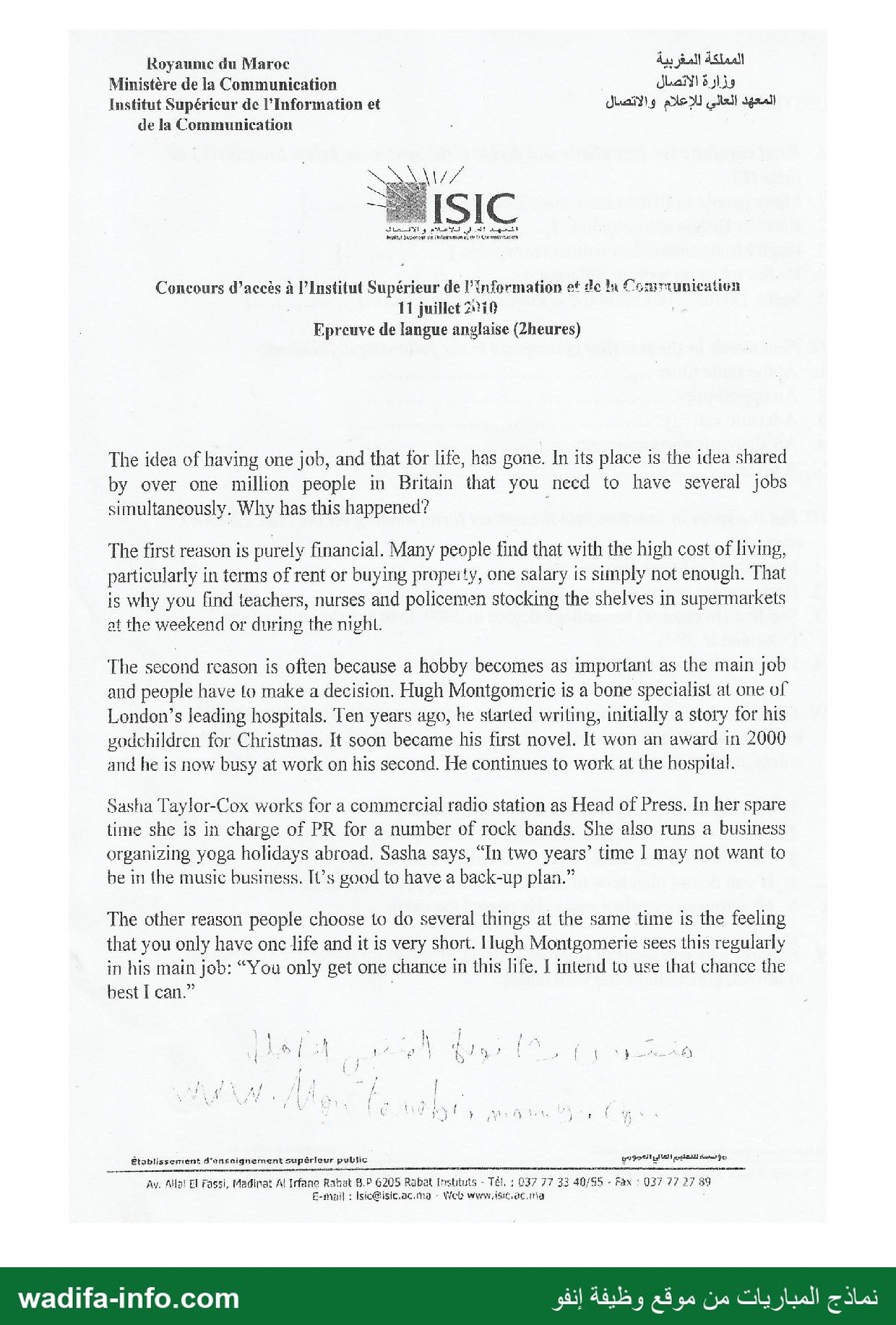
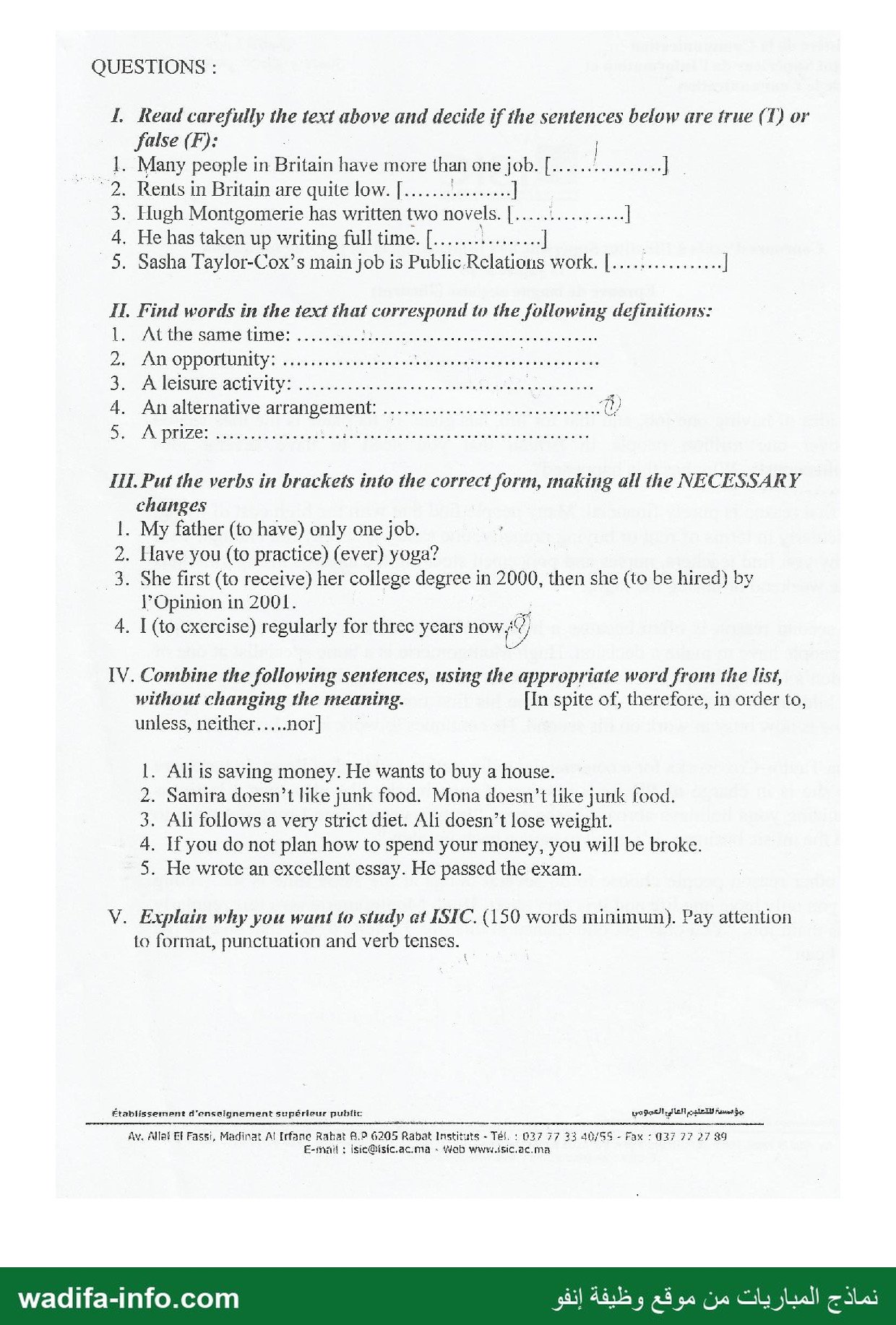
Royaume du Maroc المملكة المغربية Ministère de la Communication وزارة الاتصال Institut Supéricur de l'Information et المعهد العالي للإعلام والاتصال de la Communication ا \ Fe % ISIC Concours d’accès à l’Institut Supérieur de l'information et de la Cenrrmunication 11 juillet 8 2 Epreuve de langue anglaise (2heures) The idea of having one job, and that for life, has gone. In its place 18 the idea shared by over one million people in Britain that you necd to have several jobs simultaneously. Why has this happened”? The first reason is purely financial. Many people find that with the high cost of living, particularly in terms of rent or buying property, one salary is simply not enough. That is why you find teachers, nurses and policemen stocking the shelves in supermarkets at the weekend or during the nighL. The second reason is often because a hobby becomes as important as the main job aud people have ما make a decision. Hugh Montgomeric is a bone specialist at one of London’s leading hospitals. Ten years ago, he started writing, initially a story for his vodchildren for Christmas. It soon became his first novel. It won an award in 2000 and he is now busy at work on his second. He continues to work at the hospital. Sasha Taylor-Cox works for a commercial radio station as Head of Press. In her spare time she is in charge of PR for a number of rock bands. She also runs a business organizing yoga holidays abroad. Sasha says, “In two years’ time 1 may not want to be in the music business. IL’s good to have a back-up plan.” The other reason people choose to do several things at the same time is the feeling that you only have onc life and it is very short. Ilugh Montgomerie sees this regularly in his main job: “You only get one chance in this life. Lintend to use that chance the best ] can.” د Établissement d'onsoignement supérieur pubiic تعالي ا نعموجن SE dat و Av. Alat اج Fassi, Médinat مم1 إم Rahat 8.P 6205 Rabat فتاوه - TE, 037 77 33 40/55 - Fax : 037 77 27 9 E-mail : Isic@isic. ac.ma - Mob wii, àt ma wadifa-info.com نماذج المباريات من موقع وظيفة إنفو QUESTIONS : .ا Read carefully the text above and decide if the sentences below are true (T) or false (F): : | HE Many people in Britain have more than one job. [1 * “2, Rents in Britain are quite low. |... 3. Hugh Montgomerie has written two novels. | ...............[ 4, He has taken up writing full time. ]................[ 5. Sasha Taylor-Cox’s main job is PublicRelatious work. [................] IT, Find words in the text that correspond to the following definitions: مم امام مما لاماي مم مو عمق طم ممه :113136 583116 108 .1 معام عام العام ممم مم اماه باع م عا مم ع :01000111111 للا .2 الم مسري ااي لاا API)... 116181016 .3 4. An alternative arrangement: 0) وامتعاقام متعاة مام واتة مهاه موه ممعم عدم م قو عا وه مع 101126 78 .5 III. Put the verbs in brackefs into the correct form, making اله the NECESSARY changes 1. My father (to have) only one job. 2. Have you (to practice) (ever) yoga? 3. She first (to receive) her college degree in 2000, then she (to be hired) by Opinion in 2001. زر 4, 1 (to exercise) regularly for threc years now“ IV. Combine the following sentences, using the appropriate word from the list, without changing the meaning. [In spite of, therefore, in order to, unless, neither..…...nor| 1. Ali is saving money. He wants to buy a house. 2. Samira doesn”t like junk food. Mona doesn't like junk food. 3. Ali follows a very strict diet. Ali doesn't lose weight. 4. If you do not plan how to spend your money, you will be broke. 5. He wrote an excellent essay. He passed the exam. V. Explain why you want te study له ISIC. (150 words minimum). Pay attention to format, punctuation and verb tenses. Établissement d'enseignement supérieur pubtic مؤسمسة للتعليم العألئ العموس Av. اط عالت Fassi, Medinat لم Erfonc Rabat 6.9 6205 Rabat Instituts - 181. : 037 77 33 40/55 - Fax : 037 77 27 9 E-mul : [email protected] ٠ دما www.isic,ac.rma wadifa-info.com نماذج المباريات من موقع وظيفة إنفو
Correction proposée
Il s'agit d'une correction proposée, rédigée par l'équipe wadifa-info pour vous aider à comprendre la méthode — ce n'est pas un corrigé officiel de l'administration organisatrice.
Ce modèle est l'épreuve de langue anglaise du concours d'accès à l'Institut Supérieur de l'Information et de la Communication (ISIC, Rabat), session du 11 juillet 2010, durée 2 heures. Le texte traite d'une tendance britannique : avoir plusieurs emplois en même temps. Il est suivi de cinq exercices : vrai/faux, vocabulaire, temps verbaux, connecteurs et un essai de 150 mots minimum. Les explications sont en français, les réponses en anglais.
💡 Pour le vrai/faux, justifiez mentalement chaque réponse par une phrase précise du texte : les pièges portent souvent sur un détail (un chiffre, « main job » ou « spare time »).
I. True or false
- True — « over one million people in Britain » pensent qu'il faut avoir plusieurs emplois en même temps.
- False — le texte parle au contraire du « high cost of living, particularly in terms of rent ».
- False — il a écrit un roman (primé en 2000) et travaille sur le deuxième (« he is now busy at work on his second »).
- False — « He continues to work at the hospital » : l'écriture reste une activité à côté de son métier.
- False — son emploi principal est « Head of Press » dans une radio commerciale ; les relations publiques (PR) pour des groupes de rock, elle les fait « in her spare time ».
II. Find words in the text
- At the same time → simultaneously
- An opportunity → chance (« You only get one chance in this life »)
- A leisure activity → hobby
- An alternative arrangement → back-up plan
- A prize → award (« It won an award in 2000 »)
III. Put the verbs in the correct form
- My father has only one job. — réponse probable : sans indicateur de temps, le présent simple décrit une situation actuelle ; si l'on pense au contraste avec le texte (« The idea of having one job … has gone »), My father had only one job (situation révolue) est aussi défendable.
- Have you ever practised yoga? — present perfect avec ever (expérience) ; orthographe américaine practiced acceptée.
- She first received her college degree in 2000, then she was hired by L'Opinion in 2001. — prétérit (dates passées) ; le second verbe est au passif.
- I have been exercising regularly for three years now. — present perfect continu : action commencée il y a trois ans et toujours en cours.
IV. Combine the sentences (in spite of, therefore, in order to, unless, neither … nor)
- Ali is saving money in order to buy a house. — but.
- Neither Samira nor Mona likes junk food. — la négation disparaît, verbe au singulier (accord avec Mona).
- In spite of following a very strict diet, Ali doesn't lose weight. — opposition ; in spite of est suivi d'un nom ou d'un verbe en -ing (ou : In spite of his very strict diet, …).
- Unless you plan how to spend your money, you will be broke. — unless = if … not.
- He wrote an excellent essay; therefore, he passed the exam. — conséquence.
V. Explain why you want to study at ISIC (150 words minimum)
💡 Plan simple en trois temps : votre motivation (pourquoi le journalisme), pourquoi l'ISIC en particulier, votre projet professionnel. Restez concret et sincère ; évitez les phrases toutes faites. Vérifiez les temps : présent pour vos goûts, present perfect pour votre parcours, futur pour le projet.
Model answer :
Since I was a child, I have been fascinated by the news. I read newspapers every day and I have written several articles for my school magazine. This is why I want to study at the Higher Institute of Information and Communication.
First of all, ISIC is the main public school of journalism in Morocco. It offers theoretical courses in communication, law and economics, as well as practical training in the press, radio and television. I believe this combination is exactly what a future journalist needs.
Moreover, studying at ISIC would allow me to meet professionals and to do internships in newspapers and media companies. This contact with the real world of work is essential to learn how to check information, write clearly and respect professional ethics.
Finally, I have a clear project: I would like to become a reporter specialised in social issues, in order to give a voice to people who are rarely heard. I am convinced that ISIC will help me achieve this goal.
Questions fréquentes sur ce sujet
Ce sujet est-il téléchargeable gratuitement ?
Le corrigé est-il inclus ?
Quel organisme et quel grade concerne ce sujet ?
De quelle session s'agit-il et dans quelle langue ?
Où trouver d'autres sujets du même concours ?
Vous préparez ce concours ?
Modèles similaires
Organisme : Institut Supérieur de l'Information et de la Communication (ISIC) — Rabat · 2010 — Copie issue de : archive de modèles de concours — document archivé tel que reçu ; l'avis officiel du concours fait foi.
}Citer cette page
Journaliste, blogueur, enseignant : copiez la référence ci-dessous et mettez un lien vers cette page.
Adresse permanente : https://www.wadifa-info.com/fr/modele-concours/2591/modele-de-concours-d-acces-a-l-institut-superieur-de-l-information-et-de-la-communicatio