

Modèle de concours : Professeurs de l'enseignement secondaire, 2e grade — CRMEF — Anglais (épreuve de didactique de la spécialité) — session 2023
⬇️ Télécharger le PDF Adresse permanente : wadifa-info.com/fr/modele-concours/2192
En bref
Ce document est une ancienne épreuve écrite du concours de Professeurs de l'enseignement secondaire, 2e grade organisé par Centres régionaux des métiers de l'éducation et de la formation (CRMEF) — Ministère de l'Éducation nationale, du Préscolaire et des Sports (2023), publiée sur Wadifa Info en consultation et téléchargement PDF gratuits, avec une correction proposée.
- Organisme
- Centres régionaux des métiers de l'éducation et de la formation (CRMEF) — Ministère de l'Éducation nationale, du Préscolaire et des Sports
- Grade
- Professeurs de l'enseignement secondaire, 2e grade
- Spécialité
- Anglais — épreuve de didactique de la spécialité
- Année
- 2023
- Pages
- 14
- Langue des questions
- français
- Correction
- correction proposée disponible sur cette page
📝 Texte des questions (extrait automatiquement des pages scannées)
Ce texte est extrait automatiquement des images de l'épreuve et peut contenir des erreurs de lecture — les images ci-dessus font foi.
| افاي مباراة ولوج المراكز الجهوية لمهن التربيا | الصفحة 116700 Le السلكة
الرمية 0ك 11014 10240.01 والتكوين لتوظيف أساتذة التعليم الثانوي من وي Let vbs
الدرجة الثانية A 100157 CHU ON والتطيم الأول و الرياضة اناا م
2 2023 المركز الوطني للتقويم والامتحانات دورة
الموضوع
مدة اعت
اختبار في ديداكتيك مادة أو مواد التخصص الإنجاز؛ ب
— بلبللسسسببسسسال
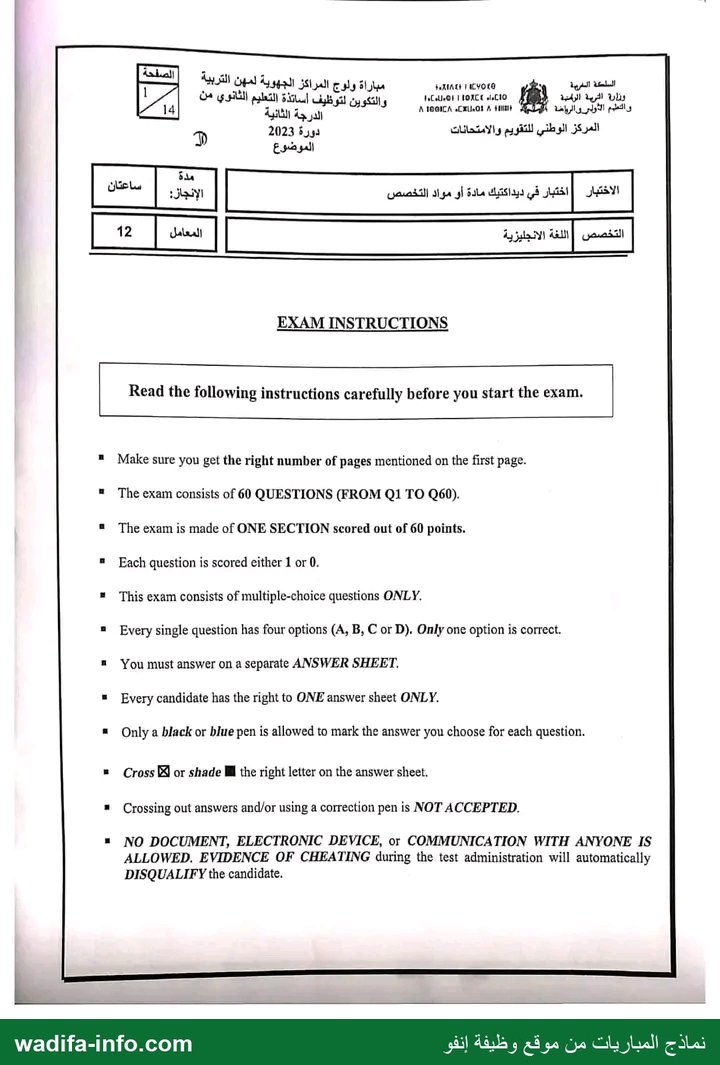
| EXAM INSTRUCTIONS
Read the following instructions carefully before you start the exam.
"Make sure you get the right number of pages mentioned on the first page.
"The exam consists of 60 QUESTIONS (FROM Q1 TO Q60).
“The exam is made of ONE SECTION scored out of 60 points.
# Each question is scored either 1 or 0.
“This exam consists of multiple-choice questions ONLY.
# Every single question has four options (A, B, C or D). Only one option is correct.
# You must answer on a separate ANSWER SHEET.
“Every candidate has the right to ONE answer sheet ONLY.
« Onlya black or blue pen is allowed to mark the answer you choose for each question.
“Cross قتا or shade M the right letter on the answer sheet.
“Crossing out answers and/or using a correction pen is NOT ACCEPTED.
«» NO DOCUMENT, ELECTRONIC DEVICE, or COMMUNICATION WITH ANYONE IS
ALLOWED. EVIDENCE OF CHEATING during the test administration will automatically
DISQUALIFY the candidate.
wadifa-info.com نماذج المباريات من موقع وظيفة إنفو
جارج SE الجهوية لمهن الترببة والتكوين لتوظيف أساشة التعيم الثانري من الدرجة الثنية - دورة 2027 [الصفحة]
" الموضوع
Ré إختبار في ديداكتيك مادة أو مواد التخصضص التخصص : اللغة الانجليزية PA
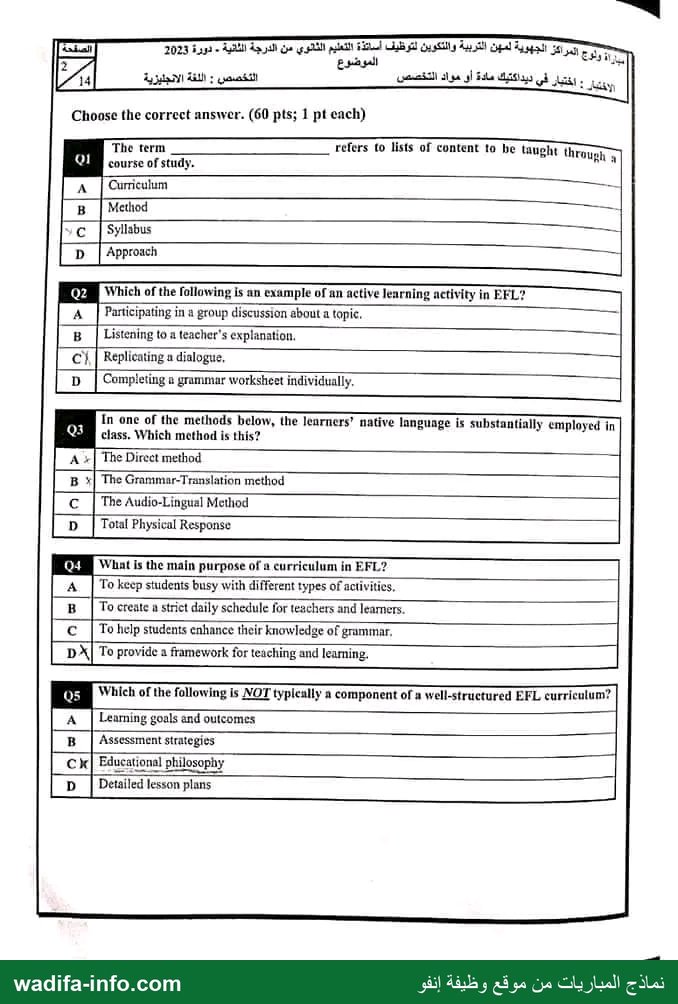
Choose the correct answer. (60 pts; 1 pt each)
The term refers to lists of content to be taught throug}
0٠" -09©303أ١0- -00-00 Fa a 01
course of study.
Curriculum =
B | Method =
sc |Syllabus
D | Approach
Which of the following is an example of an active learning activity in EFL? هزه
A | Participating in a group discussion about a topic.
B | Listening to a teacher's explanation.
C1 | Replicating a dialogue,
EN Completing à grammar worksheet individually.
In one of the methods below, the lenrners’ native language is substantiallÿ employed in
SA class. Which method is this?
The Direct method
B *| The Grammar-Translation method
The Audio-Lingual Method | €
Total Physical Response | © |
ES What is the main purpose of a curriculum in EFL?
A | To keep students busy with different types of activities.
B | To create à strict daily schedule for teachers and learners.
To help students enhance their knowledge of grammar, | ©
| ————— و جه و وو يو جراد رد RS
To provide a framework for teaching and leaming.
RER Which of the following is NOT typleally a component of a well-structured EFL curriculum?
A | Learning goals and outcomes
B | Assessment strategies
Educational philosophy
ER Detailed lesson plans
نماذج المباريات من موقع وظيفة إنفو wadifa-info.com
2023 مياراة ولوج المراكز الجهوية لمهن التربية والتكوين لتوظيف اسائذة التعليم الثانوي من الدرجة الثانية - دورة
الاتجليزية Qui : الاختبار : اختبار في ديداكتيك مادة أو مواد التخصسس التخصص
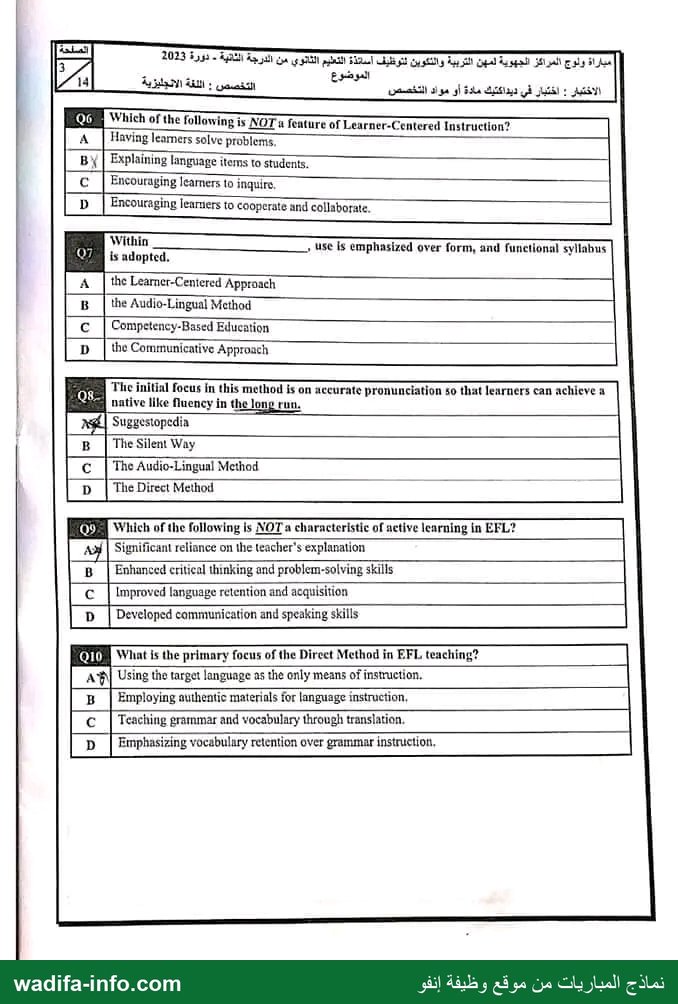
Q6 WHEN 01 1118 following 15 NOT a feature of Learner-Centered Instruction?
A | Having leamers solve problems,
BY | Explaining language items to students.
© | Encouraging Icarners to inquire.
D | Encouraging learuers to Cooperate and collaborate.
07 Within ربسا Use ls emphasized over form, and functional svllabus
لق is adopted. L
A | the Learer-Centered Approach
B | the Audio-Lingual Method
Cempetency-Based Education
| En the Communicative Approach
08 The initial focus in this method كز on aceurate pronunciation 50 that learners can achicve a
اي oative like fluency in the long run.
Ag! Suggestopedia
Cr | The Silent Way
C | The Audio-Lingual Method
١ D | The Direct دم" مك1
UM Which of the following is NOT a characteristic of active learning in EFL?
Significant reliance on 1he teacher's explanation
Enhanced critical thinking and problem-solving skills
improved language rétention and acquisition
| | Develoned cammunication and speaking skills
Ce 111186 is the primary focus of the Direct Method in EFL teaching?
Using the target language as the only means of insmuction.
ER Employing authentic materials for language instruction,
© | Teaching grammar and vocabulary through translation,
D | Emphasizing vocabulury retention over grammar instruction,
wadifa-info.com نماذج المباريات من موقع وظيفة إنفو
2023 المراكز الجهوية لمهن التربية والتكوين لتوظيف + التعليم الثانوي من الدرجة الثانية - دورة ET
ضوع 2 à |
A لاختبار : اختبار في ديداكتيك مادة أو مواد التخنصص الت : اللغة الانجليزية
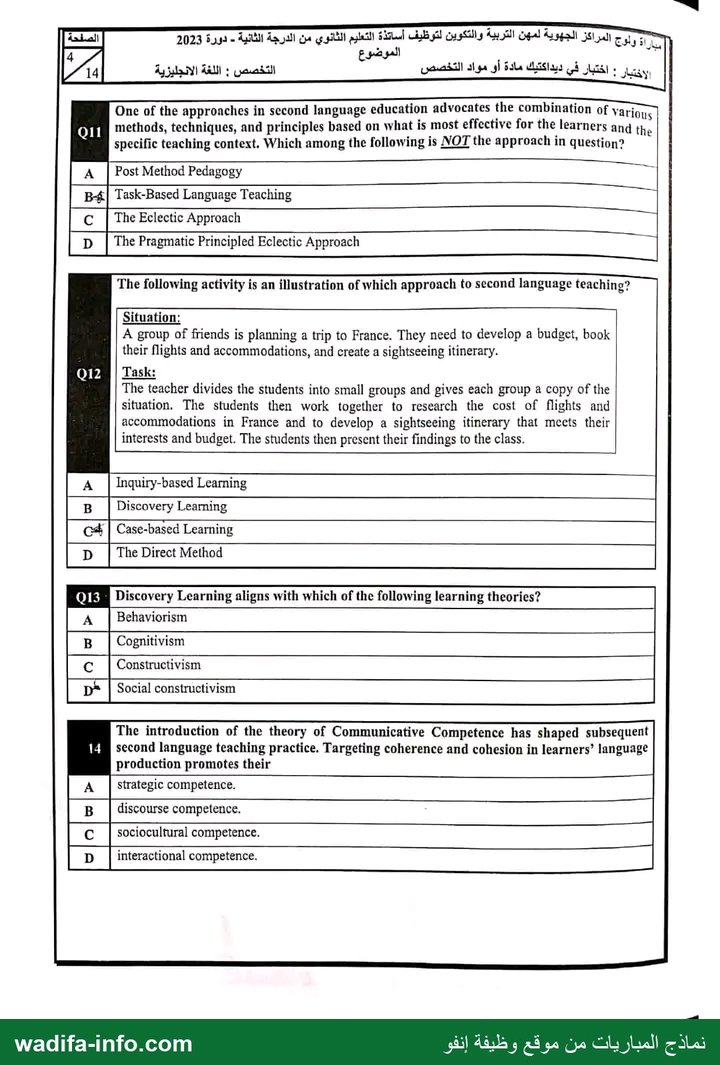
One of the appronches in second language education advocates the combination of Yarious
درو methods, techniques, and principles based on what is most effective for the learners and the
specific teaching context. Which among the following is NOT the approach in question?
بس س_س__ ا
Post Method Pedagogy
B#| Task-Based Language Teaching —
€ | The Eclectic Approach
EX The Pragmatic Principled Eclectic Approach ù
The following activity is an illustration of which approach to second language teaching?
Situation:
A group of friends is planning a trip to France. They need to develop a budget, book
their flights and accommodations, and create a sightseeing itinerary.
012 | Task:
The teacher divides the students into small groups and gives each group a copy of the
situation. The students then work together to research the cost of flights and
accommodations in France and to develop a sightseeing itinerary that 106615 their
interests and budget. The students then present their findings to the class.
Inquiry-based Learning
| 8 | Discovery Learning
Case-based Learning
EX The Direct Method
(JM Discovery Learning aligns with which of the following learning theories?
The introduction of the theory of Communicative Competence has shaped subsequent
[ER second language teaching practice. Targeting coherence and cohesion in learners’ language
production promotes their
wadifa-info.com نماذج المباريات من موقع وظيفة إنفو
SANT لاختيار : اختبار في ديداكتيك مادة أو مواد التخصص التخصص : اللفة
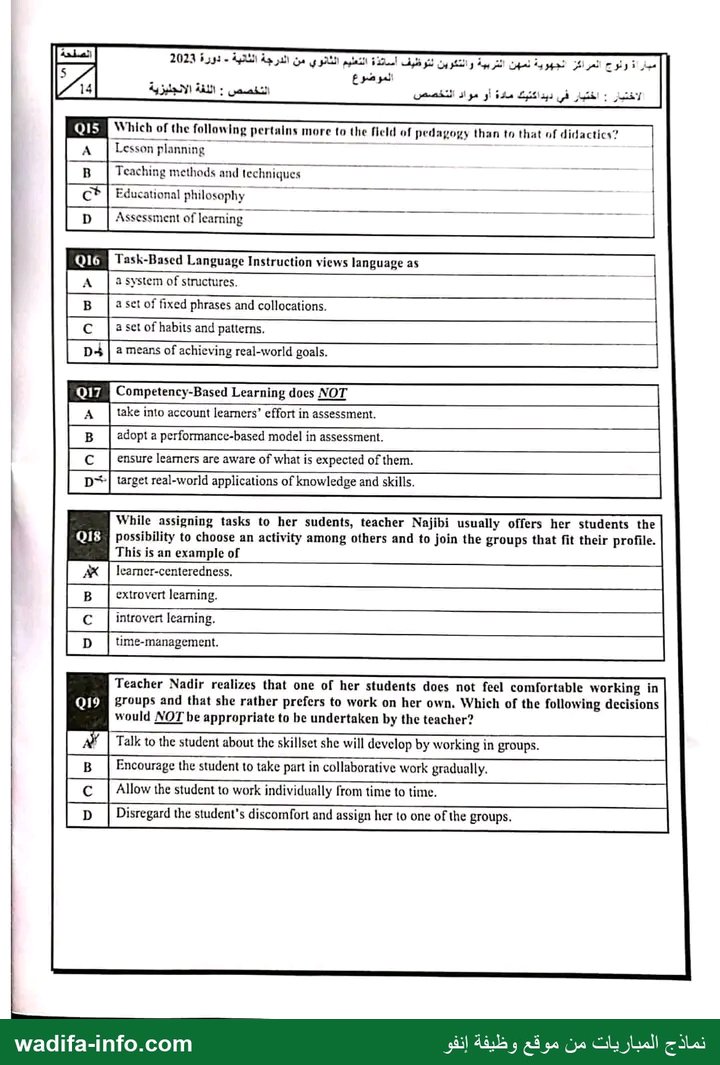
0915 Which of the following pertains more to the field of pedagogs than to that of didactics?
A | Lesson planning
B | Teaching methods andtechniques 7 ا
016 Task-Based Language Instruction views language as 08
a system of structures.
[8 | a set of fixed phrases and collocations. 0
a means of achieving real-world goals. 57
| Pr Eererstmaensmemaseme
ensure learners are aware of what is expected of them.
LE possibility to choose an activity among others and to join the groups that fit their profile.
This is an example of
| 8 | extrovert leaming.
Teacher Nadir realizes that one of her students does not feel comfortable working in
(JE groups and that she rather prefers to work on her own. Which of the following decisions
would NOT be appropriate to be undertaken by the teacher?
wadifa-info.com نماذج المباريات من موقع وظيفة إنفو
2023 وبوج المراكل الجهوية لمهن التربية والتكوين لتوظيف أساتذة التعليم الثانوي من الدرجة الثانية - دورة
77 الموضوع "Ah
1 اختبار في ديداكتيك مادة أو مواد التخنصص التخصص : اللغة الانجليزية : ha
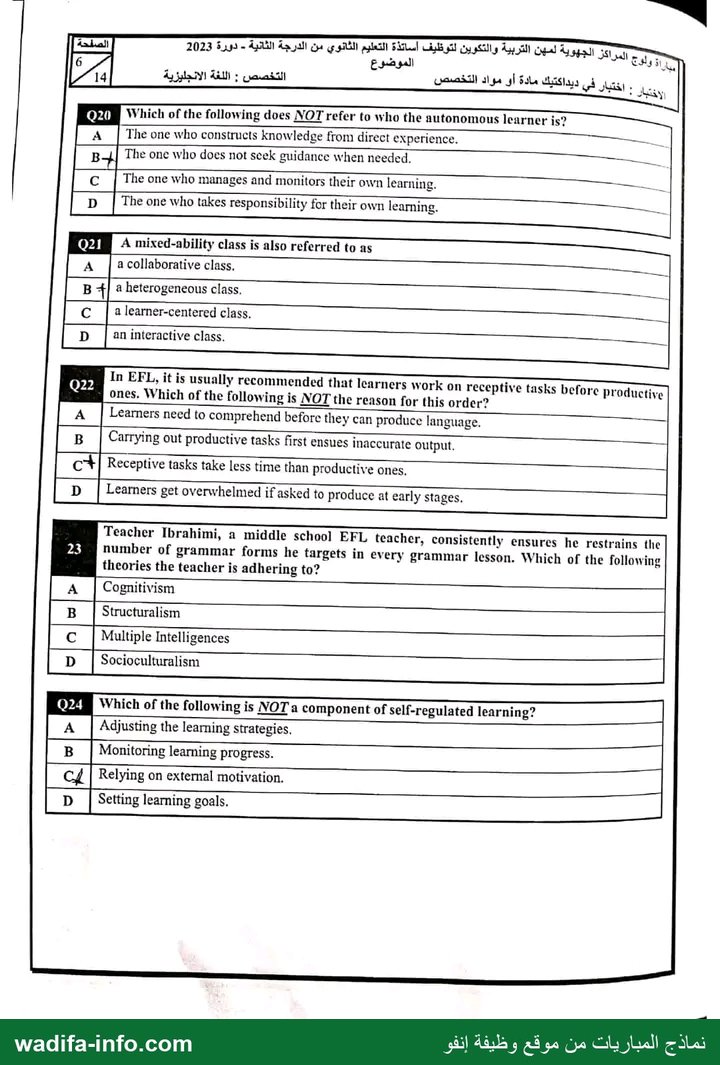
QUE Which of the following does NOT refer to who the autonomous learner is?
The one who constructs knowledge from direct experience. ممم
The one who does not scek guidance when needed. ع
The one who manages and monitors their own learning. DR
| D | The one who takes responsibility for their own learning. —
(2 À mixed-ability class is also referred to as
A |acollaborative class. ==
B +| a heterogeneous class, =
a learner-centered class. =
ا | an interactive class. —
Q22 In EFL, it is usually recommended that lcarners work on receptive tasks before productive
- ones. Which of the following is NOT the reason for this order?
Leamers need to comprehend before they can produce language.
| «| Carrying out productive tasks first ensues inaccurate output.
04| Receptive tasks take Less time than productive ones, 8»
D | Learners get overnwhelmed if asked to produce at early stages.
Teacher Ibrahimi, a middle school EFL teacher, consistently ensures he restrains the
ARS number of grammar forms he targets in every grammar lesson. Which of the following
theories the teacher is adhering to?
Multiple Intelligences
| « | Socioculturalism
2 Which of the following is NOT a component of self-regulated learning?
Adjusting the learning strategies.
[8 | Monitoring learning progress.
Relying on external motivation.
EX Setting learning goals.
à 5 à نماذج المباريات مز قع ؛ ظيفة
wadifa-info.com ج المباريات من موقع وطيفة إنقو
2023 الثانوي من الدرجة الثاتية - دورة us مباراة ولوج المرائز الجهوية لمهن التربية والتكوين لتوقليف
الاختبار : اختبار في ديداكتيك مادة أو مواد التخصصس التخصص : اللغة الانجليزية بر
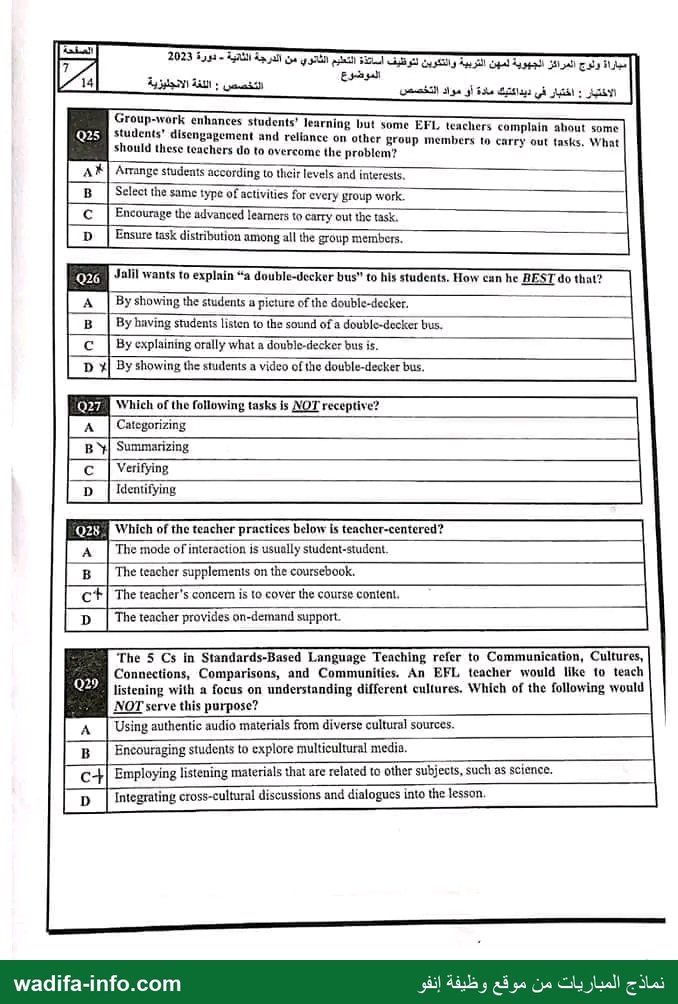
Group-wark enhances students! learning but some EFL teachers complain about some
025 students’ disengagement and relance on other group members to carry out tasks. What
should these teachers do to overcome the problem? 5
A%| Arrange students according to their levels and interests,
RRQ Em
B Select the same type of activities for cvery group work.
EEE
Encourage the alvanced learners to carry out the task.
ها | Ensure task distribution among all the group members.
026 Jalil wants to explain “a double-decker bus" to his students. How can he BEST do that?
...تت D ا ل لت ب
A | لإ showing the students à picture of the double-decker.
TP ل بل =
B | By having students listen to tbe sound of a double-decker bus.
© | Byexplaining orally what a double-decker bus is.
D أل By showing the students a video of the double-decker bus.
طرق \Which of the following tasks is NOT receptive?
Categorizing
B Yÿ| Summarizing
+ | Verifying
D |identifying
LM Which of the teacher practices below is teacher-centered?
A | The mode of interaction is usually student-student.
B | The teacher supplements on the coursebook.
The teacher's concem is Lo cover he course content.
| « | The teacher provides on-demand support.
The 5 Cs in Standards-Based Language Teaching عا to Communication, Cultures,
Connections, Comparisons, and Communities. An EFL teacher would like to teach
Q29 listening with a focus on understanding different cultures. Which of the following would
D 101 serve this purpose?
A | Using authentic audio materials from diverse cultural sources.
B | Encouraging students to explore multicultural media.
c+| Employing listening materials that are related to other subjects, such as science.
D |iIntegrating cross-cultural discussions and dialogues into the lesson.
wadifa-info.com نماذج المباريات من موقع وظيفة إنفو
2023 المراكز الجهوية لمهن التربية والتكوين لتوظيف ل التعليم الثانوي من الدرجة الثانية = دورة ENS
DA اللغة الانجليزية : sh اختبار في ديداكتيك مادة أو مواد التخصص : re
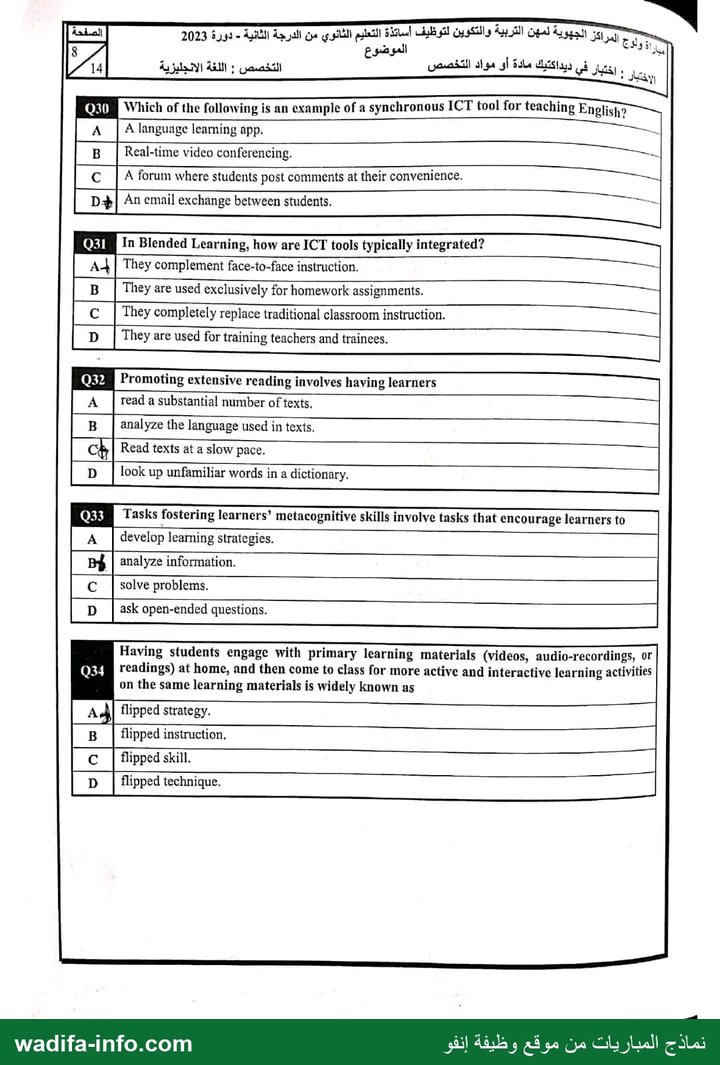
AU Which of the following is an example of a synchronous ICT tool for teaching زجاع
A language learning app. تت
| 8 | Real-time video conferencing. =
A forum where students post comments at their convenience. —
ES An email exchange between students. =
(XI In Blended Learning, how are ICT tools typically integrated?
They complement face-to-face instruction. j
| 8. They are used exclusively for homework assignments.
They completely replace traditional classroom instruction. =
EX They are used for training teachers and trainces.
ثري Promoting extensive reading involves having learners
read a substantial number of texts.
| 8 8081728 the language used in texts.
Read texts at a slow pace.
EX 10016 up unfamiliar words in a dictionary.
رثع Tasks fostering learners’ metacognitive skills involve tasks that encourage learners to
develop learning strategies.
| B$ analyze information.
solve problems.
Ex ask open-ended questions.
Having students engage with primary learning materials (videos, audio-recordings, or
(RER readings) at home, and then come to class for more active and interactive learning activities
on the same learning materials is widely known as
| Ad flipped strategy.
flipped skill.
EX flipped technique.
wadifa-info.com نماذج المباريات من موقع وظيفة إنفو
y 2023 الثانية - دورة à 7 >
2 23 اتيجيف أحائاة التليم الثانوي من الدرجة الثلنية - دورة En Enr ET PLIS
اللغة الانجليزية : sé الموضرع À
2 Le الاختبار : اختبار في دبداكتيك مادة أو مواد التخصس
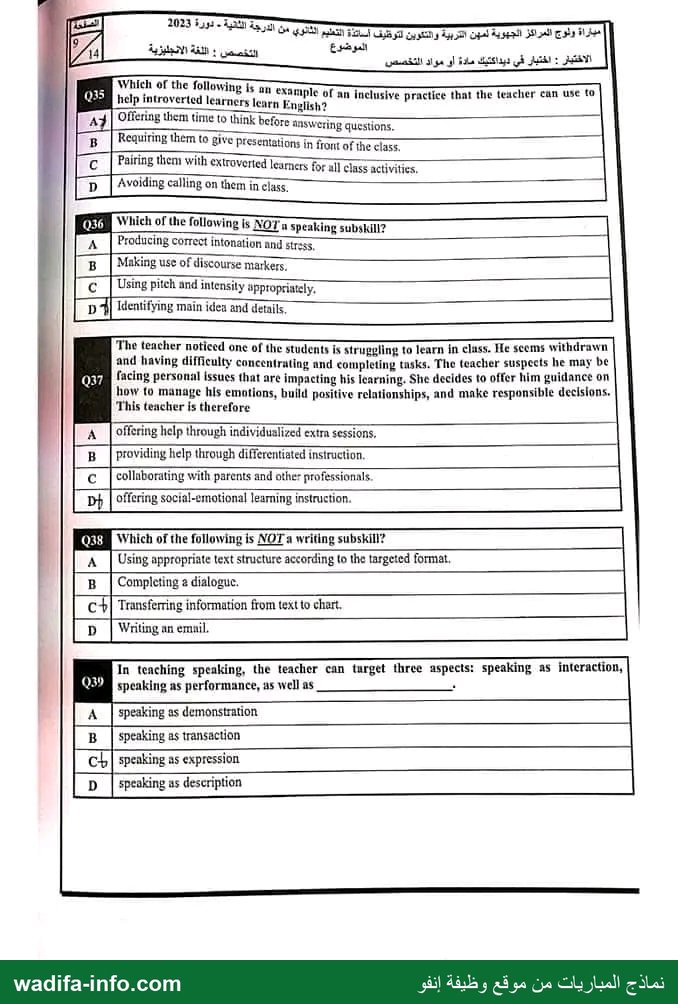
© \Vhich of the followinp وز
035 bcp introvertcd pie pape ا an inclusive practice that the teacher can use to
Offering them time to think before 2051761108 questions.
Requiring them ما give presentetions م class.
Fc. Pairing them with extroverted Icarners for ail يمن actes 37 (0 (0101/١/١
[nr] Avoiding calling on them in class. "|
GER Which of We following is NOT n speaking subsKINI?
A | Producing correct intonation ang stress.
B | Making use of discourse markers.
ç | Using pitch and intensity appropriately,
ا 1 Identifying main idea and details,
The teacher noticed one of the students is struggling to learn in class. He scems withdrawn
| and having difficulty concentraling and completing tusks. The teacher suspects he may be
1M 7 facing personal issues that are impacting his learning. She decides to offer him guidance on
| how to manage his emntions, build positive relationships, and make responsible decisions.
This teacher {s therefore
offering help through individualized extra sessions,
providing help through differentiated instruction.
colluborating with parents and other professionals.
offering social-emotional learning instruction.
زر Which of the following is NOT a writing subskill?
Using appropriate text structure according lo the targeted format.
[B| Completing 2 dialogue.
Transferring information from text to chart.
| | Writing an emuil.
| In teaching speaking, the teacher can turget three aspects: speaking as interaction,
VE speaking as performance, 45 Well ns.
speaking as demonstration
speaking as expression
| | speaking ss description
wadifa-info.com نماذج المباريات من موقع وظيفة إنفو
2023 المراكز الجهوية لمهن التربية والتكوين لتوظيف أساتذة التعليم الثانوي من الدرجة الثانية - دورة FE
ل الموضوع 3
إختبار في ديداكتيك مادة أو مواد التخصص التخصص : اللغة الانجليزية اص ! Aa
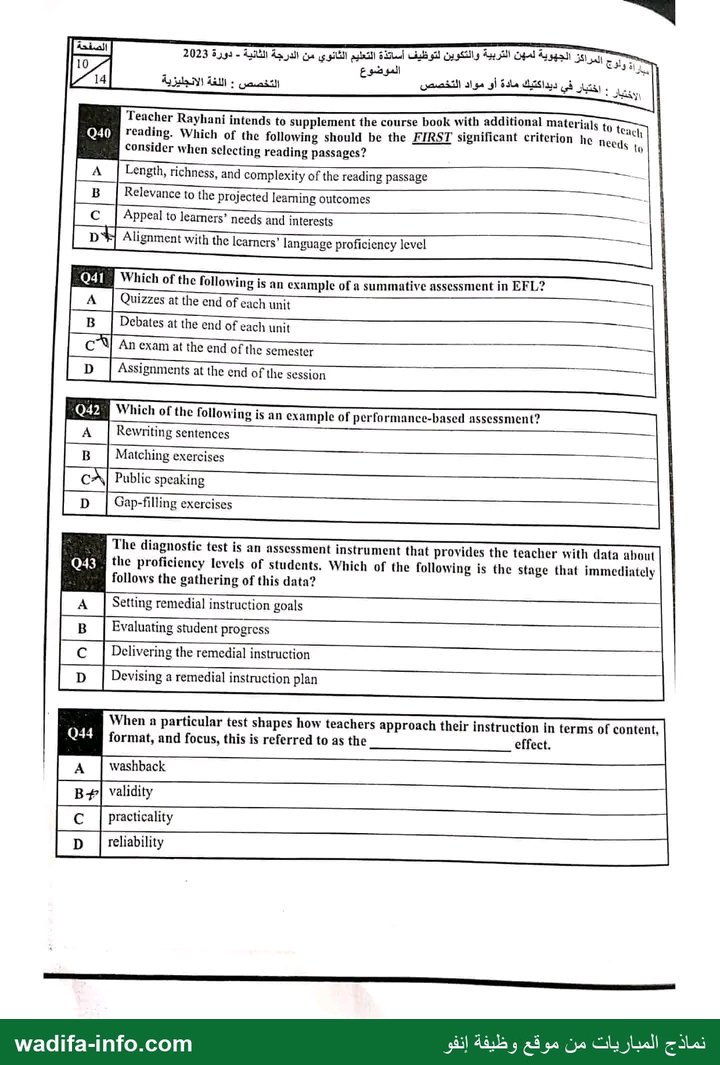
Teacher Rayhani intends to supplement the course book with additional materials to الا
040 reading. Which of the following should be the FIRST significant criterion he needs to
consider when sclecting reading passages?
االاااقث__“_#سنبن___ م وري _—
A | Length, richness, and complexity of the reading passage
.هه ET ...حي جا جر ور SR res —
B | Relevance to the projected leaming outcomes
Appeal to leamners needs and interests
| «+ Alignment with the 'وتعصمعا language proficiency level ب"
9041 Which of the following is an example of a summative assessment in EFL?
Debates at the end of each unit ب
ألا An exam at the end ofthe semester ns
| « | Assignments at the end of the session =
042 Which of the following is an example of performance-based assessment?
A | Rewriting sentences
B | Matching exercises .ع
رخ Public speaking
D | Gap-filling exercises EL
The diagnostic test is an assessment instrument that provides the teacher with data about
(eZkM the proficiency levels of students. Which of the following is the stage that immediately
follows the gathering of this data?
Setting remedial instruction goals
B | Evaluating student progress
C | Delivering the remedial instruction
| | Devising a remedial instruction plan
When a particular test shapes how teachers approach their instruction in terms of content,
VAR format, and focus, this is referred to as the Re
washback
validity
practicality
١ ِ ail Aa » اريات مز قع sal! نماذج
wadifa-info.com ج المباريات من موقع وطيفة إنقو
| es] 2023 مباراة ولوج المرائز الجهوية نمهن التربية والتدوين لتوظيف اساتذة التعليم الثانوي من الدرجة الثانية - دورة
| 2 الاختبار : اختبار في ديداكتيك مادة او مواد التخصصس التخصص : اللغة الانجلبزية
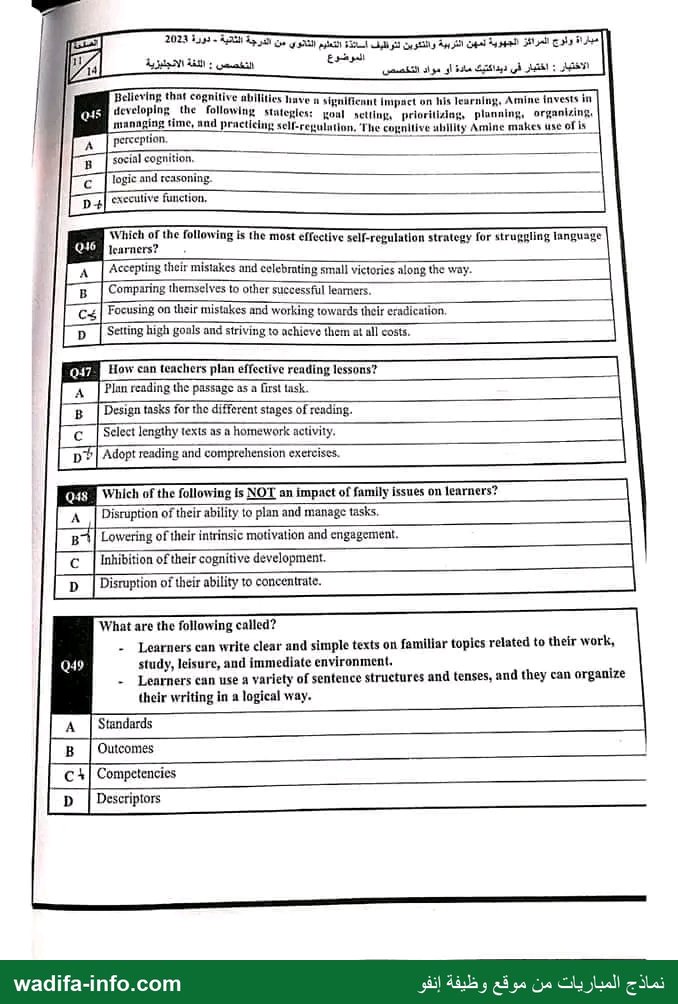
/ Fe de ا وما abilities have ه signifient impact on his learning, Amine invests in
"15 مد بج AVES RE) A Sategles: ponl setting, prioritidog, planning, organizing,
- - practieing بصمل ملسيرء-اك؟ The cognitive ability Amine makes use of is
} perccplion, rm ten en nr
| وجي CAPE DT
social cognition, ——————————
ييا ات اتات سب ف
و( logic and rcasoning. —————— إبجبس+س|
4ه ا executive function, _
Which of the following is 8
TA يي ١ gis the most effective self-regulation strategy for struggling language
[a Accepting their mistakes and celebrating small victories along the way.
Comparing themselves to other successful lenrners.
جا كير رو ا ا ا 7 77577777 7سا تلا|تقققف#,س.,. ١ ١ ١غ074:”آ7” 70703
Foeusing on their mistakes and working towards their cradication.
Setting high gonls and striving to achieve them at all costs.
زد How can teachers plan effective reading lessons?
Plan reading the passage as a Grst task.
Design tasks for the different stages of reading.
Select lengthy texts as a homework activity.
Adopt reading and comprehension exercises.
CEE Wbich of the following Is NOT an impact of family issues on learners?
[a Disruption of their ability to plan and manage tasks.
| 81] Lowering of their intrinsic motivation and engagement.
Inhibition of their cognitive development.
[n. Disruption of their ability to concentrate.
What are the following called?
= Learners can write clear and simple texts on familiar topics related to their work,
Q49 study, leisure, and immediate environment.
= Lenrners can use a variety of sentence structures and tenses, and they can organize
their writing in a logical way.
Standards
EI Outcomes
C4| Compctencies
A ——_—_————
D | Descriptors
wadifa-info.com نماذج | ت من موقع وظيفة إن
نماذج المباريات من موقع وظيفة إنفو
2023 ج<جج إمراوز الجهوية لمهن التربية والتكوين لتوظيف أساتذة التعليم الثانوي من الدرجة الثانية - دورة
الموضوع Eat
F4 ...ىر : اختبار في ديداكتيك مادة أو مواد التخصص التخصص : اللغة الانجليزية
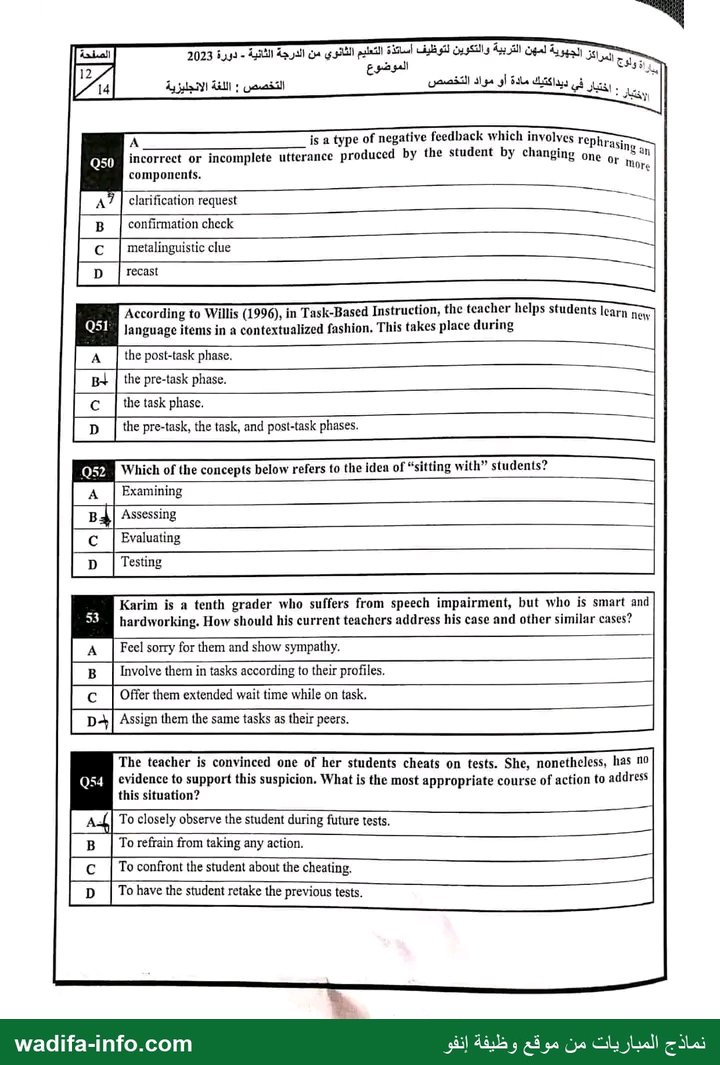
À is a type of negative feedback which involves rephrasne>
COEUR incorrect or incomplete utterance produced by the student by changing one or ne
components. ع
metalinguistic clue
05 language items in a contextualized fashion. This takes place during
the post-task phase.
B+ | the pre-task phase. dd
the task phase.
EX the pre-task, the task, and post-task phases. 7
Examining
| 84 Assessing
Evaluating
| | Testing
Karim is a tenth grader who suffers from speech impairment, but who is smart and
لق hardworking. How should his current teachers address his case and other similar cases?
Feel sorry for them and show sympathy.
| 8 | Involve them in tasks according to their profiles.
Offer them extended wait time while on task.
(LR cvidence to support this suspicion. What is the most appropriate course of action to address
this situation?
> 2023 يجيج «ديجججمن الدرجة الثانية + دورة
| اساتذة التعليم الثانوي من الدرجة الثانية لص OR والتكوين ET RP مباراة ولوج المرار الجودية
| 2 التخغصص : اللئة الانجلبزية Era
| الاختيار : اختبار في ديداكتبك مادة أو مواد التخصمص
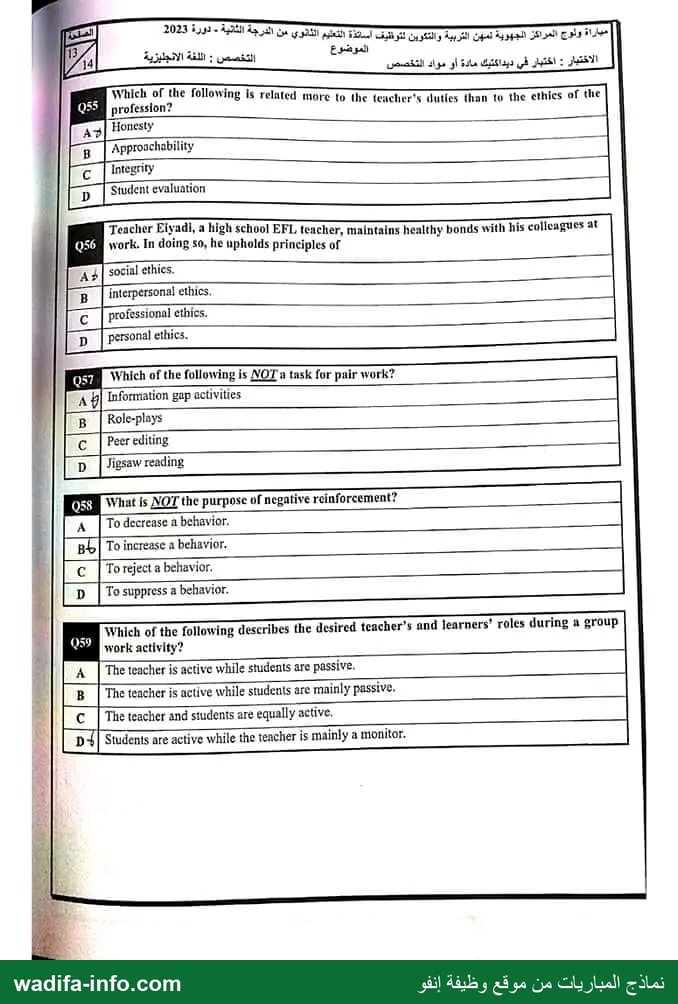
| Which of the followi
١ م ال 011108 Îs related more to the teacher*s duties than to the ethics of the
| pas Honesty
ا ا Approachability
Teacher Eiyadi, a high school EFL teach q 1 0 at
PA 101110 doing 50, he upholds principles 0 malntains healthy bonds with his colleagues
| EE social ethies.
| [8 | interpersonal ethics.
| 3 professional ethics.
| 057 MU of the following is NOT a task for pair work?
Fan papas —
Î [8 | Role-plays
Peer editing
[n. Jigsaw reading
| از What is NOT the purpose of negative reinforcement?
To decrease a behavior.
| اا To increase a behavior.
To reject a behavior.
EX To suppress a behavior.
6 05 Which of the following describes the dcsired teacher's and learners' roles during a group
| ليع vork activity?
The teacher is active while students are passive.
L. Ex The teacher is active while students are mainly passive,
= The teacher and students are equally active.
À نت Students are active while the teacher is mainly a monitor.
الت
الأ
ددا
wadifa-i TC ون ل ل :
ifa-info.com نماذج المباريات من موقع وظيفة إنفو
TD حي ج المراكز الجهوية لمهن التربية والتكوين لن
ET 2023 مباراة ولوج المراكز الجهوية لمهن التربية والتكوين لتوظيف أسائذة التعليم الثانوي من الدرجة الثانية - دورة
3 555 - 29 : |
FA الاختبار : اختبار في ديداكتيك مادة او مواد التخصمصس الموضوع
التخصص : اللغة الاتجليزية
ic ft 5 wc
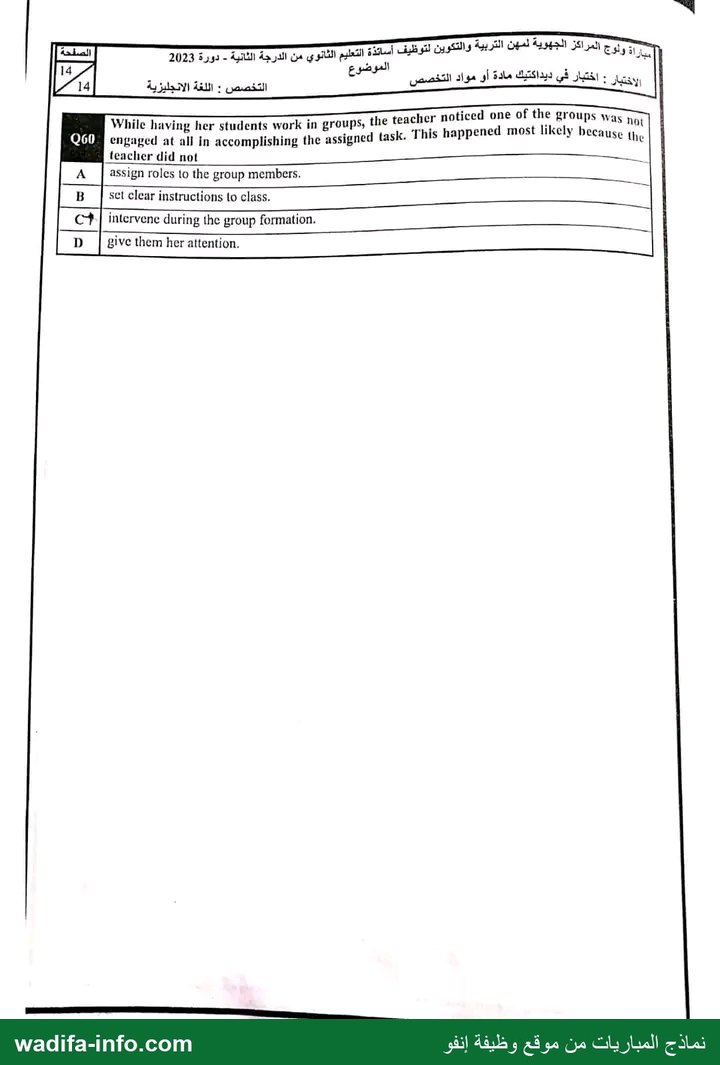
CITE engage at all in accomplishing the assigned task. fe
SR COQ —
A | assign roles to the group members. se |
Ro ...ا ححا ا ا
B set clear instructions lo class.
ب بوت م بم ل[ت يا —
4.١ intervene during the group formation. _
ل 08008 مضع 1 00118 نمم امه
D |givethem her attention.
wadifa-info.com ج المباريات من موقع وظيفة إنفو
Correction proposée
Il s'agit d'une correction proposée, rédigée par l'équipe wadifa-info pour vous aider à comprendre la méthode — ce n'est pas un corrigé officiel de l'administration organisatrice.
This paper is the specialty didactics test (English) of the CRMEF entrance exam for recruiting secondary school teachers, 2nd grade — Ministry of National Education, Preschool and Sports, 2023 session. Duration: 2 hours, coefficient 12. It contains 60 multiple-choice questions (Q1–Q60), four options each, one correct answer, 1 point per question (total 60). Below is a proposed correction with a one-line justification for each answer.
💡 Method: many items are phrased in the negative (NOT). Read the stem twice, then eliminate the three options that are true. In scenario items (Teacher X does…), choose the option that reflects learner-centred, inclusive practice — that is the logic of the Moroccan English guidelines and of the training curriculum.
Q1 – Q10: curriculum, syllabus and methods
- Q1 — C (Syllabus). A syllabus is the list of content (and its sequencing) for a given course; the curriculum is the wider framework (goals, content, methods, assessment).
- Q2 — A (Participating in a group discussion). Learners construct and negotiate meaning themselves; listening to the teacher (B) is passive, and replicating a dialogue (C) or an individual worksheet (D) are mechanical practice.
- Q3 — B (Grammar-Translation). The mother tongue is the medium of instruction and of translation; the Direct Method, ALM and TPR all avoid it.
- Q4 — D (To provide a framework for teaching and learning). The curriculum sets goals, content, methods and assessment; the other options are narrow or wrong.
- Q5 — D (Detailed lesson plans). Goals, assessment strategies and an educational philosophy (rationale) belong to the curriculum; detailed lesson plans are written by the teacher from it.
- Q6 — B (Explaining language items to students). Teacher explanation is a teacher-centred practice; problem solving, inquiry and cooperation are learner-centred.
- Q7 — D (the Communicative Approach). CLT stresses use over form and adopts a functional (notional-functional) syllabus.
- Q8 — Probable answer: B (The Silent Way). In the classic description of the Silent Way, the general goal is near-native fluency and correct pronunciation and the prosody of the language are worked on from the very beginning. The Audio-Lingual Method (C) also values accurate pronunciation, but its goal is the formation of correct habits, not fluency "in the long run".
- Q9 — A (Significant reliance on the teacher's explanation). This is the opposite of active learning; B, C and D are its benefits.
- Q10 — A (Using the target language as the only means of instruction). The defining principle of the Direct Method: no translation, meaning conveyed through demonstration and realia.
Q11 – Q20: approaches, competences and learner-centredness
- Q11 — B (Task-Based Language Teaching). TBLT is one specific approach; post-method pedagogy, the eclectic approach and principled eclecticism all combine methods according to what works in the context.
- Q12 — Probable answer: C (Case-based learning). The teacher hands each group a written situation (a realistic case) and a task: analyse it, research the costs, produce and present a solution. That is the structure of case-based learning. Inquiry-based learning (A) would start from a question raised by the learners themselves.
- Q13 — C (Constructivism). Discovery learning (Bruner) has learners build knowledge by exploring; it is the standard example of a constructivist approach. Social constructivism (D) puts the stress on interaction, which the stem does not mention.
- Q14 — B (discourse competence). In the Canale & Swain model, coherence and cohesion across sentences are part of discourse competence.
- Q15 — C (Educational philosophy). Pedagogy is the general science/philosophy of education; didactics deals with the teaching of a given subject (planning, methods, assessment).
- Q16 — D (a means of achieving real-world goals). TBLT sees language as a tool to get things done; A and C reflect structural and behaviourist views.
- Q17 — A (take into account learners' effort in assessment). CBE assesses demonstrated performance against explicit criteria, not effort; B, C and D are features of CBE.
- Q18 — A (learner-centeredness). Letting learners choose activities and groups that fit their profiles places the learner at the centre (choice, differentiation).
- Q19 — D (Disregard the student's discomfort and assign her to one of the groups). Ignoring the learner's feelings is not appropriate; A, B and C support her gradually.
- Q20 — B (The one who does not seek guidance when needed). Autonomous learners take charge of their learning, which includes knowing when to ask for help.
Q21 – Q30: classroom management, skills, ICT
- Q21 — B (a heterogeneous class). A mixed-ability class is a heterogeneous class.
- Q22 — C (Receptive tasks take less time than productive ones). This is not why receptive work comes first; the real reasons are comprehension before production (A), more accurate output (B) and not overwhelming learners (D).
- Q23 — A (Cognitivism). Limiting the number of new forms per lesson respects working-memory limits (cognitive load), a cognitivist principle.
- Q24 — C (Relying on external motivation). Self-regulated learning rests on goal setting, monitoring and adjusting strategies, driven by internal motivation.
- Q25 — D (Ensure task distribution among all the group members). Giving each member a role creates individual accountability and prevents "free riding".
- Q26 — Probable answer: D (a video of the double-decker bus). A video gives the fullest picture (shape, two decks, movement, context) and is the most memorable; a picture (A) also works but carries less information, and a sound (B) or an oral explanation (C) are less effective.
- Q27 — B (Summarizing). Summarizing requires the learner to produce language; categorizing, verifying and identifying are reception tasks.
- Q28 — C (The teacher's concern is to cover the course content). Focus on the syllabus rather than on learners is teacher-centred; A, B and D are learner-oriented practices.
- Q29 — C (Listening materials related to other subjects, such as science). This serves the Connections standard, not Cultures; A, B and D all bring in other cultures.
- Q30 — B (Real-time video conferencing). Synchronous means "at the same time"; an app, a forum and e-mail are asynchronous.
Q31 – Q40: blended learning, reading, skills
- Q31 — A (They complement face-to-face instruction). Blended learning combines online and face-to-face work; it does not replace class teaching.
- Q32 — A (read a substantial number of texts). Extensive reading = reading a lot, for pleasure and general meaning; B, C and D describe intensive reading.
- Q33 — A (develop learning strategies). Metacognition is thinking about one's own learning: planning, monitoring and evaluating the strategies one uses.
- Q34 — B (flipped instruction). Studying the input at home and doing the active work in class is known as flipped instruction (the flipped classroom).
- Q35 — A (Offering them time to think before answering questions). Wait time supports introverts without forcing exposure (B), constant pairing (C) or exclusion (D).
- Q36 — D (Identifying main idea and details). This is a reading/listening sub-skill; intonation, discourse markers and pitch are speaking sub-skills.
- Q37 — D (offering social-emotional learning instruction). Managing emotions, building relationships and making responsible decisions are the core SEL competencies.
- Q38 — Probable answer: C (Transferring information from text to chart). Information transfer from a text to a chart is a reading-comprehension activity; using a text structure suited to the format (A), completing a dialogue in writing (B) and writing an email (D) belong to writing.
- Q39 — B (speaking as transaction). Richards' three functions of speaking: talk as interaction, talk as transaction, talk as performance.
- Q40 — Probable answer: B (Relevance to the projected learning outcomes). When a teacher supplements the textbook, the first filter is whether the passage serves the lesson objectives; level (D), length/complexity (A) and interest (C) are then used to choose among relevant texts.
Q41 – Q50: assessment, cognition, feedback
- Q41 — C (An exam at the end of the semester). Summative assessment measures learning at the end of a period, for certification.
- Q42 — C (Public speaking). Performance-based assessment asks learners to perform a real task; A, B and D are discrete-point exercises.
- Q43 — Probable answer: A (Setting remedial instruction goals). The usual cycle is diagnose → set remedial goals → devise the plan → deliver it → evaluate progress; goal setting comes right after the data are gathered and analysed.
- Q44 — A (washback). The influence of a test on teaching (content, format, focus) is the washback (backwash) effect.
- Q45 — D (executive function). Goal setting, prioritising, planning, organising, time management and self-regulation are executive functions.
- Q46 — A (Accepting their mistakes and celebrating small victories). It builds self-efficacy; comparing themselves to others (B), fixating on mistakes (C) or goals "at all costs" (D) discourage weak learners.
- Q47 — B (Design tasks for the different stages of reading). An effective reading lesson is planned in pre-, while- and post-reading stages.
- Q48 — Probable answer: C (Inhibition of their cognitive development). Family problems typically disturb concentration, planning and motivation (A, B, D); "inhibiting cognitive development" is too strong and is not the usual effect described.
- Q49 — Probable answer: D (Descriptors). "Learners can…" statements describing what learners can do at a given level are can-do descriptors (as in the CEFR). Learning outcomes (B) are usually written for a specific unit or lesson.
- Q50 — D (recast). A recast reformulates the learner's erroneous utterance correctly, changing one or more components, without stopping communication.
Q51 – Q60: TBL, inclusion, ethics, group work
- Q51 — Probable answer: B (the pre-task phase). In Willis's framework (1996), the teacher introduces the topic in the pre-task phase and highlights useful words and phrases in context. Explicit analysis and practice of forms come later, in the language-focus stage.
- Q52 — B (Assessing). "Assess" comes from the Latin assidere, "to sit beside".
- Q53 — Probable answer: B (Involve them in tasks according to their profiles). Inclusion means adapting tasks to each learner's needs and strengths; pity (A) and identical tasks (D) are not inclusive, and wait time (C) is only one possible adaptation.
- Q54 — A (To closely observe the student during future tests). Without evidence, the teacher must not accuse (C) or penalise (D) but must not ignore it (B) either: observe and collect evidence.
- Q55 — D (Student evaluation). Evaluating students is a professional duty; honesty, approachability and integrity are ethical values.
- Q56 — C (professional ethics). Collegial relationships at work fall under professional ethics, which govern conduct towards colleagues as well as learners.
- Q57 — D (Jigsaw reading). Jigsaw is a group technique (expert groups, then home groups); information gaps, role-plays and peer editing are typical pair work.
- Q58 — Flawed item. Expected answer: A (To decrease a behavior). Negative reinforcement removes an unpleasant stimulus so that a behaviour increases (B is its purpose). Because of the "NOT", options A, C and D are all strictly correct. The examiners most likely wanted A, the classic confusion between negative reinforcement and punishment.
- Q59 — D (Students are active while the teacher is mainly a monitor). In group work the teacher monitors and facilitates; the learners do the work.
- Q60 — A (assign roles to the group members). The other groups worked, so the instructions were clear; a group that does nothing at all usually has no individual roles or accountability.
Answer key
| Q | Ans. | Q | Ans. | Q | Ans. | Q | Ans. | Q | Ans. | Q | Ans. |
|---|---|---|---|---|---|---|---|---|---|---|---|
| 1 | C | 11 | B | 21 | B | 31 | A | 41 | C | 51 | B* |
| 2 | A | 12 | C* | 22 | C | 32 | A | 42 | C | 52 | B |
| 3 | B | 13 | C | 23 | A | 33 | A | 43 | A* | 53 | B* |
| 4 | D | 14 | B | 24 | C | 34 | B | 44 | A | 54 | A |
| 5 | D | 15 | C | 25 | D | 35 | A | 45 | D | 55 | D |
| 6 | B | 16 | D | 26 | D* | 36 | D | 46 | A | 56 | C |
| 7 | D | 17 | A | 27 | B | 37 | D | 47 | B | 57 | D |
| 8 | B* | 18 | A | 28 | C | 38 | C* | 48 | C* | 58 | A* |
| 9 | A | 19 | D | 29 | C | 39 | B | 49 | D* | 59 | D |
| 10 | A | 20 | B | 30 | B | 40 | B* | 50 | D | 60 | A |
* probable answer (see the justification above).
Questions fréquentes sur ce sujet
Ce sujet est-il téléchargeable gratuitement ?
Le corrigé est-il inclus ?
Quel organisme et quel grade concerne ce sujet ?
De quelle session s'agit-il et dans quelle langue ?
Où trouver d'autres sujets du même concours ?
Vous préparez ce concours ?
Modèles similaires
Organisme : Centres régionaux des métiers de l'éducation et de la formation (CRMEF) — Ministère de l'Éducation nationale, du Préscolaire et des Sports · Session 2023 — Copie issue de : archive de modèles de concours — document archivé tel que reçu ; l'avis officiel du concours fait foi.
}Citer cette page
Journaliste, blogueur, enseignant : copiez la référence ci-dessous et mettez un lien vers cette page.
Adresse permanente : https://www.wadifa-info.com/fr/modele-concours/2192/modele-de-concours-professeurs-de-l-enseignement-secondaire-2e-grade-crmef-anglais-epreu