
Modèle de concours d'accès — CNAEM (écoles de management) — filières ECT et ECS — session 2014 — anglais
⬇️ Télécharger le PDF Adresse permanente : wadifa-info.com/fr/modele-concours/5506
En bref
Ce document est une ancienne épreuve écrite du concours de 1re année des écoles de management (après CPGE) organisé par Concours National d'Accès aux Écoles de Management (CNAEM — ENCG / ISCAE) (2014), publiée sur Wadifa Info en consultation et téléchargement PDF gratuits.
- Organisme
- Concours National d'Accès aux Écoles de Management (CNAEM — ENCG / ISCAE)
- Grade
- 1re année des écoles de management (après CPGE)
- Spécialité
- filières ECT et ECS
- Année
- 2014
- Pages
- 1
- Langue des questions
- français
- Correction
- pas encore disponible
- Ajouté au site
- 19/11/2026
Pages du modèle (1)
Questions fréquentes : Modèle de concours d'accès — CNAEM (écoles de management) — filières ECT et ECS — session 2014 — anglais
Le sujet du concours « 1re année des écoles de management (après CPGE) » est-il téléchargeable gratuitement ?
Le corrigé est-il inclus avec le sujet du concours « 1re année des écoles de management (après CPGE) » ?
Quel organisme et quel grade concerne ce sujet ?
De quelle session s'agit-il et dans quelle langue ?
Où trouver d'autres sujets du même concours ?
📝 Texte des questions (extrait automatiquement des pages scannées)
Ce texte est extrait automatiquement des images de l'épreuve et peut contenir des erreurs de lecture — les images ci-dessus font foi.
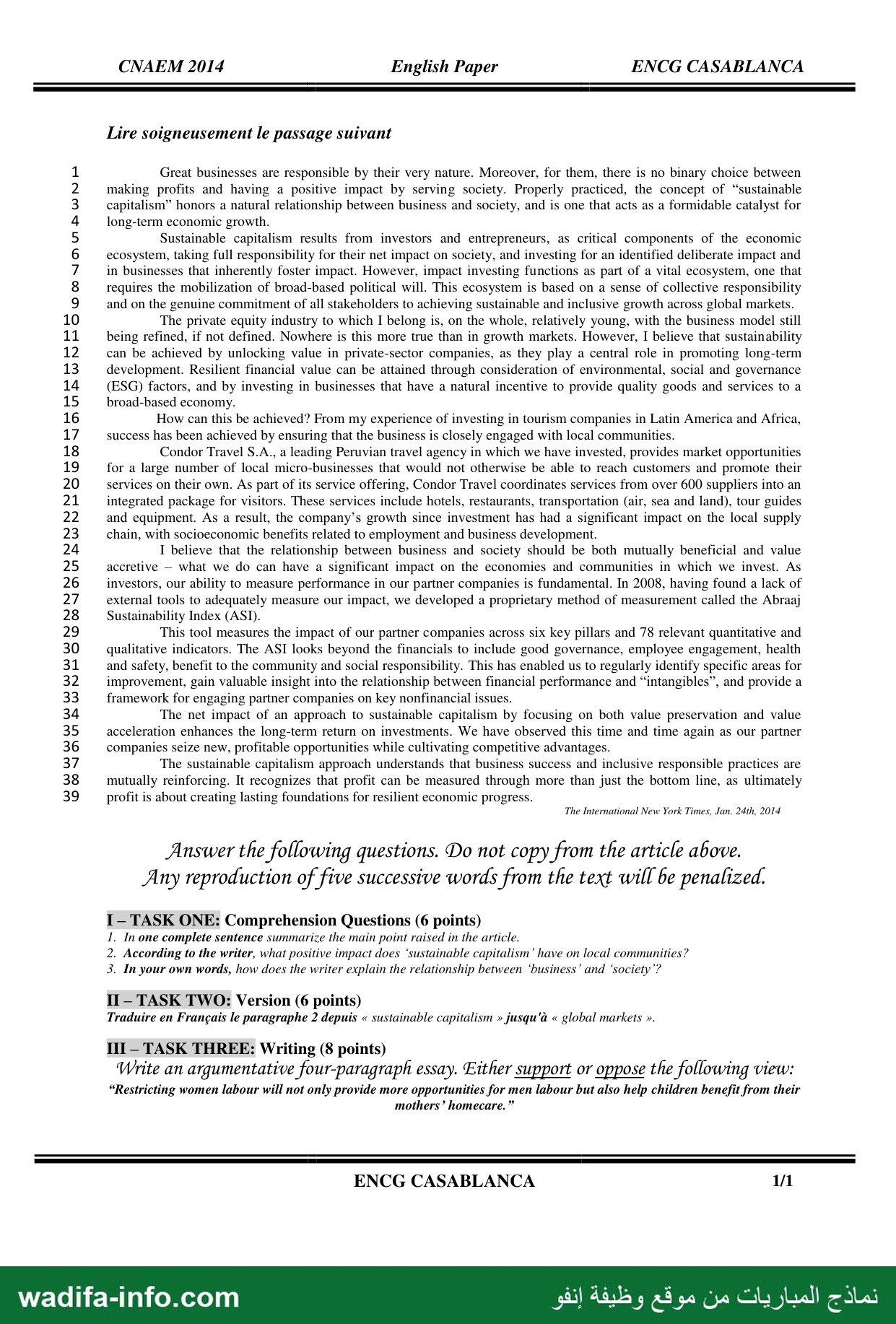
— صفحة 1 — CNAEM 2014 English Paper ENCG CASABLANCA Lire soigneusement le passage suivant Great businesses are responsible by their very nature. Moreover, for them, there is no binary choice between making profits and having a positive impact by serving society. Properly practiced, the concept of “sustainable capitalism” honors a natural relationship between business and society, and is one that acts as a formidable catalyst for long-term economic growth. Sustainable capitalism results from investors and entrepreneurs, as critical components of the economic ecosystem, taking full responsibility for their net impact on society, and investing for an identified deliberate impact and in businesses that inherently foster impact. However, impact investing functions as part of a vital ecosystem, one that requires the mobilization of broad-based political will. This ecosystem is based on a sense of collective responsibility and on the genuine commitment of all stakeholders to achieving sustainable and inclusive growth across global markets. The private equity industry to which 1 belong is, on the whole, relatively young, with the business model still being refined, if not defined. Nowhere is this more true than in growth markets. However, I believe that sustainability can be achieved by unlocking value in private-sector companies, as they play a central role in promoting long-term development. Resilient financial value can be attained through consideration of environmental, social and governance (ESG) factors, and by investing in businesses that have a natural incentive to provide quality goods and services to a broad-based economy. How can this be achieved? From my experience of investing in tourism companies in Latin America and Africa, success has been achieved by ensuring that the business is closely engaged with local communities. Condor Travel S.A., a leading Peruvian travel agency in which we have invested, provides market opportunities for a large number of local micro-businesses that would not otherwise be able to reach customers and promote their services on their own. As part of its service offering, Condor Travel coordinates services from over 600 suppliers into an integrated package for visitors. These services include hotels, restaurants, transportation (air, sea and land), tour guides and equipment. As a result, the company’s growth since investment has had a significant impact on the local supply chain, with socioeconomic benefits related to employment and business development. 1 believe that the relationship between business and society should be both mutually beneficial and value accretive — what we do can have a significant impact on the economies and communities in which we invest. As investors, our ability to measure performance in our partner companies is fundamental. In 2008, having found a lack of external tools to adequately measure our impact, we developed a proprietary method of measurement called the Abraaj Sustainability Index (ASD). This tool measures the impact of our partner companies across six key pillars and 78 relevant quantitative and qualitative indicators. The ASI looks beyond the financials to include good governance, employee engagement, health and safety, benefit to the community and social responsibility. This has enabled us to regularly identify specific areas for improvement, gain valuable insight into the relationship between financial performance and “intangibles”, and provide a framework for engaging partner companies on key nonfinancial issues. The net impact of an approach to sustainable capitalism by focusing on both value preservation and value acceleration enhances the long-term return on investments. We have observed this time and time again as our partner companies seize new, profitable opportunities while cultivating competitive advantages. The sustainable capitalism approach understands that business success and inclusive responsible practices are mutually reinforcing. It recognizes that profit can be measured through more than just the bottom line, as ultimately profit is about creating lasting foundations for resilient economic progress. The International New York Times, Jan. 241h, 2014 Answer the following questions. Do not copy from the article above. Any reproduction of five successive words from the text will 6e penalized. I1- TASK ONE: Comprehension Questions (6 points) 1. In one complete sentence summarize the main point raised in the article. 2. According to the writer, what positive impact does ‘sustainable capitalism” have on local communities ? 3. In your own words, how does the writer explain the relationship between ‘business’ and ‘society "? IL - TASK TWO: Version (6 points) Traduire en Français le paragraphe 2 depuis « sustainable capitalism » jusqu'à « global markets ». 111 - TASK THREE: Writing (8 points) Write an argumentative four-paragraph essay. Either support or oppose the following view: “Restricting women labour will not only provide more opportunities for men labour but also help children benefit from their mothers’ homecare.” ENCG CASABLANCA 1/1 حر يح رن كذ 0٠ U1 + 00 مي
🔗 Citer ce sujet sur votre site, blog ou forum
Copiez ce lien (le PDF reste à jour sur la page) :
Vous préparez ce concours ?
Modèles similaires
Organisme : Concours National d'Accès aux Écoles de Management (CNAEM — ENCG / ISCAE) · 2014 — Copie issue de : concours d'accès aux écoles et instituts supérieurs — document archivé tel que reçu ; l'avis officiel du concours fait foi.
}Citer cette page
Journaliste, blogueur, enseignant : copiez la référence ci-dessous et mettez un lien vers cette page.
Adresse permanente : https://www.wadifa-info.com/fr/modele-concours/5506/modele-de-concours-d-acces-cnaem-ecoles-de-management-filieres-ect-et-ecs-session-2014-ang