

نموذج مباراة ولوج المعهد العالي للإعلام والاتصال ISIC 2008 - اللغة الإنجليزية
⬇️ تحميل PDF الرابط الدائم: wadifa-info.com/نموذج-مباراة/2589
باختصار
هذا نموذج امتحان كتابي سابق لمباراة طالب - سلك الإجازة في الصحافة والاتصال لدى المعهد العالي للإعلام والاتصال ISIC - الرباط (2008)، منشور على وظيفة إنفو للاطلاع والتحميل المجاني بصيغة PDF مع تصحيح مقترح.
- الجهة المنظمة
- المعهد العالي للإعلام والاتصال ISIC - الرباط
- الدرجة
- طالب - سلك الإجازة في الصحافة والاتصال
- التخصص
- اللغة الإنجليزية
- الدورة
- 2008
- عدد الصفحات
- 2
- لغة الأسئلة
- الفرنسية
- التصحيح
- تصحيح مقترح متوفر في هذه الصفحة
📝 نص أسئلة النموذج (مستخرج آلياً من الصفحات الممسوحة)
استُخرج هذا النص آلياً من صور الامتحان وقد يحتوي على أخطاء في القراءة — الصور أعلاه هي المرجع.
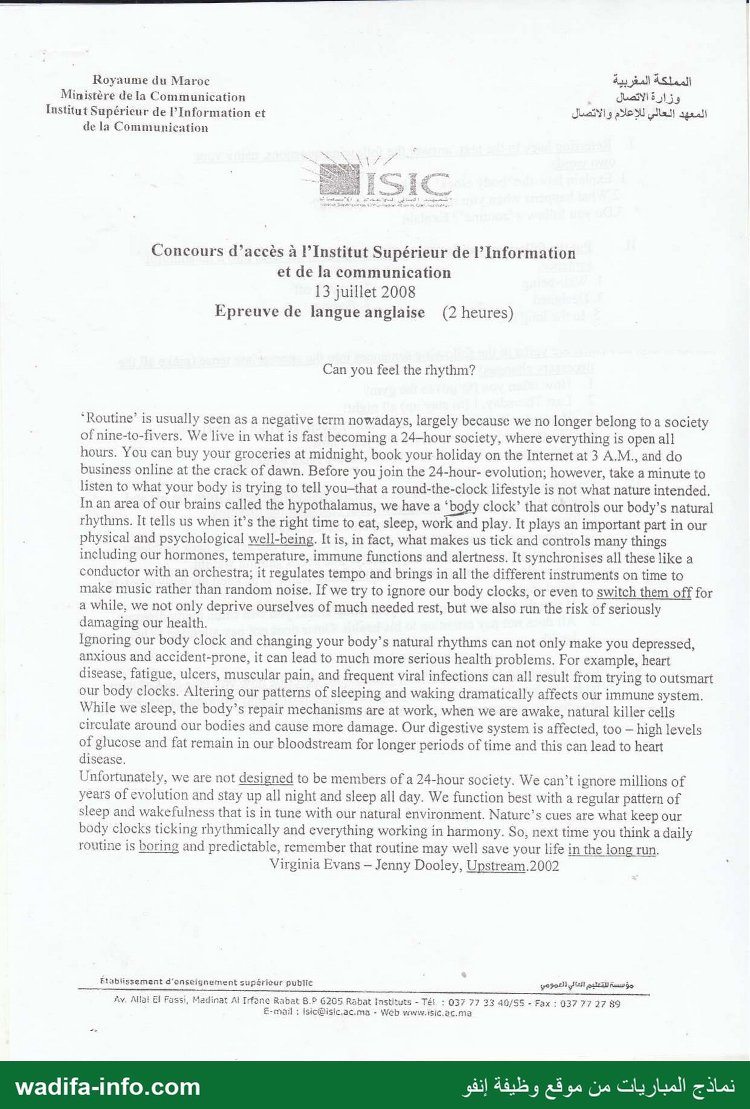
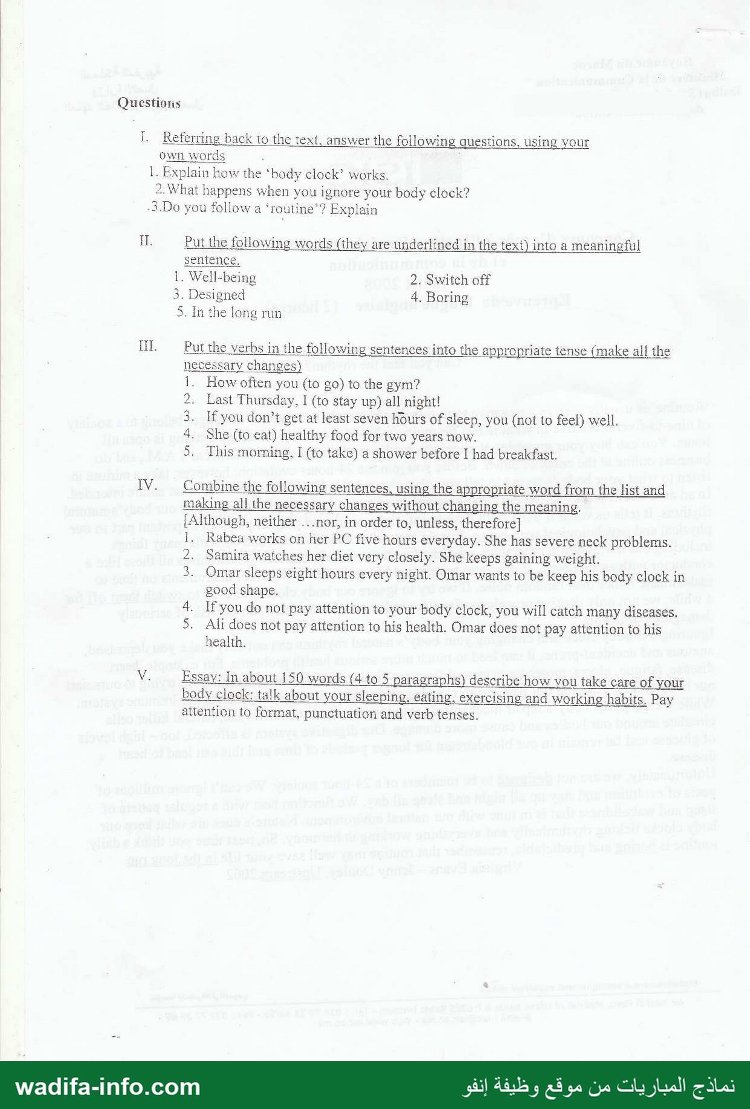
EEE «de Royaume du Maroc المملكة المغربية Ministère de la Communication وزارة الاتصال Institut Supérieur de l'Information et المعهد العالي للإعلام والاتصال de la Communication ass سن له ا FIST Concours d’accès à PInstitut Supérieur de Information et de la communication 13 juillet 2008 Epreuve de langue anglaise (2 heures) Can you feel the rhythm? “Routine’ is usually seen as a negative term nowadays, largely because we no longer belong to a society ofnine-to-fivers. We live in what is fast becoming a 24-hour society, where everything is open all hours. You can buy your groceries at midnight, book your holiday on the Internet at 3 A.M., and do business online at the crack of dawn. Before you join the 24-hour- evolution; however, take a minute to listen to what your body is trying to tell you-that a round-the-clock lifestyle is not what nature intended, In an area of our brains called the hypothalamus, we have a “body clock’ that controls our body’s natural rhythms. It tells us when it’s the right time to eat, sleep, work and play. It plays an important part in our physical and psychological well-being. It is, in fact, what makes us tick and controls many things including our hormones, temperature, immune functions and alertness. It synchronises all these like a conductor with an orchestra; it regulates tempo and brings in all the different instruments on time to make music rather than random noise, If we try to ignore our body clocks, or even to switch them off for a While, we not only deprive ourselves of much needed rest, but we also run the risk of seriously damaging our health. Ignoring our body clock and changing your body’s natural rhythms can not only make you depressed, anxious and accident-prone, it can lead to much more serious health problems. For example, heart disease, fatigue, ulcers, muscular pain, and frequent viral infections can all result from trying to outsmart our body clocks. Altering our patterns of sleeping and waking dramatically affects our immune system. While we sleep, the body?s repair mechanisms are at work, when we are awake, natural killer cells circulate around our bodies and cause more damage. Our digestive system is affected, too — high levels of glucose and fat remain in our bloodstream for longer periods of time and this can lead to heart disease. Unfortunately, we are not designed to be members of a 24-hour society. We can't ignore millions of years of evolution and stay up all night and sleep all day. We function best with a regular pattern of sleep and wakefulness that is in tune with our natural environment. Naturc’s cues are what keep our body clocks ticking rhythmically and everything working in harmony. So, next time you think a daily routine is boring and predictable, remember that routine may well save your life in the long run. Virginia Evans — Jenny Dooley, Upstream.2002 k Établissement d'onscignement supérieur public : مؤسسة للتعليم العالي العمومي ل Av, Not El ,أككدة Madinat Al Trance Rabat 8.9 6205 Rabat Instituts - Tét : 037 77 25 40/55 - Fax : 037 77 27 و E-mail : [email protected] - Wéb vawmw.isic.oc.ma wadifa-info.com نماذج المباريات من موقع وظيفة إنفو Questions 1. Referring back م the text, answer the following questions, using vour 1 Explain how the ‘body clock’ works. 2. What happens when vou ignore your body clock? -3.Do you follow a ‘routine’? Explain IT. Put the following words (they are underlined in the text) into a meaningful 1. Well-being 2. Switch off 3. Designed 4, Boring 5. In the long run D. عباس عمط verbs in the following sentences into the appropriate tense make al! the 1. Howoften you (to go) to the gym? 2. Last Thursday. I (to stay up) all night! 3. If you don’t get at least seven Hours of sleep, you (not to feel) well. 4. She (to eat) healthy food for two years now. 5. This moming. I (to teke) a shower before 1 had breakfast. IV. Combine the following sentences, using the appropriate word from the fist and making all the necessary changes without changing the meaning. {Although, neither …nor, in order to, unless, therefore] 1. Rabea works on her PC five hours everyday. She has severe neck préblems. 2. Samira watches her diet very closely. She keeps geining weight. 3. Omar sleeps eight hours cvery night. Omar wants to be Keep his body clock in good shape. 4. IF you do not pay attention to your body clock, you will catch many diseases. 5. Ali does not pay attention to his health. Omar does not pay attention to his health. V. Essay: In about 150 words {d to 5 paragraphs) describe how vou take care of your body clock: talk about vour sleeping. eating. exercising and working habits. Pay attention to format, punctuatien and verb tenses. نماذج المباريات من موقع وظيفة إنفو wadifa-info.com
التصحيح المقترح
هذا تصحيح مقترح من إعداد فريق wadifa-info لمساعدتك على فهم منهجية الإجابة — وليس تصحيحاً رسمياً صادراً عن الإدارة المنظِّمة. أسئلة هذا الامتحان محررة بالفرنسية، لذلك التصحيح محرر بالفرنسية أيضاً.
Ce modèle est l'épreuve de langue anglaise du concours d'accès à l'Institut Supérieur de l'Information et de la Communication (ISIC, Rabat), session du 13 juillet 2008, durée 2 heures. Elle porte sur un texte intitulé Can you feel the rhythm? (Virginia Evans – Jenny Dooley, Upstream, 2002) consacré à l'horloge biologique, suivi de cinq exercices : compréhension, emploi de mots, temps verbaux, connecteurs et un essai de 150 mots. Les explications sont en français, les réponses en anglais.
💡 « Using your own words » : le correcteur pénalise le recopiage de phrases entières du texte. Reprenez les idées, mais reformulez avec votre propre vocabulaire et des phrases courtes et correctes.
I. Compréhension (answer in your own words)
1. Explain how the 'body clock' works.
The body clock is located in a part of the brain called the hypothalamus. It controls our natural rhythms: it tells us when it is time to eat, sleep, work and play. It also coordinates many functions such as hormones, body temperature, the immune system and alertness. The writer compares it to the conductor of an orchestra, who makes all the instruments play together at the right time.
2. What happens when you ignore your body clock?
If we ignore our body clock, we lose the rest we need and we put our health in danger. We may become depressed, anxious and more likely to have accidents. In the long term, we may suffer from serious illnesses such as heart disease, ulcers, tiredness, muscle pain and frequent viral infections. Our immune system becomes weaker, because the cells that repair the body work while we sleep, and our digestion is disturbed: sugar and fat stay longer in the blood, which can cause heart disease.
3. Do you follow a 'routine'? Explain.
Question personnelle : donnez une position claire et deux ou trois exemples concrets. Exemple : Yes, I try to follow a routine. I go to bed at about 11 p.m. and get up at 7 a.m., even at the weekend. I have breakfast every morning and I avoid eating late at night. Since I started this routine, I feel less tired and I concentrate better in class.
II. Put the words into a meaningful sentence
- Well-being (bien-être) : Regular exercise and enough sleep are essential for our physical and mental well-being.
- Switch off (éteindre / déconnecter) : Please switch off your phone before the exam starts.
- Designed (conçu) : This program was designed to help students revise for their exams.
- Boring (ennuyeux) : The film was so boring that I fell asleep before the end.
- In the long run (à long terme) : Saving a little money every month will help you in the long run.
III. Put the verbs into the appropriate tense
- How often do you go to the gym? — présent simple : habitude (« how often »), interrogation avec do.
- Last Thursday, I stayed up all night! — prétérit : moment passé daté (« last Thursday »).
- If you don't get at least seven hours of sleep, you won't feel well. — conditionnel de type 1 : présent après if, futur dans la principale.
- She has been eating healthy food for two years now. — present perfect continu : action commencée dans le passé et qui dure encore (« for … now ») ; has eaten est aussi accepté.
- This morning, I took a shower before I had breakfast. — prétérit (succession d'actions passées) ; had taken (past perfect) est aussi correct pour marquer l'antériorité.
IV. Combine the sentences (although, neither … nor, in order to, unless, therefore)
- Rabea works on her PC five hours every day; therefore, she has severe neck problems. — relation de cause à conséquence.
- Although Samira watches her diet very closely, she keeps gaining weight. — opposition.
- Omar sleeps eight hours every night in order to keep his body clock in good shape. — but (la phrase de l'énoncé contient une coquille : « wants to be keep »).
- Unless you pay attention to your body clock, you will catch many diseases. — unless = if … not : on supprime la négation.
- Neither Ali nor Omar pays attention to his health. — les deux négations disparaissent ; le verbe s'accorde au singulier avec le sujet le plus proche (Omar).
V. Essay (about 150 words, 4 to 5 paragraphs)
💡 Le sujet impose quatre volets : sommeil, alimentation, exercice, travail. Un paragraphe par volet, plus une introduction et une conclusion courtes. Utilisez surtout le présent simple (habitudes) et des adverbes de fréquence (always, usually, often, rarely).
Model answer :
I believe that a healthy routine is the key to a balanced life, so I try to respect my body clock every day.
First, I take my sleep seriously. I usually go to bed at eleven and wake up at seven, even at the weekend. I avoid using my phone in bed because the screen keeps me awake.
Second, I eat three regular meals a day. I never skip breakfast, and I try to eat fruit and vegetables instead of fast food. I also drink a lot of water and avoid eating late at night.
Third, I exercise three times a week. I go jogging on Saturday mornings and I play football with my friends on Wednesdays. Exercise helps me relax and sleep better.
Finally, I organise my work. I study in the morning, when I am most alert, and I take short breaks every hour. Thanks to these habits, I feel more energetic and I get better results.
أسئلة شائعة حول هذا النموذج
هل يمكن تحميل هذا النموذج مجاناً؟
هل يتضمن هذا النموذج التصحيح؟
ما هي الجهة المنظمة والدرجة المعنية بهذا النموذج؟
ما هي دورة هذا الامتحان ولغة أسئلته؟
أين أجد نماذج أخرى لنفس المباراة؟
ناقش هذا النموذج (0)
شارك إجاباتك أو صحّح التصحيح — إذا كان لديك رأي مختلف حول أي نقطة، اكتبه هنا ليستفيد باقي المترشحين.
لا يوجد نقاش بعد — شارك إجابتك أو سؤالك حول هذا النموذج.
⚠️ ممنوع نشر أرقام الهاتف أو الروابط أو أي عرض مقابل مال — تُحذف هذه المشاركات تلقائياً.
هل تحضّر لهذه المباراة؟
نماذج مشابهة قد تهمّك
الجهة المنظمة: المعهد العالي للإعلام والاتصال ISIC - الرباط · 2008 — مصدر النسخة: وثائق منشورة للعموم (alloschool / Scribd)؛ الإعلان الرسمي للمباراة هو المرجع.
كيف تستشهد بهذه الصفحة؟
صحفي أو مدوّن أو أستاذ؟ انسخ المرجع أسفله وضع رابطاً نحو هذه الصفحة.
الرابط الدائم: https://www.wadifa-info.com/نموذج-مباراة/2589/نموذج-مباراة-ولوج-المعهد-العالي-للإعلام-والاتصال-ISIC-2008-اللغة-الإنجليزية