

نموذج المباراة الوطنية المشتركة CNC 2007: اللغة الإنجليزية - شعبة MP/PSI/TSI/BCPST لولوج مدارس المهندسين
⬇️ تحميل PDF الرابط الدائم: wadifa-info.com/نموذج-مباراة/2551
باختصار
هذا نموذج امتحان كتابي سابق لمباراة طالب - الأقسام التحضيرية العلمية لدى وزارة التعليم العالي - المباراة الوطنية المشتركة لولوج مدارس المهندسين (1 يونيو 2007)، منشور على وظيفة إنفو للاطلاع والتحميل المجاني بصيغة PDF مع تصحيح مقترح.
- الجهة المنظمة
- وزارة التعليم العالي - المباراة الوطنية المشتركة لولوج مدارس المهندسين
- الدرجة
- طالب - الأقسام التحضيرية العلمية
- التخصص
- اللغة الإنجليزية
- الدورة
- 1 يونيو 2007
- عدد الصفحات
- 3
- لغة الأسئلة
- الفرنسية
- التصحيح
- تصحيح مقترح متوفر في هذه الصفحة
📝 نص أسئلة النموذج (مستخرج آلياً من الصفحات الممسوحة)
استُخرج هذا النص آلياً من صور الامتحان وقد يحتوي على أخطاء في القراءة — الصور أعلاه هي المرجع.
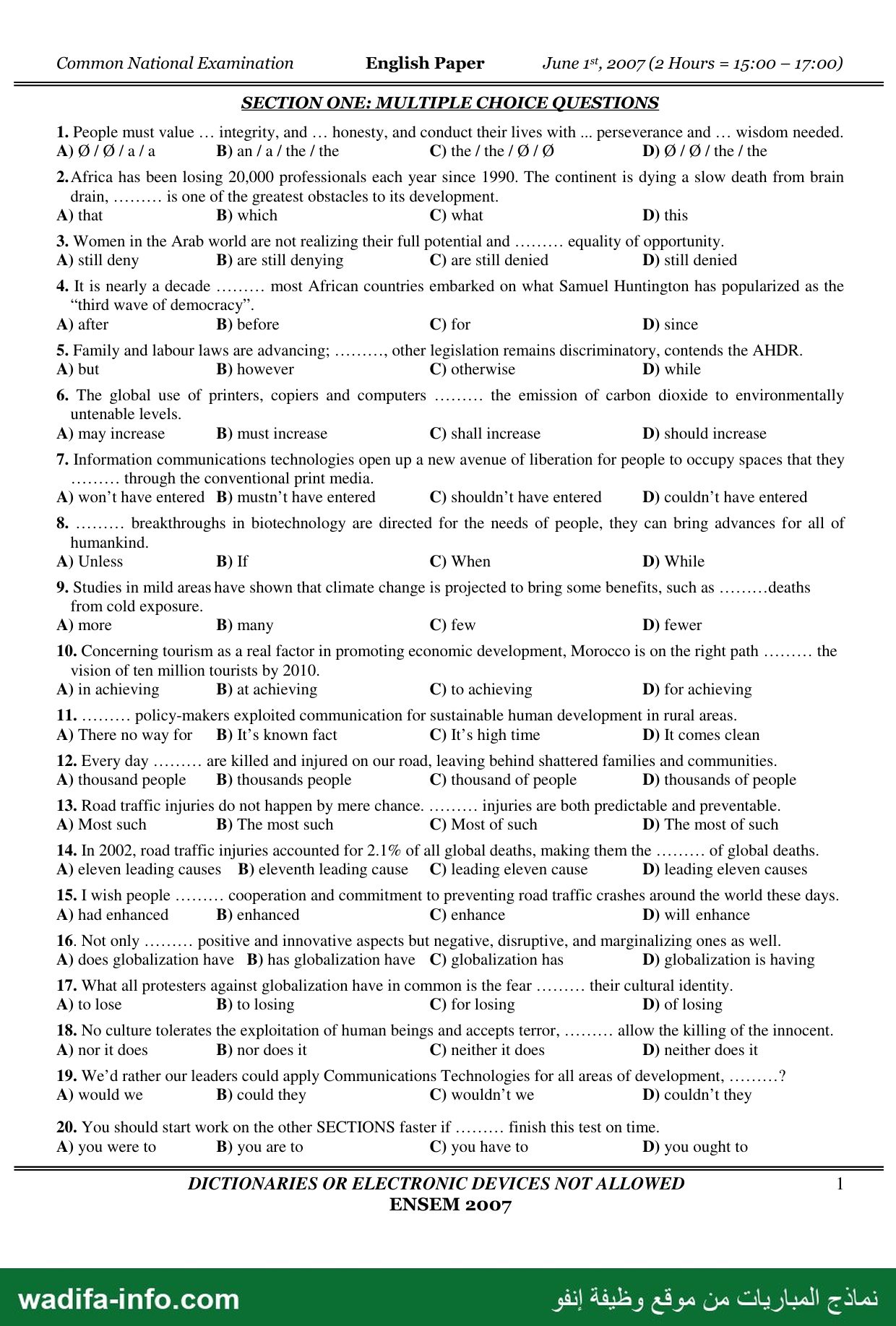
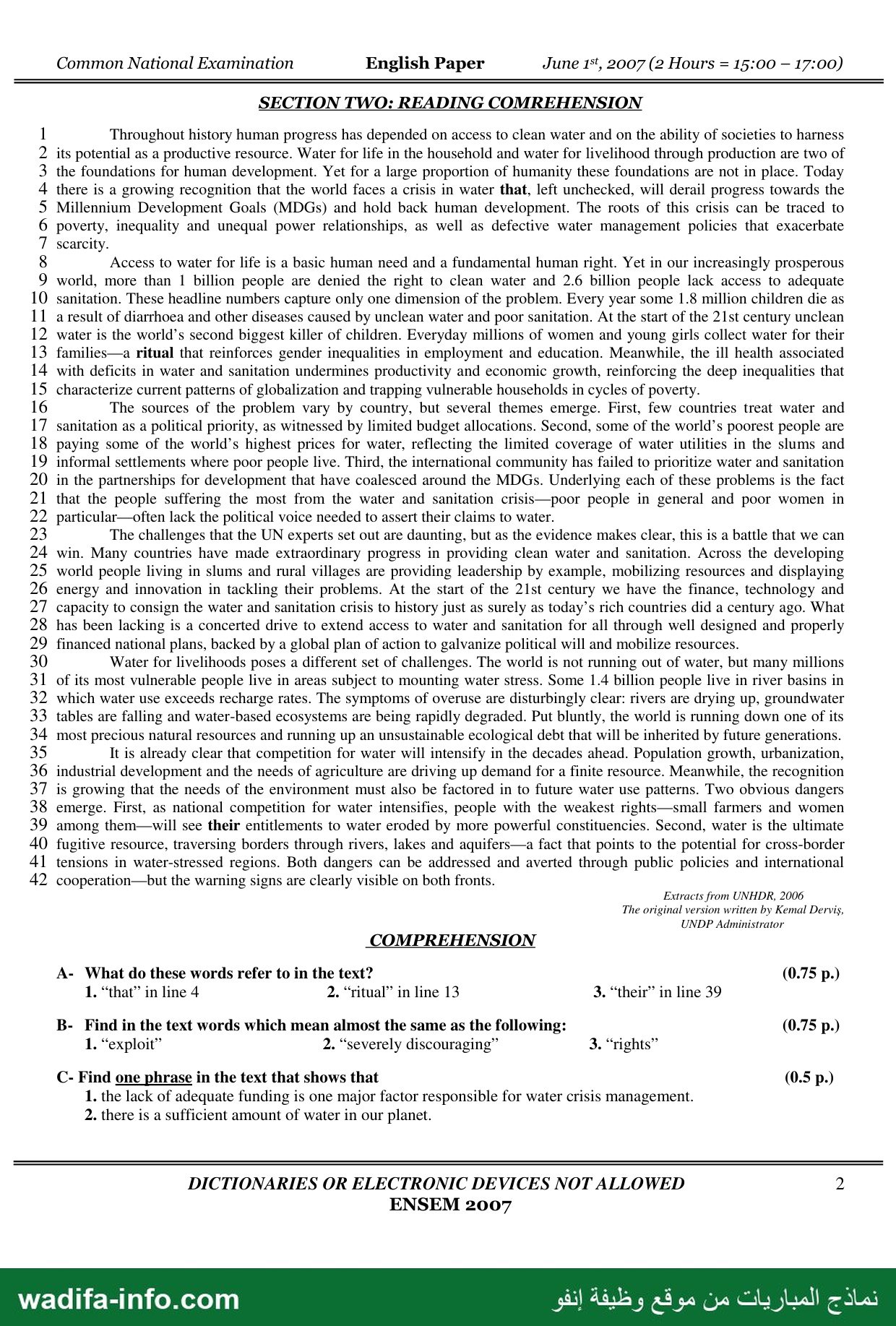
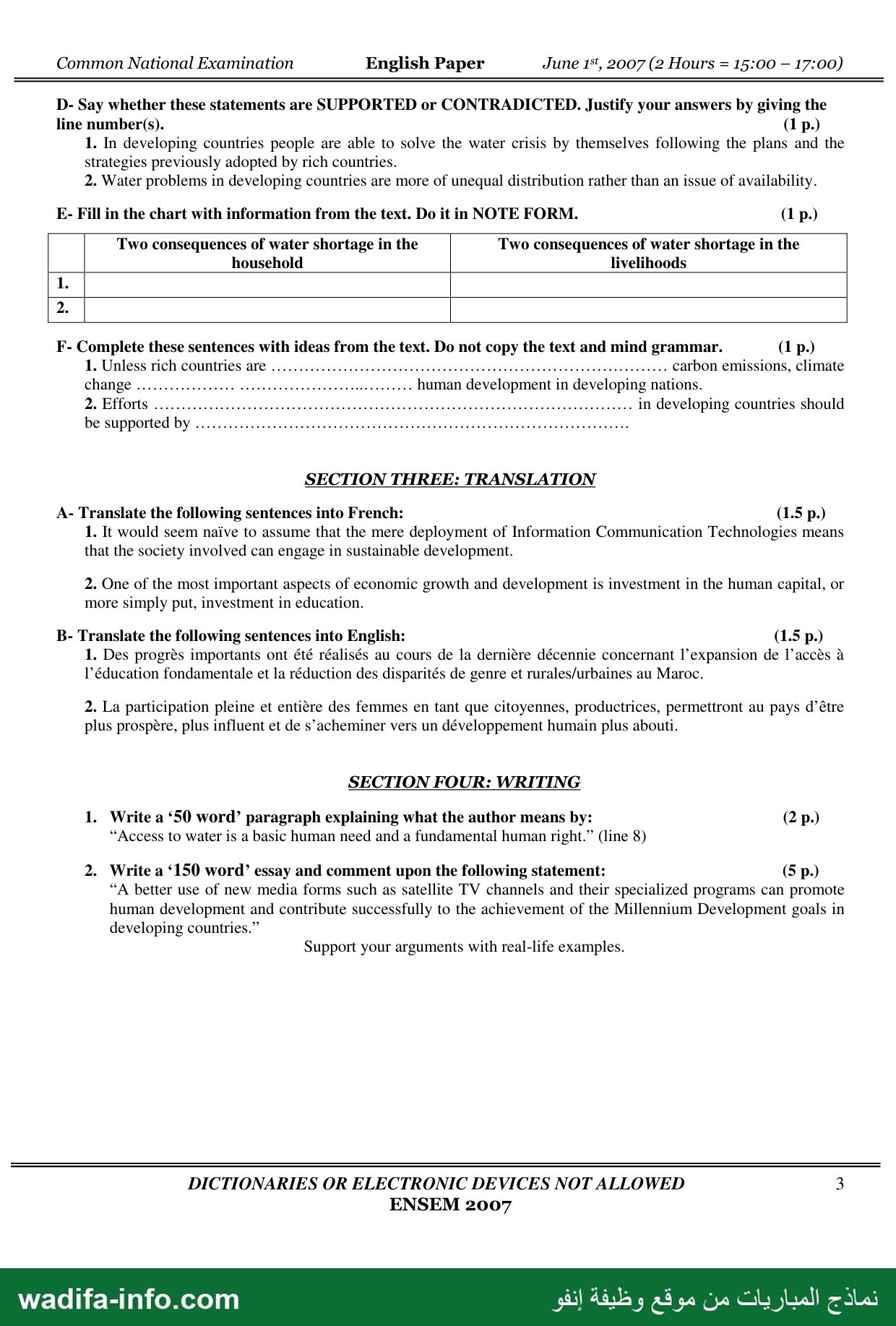
Common National Examination English Paper June 15, 2007 (2 Hours = 15:00 — 17:00) SECTION ONE: MULTIPLE CHOICE QUESTIONS 1. People must value ... integrity, and ... honesty, and conduct their lives with ... perseverance and ... wisdom needed. عط / عط / 6 / 6 Bjan/a/the/the C)the/the/0/© D) 6 / 6 (ذ 2. Africa has been losing 20,000 professionals each year since 1990. The continent is dying a slow death from brain drain, ......... is one of the greatest obstacles to its development. À) that B) which C) what D) this 3. Women in the Arab world are not realizing their full potential and ......... equality of opportunity. A) still deny B) are still denying ©) are still denied D) still denied 4. It is nearly a decade ......... most African countries embarked on what Samuel Huntington has popularized as the “third wave of democracy”. A) after B) before ©) for D) since 5. Family and labour laws are advancing; ........., other legislation remains discriminatory, contends the AHDR. A) but B) however ©) otherwise D) while 6. The global use of printers, copiers and computers ......... the emission of carbon dioxide to environmentally untenable levels. À) may increase B) must increase ©) shall increase D) should increase 7. Information communications technologies open up a new avenue of liberation for people to occupy spaces that they ......... through the conventional print media. A) won't have entered B) mustn’t have entered C) shouldn’t have entered D) couldn’t have entered 8. ......... breakthroughs in biotechnology are directed for the needs of people, they can bring advances for all of humankind. A) Unless B) If C) When D) While 9. Studies in mild areas have shown that climate change is projected to bring some benefits, such as .........5 from cold exposure. A) more B) many ©) few D) fewer 10. Concerning tourism as a real factor in promoting economic development, Morocco is on the right path ......... the vision of ten million tourists by 2010. A) in achieving B) at achieving ©) to achieving D) for achieving 11. ......... policy-makers exploited communication for sustainable human development in rural areas. A) There no way for B)It’s known fact ©) It's high time D) It comes clean 12. Every day ......... are 101160 and injured on our road, leaving behind shattered families and communities. A) thousand people B) thousands people ©) thousand of people D) thousands of people 13. Road traffic injuries do not happen by mere chance. ......... injuries are both predictable and preventable. A) Most such B) The most such C) Most of such D) The most of such 14. In 2002, road traffic injuries accounted for 2.1% of all global deaths, making them the ......... of global deaths. A) eleven leading causes B) eleventh leading cause ©) leading eleven cause D) leading eleven causes 15. I wish people ......... cooperation and commitment to preventing road traffic crashes around the world these days. A) had enhanced B) enhanced C) enhance D) will enhance 16. Not only ......... positive and innovative aspects but negative, disruptive, and marginalizing ones as well. A) does globalization have B) has globalization have ©) globalization has D) globalization is having 17. What all protesters against globalization have in common is the fear ......... their cultural identity. A) to lose B) to losing ©) for losing D) of losing 18. No culture tolerates the exploitation of human beings and accepts terror, ......... allow the killing of the innocent. A) nor it does B) nor does it ©) neither it does D) neither does it 19. We’d rather our leaders could apply Communications Technologies for all areas of development, ......... 4 A) would we B) could they C) wouldn’t we D) couldn’t they 20. You should start work on the other SECTIONS faster if ......... طقتصط this test on time. A) you were to B) you are to ©) you have to D) you ought to DICTIONARIES OR ELECTRONIC DEVICES NOT ALLOWED 1 ENSEM 2007 wadifa-info.com نماذج المباريات من موقع وظيفة إنفو Common National Examination English Paper June 15, 2007 (2 Hours = 15:00 — 17:00) SECTION TWO: READING COMREHENSION 1 Throughout history human progress has depended on access to clean water and on the ability of societies to 5 2 its potential as a productive resource. Water for life in the household and water for livelihood through production are two of 3 the foundations for human development. Yet for a large proportion of humanity these foundations are not in place. Today 4 there is a growing recognition that the world faces a crisis in water that, left unchecked, will derail progress towards the 5 Millennium Development Goals (MDGs) and hold back human development. The roots of this crisis can be traced to 6 poverty, inequality and unequal power relationships, as well as defective water management policies that exacerbate 7 scarcity. 8 Access to water for life is a basic human need and a fundamental human right. Yet in our increasingly prosperous 9 world, more than 1 billion people are denied the right to clean water and 2.6 billion people lack access to adequate 10 sanitation. These headline numbers capture only one dimension of the problem. Every year some 1.8 million children die as 11 a result of diarrhoea and other diseases caused by unclean water and poor sanitation. At the start of the 21st century unclean 12 water is the world's second biggest killer of children. Everyday millions of women and young girls collect water for their 13 families—a ritual that reinforces gender inequalities in employment and education. Meanwhile, the ill health associated 14 with deficits in water and sanitation undermines productivity and economic growth, reinforcing the deep inequalities that 15 characterize current patterns of globalization and trapping vulnerable households in cycles of poverty. 16 The sources of the problem vary by country, but several themes emerge. First, few countries treat water and 17 sanitation as a political priority, as witnessed by limited budget allocations. Second, some of the world’s poorest people are 18 paying some of the world's highest prices for water, reflecting the limited coverage of water utilities in the slums and 19 informal settlements where poor people live. Third, the international community has failed to prioritize water and sanitation 20 in the partnerships for development that have coalesced around the 11065. Underlying each of these problems is the fact 21 that the people suffering the most from the water and sanitation crisis—poor people in general and poor women in 22 particular —often lack the political voice needed to assert their claims to water. 23 The challenges that the UN experts set out are daunting, but as the evidence makes clear, this is a battle that we can 24 win. Many countries have made extraordinary progress in providing clean water and sanitation. Across the developing 25 world people living in slums and rural villages are providing leadership by example, mobilizing resources and displaying 26 energy and innovation in tackling their problems. At the start of the 21st century we have the finance, technology and 27 capacity to consign the water and sanitation crisis to history just as surely as today’s rich countries did a century ago. What 28 has been lacking is a concerted drive to extend access to water and sanitation for all through well designed and properly 29 financed national plans, backed by a global plan of action to galvanize political will and mobilize resources. 30 Water for livelihoods poses a different set of challenges. The world is not running out of water, but many millions 31 of its most vulnerable people live in areas subject to mounting water stress. Some 1.4 billion people live in river basins in 32 which water use exceeds recharge rates. The symptoms of overuse are disturbingly clear: rivers are drying up, groundwater 33 tables are falling and water-based ecosystems are being rapidly degraded. Put bluntly, the world is running down one of its 34 most precious natural resources and running up an unsustainable ecological debt that will be inherited by future generations. 35 It is already clear that competition for water will intensify in the decades ahead. Population growth, urbanization, 36 industrial development and the needs of agriculture are driving up demand for a finite resource. Meanwhile, the recognition 37 is growing that the needs of the environment must also be factored in to future water use patterns. Two obvious dangers 38 emerge. First, as national competition for water intensifies, people with the weakest rights—small farmers and women 39 among them—will see their entitlements to water eroded by more powerful constituencies. Second, water is the ultimate 40 fugitive resource, traversing borders through rivers, lakes and aquifers—a fact that points to the potential for cross-border 41 tensions in water-stressed regions. Both dangers can be addressed and averted through public policies and international 42 cooperation—but the warning signs are clearly visible on both fronts. Extracts from UNHDR, 2006 The original version written by Kemal Dervis, UNDP Administrator -COMPREHENSION A- What do these words refer to in the text? (0.75 p.) 1. “that” in line 4 2. “ritual” in line 13 3. “their” in line 39 B- Find in the text words which mean almost the same as the following: (0.75 p.) 1. “exploit” 2. “‘severely discouraging” 3. “rights” C- Find one phrase in the text that shows that (0.5 p.) 1. the lack of adequate funding is one major factor responsible for water crisis management. 2. there is a sufficient amount of water in our planet. DICTIONARIES OR ELECTRONIC DEVICES NOT ALLOWED 2 ENSEM 2007 wadifa-info.com نماذج المباريات من موقع وظيفة إنفو Common National Examination English Paper June 15, 2007 (2 Hours = 15:00 - 17:00) D- Say whether these statements are SUPPORTED or CONTRADICTED. Justify your answers by giving the line number(s). (1 p.) 1. In developing countries people are able to solve the water crisis by themselves following the plans and the strategies previously adopted by rich countries. 2. Water problems in developing countries are more of unequal distribution rather than an issue of availability. E- Fill in the chart with information from the text. Do it in NOTE FORM. (1 p.) Two consequences of water shortage in the Two consequences of water shortage in the household livelihoods DE لللصللللللبىي سا F- Complete these sentences with ideas from the text. Do not copy the text and mind grammar. (1 p.) 1. Unless rich countries are كي ا و واي لاا وكا الت ليا لا ا الأ زا ااا اا ون ا دي Cal DON EMISSIONS, climate change .................. ............................... human development in developing nations. 2 راد eo dé VélOpIn EE رسن رين Should DÉSUDDOEd DV ااي ااا ااا الاي لاما تيا اا ااا الاو لوي د ممه NET SECTION THREE: TRANSLATION A- Translate the following sentences into French: (LS p.) 1. It would seem naïve to assume that the mere deployment of Information Communication Technologies means that the society involved can engage in sustainable development. 2. One of the most important aspects of economic growth and development is investment in the human capital, or more simply put, investment in education. B- Translate the following sentences into English: (LS p.) 1. Des progrès importants ont été réalisés au cours de la dernière décennie concernant l’expansion de l’accès à l’éducation fondamentale et la réduction des disparités de genre et rurales/urbaines au Maroc. 2. La participation pleine et entière des femmes en tant que citoyennes, productrices, permettront au pays d’être plus prospère, plus influent et de s’acheminer vers un développement humain plus abouti. SECTION FOUR: WRITING 1 Write a ‘50 word’ paragraph explaining what the author means by: (2 p.) “Access to Water is a basic human need and a fundamental human right.” (line 8) 2. Write a ‘150 word” essay and comment upon the following statement: (5 p.) “A better use of new media forms such as satellite TV channels and their specialized programs can promote human development and contribute successfully to the achievement of the Millennium Development goals in developing countries.” Support your arguments with real-life examples. DICTIONARIES OR ELECTRONIC DEVICES NOT ALLOWED 3 ENSEM 2007 wadifa-info.com نماذج المباريات من موقع وظيفة إنفو
التصحيح المقترح
هذا تصحيح مقترح من إعداد فريق wadifa-info لمساعدتك على فهم منهجية الإجابة — وليس تصحيحاً رسمياً صادراً عن الإدارة المنظِّمة. أسئلة هذا الامتحان محررة بالفرنسية، لذلك التصحيح محرر بالفرنسية أيضاً.
Ce modèle est l'épreuve d'anglais du Concours National Commun (CNC) 2007 d'admission aux écoles d'ingénieurs (filières MP/PSI/TSI/BCPST), session du 1er juin 2007, 15 h 00 - 17 h 00 (2 heures), dictionnaires et appareils électroniques interdits. Quatre sections : One — QCM de 20 questions ; Two — compréhension d'un extrait du Rapport mondial sur le développement humain 2006 (PNUD) consacré à la crise de l'eau (A à F, 5 points) ; Three — traduction (anglais → français et français → anglais, 3 points) ; Four — expression écrite (paragraphe de 50 mots, 2 points ; essai de 150 mots, 5 points). Réponses modèles en anglais, explications en français.
💡 Le barème oriente le temps : l'essai de 150 mots vaut à lui seul 5 points, autant que toute la compréhension. Réservez-lui au moins 35 minutes.
Section One — Multiple Choice Questions
- D) Ø / Ø / the / the — noms abstraits pris au sens général sans article (integrity, honesty) ; the perseverance and the wisdom needed sont déterminés par needed.
- B) which — relative non déterminative reprenant brain drain.
- C) are still denied — passif : les femmes se voient refuser l'égalité des chances.
- D) since — It is + durée + since + prétérit.
- B) however — connecteur d'opposition après point-virgule et suivi d'une virgule.
- A) may increase — modal de possibilité ; must / shall / should exprimeraient obligation, certitude ou conseil, sans sens ici.
- D) couldn't have entered — impossibilité dans le passé : des espaces qu'ils n'auraient pas pu investir par la presse écrite.
- B) If — condition : « si les percées… sont orientées vers les besoins des gens, elles peuvent… ».
- D) fewer — deaths est dénombrable ; le bénéfice est une diminution.
- C) to achieving — on the right path to + V-ing (to est ici une préposition).
- C) It's high time — seule expression suivie d'un prétérit (exploited) à valeur de présent.
- D) thousands of people — thousands of pour un nombre indéterminé.
- A) Most such — most such injuries = la plupart de ces blessures ; most of exigerait un déterminant.
- B) eleventh leading cause — ordinal + leading cause au singulier après the.
- B) enhanced — wish + prétérit pour un souhait sur le présent (these days).
- A) does globalization have — inversion avec do après Not only en tête de phrase.
- D) of losing — the fear of + V-ing.
- B) nor does it — reprise négative avec inversion.
- C) wouldn't we — We'd rather = We would rather : le tag reprend would et le sujet we.
- B) you are to — if you are to = « si vous voulez » (but à atteindre).
| 1 | 2 | 3 | 4 | 5 | 6 | 7 | 8 | 9 | 10 |
|---|---|---|---|---|---|---|---|---|---|
| D | B | C | D | B | A | D | B | D | C |
| 11 | 12 | 13 | 14 | 15 | 16 | 17 | 18 | 19 | 20 |
| C | D | A | B | B | A | D | B | C | B |
Section Two — Reading Comprehension
A — References (0.75 p.)
- « that » (line 4) : a crisis in water.
- « ritual » (line 13) : women and young girls collecting water for their families every day.
- « their » (line 39) : people with the weakest rights — small farmers and women.
B — Synonyms (0.75 p.)
- « exploit » = harness (line 1).
- « severely discouraging » = daunting (line 23).
- « rights » = entitlements (line 39).
C — One phrase showing that… (0.5 p.)
- lack of funding: "few countries treat water and sanitation as a political priority, as witnessed by limited budget allocations" (lines 16-17).
- enough water on the planet: "The world is not running out of water" (line 30).
D — Supported or contradicted? (1 p.)
- Contradicted (lines 27-29, see also 19-20) — réponse probable. Le texte reconnaît que les populations des bidonvilles et des villages font preuve d'initiative (l. 24-26), mais il affirme que ce qui manque, c'est un effort concerté appuyé par des plans nationaux bien financés et un plan d'action mondial ; ils ne peuvent donc pas résoudre la crise seuls.
- Supported (lines 5-7 and 30-31) : the roots of the crisis are poverty, inequality and unequal power relationships; the world is not running out of water.
E — Chart (note form, 1 p.)
| Water shortage in the household | Water shortage in livelihoods | |
|---|---|---|
| 1. | 1.8 million child deaths a year (diarrhoea, water-borne diseases) | rivers drying up, falling groundwater, degraded ecosystems |
| 2. | women and girls fetch water → gender inequalities in education and employment | competition: weakest (small farmers, women) lose entitlements; cross-border tensions |
On accepte aussi, côté foyer : mauvaise santé → baisse de la productivité, ménages piégés dans la pauvreté (l. 13-15).
F — Completion (1 p.)
- Unless rich countries are ready to cut their carbon emissions, climate change will seriously hold back human development in developing nations.
- Efforts made by poor communities and governments to extend access to water and sanitation in developing countries should be supported by a global plan of action that mobilizes political will and resources.
Section Three — Translation
A — Into French (1.5 p.)
- Il semblerait naïf de supposer que le simple déploiement des technologies de l'information et de la communication signifie que la société concernée peut s'engager dans un développement durable.
- L'un des aspects les plus importants de la croissance économique et du développement est l'investissement dans le capital humain ou, plus simplement, l'investissement dans l'éducation.
B — Into English (1.5 p.)
- Significant progress has been made over the last decade in expanding access to basic education and reducing gender and rural/urban disparities in Morocco.
- The full participation of women as citizens and producers will enable the country to be more prosperous and more influential, and to move towards more complete human development.
💡 Des progrès … ont été réalisés → progress has been made (progress est indénombrable : jamais « progresses ») ; permettre à … de → enable … to. Dans la phrase 2, le verbe français « permettront » est au pluriel alors que le sujet est singulier : traduisez au singulier (will enable).
Section Four — Writing
1. « Access to water is a basic human need and a fundamental human right. » (50 words, 2 p.)
The author means that water is not a luxury or an ordinary commodity. Without clean water nobody can drink, cook, stay healthy or live in dignity. Therefore every person, rich or poor, is entitled to it, and states have a duty to guarantee safe and affordable water for all their citizens.
2. New media and the Millennium Development Goals (150 words, 5 p.) — modèle
New media, and satellite television in particular, can be powerful tools for human development. Unlike newspapers, they reach millions of people, including those who cannot read, in the remotest villages.
First, specialised programmes can educate. Health channels and campaigns explain how to prevent diseases, why children should be vaccinated or how to save water. Educational channels, such as Morocco's Arrabiaa, which broadcasts school lessons, offer courses to pupils who have no teacher nearby.
Second, these media can promote gender equality and participation. Programmes showing successful women entrepreneurs or explaining citizens' rights encourage people to take part in public life. Debates on local development projects also give a voice to rural populations.
However, the effect depends on content. Many channels mainly broadcast entertainment and advertising that encourage consumption rather than development.
In short, a better use of new media, with quality programmes in local languages, can genuinely help achieve the Millennium Development Goals.
💡 La consigne exige des exemples réels : chaînes éducatives, campagnes de vaccination ou de sécurité routière, émissions agricoles. Un exemple marocain précis vaut mieux qu'une généralité.
أسئلة شائعة حول هذا النموذج
هل يمكن تحميل هذا النموذج مجاناً؟
هل يتضمن هذا النموذج التصحيح؟
ما هي الجهة المنظمة والدرجة المعنية بهذا النموذج؟
ما هي دورة هذا الامتحان ولغة أسئلته؟
أين أجد نماذج أخرى لنفس المباراة؟
ناقش هذا النموذج (0)
شارك إجاباتك أو صحّح التصحيح — إذا كان لديك رأي مختلف حول أي نقطة، اكتبه هنا ليستفيد باقي المترشحين.
لا يوجد نقاش بعد — شارك إجابتك أو سؤالك حول هذا النموذج.
⚠️ ممنوع نشر أرقام الهاتف أو الروابط أو أي عرض مقابل مال — تُحذف هذه المشاركات تلقائياً.
هل تحضّر لهذه المباراة؟
نماذج مشابهة قد تهمّك
الجهة المنظمة: وزارة التعليم العالي - المباراة الوطنية المشتركة لولوج مدارس المهندسين · 1 يونيو 2007 — مصدر النسخة: وثائق منشورة للعموم (Scribd / alloschool)؛ الإعلان الرسمي للمباراة هو المرجع.
كيف تستشهد بهذه الصفحة؟
صحفي أو مدوّن أو أستاذ؟ انسخ المرجع أسفله وضع رابطاً نحو هذه الصفحة.
الرابط الدائم: https://www.wadifa-info.com/نموذج-مباراة/2551/نموذج-المباراة-الوطنية-المشتركة-CNC-2007-اللغة-الإنجليزية-شعبة-MP-PSI-TSI-BCPS