
نموذج امتحان الكفاءة المهنية (الدرجة الأولى) - ديداكتيك مادة التخصص: اللغة الإنجليزية - المركز الوطني للتقويم والامتحانات 2022
⬇️ تحميل PDF الرابط الدائم: wadifa-info.com/نموذج-مباراة/1427
باختصار
هذا نموذج امتحان كتابي سابق لمباراة اختبار في ديداكتيك مادة التخصص: اللغة الإنجليزية لدى وزارة التربية الوطنية - المركز الوطني للتقويم والامتحانات (دورة دجنبر 2022)، منشور على وظيفة إنفو للاطلاع والتحميل المجاني بصيغة PDF مع تصحيح مقترح.
- الجهة المنظمة
- وزارة التربية الوطنية - المركز الوطني للتقويم والامتحانات
- الدرجة
- اختبار في ديداكتيك مادة التخصص: اللغة الإنجليزية
- التخصص
- اللغة الإنجليزية - التعليم الثانوي التأهيلي
- الدورة
- دورة دجنبر 2022
- عدد الصفحات
- 13
- لغة الأسئلة
- الفرنسية
- التصحيح
- تصحيح مقترح متوفر في هذه الصفحة
📝 نص أسئلة النموذج (مستخرج آلياً من الصفحات الممسوحة)
استُخرج هذا النص آلياً من صور الامتحان وقد يحتوي على أخطاء في القراءة — الصور أعلاه هي المرجع.
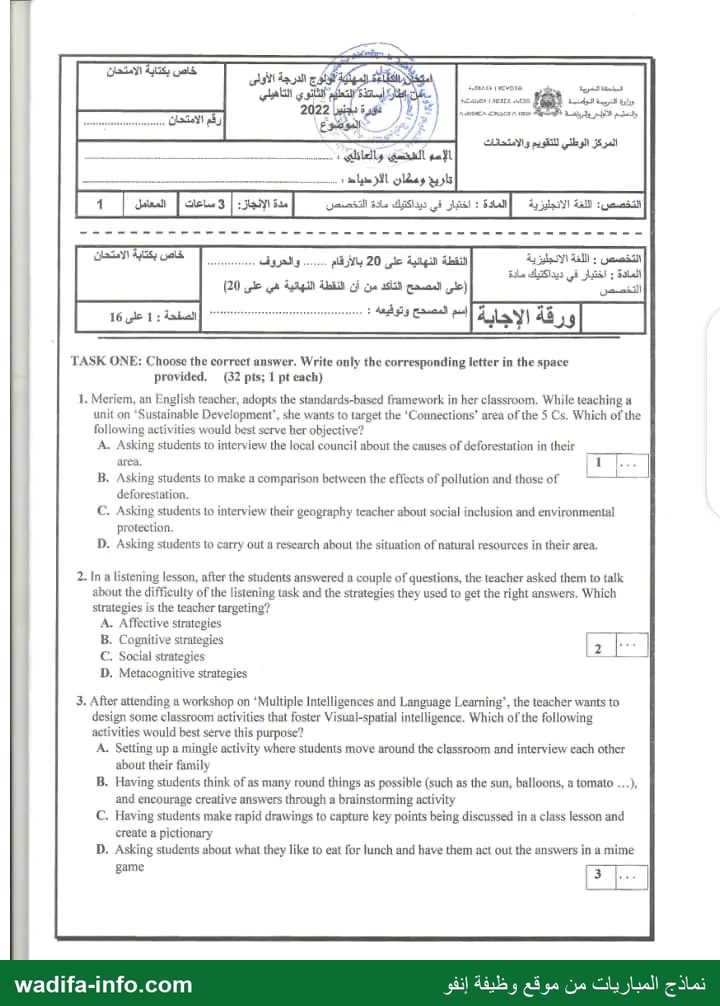
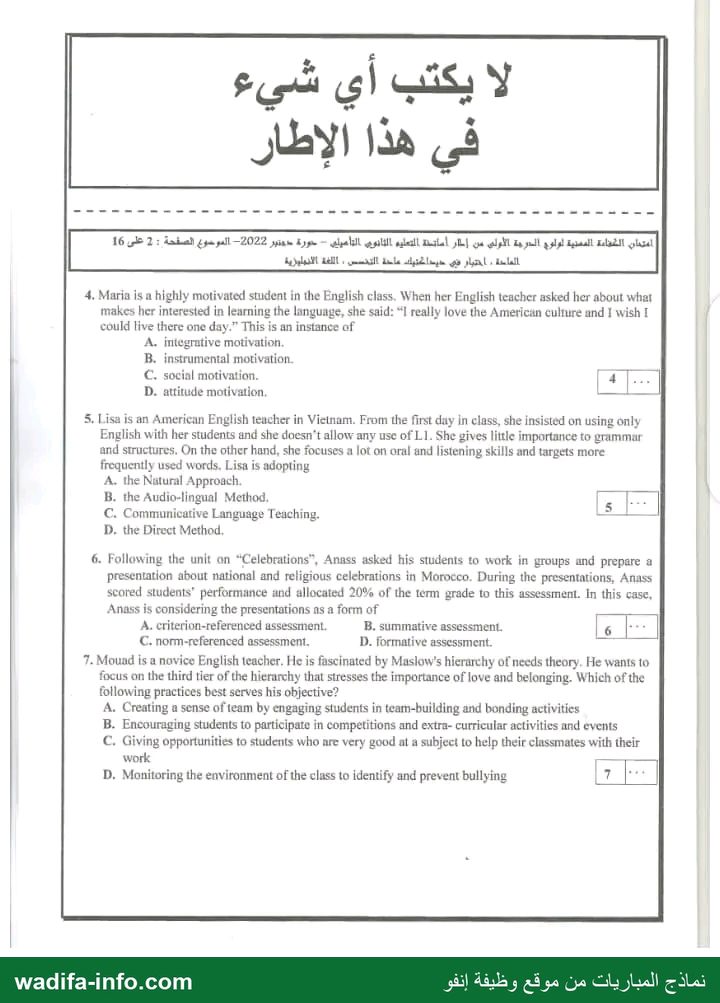
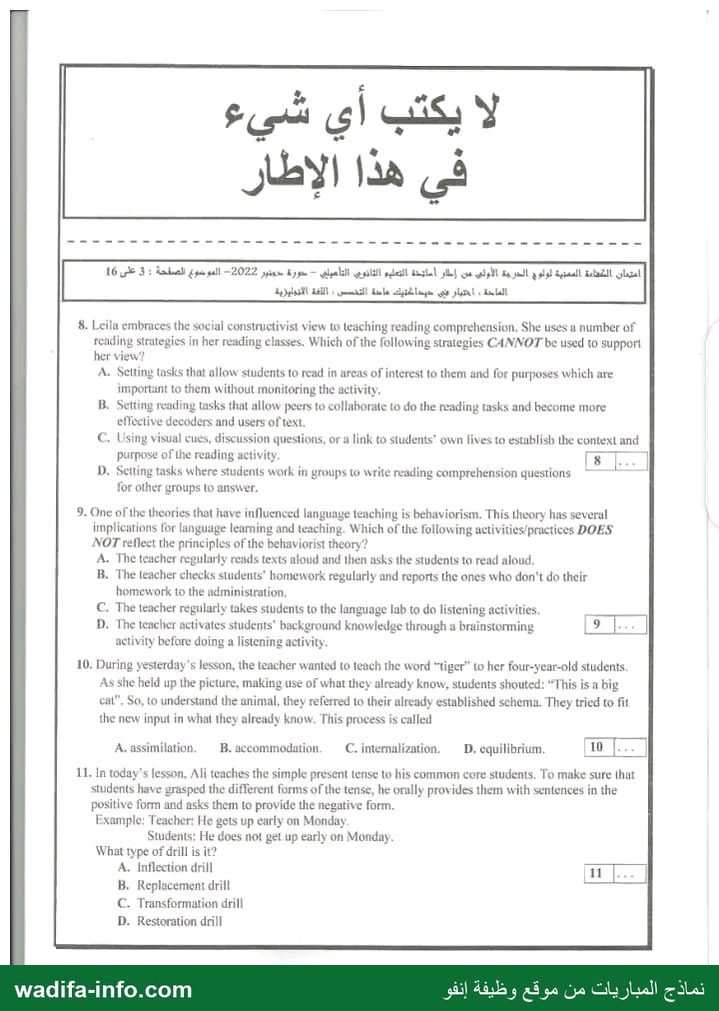
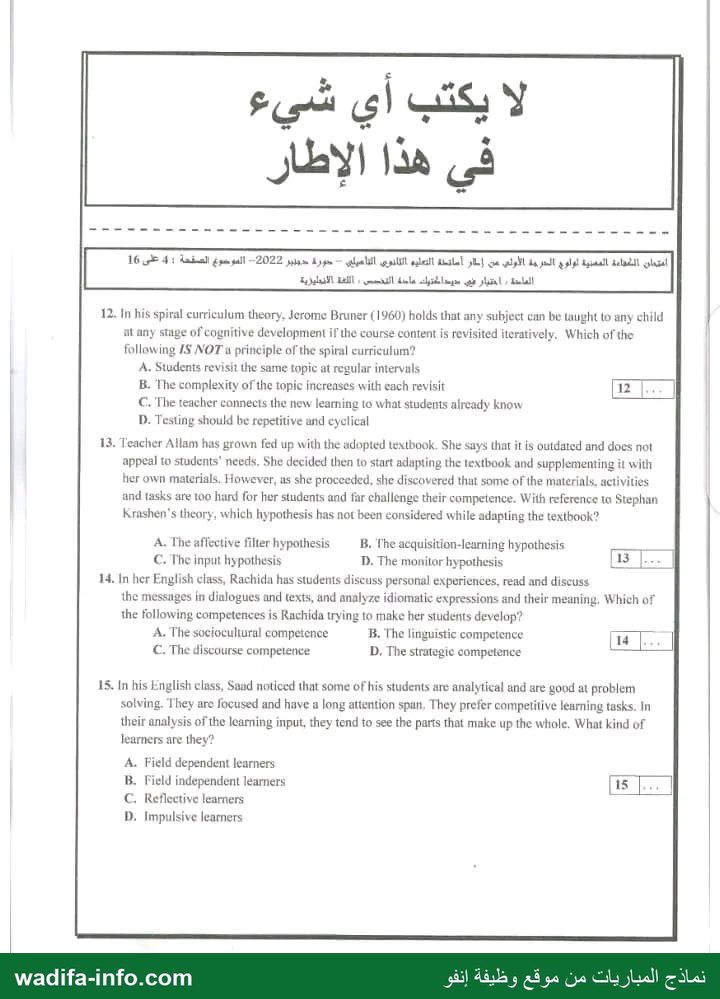
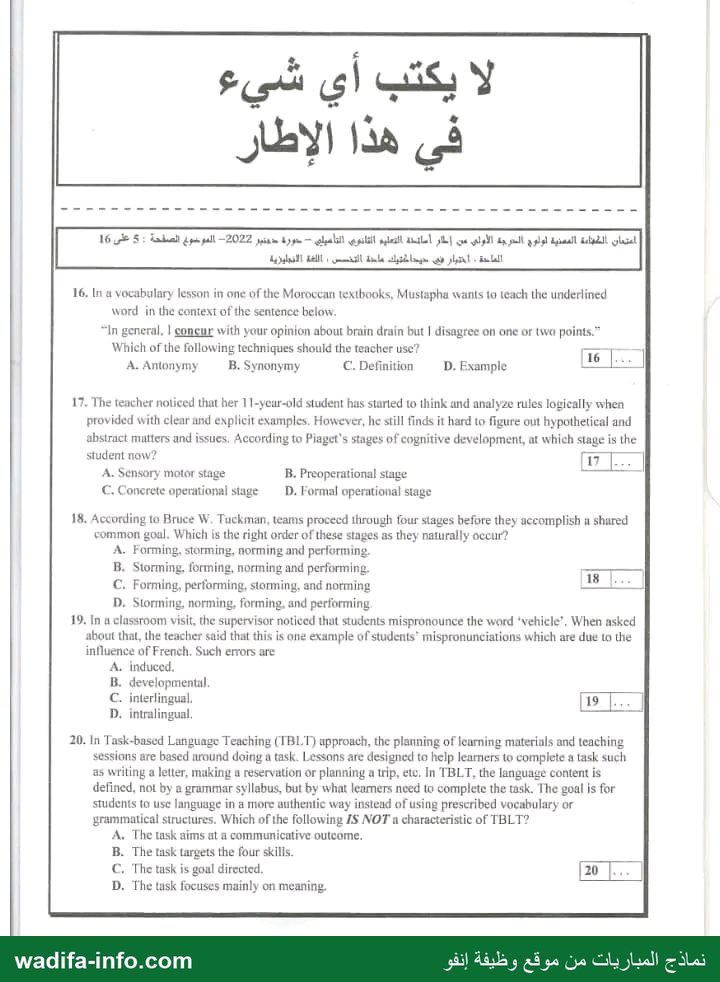
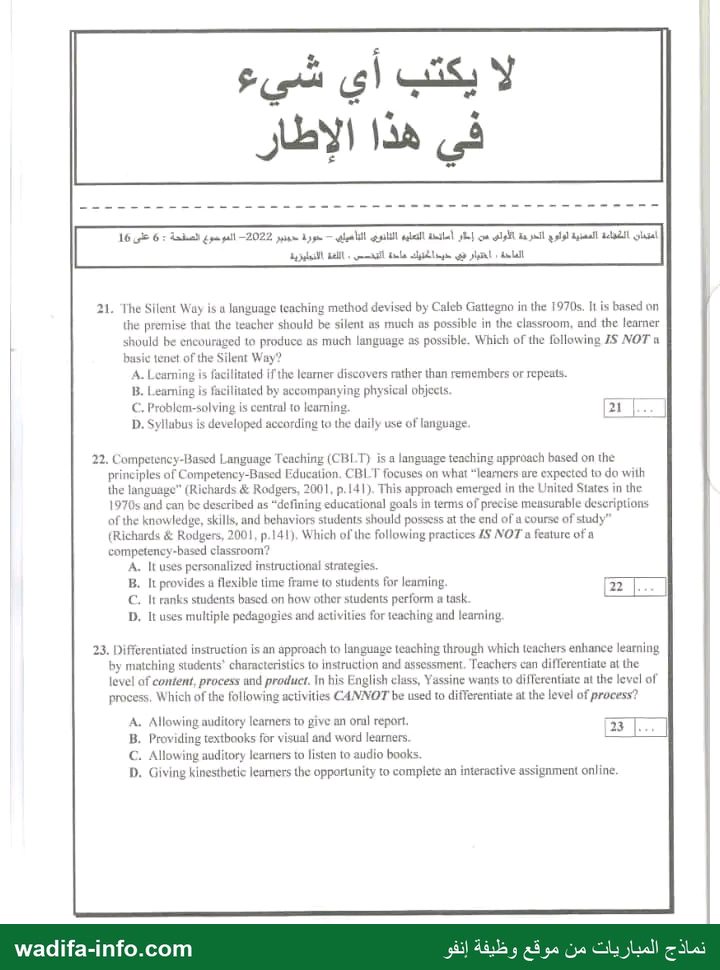
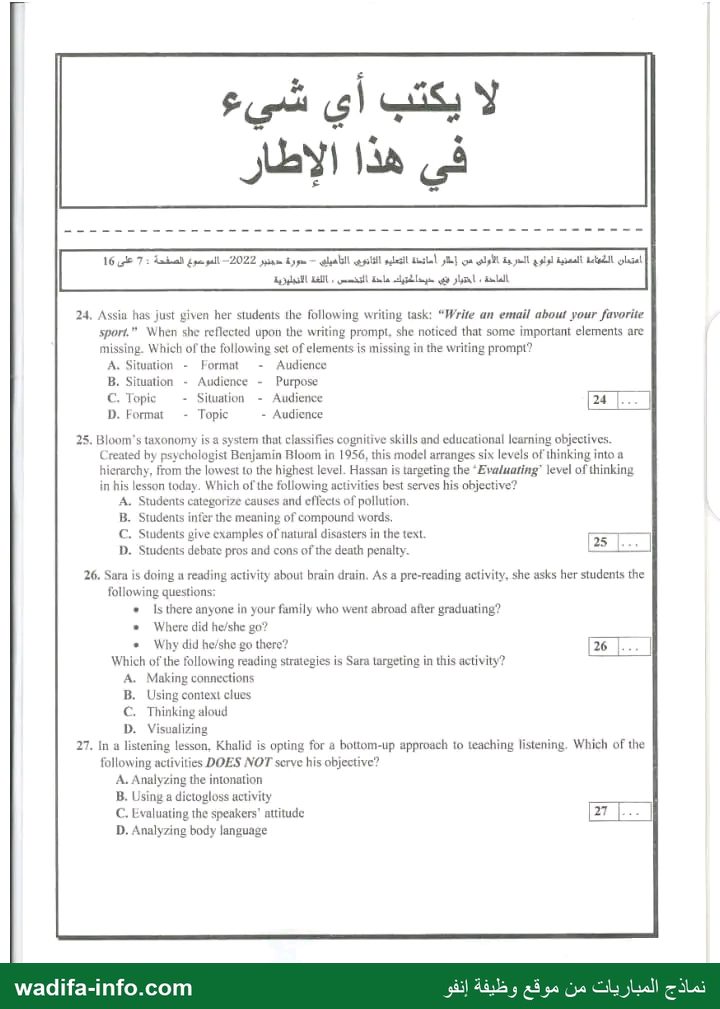
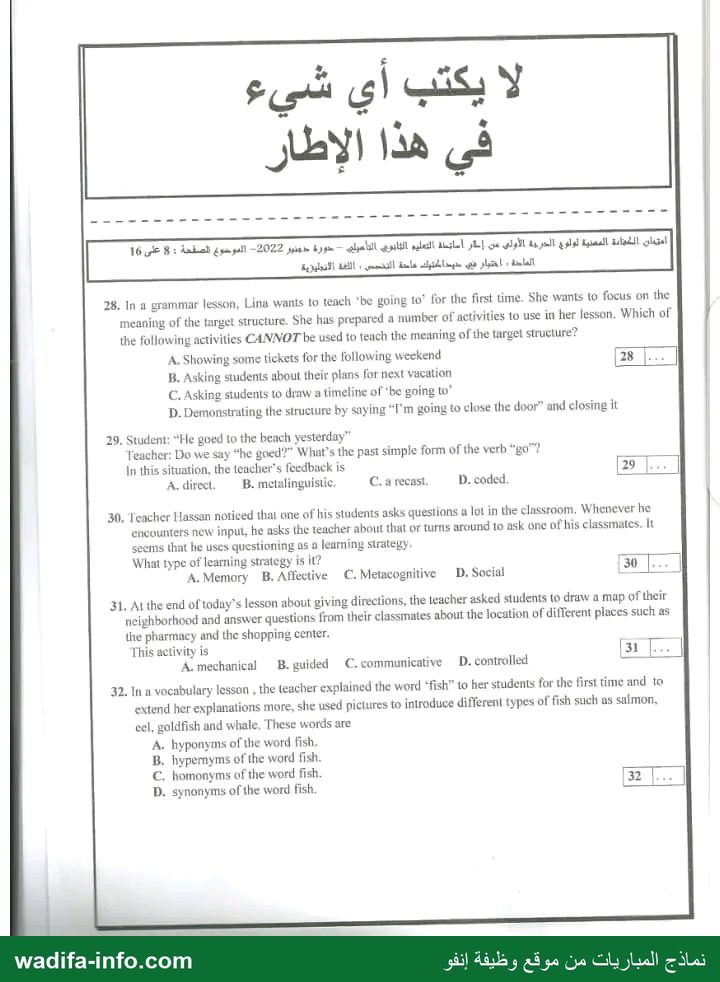
DE \ = ce FPE TE] 1 7 لوج الدرجة الأولى بزارة التريبة sin Hans. | dans ١117 At fe! de التعليم الثانوي التأهيلي والتعليم لول Le 5 184 LISE] | had 2e 2022 جو جود المركز الوطني للتقويم والامتحتات ب الإسم المحسق والعالله ااا ا ا ا تاريج ومكشان لأسا هم 6 CELL mme une خاص بكتابة الامتحان - ١ .............. التخصص : اللقة الانجليزية النقطة النهائية على 20 بالأرقام ....... والحروف 16 الصفحة : 1 على na ورقة الجا | | TASK ONE: Choose the correct answer. Write only the corresponding letter in the space provided, (32 pts; 1 pt each) 1. Meriem, an English teacher, adopts the standards-based framework in her classroom. While teaching a unit on ‘Sustainable Development’, she wants ما target the ‘Connections’ area of the 5 Cs. Which of the following activities would best serve her objective? A. Asking students to interview the local council about the causes of deforestation in their aréa. 1 |... | B. Asking students ما make a comparison between the effects of pollution and those of ee déforestation. > Asking students ما interview their geography teacher about social inclusion and environmental protéction. D. Asking students to carry out a research about the situation of natural resources in their area. 2. In a listening lesson, after the students answered a couple of questions, the teacher asked them to talk about the difficulty of the listening task and the strategies they used to get the right answers. Which | strategies is the teacher targeting? A. Affective strategies Co B. Cognitive strategies | [: 5 | C. Social s le: 2 ل 1 . Social strategies | D. Metacognitive strategies 3. After attending a workshop on ‘Multiple Intelligences and Language Learning”, the teacher wants to | design some classroom activities that foster Visual-spatial intelligence. Which of the following | activities would best sérve this purpose? A. Setting up & mingle activity where students move around the classroom and interview داعم other about their family B. Having students think of as many round things as possible (such as the sun, balloons, a tomato ...(, and encourage creative answers through a brainstorming activity ©. Having students make rapid drawings to capture key points being discussed in a class lesson and create a pictionary | D. Asking students about what they like ما eat for lunch and have them act out the answers in a mime game ES wadifa-info.com نماذج المباريات من موقع وظيفة إنفو لا بكتب أى شىء فى هذا الاطا امتدان الشفاءة المعدية لولوج Le pull الأولى من إطار أماتسنة التعليم الثانوي التاميلي - ستورة sine 2022- الموسوع الصفحة : 2 على 16 العاسة à احتبار في ديداشتيك Lula التخسس à اللغة اللنبلوزية Maria is a highly motivated student in the English class. When her English teacher asked her about what .4 makes her interested in leurning the language, she said: “I really love the American culture and 1 wish 1 could live there one day.” This is an instance af A. intégrative motivation. B. instrumental motivation C. social motivation. ١ 4 | 5 | لا D. attitude motivation, Lisa is an American English teacher in Vieinam. From the first duy in class, she insistéd on using only .5 English with her students and she doesn't allow any use of L1. She gives little importance to grammar and structures, On the other hand, she focuses a lot on oral and listening skills and targets more frequently used words. Lisa is adopting A. the Nütural Approach | اا B. the Audio-lingual Method, fe. | C. Communicative Language Teaching. — D. the Direct Method, 6. Following the unit an “Celebrations”, Annss asked his students to work in groups and prepare a presentation about national and religious celebrations in Morocco. During the presentations, Anass scored students’ performance and allocated 20% of the térm grade to this assessment. In this case, Anass is considering the presentations as a form of ب A. criterion-referenced assessment. 13. summative assessment. | 6 | 1 1 C. nom-referenced assessment. D. formative assessment. ل لل 7. Mouad is a novice English teacher. He is fascinated by Maslow’s hierarchy of needs theory, He كتمع to focus on the third tier of the hierarchy that stresses the importance of love and belonging. Which of the following practices best serves his objective? A. Creating a sense of team by engaging students in team-building and bonding activities B. Encouraging students to participate in compétitions and extra- curricular activities and events ©. Giving opportunities 10 students who are very good at a subject ما help their classmates with their work نبي D. Monitoring the environment of the class to identify and prevent bullying 7 |” | wadifa-info.com نماذج المباريات من موقع وظيفة إنفو | لا يكتب أى شىء يِ سي *» 0 فى هذا الإطا 16 الصفحة : 3 على gge pull -2022 اعتدان الشقامة الممدية لولوج الدرجة الأولي من إطار أماتدة التعليم الثاذوي التاعيلي - ستورة -تيثير LD ؛ اللغة mail Lula ciblage في DUAL à Lu 8. Leila embraces the social constructivist view to teaching reading compréhension, She uses a number of reading Strategies in her reading classes. Which of the following strategies CANNOT be used to support her view? A. Setting tasks that allow students ما read in areas of interest to them and for purposes which are important to them without monitoring the activity, ال١ Setting reading tasks that allow بعر to coflaborate to do the reading tasks and become more efMoctive decoders and users of text. ©. Using visual كيه discussion questions, or a link م students’ own lives to establish the context and purpose of the reading activity. EE D. Setting tasks where students work in groups ما write reading compréhension questions © ١ 1 for other groups Lo answer. 9. One of the theories that have influenced language teaching is béhaviorism. This theory has several implications for language learning and teaching. Which of the following activities/practices DOES NOT refleet the principles of the behaviorist theory? A. The teacher regularty regds texts aloud and then asks the students to read aloud B. The teacher checks students’ homework regularly and reports the ones who don't do their homework ها the administration, C. The teacher régularly takes students to the language lab to do listening activities. : D. The teacher activates students’ background knowledge through a brainstorming عا قا | activity before doing a listening activity. 10. During vesterday's lesson, the teacher wanted to teach the word “tiger” to her four-year-old students. AS she held up the picture, making use of what they already know, students shouted: “This is a big cat”, So, ا understand the animal, they referred to their already established schema. They tried to fit the new input in what they already know. This process is called A. assimilation, B. accommodation C.internalization. D. equilibrium. [10 |... 11. In today’s lesson, Ali teaches the simple present tense to his common core students. To make sure that students have grasped the different forms of the tense, he orally provides them with sentences in the positive form and asks them م provide the negative form. Example: Teacher: He ges up early on Monday Students: He does not get up early on Monday. Wbat type of drill is it? A. Inflection drill 11 ...أ [ B. Replacement drill 7 7 C. Transformation drill D. Restoration drill wadifa-info.com ج المباريات من موقع وظيقة إنفو ع à لا بكتب أ Een © = =: في ب مار 16 الصفحة : 4 على gg pall 2022 ppm اعتمان الغفاءة الممنية لولوج الحرجة الأوثي من إملار أسائطة التعليم الثانوي التاميلبي — دورة احتبار في ديداشتيك ماضة التنسس ؛ اللغة الانيليزية à العامدة 12. In his spiral curriculum theory, Jerome Bruner (1960) holds that any subject can be taught to any child ال any stage of cognitive development if the voursé content is revisited iteratively. Which ofthe following /5 NOT à principle عط اه spiral curriculum? À. Students revisit the same topic at regular intervals B. The complexity of the topic increases with each revisit 12 |... | C. The teacher connects the new learning to what students already know D. Testing should be repetitive and cyclical 13. Teacher Allam has grown fed up with the adopted textbook. She says that it is outdated and docs not appeal to students’ needs, She decided then to start adapting the textbook and supplementing it with her own materials. However, as she proceeded, she discovered that some of the materials, activities and tasks are 100 hurd for her students and far challenge their competence. With reference ما Stephan Krashen's theory, which hypothesis has not beën considered while adapting the texthook? A. The affective filter hypothesis B. The acquisition-learning hypothesis بم ©. The input hypothesis D. The monitor hypothesis 3ل loss) 14. In her English class, Rachida has students discuss personal experiences, read and discuss the messages in dialogues and texts, and analyze idiomatic expressions and their meaning, Which of the Following competences is Rachida trying to make her students develop? A. The sociocultural competence B. The linguistic competence 14 2 + ب { ِ C. The discourse competence D. The strategie competence 15. In his English class, Sad noticed that some of his students are analytical and are good at problem solving. They are focused and have a long attention span, They prefer competitive learning tasks. In their analysis of the learning input, they tend to see the parts that make up the whole. What kind of learners are they? A. Field dependent learners | B. Field independent learners 115 | | C. Reflective learners D. Impulsive learners | wadifa-info.com نماذج المباريات من موقع وظيفة إنفو لا يكتب أي شىء فى هذا الإطا لممتعان الشفامة المعنية لولوج المترجة الأولي من aile) JL التعليم الثانوي التأميلني - دورة «جنبر 2022- الموشضوغ الصفحة : 5 على 16 En Lil . احتيار فى ديسداحتيك مامدة التنسس , اللغة الانجليزية to teach the underlined كلصة a Vocabulary lesson in one of the Moroccan textbooks, Mustapha ها .16 word in the context of the sentence below “In general, | concur with your opinion about brain drain but | disagree on one or tiva points.” Which of the following techniques should the teacher use? 16 | Le | A. Antonymy B. Synonymy C. Definition D. Example —— The teacher noticed that her 1 1-yeur-old student has started to think and analyze rules logically when .17 figure out hypothetical and ما provided with clear and explicit examples. However, he still finds it hard abstract mutters and issues, According to Piaget's stages of cognitive development, at which stage is the | ب" ] 17[ student now? A. Sensory motor stage B. Preoperational stage "١ Concrete operational stage D. Formal operational stage .ع According 10 Bruce W. Tuckman, teams procecd through four stages before they accomplish a shared .18 common goal. Which is the right order of these stages as they naturally occur? A. Forming, storming, norming and performing B. Storming. forming, norming and performing. ET Forming, performing, storming, and norming —— .© D, Storming, norming, forming, and performing In a classroom visit, the supervisor noticed that students mispronounce the word ‘vehicle’, When asked .19 thé ما example of students’ mispronunciations which are due عدو about that, the teacher said that this is influence of French. Such errors are A. induced. B. developmentul. C. interlingual, [19 [... | D, intralingual, | In Task-based Language Teaching (TBLT) approach, the planning of learning materials and teaching .20 sessions are based around doing a task. Lessons are designed to help learners to complete a task such as writing a letter, muking a reservation or planning a trip, ete, In TBLT, the language content is defined, not by a grammar syllabus, but by what learners need to complete the task. The goal is for use language in a more authentic way instead of using prescribed vocabulary or ما students grammatical structures. Which of the following /5 NOT a characteristic of TBLT? A. The task aims at a communicative outcome. B. The tusk targets the four skills. 0 The tusk is goul directed. [20 ].. .© D. The task focuses mainly on meaning. نماذج المباريات من موقع وظيفة إنفو wadifa-info.com لا يكتب أي شىء فى هذا الاطا في 18 الإطار امتدان الشفاءة الممنية لولوج da juil الأول من إطلار أسائطة التعليم الثانوي التأضيلبي - دورة ديدير 2022- gp pull الصفحة : 6 على 16 الفاحة ؛ اختبار في ديداحتيك matt tube اللغة الأنيليزية The Silent Way is à language teaching method devised by Caleb Gattegno in the 19705. ١! is based on .21 the premise that the teacher should be silent as much as possible in the classroom, and the learner produce as much language as possible. Which of the following ZS NOT a ما should be encouraged | basic tenet of the Silent Way? A. Learning is facilitated if the learner discovers rather than remembers or repeats. B. Learning is facilitated by accompanving physical objects Problem-solving is central to leurning. 21: | ,€ D. Syllubus is developed according to the daily use of language = Competency-Based Language Teaching (CBLT) is a language teaching approach based on the .22 principles of Competency-Based Education, CBLT focuses on what “learners are expected to do with the language" (Richards & Rodgers, 2001, p.141). This approach emerged in the United States in the 1970s and can be described as “defining educational goals in terms of precise meusurable descriptions of the knowledge, skills, and behaviors students should possess at the end of a course of study" (Richards & Rodgers, 2001, p.141), Which of the following practices £$ NOT a feature of a competency-based classroom? A. lt uses personalized instructional strategies. students for learning. [2 |... | ما B. It provides a flexible time frame Itranks students based on how other students perform a task EE .ع D, It uses multiple pedagogies and activities for teaching and learning Differentiated instruction is an approach to language teaching through which teachers enhance learning .23 by matching students’ charmctcristies to instruction and assessment, Teachers can differentiate at the level of content, process and produer, In his English cluss, Yassine wants to differentiate at the level of differentiate at the level of process? | ما process, Which of the following activities CANNOT be used A. Allowing auditory learners to give an oral réport. 3 |... | | B. Providing textbooks for visual and word learners. LES Allowing auditory lcarners to listen to audio books. | .© D. Giving kinesthetic learners the opportunity to complete an interactive assignment online. | نماذج المباريات من موقع وظيفة إنفو wadifa-info.com لا يكتب أى شىء بصب ( بي سي فى هذا الاطا اعتمان الخمامة المعنية لولوج الندرجة الأولي من ji] أمائنة التعليو الثانوي التأهيليي - مدورة «دينبر 2022 - الموموع الصفحة : 7 على 16 الماحنة , احتيار في نيداحتيك ماحدة التنسس , اللغة الانبليزية Assia has just given her students the following writing task: “Write an email about your favorite .24 sport." When she reflected upon the writing prompt, she noticed that some important elements are missing. Which of the following set of elements is missing in the writing prompt? A. Situation - Format - Audience B. Situation - Audience - Purpose Topic - Situation - Audience [24 [..] ع | حو D. Format - Topic - Audience Bloom's taxonomy is a system that classifies cognitive skills and educational learning objectives. .25 Created by psychologist Benjamin Bloom in 1956, this model arranges six levels of thinking into a the highest level. Hassan is targeting the ‘Eva/uaring" level of thinking ما hicrarchy, from the lowest in his lesson today. Which of the following activities best serves his objective? A. Students categorize causes and effects of pollution. B. Students infer the meaning of compound words. Students give examples of natural disasters in the text. Rs .© D. Students debate pros and cons of the death penalty. EL Sara is doing a reading activity about brain drain, As a pre-rcading activity, she asks her students the .26 following questions: there anyone in your family who went abroad after graduating? دا * Where did he/she go? « Why did he/she go there? 26 ٠... * Which of the following reading strategies is Sara targeting in this activity? = —| A. Making connections B. Using context clues C. Thinking aloud D. Visualizing In a listening lesson, Khalid is opting for à bottom-up approach to teaching listening. Which of the .27 following activities DOES NOT serve his objective? A. Analyzing the intonation B. Using a dictogloss activity C. Evaluating the speakers’ attitude [27 1... D. Analyzing body language نماذج المباريات من موقع وظيفة إنفو wadifa-info.com ا يكتب اى شىء دا اي سي نََ ro e فى £ ب نََ 16 <نهنيزر 2022- الموحوع الصفحة : 8 على big التعليم الثابوي التأميلي autel JE الأولي من da poil أمتمان الشفامة المعنية لولوج التنمس ؛ اللغة الاتجليزية due اختبار في ديداشتيك + lait 28. In a grammar lesson, Lina wants 10 teach ‘be going t0° for the first me. She wants ما focus on the | meaning of the target structure. She has prepared a number of activities 10 use in her lesson, Which of the following activities CANNOT be used ن) teach the meaning of the target structure? A. Showing some tickets for the following weckend [28 17 B. Asking students about their plans for next vacation —_—_— | © Asking students to حمل a timeline of ‘be going to° D. Demonstrating the strucuure by saying “Fm going to close the door” and elosing it 29. Student: “He goed ما the beach yesterday” l'eacher: Do we say “he goed?" What's the past simple form of the verb “go? In this situation, the teacher's fecdback is 29 0 ] A. direct. B. metalinguistic C. a recast. D. coded EEE 30. Teacher Hassan noticed that ne of his students asks questions a lot in the clnssroom. Whenever he encounters new input, he asks the teacher about that or turns around ما ask one of his classmates. ]! seems that he uses questioning كه a learning Stralepy What type of learning strategy is 7 FETE ب وملام B.Affective C.Metacognitive D. Social لحك 31. Atthe end >*بينمالاه lesson about giving directions, the teacher asked students ما draw a map of their neighborhood and answer questions from their classmates about the location of different places such as the pharmacy and the shopping center. This activity is (31 T_ | A: mechanical B.guided C.communicative D. controlled لنت 32.10 n vocabulary lesson عط teacher explained the word “fish” 10 her students for the first time and to extend herexplanations more, she used piclures ما introduce different types of fish such as saimon, cel, goldfish and whale, These words are A. hyponyms of the word fish. B. hypernyms of the word fish. © homonyms of the word fish. HT. D. synonyms of the word fish. [32 +. | wadifa-info.co dub. ac "7 m نماذج المباريات من موقع وظيفة إنفو
— صفحة 9 —
| 2 gi (S | لا يكتب:
= _ ٠. *ْ
ذا الاطا À
16 أماقة التعليم الثاذوي التأميلبي - سدورة -<تجنبر 2022- المووغ الصفحة : 9 على JE امتمان الشناءة الممنية لولوج السدزية الأولي من
احتبار في ديسالشتيك ماضدة النتسس ؛ اللغة النيايزبة à الماضة
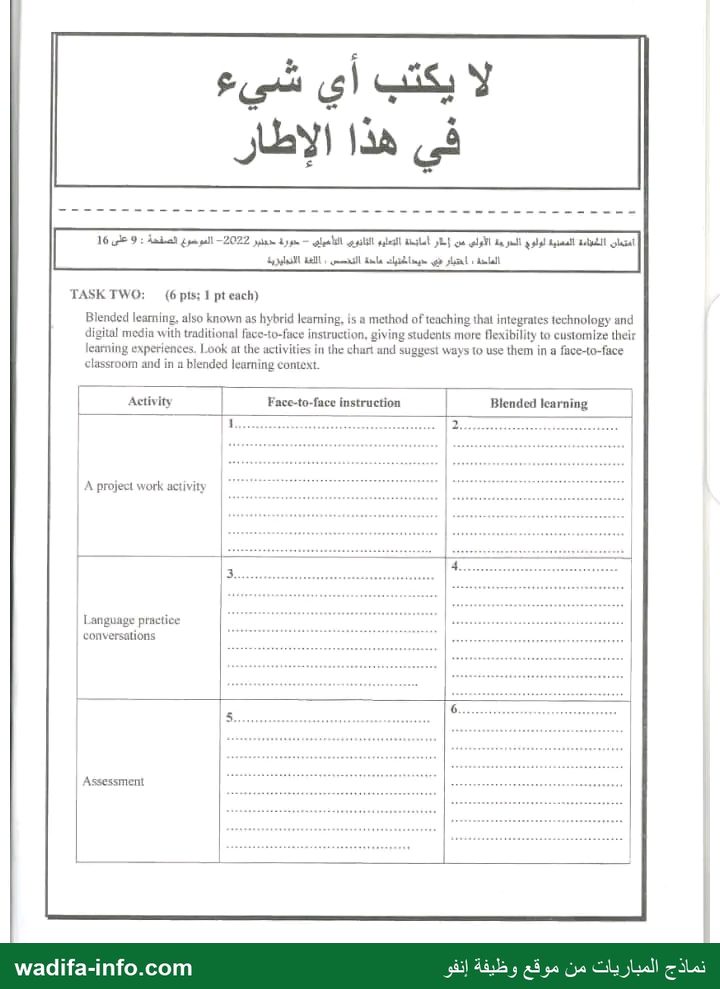
TASK TWO: )6 pts; 1 أم each)
Blended learning, also known as hybrid learning, is a method of teaching that integrates technology and
digital media with traditional face-to-face instruction, giving students more flexibility to customize their
lcarning experiences. Look at the activities in the chart und suggest ways to use them in a face-to-face
classroom and in a blended learning context.
; — = يبب
| Activity Face-to-face instruction Blended learning
— صفحة 10 —
du لا بكتب أى
جا أي سي ع
es ra بن
16 أماجنة التصليم الثانوي الباميلي عدورة دينير 2022 الموسوع الصفحة : 10 على jt امتمان اللخفاعة الممنية لواوي الترجة الأولي عن
اللغة النبليزية à التنسس Ana cul في pal : الماضة
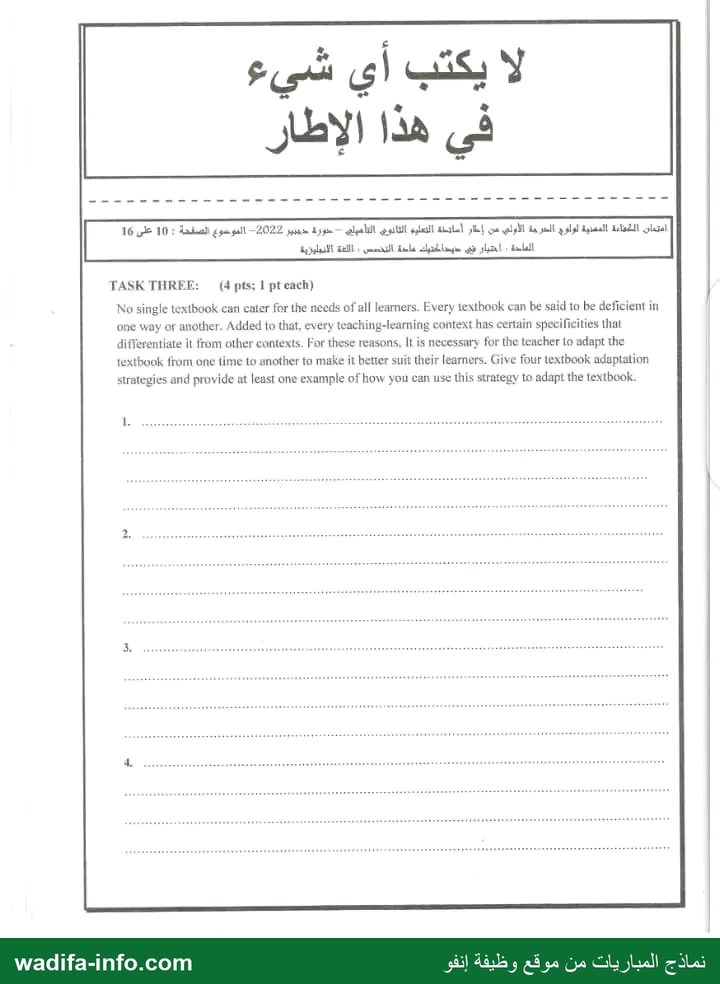
TASK THREE: )4 pts; ١ pteach) |
No single textbook can cater for the necds of all lenrners. Every 1extbook can be said 16 be deficient in
one way or another. Added ما that, every teaching-learning context has certain specificities that
différentiate it from other contexts. For these reasons, It is necessary for the leacher ما adapt the
textbook from one time to another to make it better suit their learners. Give four textbook adaptation
strategies and provide at least one example of how you can use this strategy to adapt the textbook.
— صفحة 11 —
2 لا يكتب اى شم
7 re ® ين
ا الإاطا :
في ب مار
نََ
16 الصفحة : 11 على gp pull -2022 ja امتدان الشفامة العمنية لولوج الحرجة الأولي من إطار أساتطة التعليم الثانوي التامياي - دورة
التننسس , اللغة الانجليزية Aube الماصسة « احتبار في <ديداحشتيك
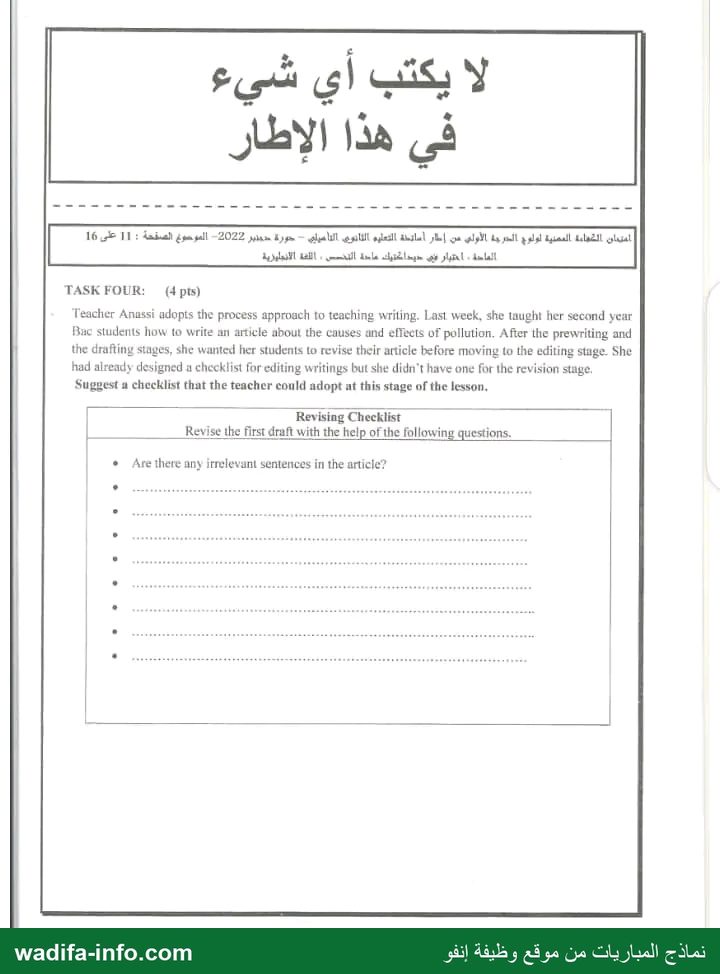
TASK FOUR: (4 pts)
Teacher Anassi adopts the process approach to teaching writing. Last week, she taught her second year
Bac students how to write an article about the causes and effects of pollution. After the prewriting and
the drafting stages, She wanted her students ما revise their article before moving to the editing stage. She
had already designed ه checklist for editing writings but she didn't have one for the revision stage
Suggest a checklist that the teacher conld adopt at this stage of the lesson,
Revising Checklist 0 |
Revise the First draft with the help ofthe following questions. 0 |
* Arethere any irrelevant sentences in the article?
— صفحة 12 —
لا يكتب أى شىء
(CS = = سي
À ذا الإطار
امتعان الخفاءة المعنية لولوج المترجة الأولي من إطار أساتطة التعليم الثاتوي التأميلي junte à jp 2022 - العم وع الصفحة : 12 على 16
الماضة ؛ احتبار في ديد اتيك ماءدة التتسي ,؛ اللغة الادبليزبة
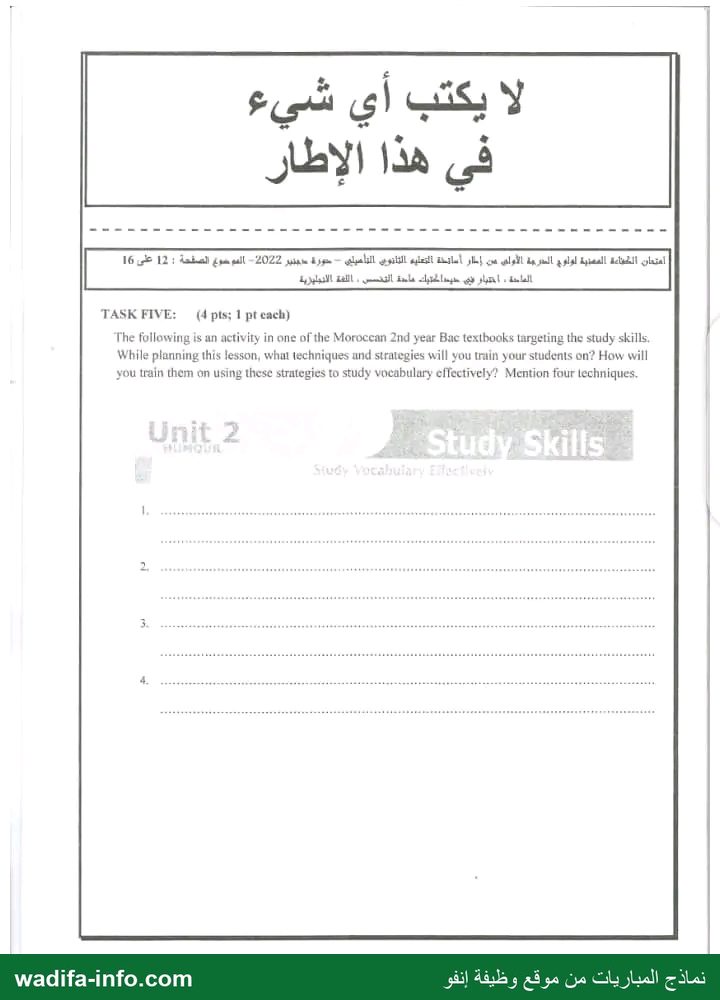
TASK FIVE: )4 pts; 1 أت each) |
Fhe following is an activity in one of the Moroccan 2010 year Bac texthooks targeting the study skills
While planning this lesson, what techniques and strategies will vou train your students on? How will
you train them on using these strategies to study vocabulary effectively? Mention four techniques.
— صفحة 13 —
ب > ٠. ف
لاطا ١١ ! :
16 الموضوع الصقحة : 13 على -2022 pue اعتمان الحفامة المصنية لولوج الدرجة الأوالي من إطار أساتسلة التعليم الثانوي التأهيلي - سدورة
احتبار عي <بداحتيك مادة الننسى , اللغة النجليزية à الماضة
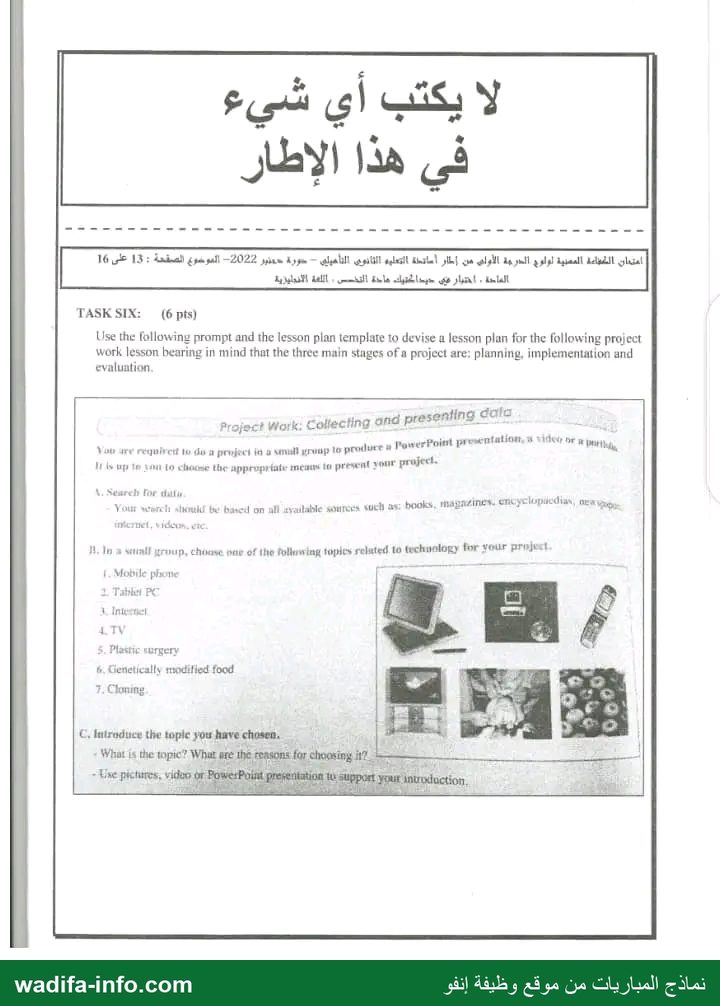
TASK SIX: )6 pts)
Use the following prompt and the lesson plan template 10 devise a lesson plan for the following project
work lesson bearing in mind that the three main stages of a project are: planning, implementation and
evaluation
j nting 3
Project Work: Collec وم 42 presen ps
رويين؛ Point presntations 1000 ve x puy
Vou are require مل ما à project de à anal اي | مسوم © تمصي 5 | die
| ١١ عا up Le va 10 choose the appropréaté mecs to present 7 رمح
٠١ Sesreb لا بينسل ع Ltd ده
Voir تمي سا تعمل اتوي on all available توم such as: بويا ع1 كاب الال يف11 كوم
ص1 .إل à seal group, choose كه عدم the برما لاه toples related 10 ةاداعم for your projet
1. Mobile phone
LIT | . ‘a 8
| Plastic surgery À 3
6. Genetically modilied food | L
7. Cloning | l <
C, Iiroduce the tople you have chosen. x :
What كا the topic? What are تصمومع عرلا for Choosinys جا _ورز = mt
pie 9 تابط جعي proferiation دا support your introduction.
difa-inf تماذح الميا؛ يات ي* قع و ظبفةٌ انو
waqdlta-InTo.com (دفو A8 5 دج المباريات من موقع
التصحيح المقترح
هذا تصحيح مقترح من إعداد فريق wadifa-info لمساعدتك على فهم منهجية الإجابة — وليس تصحيحاً رسمياً صادراً عن الإدارة المنظِّمة. أسئلة هذا الامتحان محررة بالفرنسية، لذلك التصحيح محرر بالفرنسية أيضاً.
This paper is the subject-didactics test (English) of the professional aptitude examination for promotion to first grade, qualifying secondary school teachers — National Centre for Evaluation and Examinations, December 2022 session. Time allowed: 3 hours; coefficient 1; marked out of 20 after conversion. It has six tasks: Task One (32 multiple-choice items, 1 pt each), Task Two (blended learning, 6 pts), Task Three (textbook adaptation, 4 pts), Task Four (revising checklist, 4 pts), Task Five (study skills, 4 pts) and Task Six (project-work lesson plan, 6 pts). Below is a suggested answer key.
How to use this key: Task One answers come with a one-line reason. Tasks Two to Six are open: the answers given are models, and other well-justified answers are acceptable. Items marked "probable answer" are those where two options can be defended; the reasoning is shown.
Task One — Multiple choice (32 pts)
| Item | Answer | Why |
|---|---|---|
| 1 | C | In the 5 Cs, "Connections" means linking English with other school subjects. Interviewing the geography teacher connects the unit with another discipline; interviewing the local council (A) or researching the local area (D) belongs to "Communities", and B is a plain "Comparisons" task. |
| 2 | D — Metacognitive | Students reflect on task difficulty and on the strategies they used: thinking about one's own thinking and learning. |
| 3 | C | Rapid drawings and a Pictionary game make learners represent ideas visually. A is interpersonal/kinaesthetic, D is bodily-kinaesthetic, B is mainly a verbal brainstorm. |
| 4 | A — Integrative motivation | She learns the language because she admires the culture and wants to become part of the community (Gardner and Lambert). |
| 5 | D — The Direct Method | Exclusive use of the target language, no L1, priority to speaking and listening, everyday vocabulary, little explicit grammar. |
| 6 | B — Summative assessment | The presentations are scored at the end of the unit and count for 20% of the term grade. |
| 7 | A | Love and belonging are met by building a sense of team and bonding. B serves esteem, C serves esteem and self-actualisation, D serves safety. |
| 8 | A | Social constructivism rests on interaction and scaffolding. Reading alone, with no monitoring, involves neither peers nor teacher mediation. |
| 9 | D | Activating background knowledge through brainstorming is a cognitive (schema-theory) practice. Imitation and repetition (A), reinforcement and punishment (B) and lab drills (C) are behaviourist. |
| 10 | A — Assimilation | The children fit the new input (tiger) into an existing schema (big cat). Changing the schema would be accommodation. |
| 11 | C — Transformation drill | Learners transform a sentence from one form into another (affirmative to negative). |
| 12 | D | The spiral curriculum is about revisiting topics, increasing complexity and building on prior learning; it says nothing about repetitive, cyclical testing. |
| 13 | C — The input hypothesis | Input must be comprehensible, just one step beyond the learner's level (i + 1). Materials that are "too hard" and "far challenge their competence" violate it. |
| 14 | A — Sociocultural competence | The English Language Guidelines for secondary schools (2007) define socio-cultural competence as “the ability to understand and use utterances appropriately in different sociolinguistic contexts depending on contextual factors/clues”. Discussing personal experiences, interpreting the messages behind dialogues and analysing idiomatic expressions all deal with meaning in its social and cultural context. B would focus on grammar and vocabulary forms, C on cohesion and coherence, D on repair strategies. |
| 15 | B — Field-independent learners | Analytical, focused, competitive, they see the parts that make up the whole. Field-dependent learners see the whole and prefer cooperation. |
| 16 | A — Antonymy | The sentence itself gives the contrast: "I concur … but I disagree". The context leads learners to the meaning through the opposite. |
| 17 | C — Concrete operational stage | Logical thinking with concrete examples, but difficulty with hypothetical and abstract matters, which only come at the formal operational stage. |
| 18 | A | Tuckman (1965): forming, storming, norming, performing. |
| 19 | C — Interlingual | Errors caused by transfer from another language (here French "véhicule"). Intralingual errors come from the target language itself. |
| 20 | B | A task has a communicative outcome, is goal-directed and focuses on meaning. It does not have to target the four skills. |
| 21 | D | The Silent Way follows a structural syllabus built around grammar items and vocabulary, not around daily use of language. A, B and C are its three learning principles (discovery, mediating physical objects such as rods and charts, problem-solving). |
| 22 | C | Competency-based teaching is criterion-referenced: each learner is judged against the competency, not ranked against other students (norm-referencing). |
| 23 | A (probable answer) | An oral report is the way the learner shows what has been learnt: that is differentiation of product, not of process. B, C and D concern the way learners access and work on the material. Note that in some models, offering textbooks or audio books is classified under content; the option that clearly cannot be process is A. |
| 24 | B — Situation, audience, purpose | The prompt already gives the format (an email) and the topic (your favourite sport). It does not say in what situation, to whom or why the student is writing. |
| 25 | D | Debating pros and cons requires judging and defending a position: evaluating. A is analysing, B is understanding/inferring, C is understanding. |
| 26 | A — Making connections | The questions link the topic to the students' own lives (text-to-self connections) and activate background knowledge. |
| 27 | C (probable answer) | Bottom-up listening decodes the signal itself: sounds, intonation, words (A), and the word-by-word reconstruction of a dictogloss (B). Evaluating the speakers' attitude is an inference built on context and world knowledge: a top-down activity. Body language (D) is not strictly linguistic decoding either, but it is still a surface cue taken from the input, which makes C the best answer. |
| 28 | C (probable answer) | The aim is to convey meaning to learners who meet the structure for the first time. Realia (A), a personalised context (B) and a demonstration (D) all show meaning. Asking the students themselves to draw a timeline presupposes that they already understand the structure: it can check meaning, not teach it. |
| 29 | B — Metalinguistic feedback | The teacher does not give the correct form; she asks a question about the rule ("What's the past simple form of 'go'?"). A recast would simply reformulate: "He went to the beach". |
| 30 | D — Social | In Oxford's taxonomy, asking questions for clarification or help, to the teacher or to peers, is a social strategy. |
| 31 | C — Communicative | Each student has a different map: there is an information gap, a real purpose and free choice of language. |
| 32 | A — Hyponyms | Salmon, eel and goldfish are kinds of fish; "fish" is the hypernym (superordinate). |
Answer grid: 1 C · 2 D · 3 C · 4 A · 5 D · 6 B · 7 A · 8 A · 9 D · 10 A · 11 C · 12 D · 13 C · 14 A · 15 B · 16 A · 17 C · 18 A · 19 C · 20 B · 21 D · 22 C · 23 A · 24 B · 25 D · 26 A · 27 C · 28 C · 29 B · 30 D · 31 C · 32 A.
Task Two — Face-to-face and blended learning (6 pts)
| Activity | Face-to-face instruction | Blended learning |
|---|---|---|
| A project work activity | 1. Groups plan the project in class, share out roles, collect data from the library, interviews and magazines, make a poster or wall display and present it to the class, who give feedback with a checklist. | 2. Groups plan in class, then research online at home, co-write on a shared document, keep in touch through a class platform or messaging group, and produce a digital product (slides, video, blog post). Class time is kept for presentations and feedback. |
| Language practice conversations | 3. Pair work and role plays in class with cue cards, information-gap activities and mingle activities; the teacher monitors and gives delayed feedback. | 4. Students watch or listen to model dialogues online before class, record their own conversations (voice messages, video calls with a partner) and post them; class time is used for freer practice and feedback on the recordings. |
| Assessment | 5. Paper-and-pencil quizzes and tests, oral interviews and presentations assessed in class with a rubric; paper portfolios. | 6. Online self-correcting quizzes with immediate feedback, e-portfolios, recorded oral tasks and peer assessment on a forum, combined with an in-class test for the summative mark. |
Task Three — Four textbook adaptation strategies (4 pts)
- Adding (supplementing/expanding): bringing in what the textbook lacks. Example: the unit has no listening text, so the teacher adds a short authentic video on the same theme with a comprehension task; or adds extra practice exercises for a grammar point.
- Deleting (omitting): leaving out material that is irrelevant, outdated or too long. Example: skipping a reading passage about obsolete technology, or doing only five of the ten items of a mechanical exercise.
- Modifying (rewriting/changing the task): keeping the material but changing the activity or the mode of work. Example: turning a set of written comprehension questions into a jigsaw reading done in groups, or making a controlled exercise communicative by personalising the questions.
- Simplifying: making the text or the instructions easier for weaker classes. Example: shortening a text, glossing difficult words, rewording a complicated rubric, pre-teaching key vocabulary.
Also acceptable: reordering (teaching the writing lesson after the grammar lesson it depends on, or changing the order of units to fit the school calendar) and replacing (substituting a culturally distant text with one about the Moroccan context).
Task Four — Revising checklist (4 pts)
In the process approach, revising deals with content and organisation (ideas, relevance, order, paragraphing, linking). Grammar, spelling, punctuation and capitalisation belong to the editing stage, for which the teacher already has a checklist: do not put them here.
Revise the first draft with the help of the following questions.
- Are there any irrelevant sentences in the article? (given)
- Does the article have a title and an introduction that presents the topic of pollution?
- Is there a separate paragraph for the causes and another for the effects?
- Does each paragraph start with a clear topic sentence?
- Is each cause or effect supported with an explanation or an example?
- Are the ideas in a logical order?
- Are cause-and-effect linking words used correctly (because, due to, as a result, therefore, lead to)?
- Is any idea repeated, or is any important idea missing?
- Does the conclusion sum up the article or suggest a solution?
Task Five — Study skills: studying vocabulary effectively (4 pts)
The textbook activity reproduced in the paper is not legible in the scan (only the headings "Unit 2", "Study Skills" and "Study Vocabulary Effectively" can be read). The answer below therefore gives four standard vocabulary-study techniques and how to train students on each; the expected answer rests on the content of that textbook page.
- Keeping a vocabulary notebook: show a model entry (word, part of speech, pronunciation, definition or translation, example sentence). Students record five words from the unit in this format; notebooks are checked regularly.
- Organising words in word maps and word families: build a spidergram on the board around the unit theme (humour: joke, funny, laugh, comedian…), then a word-family table (noun, verb, adjective, adverb) with prefixes and suffixes. Students complete a second map in pairs.
- Guessing meaning from context and checking in a dictionary: model the steps on a sentence from the unit (part of speech, surrounding clues, affixes), then train students to read a dictionary entry: meaning, stress, collocations, example.
- Recording collocations and reviewing regularly: students note words with their partners (tell a joke, burst out laughing), make flashcards, and test each other at spaced intervals (next lesson, next week), then reuse the words in their own sentences or a short paragraph.
Training sequence for each technique: raise awareness (how do you usually learn new words?), model the technique, guided practice with the unit vocabulary, independent use at home, then reflection on what worked.
Task Six — Lesson plan for the project-work lesson (6 pts)
The lesson plan template is on a page that is not included in the scan; the plan below follows the three stages required by the question (planning, implementation, evaluation) and the textbook prompt "Project Work: Collecting and presenting data".
| Lesson information | |
|---|---|
| Level / unit | 2nd year Baccalaureate — unit on science and technology |
| Lesson | Project work: collecting and presenting data |
| Competencies / standards | Learners conduct simple research, select and organise information from several sources, and present it orally with visual support; they work cooperatively. |
| Objectives | By the end of the project, students will be able to: (1) plan a group project and share out roles; (2) collect and select relevant data on a technology topic from at least three sources; (3) organise the data in a PowerPoint presentation, a video or a portfolio; (4) present the project and answer questions; (5) assess their own and their peers' work with a rubric. |
| Materials | Textbook prompt, topic list, planning sheet, sources (books, magazines, encyclopedias, internet, videos), computer and projector, evaluation rubric. |
| Time | One class session for planning, about two weeks of out-of-class work with a short progress check, one or two sessions for presentations and evaluation. |
| Stage | Procedure (teacher and students) | Interaction / time |
|---|---|---|
| 1. Planning (in class) |
Warm-up: the teacher shows the pictures of the prompt and elicits the technology topics. The teacher explains the aim, the final product and the deadline, and shares the evaluation rubric. Students form small groups of four or five and choose one topic from the list (mobile phone, tablet PC, internet, TV, plastic surgery, genetically modified food, cloning); the teacher makes sure topics are varied. Each group answers: What is the topic? Why did we choose it? What do we need to find out? and chooses its means of presentation. Groups assign roles (coordinator, researchers, writer/designer, presenters) and fill in a planning sheet with tasks, sources and dates. The teacher gives guidance on searching, note-taking and citing sources. | T–Ss, then group work / 50–55 min |
| 2. Implementation (mostly out of class) |
Students search for data in all available sources, take notes and select relevant information. They organise it: introduction of the topic and reasons for choosing it, description, advantages and drawbacks, conclusion and sources. They prepare the product (slides, video or portfolio) with pictures to support the introduction, and rehearse. Mid-way progress check in class (10 minutes): each group reports briefly; the teacher gives feedback on content and language and helps solve problems. | Group work, teacher as facilitator / 2 weeks |
| 3. Evaluation (in class) |
Each group presents its project (7 to 10 minutes), followed by questions from the class. Listeners fill in a peer-assessment grid (content, organisation, language, visual support, delivery, teamwork). The teacher assesses with the same rubric and gives delayed feedback on recurrent language errors. Groups complete a short self-evaluation: what went well, what was difficult, what they would do differently. Follow-up: the best products are displayed or shared on the class blog. | Group presentations, whole class / 1–2 sessions |
أسئلة شائعة حول هذا النموذج
هل يمكن تحميل هذا النموذج مجاناً؟
هل يتضمن هذا النموذج التصحيح؟
ما هي الجهة المنظمة والدرجة المعنية بهذا النموذج؟
ما هي دورة هذا الامتحان ولغة أسئلته؟
أين أجد نماذج أخرى لنفس المباراة؟
ناقش هذا النموذج (0)
شارك إجاباتك أو صحّح التصحيح — إذا كان لديك رأي مختلف حول أي نقطة، اكتبه هنا ليستفيد باقي المترشحين.
لا يوجد نقاش بعد — شارك إجابتك أو سؤالك حول هذا النموذج.
⚠️ ممنوع نشر أرقام الهاتف أو الروابط أو أي عرض مقابل مال — تُحذف هذه المشاركات تلقائياً.
هل تحضّر لهذه المباراة؟
نماذج مشابهة قد تهمّك
الجهة المنظمة: وزارة التربية الوطنية - المركز الوطني للتقويم والامتحانات · دورة دجنبر 2022 — مصدر النسخة: نماذج مباريات التوظيف - مواضيع الدورات السابقة؛ الإعلان الرسمي للمباراة هو المرجع.
كيف تستشهد بهذه الصفحة؟
صحفي أو مدوّن أو أستاذ؟ انسخ المرجع أسفله وضع رابطاً نحو هذه الصفحة.
الرابط الدائم: https://www.wadifa-info.com/نموذج-مباراة/1427/نموذج-اختبار-في-ديداكتيك-مادة-التخصص-اللغة-الإنجليزية-وزارة-التربية-الوطنية-المر