

نموذج مباراة ولوج مسلك تأهيل أساتذة التعليم الثانوي التأهيلي بالمراكز الجهوية لمهن التربية والتكوين 2012 - مادة التخصص المدرسة: اللغة الإنجليزية
⬇️ تحميل PDF الرابط الدائم: wadifa-info.com/نموذج-مباراة/2984
باختصار
هذا نموذج امتحان كتابي سابق لمباراة مسلك تأهيل أساتذة التعليم الثانوي التأهيلي لدى وزارة التربية الوطنية - المركز الوطني للتقويم والامتحانات - المراكز الجهوية لمهن التربية والتكوين (دورة يوليوز 2012)، منشور على وظيفة إنفو للاطلاع والتحميل المجاني بصيغة PDF.
- الجهة المنظمة
- وزارة التربية الوطنية - المركز الوطني للتقويم والامتحانات - المراكز الجهوية لمهن التربية والتكوين
- الدرجة
- مسلك تأهيل أساتذة التعليم الثانوي التأهيلي
- التخصص
- مادة التخصص المدرسة: اللغة الإنجليزية
- الدورة
- دورة يوليوز 2012
- عدد الصفحات
- 5
- لغة الأسئلة
- الفرنسية
- التصحيح
- غير متوفر بعد
صفحات النموذج (5)
📝 نص أسئلة النموذج (مستخرج آلياً من الصفحات الممسوحة)
استُخرج هذا النص آلياً من صور الامتحان وقد يحتوي على أخطاء في القراءة — الصور أعلاه هي المرجع.
: المملكة المغريية مباراة الدخول إلى مسلك تأهيل أساتذة التعليم
الثانوي التأهيلي بالمراكز الجهوية لمهن سر
التربية والتكوين - دورة يوليوز 2012 2
| ونارة التربية الوأمنية الموضوع
المركز الوطني للتقويم والامتحانات
مادة التخصص المدرسة : اللغة الانجليزية LA À
مدة َ
ساعاث
بسب©7ببسلللسسس“ل“الس“ندظللل ل(#[ب[بسس لسللللسبالسصا اللابابلبللبابللل7ى6اشل لسسلستتبَااطظمبللسسوْءً.............. سدسيسسمجس ممست
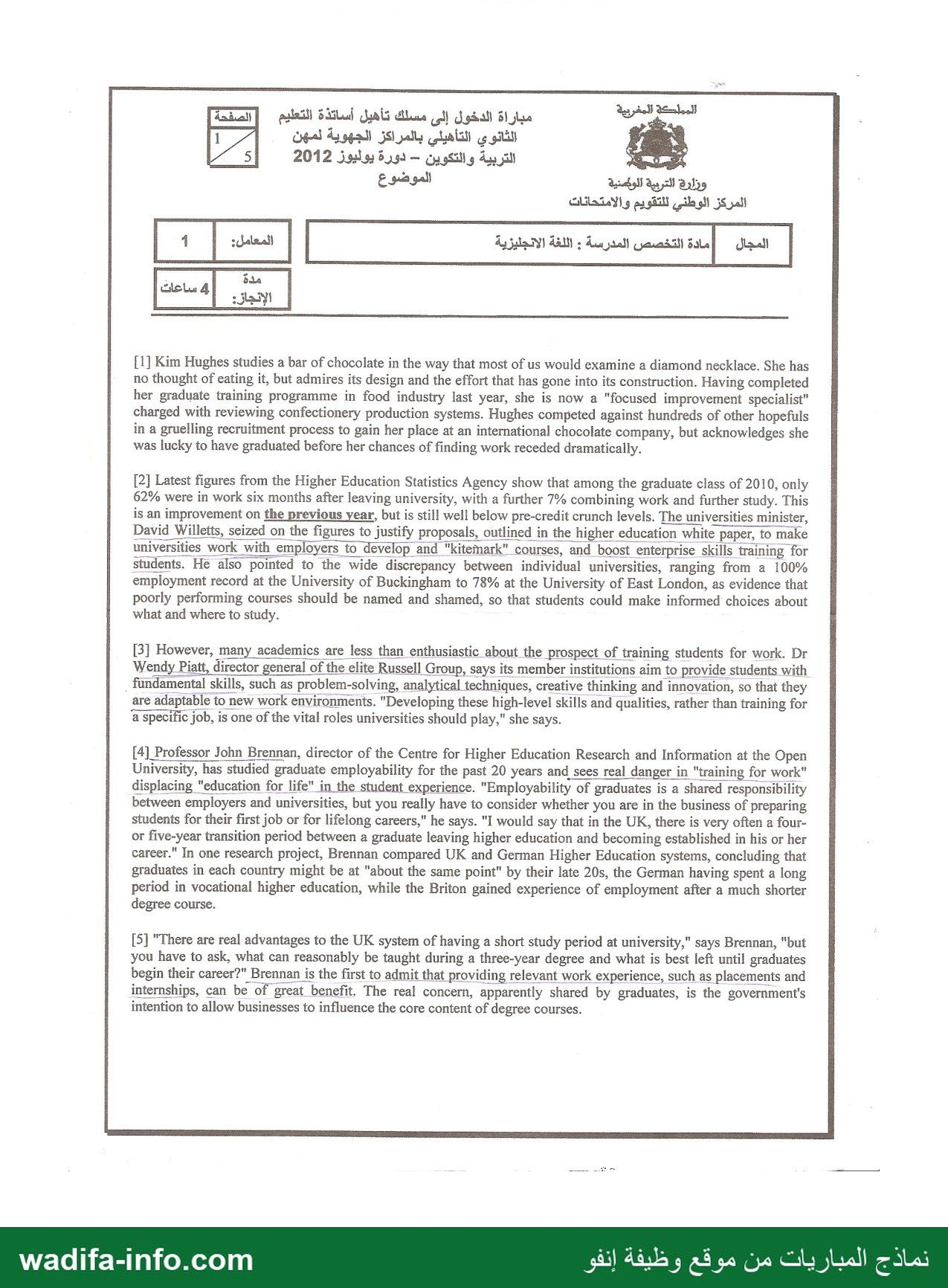
Kim Hughes studies a bar of chocolate in the way that most of us would examine a diamond necklace. She has [1]
no thought of eating it, but admires its design and the effort that has gone into its construction. Having completed
her graduate training programme in food industry last year, she is now a "focused improvement specialist"
charged with reviewing confectionery production systems. Hughes competed against hundreds of other hopefuls
in a gruelling recruitment process to gain her place at an international chocolate company, but acknowledges she
was lucky to have graduated before her chances of finding work receded dramatically.
Latest figures from the Higher Education Statistics Agency show that among the graduate class of 2010, only ]2[
were in work six months after leaving university, with a further 7% combining work and further study. This 62%
is an improvement on the previous year, but is still well below pre-credit crunch levels. The universities minister,
David Willetts, seized on the figures to justify proposals, outlined in the higher education white paper, to make
universities work with employers to develop and "kitemark" courses, and boost enterprise skills training for
students. He also pointed to the wide discrepancy between individual universities, ranging from a 100%
employment record at the University of Buckingham to 78% at the University of East London, as evidence that
poorly performing courses should be named and shamed, so that students could make informed choices about
what and where to study.
However, many academics are less than enthusiastic about the prospect of training students for work. Dr ]3[
Wendy Piatt, director general of the elite Russell Group, says its member institutions aim to provide students with
fundamental skills, such as problem-solving, analytical techniques, creative thinking and innovation, so that they .
are adaptable to new work environments. "Developing these high-level skills and qualities, rather than training for
a specific job, is one of the vital roles universities should play," she says.
Professor John Brennan, director of the Centre for Higher Education Research and Information at the Open ]4[
University, has studied graduate employability for the past 20 years and sees real danger in “training for work"
displacing "education for life"_in the student experience. "Employability of graduates is a shared responsibility
between employers and universities, but you really have to consider whether you are in the business of preparing ١
students for their first job or for lifelong careers." he says. "I would say that in the UK, there is very often a four-
or five-year transition period between a graduate leaving higher education and becoming established in his or her
career." În one research project, Brennan compared UK and German Higher Education systems, concluding that
graduates in each country might be at "about the same point" by their late 205, the German having spent a long
period in vocational higher education, while the Briton gained experience of employment after a much shorter ١
degree course.
"There are real advantages to the UK system of having a short study period at university," says Brennan, “but | ]5[
you have to ask, what can reasonably be taught during a three-year degree and what is best left until graduates
begin their career?" Brennan is the first to admit that providing relevant work experience, such as placements and
internships, can be of great benefit. The real concern, apparently shared by graduates, is the government's
intention to allow businesses to influence the core content of degree courses.
نماذج المباريات من موقع وظيفة إنفو wadifa-info.com
مباراة الدخول إلى مسلك تأهيل أساتذة التعليم الثانوي التأهيلي بالمراكز الجهوية لمهن التربية والتكوين
1 دورة يوليوز 2012
العوضوم 0 “
المجال : مادة التخصص المدرسة - اللغة الانجليزية
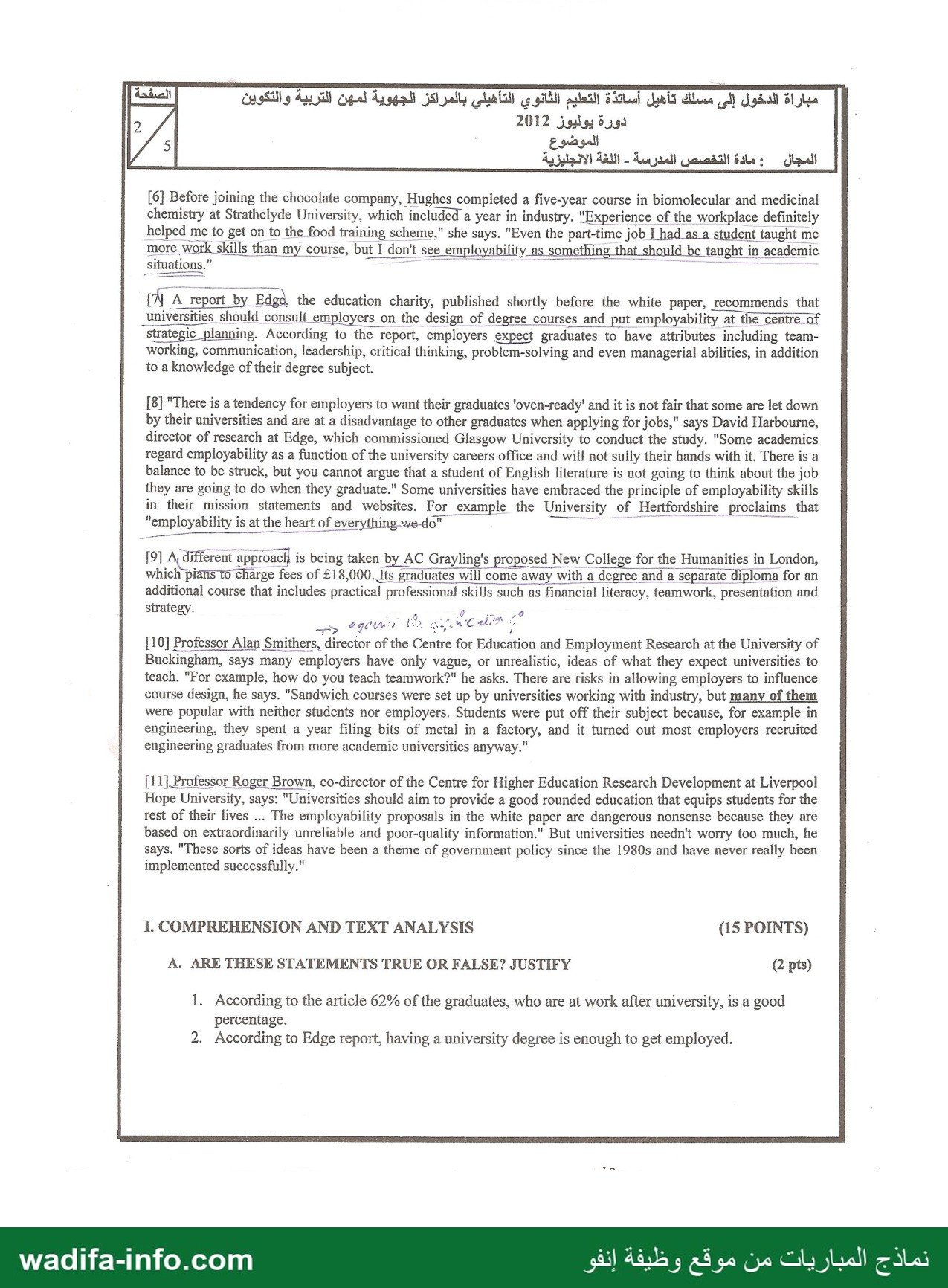
Before joining the chocolate company, Hughes completed a five-year course in biomolecular and medicinal [6]
chemistry at Strathclyde University, which included a year in industry. "Experience of the workplace definitely
helped me to get on to the food training scheme," she says. "Even the part-time job 1 had as a student taught me
more Work skills than my course, but I don't see employability_as something that should be taught in academic
the education charity, published shortly before the white paper, recommends that فو [A |A report by
_universities should consult employers on the design of degree courses and put employability at the centre of
Strategic planning. According to the report, employers expect graduates to have attributes including team-
working, communication, leadership, critical thinking, problem-solving and even managerial abilities, in addition
to a knowledge of their degree subject,
"There is a tendency for employers to want their graduates 'oven-ready' and it is not fair that some are let down ]8[
by their universities and are at a disadvantage to other graduates when applying for jobs," says David Harbourne,
director of research at Edge, which commissioned Glasgow University to conduct the study. "Some academics
regard employability as a function of the university careers office and will not sully their hands with it. There is a
balance to be struck, but you cannot argue that a student of English literature is not going to think about the job
they are going to do when they graduate." Some universities have embraced the principle of employability skills
in their mission statements and websites. For example the University of Hertfordshire proclaims that
شغ" “employability is at the heart of everything-we-do"
A different approach is being taken by AC Grayling's proposed New College for the Humanities in London, ]9[
which pians 16 charge fees of £18,000. Its graduates will come away with a degree and a separate diploma for an
additional course that includes practical professional skills such as financial literacy, teamwork, presentation and
اا ل , strategy.
ur ta gite er :ُ #90 ب 1
Professor Alan Smithers, director of the Centre for Education and Employment Research at the University of ]10[
Buckingham, says many employers have only vague, or unrealistic, ideas of what they expect universities to
teach. "For example, how do you teach teamwork?" he asks. There are risks in allowing employers to influence
course design, he says. "Sandwich courses were set up by universities working with industry, but many of them
were popular with neither students nor employers. Students were put off their subject because, for example in
١ engineering, they spent a year filing bits of metal in a factory, and it turned out most employers recruited
engineering graduates from more academic universities anyway." |
[11].Professor Roger Brown, co-director of the Centre for Higher Education Research Development at Liverpool
Hope University, says: "Universities should aim to provide a good rounded education that equips students for the
rest of their lives … The employability proposals in the white paper are dangerous nonsense because they are
based on extraordinarily unreliable and poor-quality information." But universities needn't worry too much, he
says. "These sorts of ideas have been a theme of government policy since the 1980s and have never really been
implemented successfully."
COMPREHENSION AND TEXT ANALYSIS (5 POINTS) | .1
À. ARE THESE STATEMENTS TRUE OR FALSE? JUSTIFY € pts)
According to the article 62% of the graduates, who are at work after university, is a good .1
percentage.
According to Edge report, having a university degree is enough to get employed. .2
نماذج المباريات من موقع وظيفة إنفو wadifa-info.com
51e fl. الدخول إلى مسلك تأهيل أساتذة التعليم الثانوي التأهيلي بالمراكز الجهوية لمهن التربية والتكوين
دورة يوليوز 2012
الموضوع إٍ
المجال : مادة التخصص المدرسة - اللغة الانجليزية
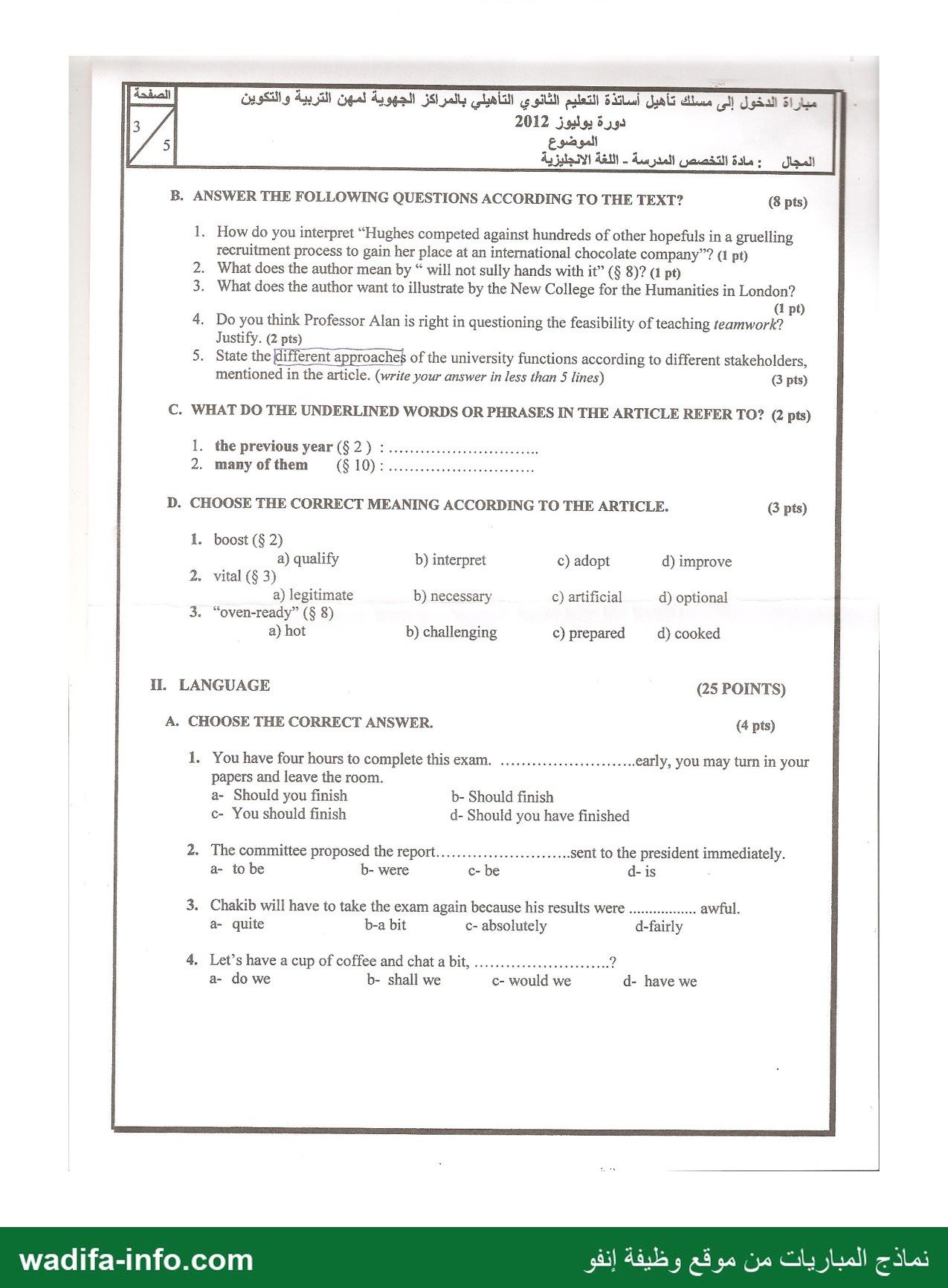
B. ANSWER THE FOLLOWING QUESTIONS ACCORDING TO THE TEXT? (8 pts)
How do you interpret “Hughes competed against hundreds of other hopefuls in a gruelling .1
recruitment process to gain her place at an international chocolate company”? (1 pt)
What does the author mean by “ will not sully hands with it” ($ 8)? (1 pd .2
What does the author want to illustrate by the New College for the Humanities in London? .3
Do you think Professor Alan is right in questioning the feasibility of teaching feamwork? .4
Justify. (2 pts)
State the Hifferent approaches of the university functions according to different stakeholders, .5
mentioned in the article. (write your answer in less than 5 lines) 3 pts)
C. WHAT DO THE UNDERLINED WORDS OR PHRASES IN THE ARTICLE REFER TO? (2 pts)
the previous year ($ 2) : ............................ .1
ال مه لود :[10 5 many of them .2
D. CHOOSE THE CORRECT MEANING ACCORDING TO THE ARTICLE. (3 pts)
boost ($ 2) .1
a) qualify b) interpret c) adopt d) improve
ا )3 $( vital .2
a) legitimate b) necessary c) artificial d) optional |
“oven-ready” ($ 8) .3
a) hot b) challenging c) prepared d) cooked |
LANGUAGE (25 POINTS) .11
A. CHOOSE THE CORRECT ANSWER. (4 pts) |
You have four hours to complete this exam. ..….....................early, you may turn in your .1
papers and leave the room.
a- Should you finish b- Should finish
c- You should finish d- Should you have finished
The committee proposed the report.….......................sent to the president immediately. .2
a- tobe b- were c- be d- is
Chakib will have to take the exam again because his results were ................. awful. .3
a- quite b-a bit c- absolutely d-fairly :
تت تت Let’s have a cup of coffee and chat a bit, ,4
a- do we b- shall we c- would we d- have we
٠. Lu : . '“ | 5 . + * .“ = —
نماذج المباريات من موقع وظيفة إنفو wadifa-info.com
| _مباراة الدخول إلى مسلك تأهيل أساتذة التعليم الثانوي التأهيلي بالمراكز الجهوية لمهن التربية والتكوين
دورة يوليوز 2012
ea 2
المجال : مادة التخصص المدرسة - اللغة الانجليزية
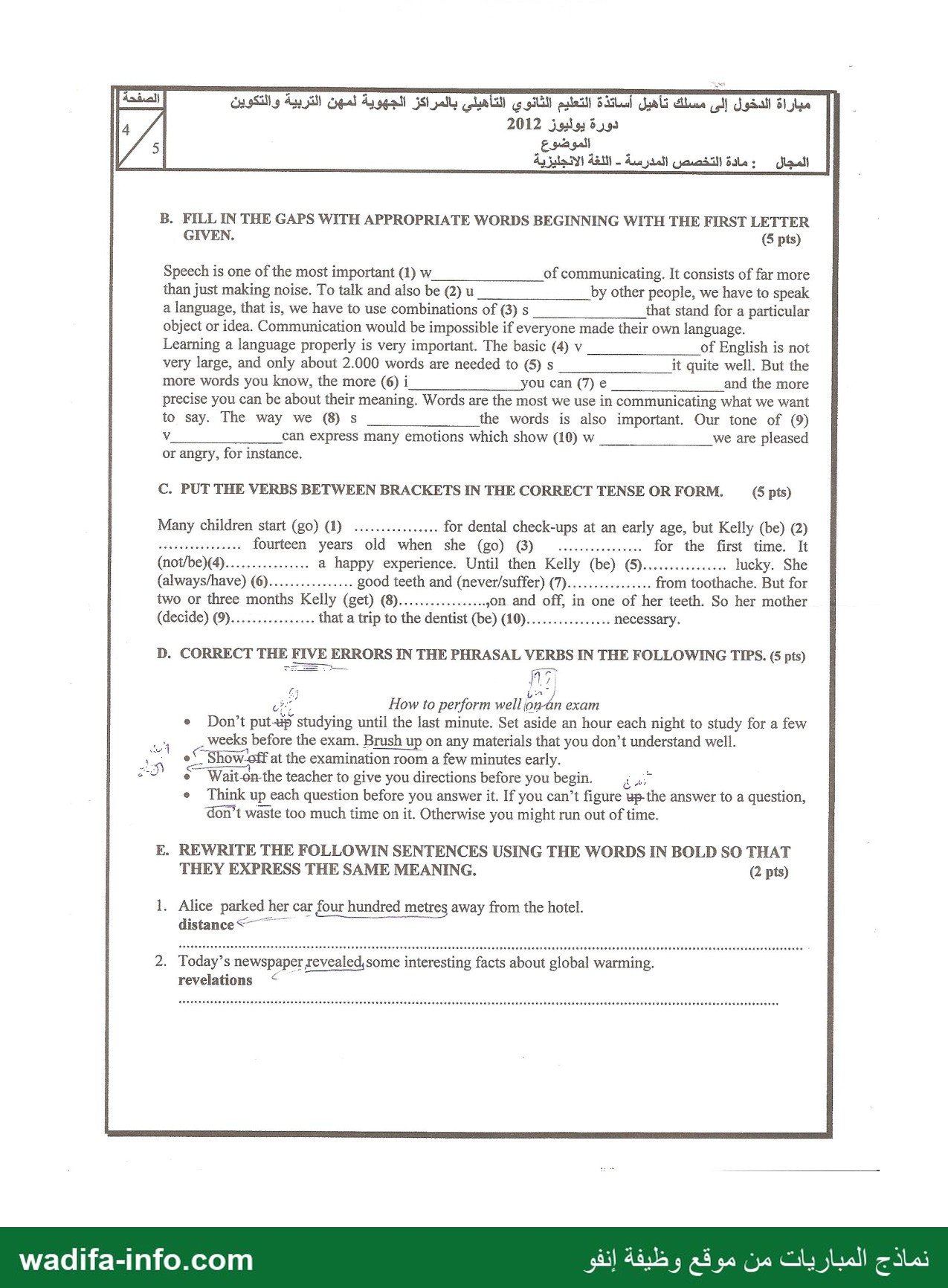
B. FILL IN THE GAPS WITH APPROPRIATE WORDS BEGINNING WITH THE FIRST LETTER
GIVEN. (5 pts)
Speech is one of the most important (1) w of communicating. It consists of far more
than just making noise. To talk and also be (2) u by other people, we have to speak
a language, that is, we have to use combinations of (3) s that stand for a particular
object or idea. Communication would be impossible if everyone made their own language.
Learning a language properly is very important. The basic (4) v of English is not
very large, and only about 2.000 words are needed to (5) s it quite well. But the
more words you know, the more (6) i you can (7)e and the more
precise you can be about their meaning. Words are the most we use in communicating what we want
to say. The way we (8) s the words is also important. Our tone of (9)
v can express many emotions which show (10) w we are pleased
or angry, for instance.
C. PUT THE VERBS BETWEEN BRACKETS IN THE CORRECT TENSE OR FORM. (5 pts)
Many children start (go) (1) ................ for dental check-ups at an early age, but Kelly (be) (2)
re... fourteen years old when she (go) (3) ..........…. for the first time. It
(not/be)(4).…............ a happy experience. Until then Kelly (be) (5)... lucky. She
(always/have) )6(. ............... good teeth and (never/suffer) )7(................ 00 toothache. But for
two or three months Kelly (get) (8)................on and off, in one of her teeth. So her mother
(decide) )9(................ that a trip to the dentist (be) )10(................ necessary.
D. CORRECT THE FIVE ERRORS IN THE PHRASAL VERBS IN THE FOLLOWING TIPS. (5 pts)
ال 7
FN How to perform well on-än exam
e Don’t put#5 studying until the last minute. Set aside an hour each night to study for a few
weeks before the exam. Brush up on any materials that you don’t understand well. . 28
e{ Showsff at the examination room a few minutes early. انا
D FWait-dn-the teacher to give you directions before you begin. & 4"
e Think up each question before you answer it. If you can’t figure ug-the answer to a question,
don’t waste too much time on it. Otherwise you might run out of time.
E. REWRITE THE FOLLOWIN SENTENCES USING THE WORDS IN BOLD SO THAT
THEY EXPRESS THE SAME MEANING. (2 pts)
Alice parked her car four hundred metres away from the hotel. .1
distance 7
newspaper revealed,some interesting facts about global warming. 5 10087 .2
revelations <
نماذج المباريات من موقع 5 AGE إنفو wadifa-info.com
: مباراة الدخول إلى مسلك تأهيل أساتذة التعليم الثانوي التأهيلي بالمراكز الجهوية لمهن التربية والتكوين
الموضوع
المجال : مادة التخصص المدرسة - اللفة الانجليزية
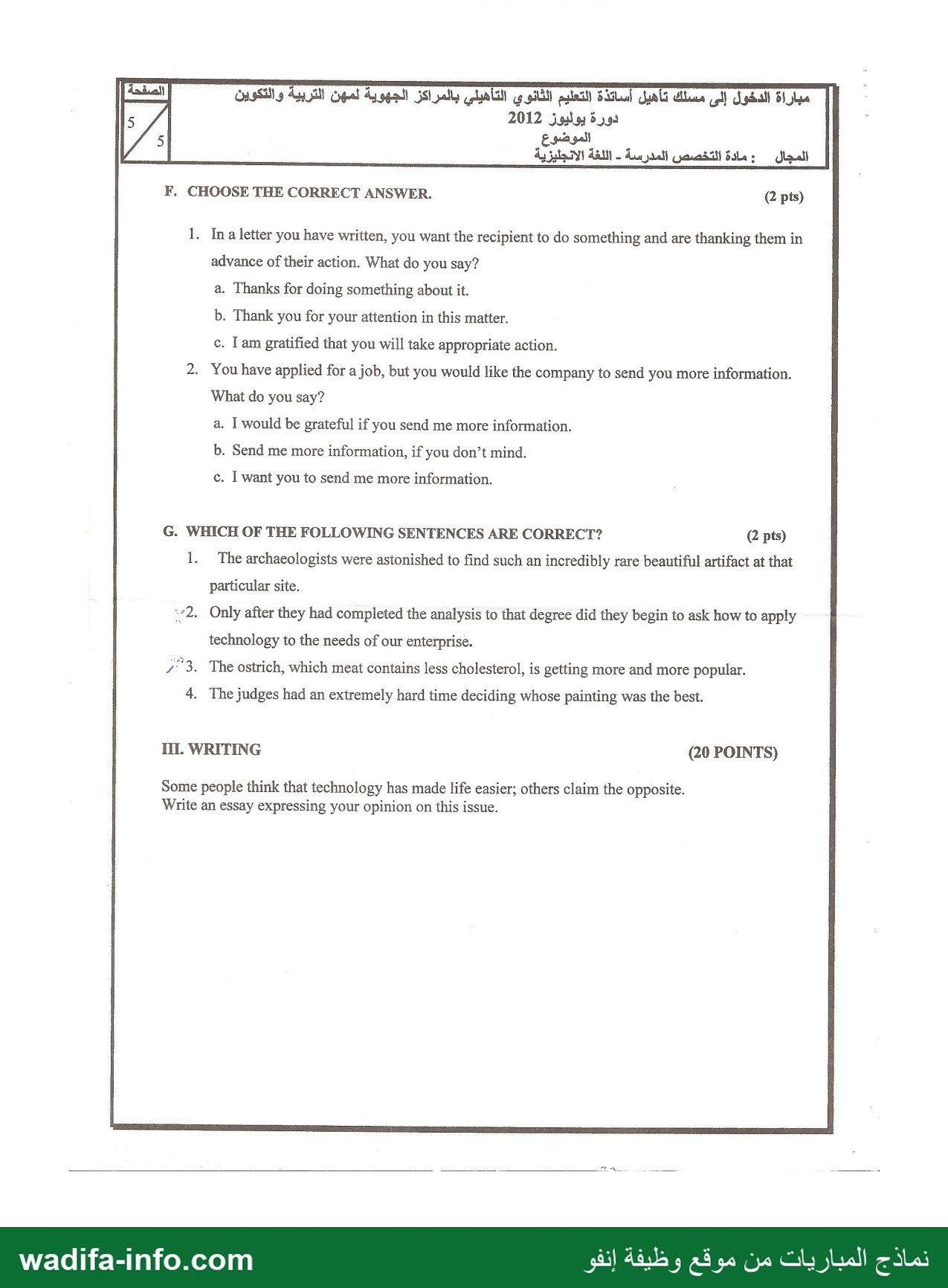
F. CHOOSE THE CORRECT ANSWER. (2 pts)
In a letter you have written, you want the recipient to do something and are thanking them in .1
advance of their action. What do you say?
a. Thanks for doing something about it.
b. Thank you for your attention in this matter.
T'am gratified that you will take appropriate action. .>
You have applied for a job, but you would like the company to send you more information. .2
What do you say?
a. I would be grateful if you send me more information.
b. Send me more information, if you don’t mind.
c. 1 want you to send me more information.
G. WHICH OF THE FOLLOWING SENTENCES ARE CORRECT? (2 pts)
archaeologists were astonished to find such an incredibly rare beautiful artifact at that 116 .1
particular site.
Only after they had completed the analysis to that degree did they begin to ask how to apply .2*:
technology to the needs of our enterprise.
The ostrich, which meat contains less cholestero!, is getting more and more popular. .23
The judges had an extremely hard time deciding whose painting was the best. .4
WRITING (20 POINTS) .111
Some people think that technology has made life easier; others claim the opposite.
Write an essay expressing your opinion on this issue.
نماذج المباريات من موقع وظيفة إنفو wadifa-info.com
أسئلة شائعة حول هذا النموذج
هل يمكن تحميل هذا النموذج مجاناً؟
هل يتضمن هذا النموذج التصحيح؟
ما هي الجهة المنظمة والدرجة المعنية بهذا النموذج؟
ما هي دورة هذا الامتحان ولغة أسئلته؟
أين أجد نماذج أخرى لنفس المباراة؟
ناقش هذا النموذج (0)
شارك إجاباتك أو صحّح التصحيح — إذا كان لديك رأي مختلف حول أي نقطة، اكتبه هنا ليستفيد باقي المترشحين.
لا يوجد نقاش بعد — شارك إجابتك أو سؤالك حول هذا النموذج.
⚠️ ممنوع نشر أرقام الهاتف أو الروابط أو أي عرض مقابل مال — تُحذف هذه المشاركات تلقائياً.
هل تحضّر لهذه المباراة؟
نماذج مشابهة قد تهمّك
الجهة المنظمة: وزارة التربية الوطنية - المركز الوطني للتقويم والامتحانات - المراكز الجهوية لمهن التربية والتكوين · دورة يوليوز 2012 — مصدر النسخة: نسخ منشورة على الويب (alwadifa-maroc)؛ الإعلان الرسمي للمباراة هو المرجع.
كيف تستشهد بهذه الصفحة؟
صحفي أو مدوّن أو أستاذ؟ انسخ المرجع أسفله وضع رابطاً نحو هذه الصفحة.
الرابط الدائم: https://www.wadifa-info.com/نموذج-مباراة/2984/نموذج-مباراة-ولوج-مسلك-تأهيل-أساتذة-التعليم-الثانوي-التأهيلي-بالمراكز-الجهوية