

نموذج مباراة ولوج المعهد العالي للإعلام والاتصال ISIC 2011 - اللغة الإنجليزية
⬇️ تحميل PDF الرابط الدائم: wadifa-info.com/نموذج-مباراة/2595
باختصار
هذا نموذج امتحان كتابي سابق لمباراة طالب - سلك الإجازة في الصحافة والاتصال لدى المعهد العالي للإعلام والاتصال ISIC - الرباط (2011)، منشور على وظيفة إنفو للاطلاع والتحميل المجاني بصيغة PDF مع تصحيح مقترح.
- الجهة المنظمة
- المعهد العالي للإعلام والاتصال ISIC - الرباط
- الدرجة
- طالب - سلك الإجازة في الصحافة والاتصال
- التخصص
- اللغة الإنجليزية
- الدورة
- 2011
- عدد الصفحات
- 2
- لغة الأسئلة
- الفرنسية
- التصحيح
- تصحيح مقترح متوفر في هذه الصفحة
📝 نص أسئلة النموذج (مستخرج آلياً من الصفحات الممسوحة)
استُخرج هذا النص آلياً من صور الامتحان وقد يحتوي على أخطاء في القراءة — الصور أعلاه هي المرجع.
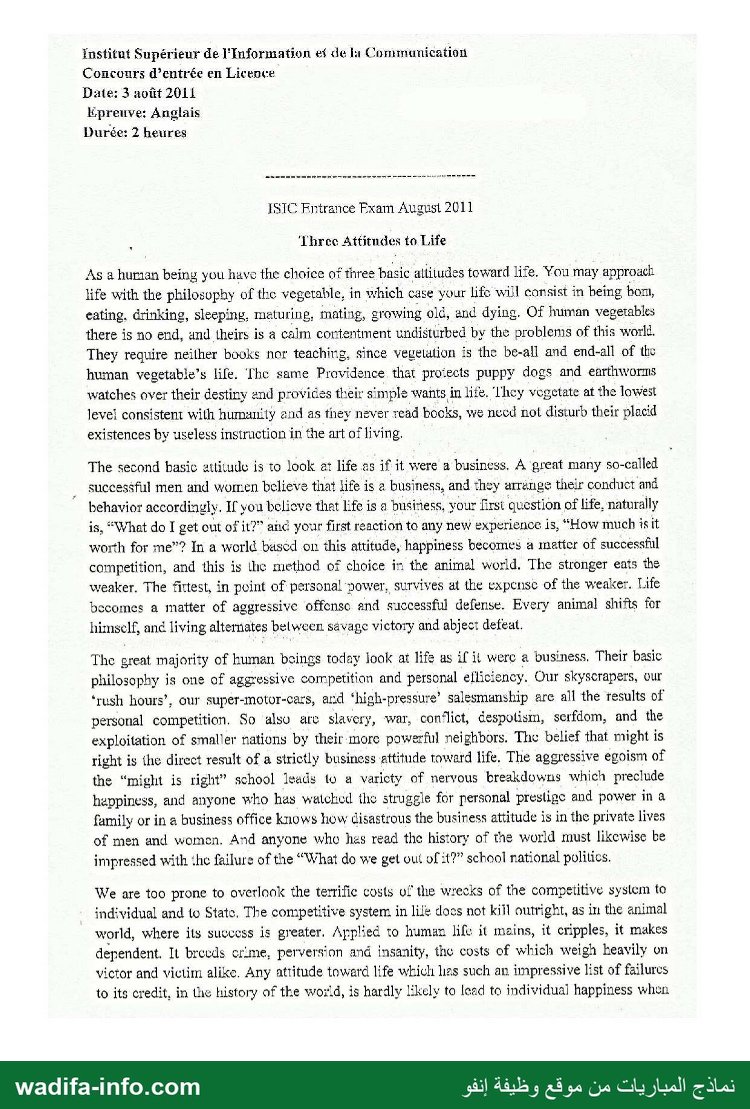
Institut Supérieur de l'Information ef عل Communication
Concours d’entrée en Licence
Date: 3 août 2011
Epreuve: Anglais
Durée: 2 heures
ISTC Fntrance Exam August 2011
: Three Attitndes to Life
As a human being you have the choice af three basic allitudes toward life. You may approach
kfe with the philosophy of the vegetable, in which case vour Life will cansist in being bo,
cating. érinking, sleeping, meturing, matisg, growing olë, and dying. Of human vegerabks
there is no end, and heirs is à calm contentment undisturbed by the problems of this world.
They require neilher books nor teaching, since veuetation 15 the be-all and end-all of the
human vegetable’s life. The same Providence that protects puppy dogs and earthworms
watches aver their destiny and proviées their simple wants in life. l'hey vegetate at the lowest
levei consistent with human!ty and as they never read books, we necd not disturb their placid
existences by useless instruction in the art of living.
The second basic atlitude is to look at life &s if it were a business. À great many s0-called
successful men and woren believe that life is a business, and they arrange their conduet anë
behavior accordinylx. 1] vou believe that life is a busiñess, vour first question of life, naturally
is, “What do I get out of it?” ané your first reaction to any new experience is, “How much is it
worth for me”? In a worlû based on this attitude, happiness becomes a metter of successfil
competition, and this is {he method of choice ir the animel world. The stronger eats de
weaker, The firtest, in point of personal nower, survives at غطا expense of the weaker. Life
becomes a matter of aggressive offense end successful defense. Every animal shiñs for
himself, an living altemates belwcen savage victory and abjec: defeat.
The great majority of kuman beings today ook at life as if it werc a business. Their basic
philosophy is one of aggressive competition and personal elicieney. Our skyscrapers, ur
‘rush hours’, our super-motor-cæs, ard “high-pressure’ salesmanship are all the results of
personal competition. So alsu arc slavery, war, conflict, despolism, scrfdom, and the
exploitation of smaller rations by their more powerful neighbors. The belief that might is
right is the direct result of a strictly business attitude roward life, The aggressive egoism of
the “might is right” school leañs ما a varicty of nervous breakdowns which preclude
heppiness, and anyone who has watched the struggle for personal prestige and power in à
family or in a business office knows how disastrous the busiress attitude is in the private lives
of men and women. And anyone who hes read the history of the world must likewise be
impressed with ‘he failure of the “What do we gel out إن 17” school rational politics.
We are too prone to overlank the terrific costs لله the wrecks of the competitive syslem to
individual and to State, The competitive system in lile does not kiïl outright, as in the animal
world, where ils success is greater. Applieë to human life it mains, it cripples, it makes
dependent. IL brevds crime, perversion ané insanity, the costs of which weigh keavily on
victor and victim alike. Any attitude toward life wkich las such an impressive list of failurcs
to its credit, in ie history of tke word, is hardly lkely ta leed to individual happiness when
wadifa-info.com نماذج المباريات من موقع وظيفة إنفو
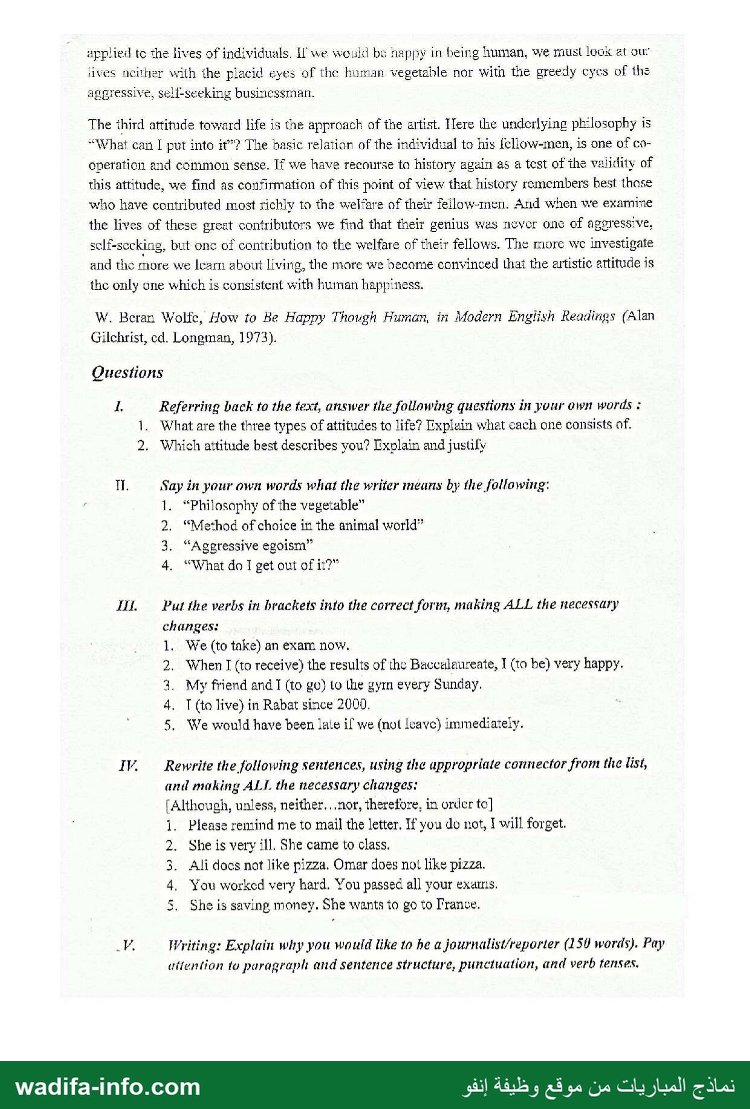
applied م the lives of individuals. ع للا would توترترقة قط in 02102 human, we must loux اع ou”
lives acither with the placid eyes of the human vegetahle nor with the greedy cyes of fhe
aggressive, sel-sceking busincssman.
The third attitude toward life is the approach of the artist. Ilere lie uaderying philosophy 5
“What can ] put into it”? The basic relatian of the individual to his {cliow-men, is one of cn-
oneration and common sense. If we have recourse to history again as a test of the validity of
this attitude, we find as confirmation of this point of view that history remembers best those
who have contributed most richly to the welfare of their feilow-men. And when vre examine
the lives of these great contributors we find that their genius wes névor onc of aggressive,
self-secking, but onc of contribution ta the welfare of their fellows. The more wc investigate
and the more we learn about Living, the more we became convinced hat the artistic attitude is
the only ane which is consistent with human hapyiness.
W. Bcrac Wolfe, How to Be Hapny Though Fuman, in Modern English Readings (Alan
Gilchrist, cd. Longman, 1973).
Questions
1 Referring back to the text, answer the following questions in your own words :
1. What are the three types of attituces to life? Explain whet each one consists af.
2. Which attitude best describes you? Exolain and justifr
IT. Say in your own words what the ssriter meuns by the following:
1. “Philosophy of the vegetable”
2. “Method of choice in the animal world” 3
3. “Aggressive egoism”
4. “What do I get out of 11?"
71711. Putihe verbs in brackets into the correct form, making ALL the necessary
changes:
1. We (to take) an exam now.
2. When] (to receive) the results of the Baccalaureate, 1 (ta be) very happy.
3. My friend and 1 (to go) Lo Che gyrn every Sunday.
4. T (to live) in Rabat since 2000.
6 5. We would have been عتما il we (not lvave) immediareiy.
IV. Rewrite the following sentences, using the appropriate connector from the list,
and making ALL the necessary changes:
[Although, unless, neither.. nor, therefore, in order to]
: 1. Please remind me to mail the letter. If you فل not, 1 will forget.
2. She is very ill. She came to class,
3. Ali docs not like pizza. Omer does not like pizza.
4. You worked very hard. Vou passec al] your exaurts.
5. Sheis saving money. She wants to go to France.
Fe Writing: Explain why pou would like 10 he a journulist/reporter (150 words). Pay
«tientian to paragraph and sentence structure, punctuation, and verb tenses.
wadifa-info.com نماذج المباريات من موقع وظيفة إنفو
التصحيح المقترح
هذا تصحيح مقترح من إعداد فريق wadifa-info لمساعدتك على فهم منهجية الإجابة — وليس تصحيحاً رسمياً صادراً عن الإدارة المنظِّمة. أسئلة هذا الامتحان محررة بالفرنسية، لذلك التصحيح محرر بالفرنسية أيضاً.
Ce modèle est l'épreuve d'anglais du concours d'entrée en Licence de l'Institut Supérieur de l'Information et de la Communication (ISIC, Rabat), session du 3 août 2011, durée 2 heures. Le texte, Three Attitudes to Life, est extrait de W. Beran Wolfe, How to Be Happy Though Human (in Modern English Readings, Longman, 1973). Il est suivi de cinq exercices : compréhension, explication d'expressions, temps verbaux, connecteurs et une rédaction de 150 mots. Les explications sont en français, les réponses en anglais.
💡 Le texte est construit sur une progression en trois attitudes, la troisième étant celle que l'auteur défend. Repérer ce plan dès la première lecture permet de répondre vite à la question I.1 et de réutiliser le vocabulaire dans l'essai.
I. Answer in your own words
1. What are the three types of attitudes to life? Explain what each one consists of.
- The vegetable attitude: life is reduced to its biological functions: being born, eating, sleeping, growing old and dying. These people are calm and satisfied, they have no intellectual needs and they do not try to understand or improve their lives.
- The business attitude: life is seen as a competition in which each person asks "What do I get out of it?". Success means defeating others, as in the animal world where the strongest wins. According to the writer, this attitude leads to selfishness, nervous breakdowns, crime, war and the exploitation of the weak.
- The artistic attitude: the basic question is "What can I put into it?". The individual cooperates with others and contributes to their welfare. The writer believes this is the only attitude that leads to real happiness, and history shows that the people we remember best are those who gave the most to humanity.
2. Which attitude best describes you? Explain and justify.
Réponse personnelle : choisissez une attitude, justifiez-la par deux exemples concrets et nuancez. Exemple : I think I am closer to the artistic attitude, although I sometimes behave like a businessman. At school, I enjoy helping my classmates with their lessons, and I volunteer in a local association that gives school supplies to poor children. These activities make me feel useful and happy. However, I must admit that I am also competitive: I want to get good marks and succeed in exams such as this one. In my opinion, a little competition is healthy, as long as it does not become selfishness.
II. Explain in your own words
- "Philosophy of the vegetable" : a way of living like a plant, only satisfying basic physical needs (food, sleep) without thinking, learning or having any ambition.
- "Method of choice in the animal world" : the usual way animals behave, that is, fighting and competing so that the strongest survives at the expense of the weakest.
- "Aggressive egoism" : a selfish attitude in which a person thinks only of his own interest and is ready to attack or crush others to obtain it.
- "What do I get out of it?" : the question of people who judge every situation only by the personal profit or advantage they can obtain from it.
III. Put the verbs in the correct form
- We are taking an exam now. — présent continu (« now »).
- When I received the results of the Baccalaureate, I was very happy. — prétérit pour deux faits passés.
- My friend and I go to the gym every Sunday. — présent simple (habitude), sujet pluriel donc pas de -s.
- I have lived (ou have been living) in Rabat since 2000. — present perfect avec since.
- We would have been late if we hadn't left immediately. — conditionnel de type 3 : past perfect après if.
IV. Rewrite using a connector (although, unless, neither … nor, therefore, in order to)
- Unless you remind me to mail the letter, I will forget (it). — unless = if … not.
- Although she was very ill, she came to class. — opposition ; le premier verbe passe au prétérit pour s'accorder avec came.
- Neither Ali nor Omar likes pizza. — la négation disparaît, verbe au singulier.
- You worked very hard; therefore, you passed all your exams. — conséquence.
- She is saving money in order to go to France. — but.
V. Writing: Explain why you would like to be a journalist/reporter (150 words)
💡 Introduction (votre déclic), deux paragraphes d'arguments (rôle social du journaliste ; qualités personnelles et goût du terrain), conclusion (projet). Le sujet fait écho au texte : la « artistic attitude » (contribuer au bien commun) est un bon fil conducteur.
Model answer :
Ever since I watched a documentary about war reporters, I have dreamt of becoming a journalist. To me, it is not just a job but a way of serving society.
First, journalists play an essential role in a democracy. They inform citizens, explain complex events and reveal problems that some people would prefer to hide. Without free and honest reporters, people could not make good decisions or hold their leaders accountable.
Second, I think I have the right qualities for this profession. I am curious, I love asking questions and I enjoy writing. I am also comfortable meeting new people, which is important when you interview witnesses or experts. Besides, I like the idea of a job in which no two days are the same.
In conclusion, I would like to be a reporter because I want to contribute to the welfare of others, as the writer of the text suggests. Studying at ISIC would be the first step towards this goal.
أسئلة شائعة حول هذا النموذج
هل يمكن تحميل هذا النموذج مجاناً؟
هل يتضمن هذا النموذج التصحيح؟
ما هي الجهة المنظمة والدرجة المعنية بهذا النموذج؟
ما هي دورة هذا الامتحان ولغة أسئلته؟
أين أجد نماذج أخرى لنفس المباراة؟
ناقش هذا النموذج (0)
شارك إجاباتك أو صحّح التصحيح — إذا كان لديك رأي مختلف حول أي نقطة، اكتبه هنا ليستفيد باقي المترشحين.
لا يوجد نقاش بعد — شارك إجابتك أو سؤالك حول هذا النموذج.
⚠️ ممنوع نشر أرقام الهاتف أو الروابط أو أي عرض مقابل مال — تُحذف هذه المشاركات تلقائياً.
هل تحضّر لهذه المباراة؟
نماذج مشابهة قد تهمّك
الجهة المنظمة: المعهد العالي للإعلام والاتصال ISIC - الرباط · 2011 — مصدر النسخة: وثائق منشورة للعموم (alloschool / Scribd)؛ الإعلان الرسمي للمباراة هو المرجع.
كيف تستشهد بهذه الصفحة؟
صحفي أو مدوّن أو أستاذ؟ انسخ المرجع أسفله وضع رابطاً نحو هذه الصفحة.
الرابط الدائم: https://www.wadifa-info.com/نموذج-مباراة/2595/نموذج-مباراة-ولوج-المعهد-العالي-للإعلام-والاتصال-ISIC-2011-اللغة-الإنجليزية