
نموذج مباراة ولوج المعهد العالي للدراسات البحرية ISEM 2015 - اللغة الإنجليزية
⬇️ تحميل PDF الرابط الدائم: wadifa-info.com/نموذج-مباراة/1150
باختصار
هذا نموذج امتحان كتابي سابق لمباراة مباراة ولوج المدارس والمعاهد العليا لدى المعهد العالي للدراسات البحرية ISEM (2015)، منشور على وظيفة إنفو للاطلاع والتحميل المجاني بصيغة PDF مع تصحيح مقترح.
- الجهة المنظمة
- المعهد العالي للدراسات البحرية ISEM
- الدرجة
- مباراة ولوج المدارس والمعاهد العليا
- التخصص
- اللغة الإنجليزية
- الدورة
- 2015
- عدد الصفحات
- 2
- لغة الأسئلة
- الفرنسية
- التصحيح
- تصحيح مقترح متوفر في هذه الصفحة
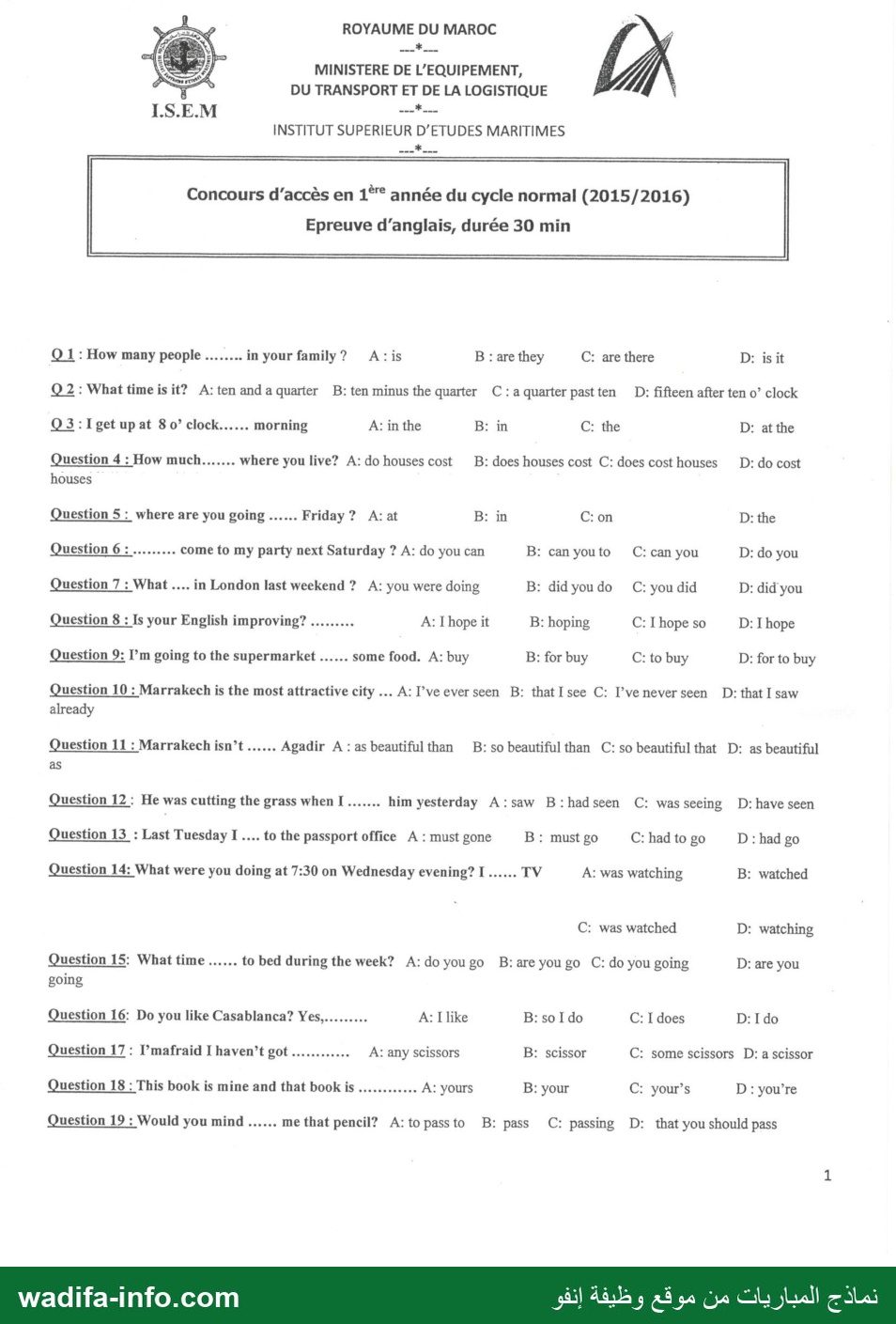
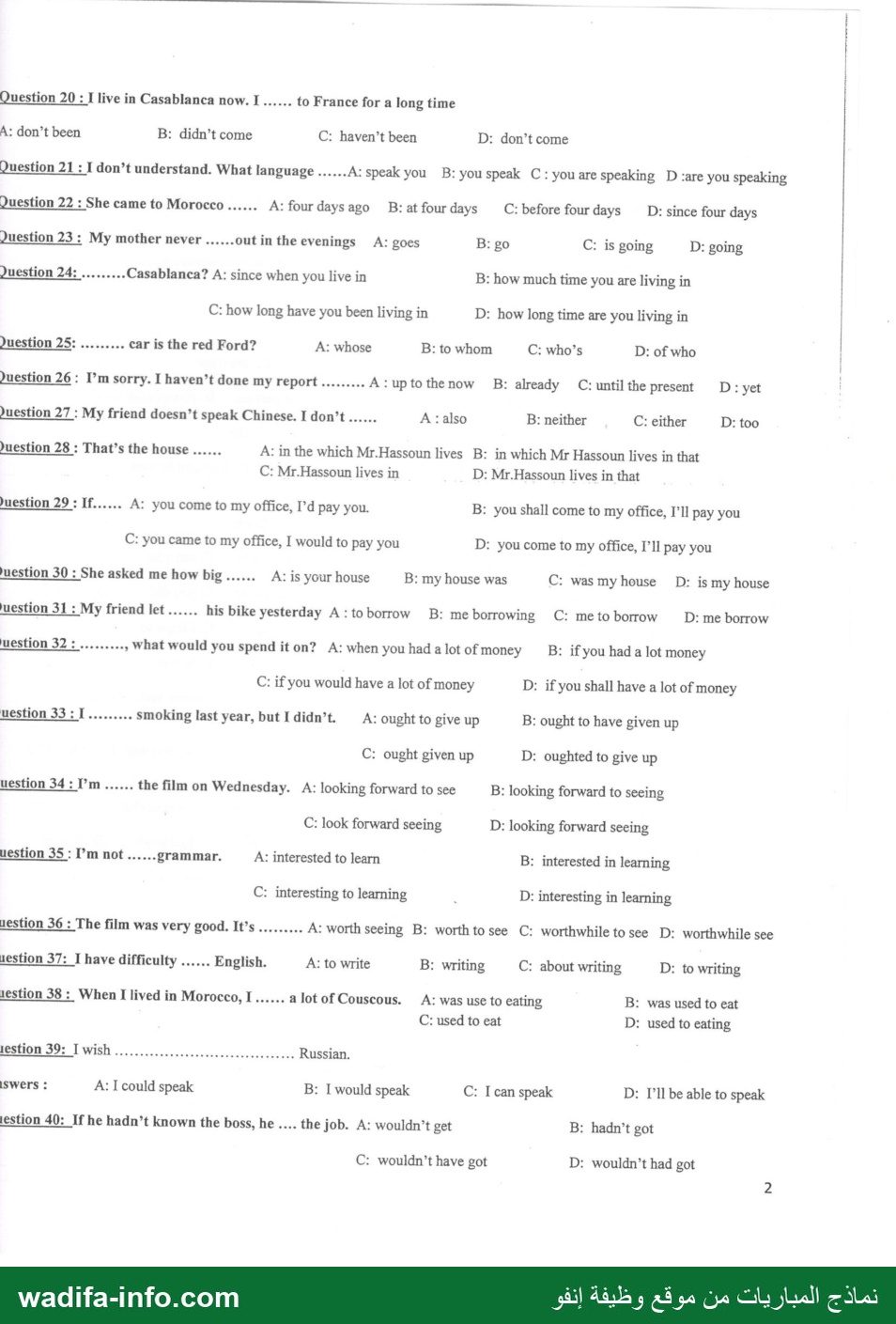
📝 نص أسئلة النموذج (مستخرج آلياً من الصفحات الممسوحة)
استُخرج هذا النص آلياً من صور الامتحان وقد يحتوي على أخطاء في القراءة — الصور أعلاه هي المرجع.
— صفحة 1 — ROYAUME DU MAROC MINISTERE DE L’EQUIPEMENT, CS DU TRANSPORT ET DE LA LOGISTIQUE I.S.E.M 0 INSTITUT SUPERIEUR D'ETUDES MARITIMES Concours d‘accès en 1°° année du cycle normal (2015/2016) Epreuve d'anglais, durée 30 min 901 : How many people ……… in your family? فح B : are they C: are there D: is it Q2 : What time is it? A: ten and a quarter B: ten minus the quarter C : a quarter pastten D: fifieen after ten 0° clock Q3:Iget upat 80° ...العمل morning A: in the B: in C: the D: atthe Question 4 : How much... where you live? A: do houses cost B: does houses cost ©: does cost houses D: do cost houses Question S : where are you going …… Friday ? A: at B: in C: on D: the Question 6 : ….…… come to my party next Saturday ? A: do you can B: canyouto ©: can you D: do you Question 7 : What …. in London last weekend ? A: you were doing B: didyoudo ©: you did 10: 1 Question 8 : Is your English improving? ……… A: 1 hope it B: hoping C: Thope so D: I hope Question 9: l’m going to the supermarket …… some food. A: buy B: for buy C: to buy D: for to buy Question 10 : Marrakech is the most attractive city … A: l’ve ever seen B: thatIsee C: l’veneverseen D: that I saw already Question 11 : Marrakech isn’t …… Agadir A :asbeautifulthan | B: so beautifulthan C: so beautiful that D: as beautiful Question 12 : He was cutting the grass when I ....... him yesterday A:saw B:hadseen C: wasseeing D: have seen Question 13 : Last Tuesday I .... to the passport office A : must gone B : must go C: had to go D : had go Question 14: What were you doing at 7:30 on Wednesday evening? 1 …… TV A: was watching B: watched C: was watched D: watching Question 15: What time …… to bed during the week? A:doyougo B:are you go C: do you going D: are you going Question 16: Do you like Casablanca? Yes... A: Ilike B:soI do C:I does D:I do Question 17 : l’mafraid I haven*t got .........ت A: any scissors B: scissor C: some scissors D: a scissor Question 18 : This book is mine and that book is ........... A: yours B: your C: your’s D : you're Question 19 : Would you mind …… me that pencil? A:topassto B: pass C: passing D: that you should pass نماذج المباريات من موقع وظيفة إنفو wadifa-info.com — صفحة 2 — Question 20 : I live in Casablanca now. I ...... to France for a long time A: don’t been B: didn’t come C: haven’t been D: don’t come Question 21 : I don’t understand. What language …… A: speak you 3: youspeak C : youare speaking D :are you speaking Question 22 : She came to Morocco ...... A: fourdaysago B:atfourdays C: before four days D: since four days Question 23 : My mother never …… out in the evenings A: goes B: go C: is going D: going Question 24: ......... Casablanca? A: since when you live in B: how much time you are living in C: how long have you been living in D: how long time are you living in Question 25: ……… car is the red Ford? A: whose B: to whom C: who’s D: of who Question 26 : P’m sorry. I haven*t done my report تل A:uptothenow 3: already C:untilthepresent D: yet Juestion 27 : My friend doesn’t speak Chinese. 1 don’t …… A : also B: neither C: either D: too juestion 28 : 111315 the house ...... À: in the which Mr.Hassoun lives B: in which Mr Hassoun lives in that C: Mr.Hassoun lives in D: Mr.Hassoun lives in that juestion 29 : If... A: you come to my office, l’d pay you. B: you shall come to my office, 111 pay you C: you came to my office, I would to pay you D: you come to my office, 111 pay you uestion 30 : She asked me how big …… A: is your house B: my house was C: wasmyhouse D: is my house luestion 31 : My friend let ...... his bike yesterday A : toborrow 3: me borrowing ©: metoborow = D: me borrow luestion 32 : ممما » What would you spend it on? A: when you had a lot ofmoney 3: if you hada lot money C: if you would have a lot of money D: if you shall have a lot of money uestion 33 : 1 ......... smoking last year, but [didn’t. A: ought to give up B: ought to have given up C: ought given up D: oughted to give up uestion 34 : Pm ...ا the film on Wednesday. A: looking forward to see B: looking forward to seeing C: look forward seeing D: looking forward seeing uestion 35 : Pm not ...... grammar. A: interested to learn B: interested in learning C: interesting to learning ; D: interesting in learning uestion 36 : The film was very 8000.105 ........ A: worthseeing B: worthtosee C: worthwhiletosee D: worthwhile see 165000 37: I have difficulty …… English. A: to write B: writing C: about writing D: to writing 1estion 38 : When I lived in Morocco, I …… a lotof Couscous. A: was use to eating B: was used to eat C: used to eat D: used to eating 1estion 39: I Wish... Russian. iswers : A: I could speak B: I would speak ©: I can speak D: 1:11 be able to speak lestion 40: If he hadn’t known the boss, he … the job. A: wouldn°t get B: hadn’t got ©: wouldn*t have got D: wouldn*t had got نماذج المباريات من موقع وظيفة إنفو wadifa-info.com
التصحيح المقترح
هذا تصحيح مقترح من إعداد فريق wadifa-info لمساعدتك على فهم منهجية الإجابة — وليس تصحيحاً رسمياً صادراً عن الإدارة المنظِّمة. أسئلة هذا الامتحان محررة بالفرنسية، لذلك التصحيح محرر بالفرنسية أيضاً.
Ce modèle est l'épreuve d'anglais du concours d'accès en 1re année du cycle normal de l'Institut Supérieur d'Études Maritimes (ISEM, Casablanca), Ministère de l'Équipement, du Transport et de la Logistique, session 2015/2016. Durée : 30 minutes. C'est un QCM de 40 questions de grammaire courante (temps, prépositions, comparatifs, conditionnels, constructions verbales). Voici une correction proposée, avec pour chaque question la bonne option et la règle qui la justifie.
💡 Méthode : 30 minutes pour 40 questions, soit moins d'une minute par item. Repérez d'abord le mot-indice de la phrase (yesterday, last, since, already, if, wish…) : c'est lui qui impose le temps ou la construction.
Questions 1 à 19
- C — are there. How many people are there in your family? : « il y a » au pluriel = there are, inversé dans la question.
- C — a quarter past ten. L'heure se dit (a) quarter past / to + heure ; « ten minus the quarter » et « fifteen after ten o'clock » ne sont pas de l'anglais correct.
- A — in the. I get up at 8 o'clock in the morning : in the morning / afternoon / evening.
- A — do houses cost. How much do houses cost where you live? : question au présent simple, sujet pluriel → auxiliaire do + sujet + verbe base.
- C — on. on Friday : on devant un jour de la semaine.
- C — can you. Can you come to my party next Saturday? : modal + sujet + verbe base (pas de to, pas de do).
- B — did you do. What did you do in London last weekend? : last weekend → prétérit ; question = did + sujet + verbe base. L'option D (did you) oublie le verbe do.
- C — I hope so. Réponse elliptique figée : I hope so / I think so.
- C — to buy. I'm going to the supermarket to buy some food : l'infinitif de but s'exprime par to + base (jamais for to buy).
- A — I've ever seen. the most attractive city I've ever seen : superlatif + present perfect + ever.
- D — as beautiful as. Comparatif d'égalité à la forme négative : not as (so) … as ; than ne s'emploie qu'avec un comparatif de supériorité.
- A — saw. He was cutting the grass when I saw him yesterday : action en cours au prétérit continu, interrompue par une action ponctuelle au prétérit simple.
- C — had to go. Last Tuesday I had to go to the passport office : le passé de l'obligation must est had to.
- A — was watching. At 7:30 on Wednesday evening I was watching TV : action en cours à un moment précis du passé → prétérit continu.
- A — do you go. What time do you go to bed during the week? : habitude → présent simple.
- D — I do. Réponse courte : Yes, I do (on reprend l'auxiliaire de la question Do you…?).
- A — any scissors. I'm afraid I haven't got any scissors : scissors est toujours pluriel (pas de a scissor) et any s'emploie dans une phrase négative.
- A — yours. This book is mine and that book is yours : pronom possessif (mine, yours) ; your est un adjectif et exige un nom.
- C — passing. Would you mind passing me that pencil? : mind est suivi du gérondif (-ing).
Questions 20 à 40
- C — haven't been. I haven't been to France for a long time : for a long time jusqu'à maintenant → present perfect ; been to = être allé quelque part.
- D — are you speaking. What language are you speaking? : action en cours au moment où l'on parle → présent continu, avec inversion.
- A — four days ago. She came to Morocco four days ago : ago se place après la durée, avec un prétérit.
- A — goes. My mother never goes out in the evenings : habitude au présent simple, 3e personne → -es.
- C — how long have you been living in. How long have you been living in Casablanca? : durée jusqu'à maintenant → present perfect continu.
- A — whose. Whose car is the red Ford? : whose + nom = à qui ; who's = who is.
- D — yet. I haven't done my report yet : yet en fin de phrase négative ; already s'emploie à l'affirmative.
- C — either. I don't speak Chinese either : « non plus » à la négative = either ; too est réservé à l'affirmative, neither s'emploie avec un verbe affirmatif (Neither do I).
- D — you come to my office, I'll pay you. Conditionnel de type 1 : If + présent, will + base. L'option A mélange présent et would ; C (would to pay) et B (shall après if) sont fautives.
- B — my house was. She asked me how big my house was : au discours indirect, la question perd son inversion (sujet + verbe) et le temps recule d'un cran.
- D — me borrow. My friend let me borrow his bike : let + complément + base verbale sans to.
- B — if you had a lot of money. Conditionnel de type 2 : If + prétérit, would + base (jamais would dans la subordonnée en if).
- B — ought to have given up. Reproche portant sur le passé (last year, but I didn't) : ought to have + participe passé.
- B — looking forward to seeing. Dans look forward to, to est une préposition, donc suivi du gérondif.
- B — interested in learning. interested (sentiment éprouvé) + in + gérondif ; interesting qualifie la chose qui intéresse.
- A — worth seeing. It's worth + gérondif (worth seeing).
- B — writing. I have difficulty writing English : have difficulty (in) + gérondif.
- C — used to eat. Habitude passée révolue : used to + base. Be used to + -ing signifie « être habitué à » et ne convient pas ici.
- A — I could speak. I wish I could speak Russian : regret sur le présent → wish + prétérit (could).
- C — wouldn't have got. Conditionnel de type 3 (irréel du passé) : If + past perfect, would have + participe passé.
Grille récapitulative
| Q | Rép. | Q | Rép. | Q | Rép. | Q | Rép. |
|---|---|---|---|---|---|---|---|
| 1 | C | 11 | D | 21 | D | 31 | D |
| 2 | C | 12 | A | 22 | A | 32 | B |
| 3 | A | 13 | C | 23 | A | 33 | B |
| 4 | A | 14 | A | 24 | C | 34 | B |
| 5 | C | 15 | A | 25 | A | 35 | B |
| 6 | C | 16 | D | 26 | D | 36 | A |
| 7 | B | 17 | A | 27 | C | 37 | B |
| 8 | C | 18 | A | 28 | C | 38 | C |
| 9 | C | 19 | C | 29 | D | 39 | A |
| 10 | A | 20 | C | 30 | B | 40 | C |
💡 À retenir : près de la moitié du sujet porte sur deux familles de règles : le choix du temps (prétérit, present perfect, formes continues) et les verbes suivis du gérondif (mind, worth, look forward to, have difficulty, interested in). Révisez-les en priorité.
أسئلة شائعة حول هذا النموذج
هل يمكن تحميل هذا النموذج مجاناً؟
هل يتضمن هذا النموذج التصحيح؟
ما هي الجهة المنظمة والدرجة المعنية بهذا النموذج؟
ما هي دورة هذا الامتحان ولغة أسئلته؟
أين أجد نماذج أخرى لنفس المباراة؟
ناقش هذا النموذج (0)
شارك إجاباتك أو صحّح التصحيح — إذا كان لديك رأي مختلف حول أي نقطة، اكتبه هنا ليستفيد باقي المترشحين.
لا يوجد نقاش بعد — شارك إجابتك أو سؤالك حول هذا النموذج.
⚠️ ممنوع نشر أرقام الهاتف أو الروابط أو أي عرض مقابل مال — تُحذف هذه المشاركات تلقائياً.
هل تحضّر لهذه المباراة؟
نماذج مشابهة قد تهمّك
الجهة المنظمة: المعهد العالي للدراسات البحرية ISEM · 2015 — مصدر النسخة: مباريات ولوج المدارس والمعاهد العليا؛ الإعلان الرسمي للمباراة هو المرجع.
كيف تستشهد بهذه الصفحة؟
صحفي أو مدوّن أو أستاذ؟ انسخ المرجع أسفله وضع رابطاً نحو هذه الصفحة.
الرابط الدائم: https://www.wadifa-info.com/نموذج-مباراة/1150/نموذج-مباراة-ولوج-المعهد-العالي-للدراسات-البحرية-ISEM-2015-اللغة-الإنجليزية