
نموذج مباراة ولوج مسلك تأهيل أساتذة التعليم الثانوي الإعدادي والتأهيلي - اختبار في ديداكتيك مادة التخصص - اللغة الإنجليزية - دورة نونبر 2025
باختصار
هذا نموذج امتحان كتابي سابق لمباراة أستاذ التعليم الثانوي الإعدادي والتأهيلي (مسلك التأهيل) لدى وزارة التربية الوطنية والتعليم الأولي والرياضة - المراكز الجهوية لمهن التربية والتكوين (دورة نونبر 2025)، منشور على وظيفة إنفو للاطلاع والتحميل المجاني بصيغة PDF مع تصحيح مقترح.
- الجهة المنظمة
- وزارة التربية الوطنية والتعليم الأولي والرياضة - المراكز الجهوية لمهن التربية والتكوين
- الدرجة
- أستاذ التعليم الثانوي الإعدادي والتأهيلي (مسلك التأهيل)
- التخصص
- اللغة الإنجليزية - ديداكتيك مادة التخصص
- الدورة
- دورة نونبر 2025
- عدد الصفحات
- 15
- لغة الأسئلة
- الفرنسية
- التصحيح
- تصحيح مقترح متوفر في هذه الصفحة
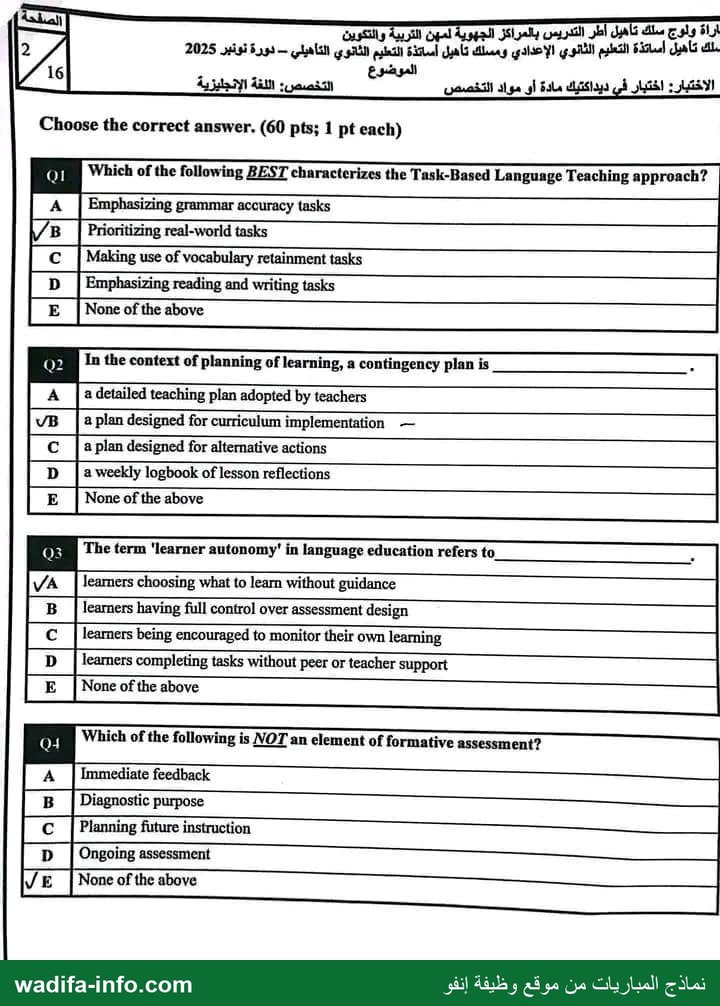
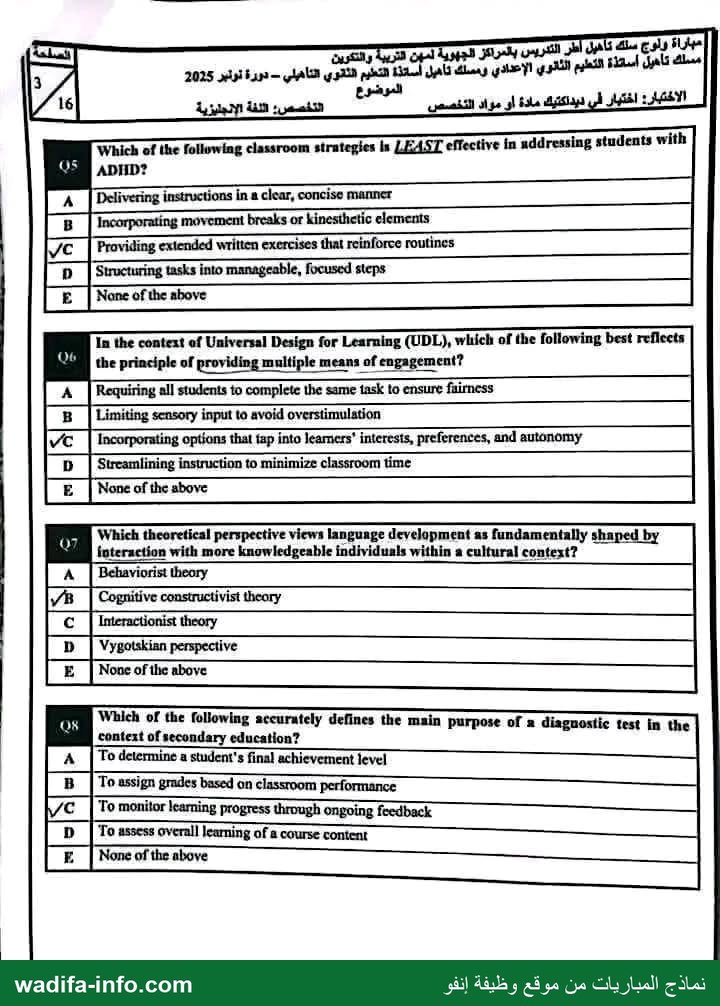
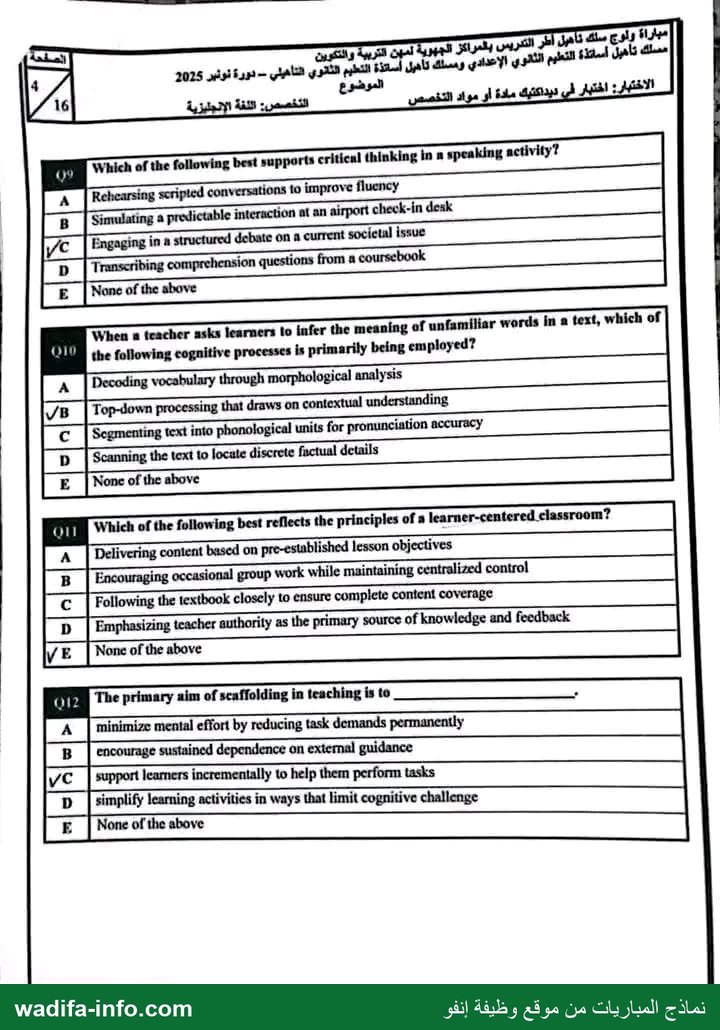
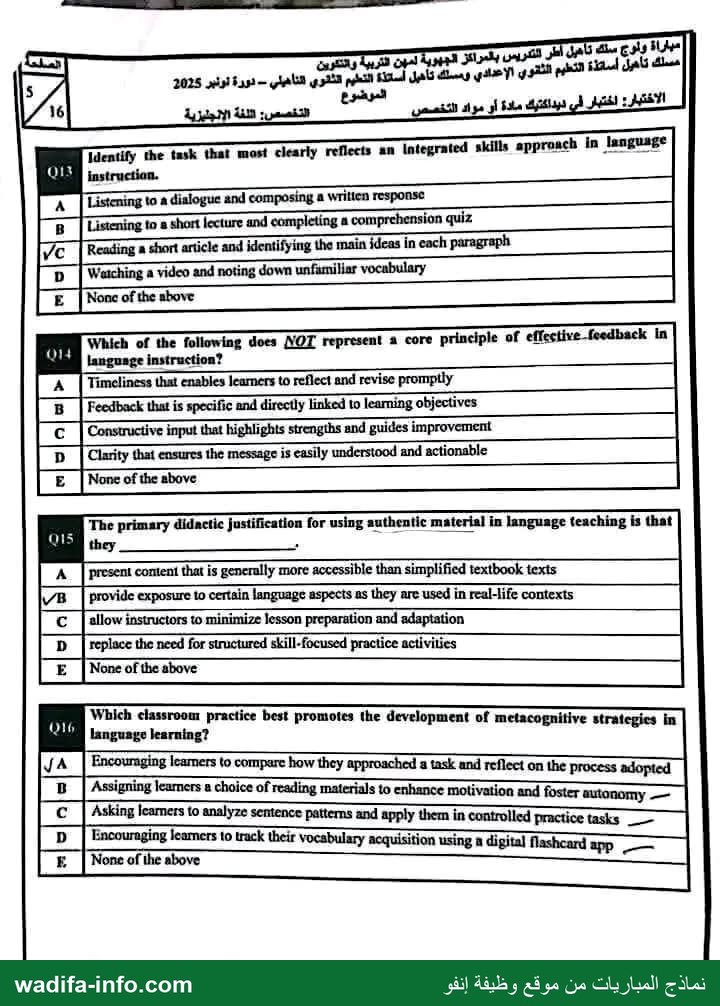
📝 نص أسئلة النموذج (مستخرج آلياً من الصفحات الممسوحة)
استُخرج هذا النص آلياً من صور الامتحان وقد يحتوي على أخطاء في القراءة — الصور أعلاه هي المرجع.
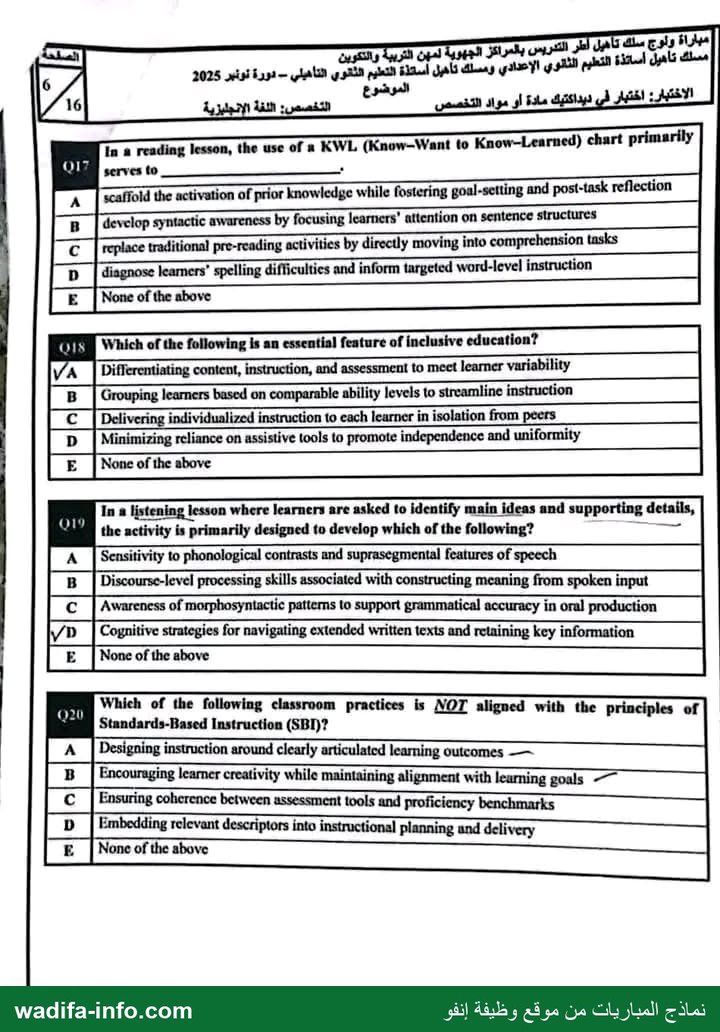
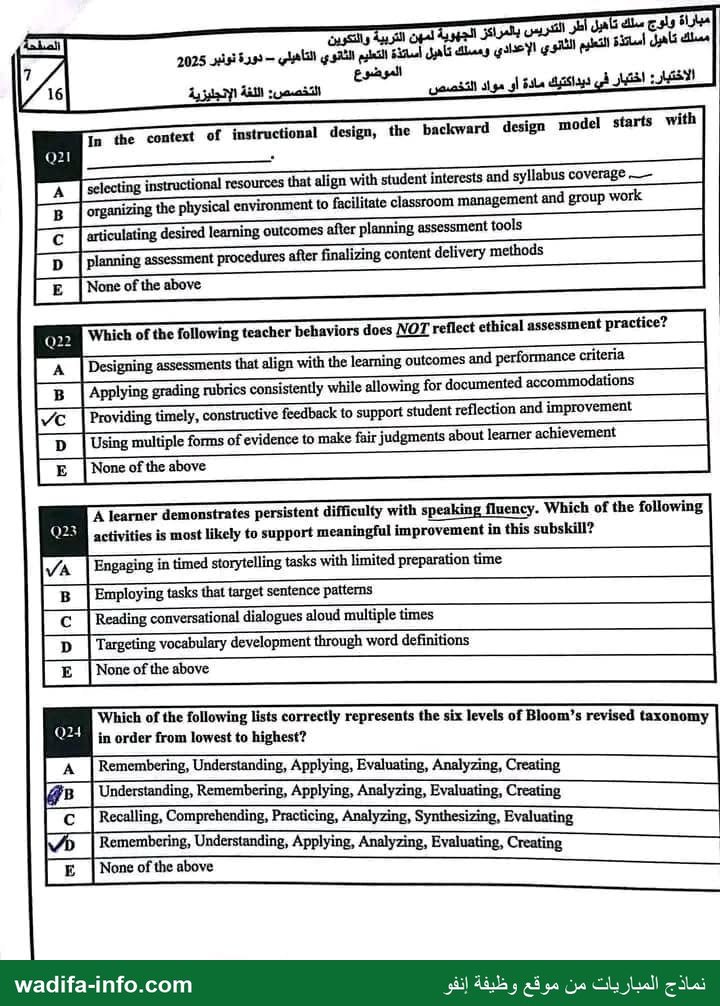
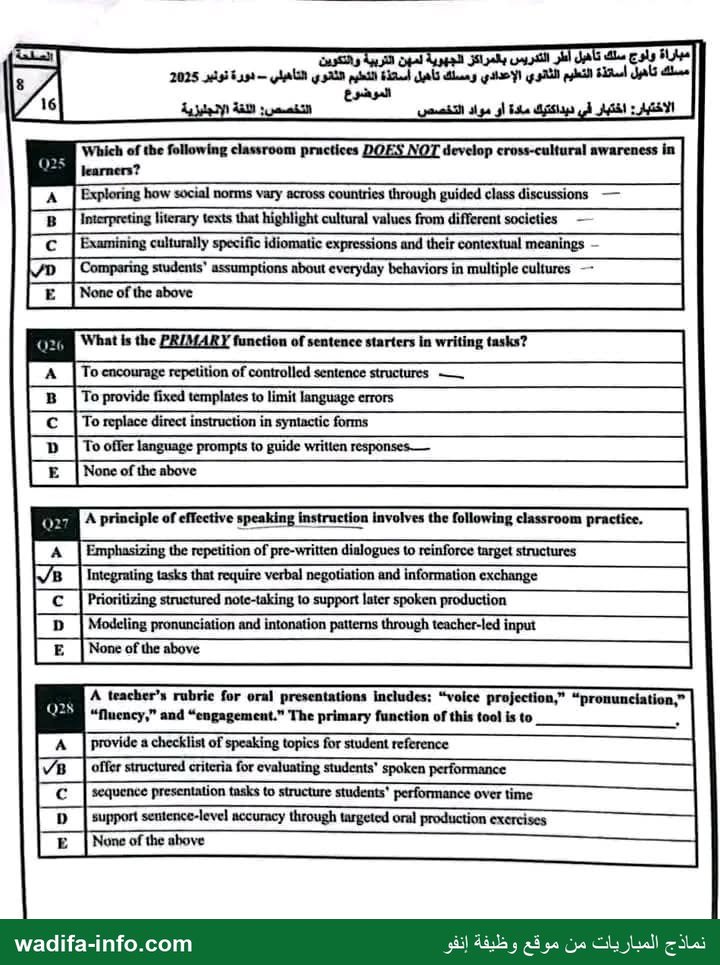
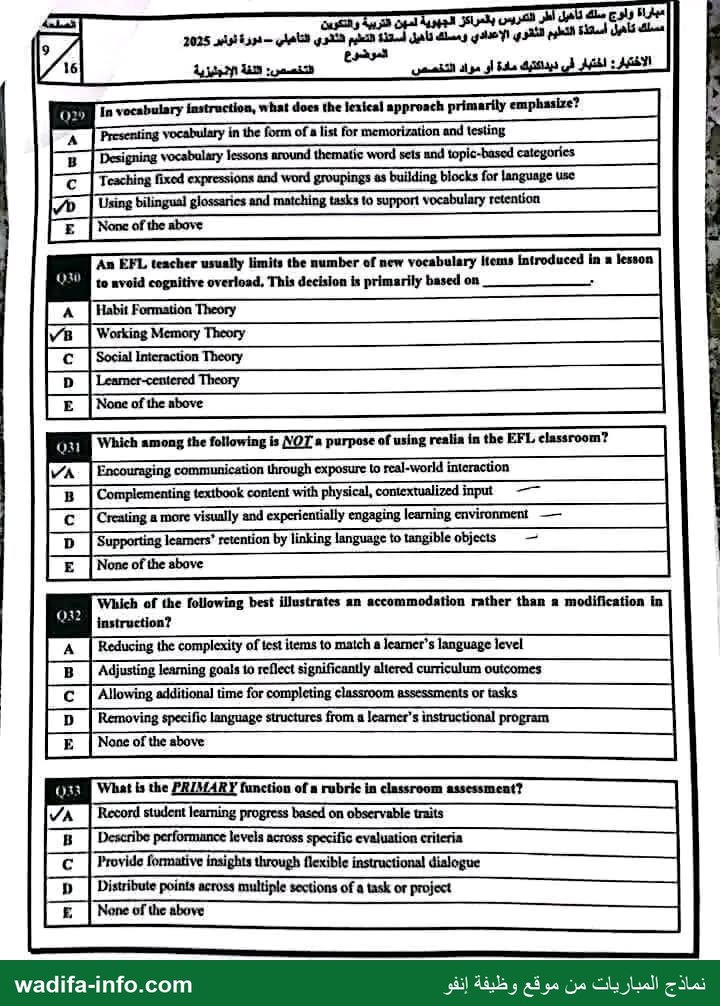
اراة ولوج سلك تاهيل أطر الن = ٍ الصفحة ولوج سلك تاهيل أطر التدريس بالمراكز لمهن التربية والتكوين ملك تاهيل اساتذة التعليم الثانوي الإعدادي ومسلك تأهيل أساتذة التعليم الثانوي التاهيلي — دورة نونبر 2025 7 ََ :8 الموضوع الاختبار: اختبار في ديداكتيك مادة أو مواد التخصمص التخصص: اللغة الإنجليزية Choose the correct answer. (60 pts; 1 pt each) Which of the following BEST characterizes the Task-Based Language Teaching approach? 01 Emphasizing grammar accuracy tasks V/B | Prioritizing real-worid tasks Making use of vocabulary retainment tasks D. Emphasizing reading and writing tasks | None of the above | © | Q2 In the context of planning of learning, a contingency plan is . a detailed teaching plan adopted by teachers [uB | a plan designed for curriculum implementation — a plan designed for alternative actions D. a weekly logbook of lesson reflections | E | None of the above | GK The term 'learner autonomy" in language education refers to : learners choosing what to learn without guidance learners having full control over assessment design | 3 | learners being encouraged to monitor their own learning EX learners completing tasks without peer or teacher support LE | None of the above Which of the following is NOT an element of formative assessment? ب Immediate feedback ES Diagnostic purpose Planning future instruction None of the above نماذج المباريات من موقع وظيفة إنفو wadifa-info.com 7 مباراة ولوج سلك تاهيل دورة توثر 2015 رد A تمل نهد اتيم لشي an op ملك تايل 2 التخصص: اللفة الإنجليز Ne في ديداكتيك مادة أو مواد JS الاختبار: 5 ADIID? | 0 | Structuring tasks into manageable, focused steps memes SUR the principle of providing multiple means of engagement? ِ foteraction with more knowledgeable individuals within a cultural context? Cognitive constructivist theory «١ متحت مس اساسا ااا ال To determine a student's final achievement level عي | To monitor learning progress through ongoing feedback wadifa-info.com نماذج المباريات من موقع وظيفة إنفو مباراة ولوج سلك ملك هبل أطر التدريس بالمراء” لمهن التربهة والتكوين تأهيل أساتذة التعليم الثانوي الإعدادي ومسلك تاهيل أساتذع التعليم الثانوي التاهيلي = دورة نونبر 2025 لا رفي بحي مف ap يمي ف من 2 AR Which of the following best supports critical thinking in n speaking activity? Es Rehcarsing scripted conversations 10 improve fluency prsdicable interaction at an airport check-in desk مستت ل | Engaging in a structured debate on a current socictal issue | ER Transcribing comprehension questions from a coursebook [x] None of the above infer the meaning of unfamiliar words in a text, which of ذا When à teacher asks learners fotlowing cognitive processes is primarily being en ployed? عر OUR [A | Decoding vocsbulary through morphological analysis Top-down processing that draws on contextual understanding Segmenting text into phonological units for pronunciation accuracy ع | locale discrete factual details م1 Ex Scanning the text Which of the following best reflects the principles of a learner-centered classroom? 011 Es Delivering content based on pre-established lesson objectives ensure complete content coverage ما Following the textbook closely | © | Emphasizing teacher authority as the primary source of knowledge and feedback | 0 | None of the above The primary aim of scaffolding in teaching is to 8 :01 | minimize mental effort by reducing task demands permanently ا encourage sustained dependence on external guidance | 9 | support leamers incrementally to help them perform tasks simplifÿ learning activities in ways that mit cognitive challenge |0 .| Es None of the above wadifa-info. ee نماذج المباريات من موقع وظيفة إنفو com M عحعسسسسس »اسمس سسسلالال66١1ل06لا06 ١ GA مباراة ولوج سنك Ro مسلك نا التدريس بالمراكز الجهوبة لمهن التربية هيل أسائذة التعليم الثانوي الاعدادي ومسلك تأهيل أساتذة التعليم انثانوي الناهيلي = دورة نونبر 2025 ب لف الموضو 7 الاختبار: اختبار في ديداكتيك مادة أو مواد التخصص 5 التخصص: اللغة الإنجليزية 10100177 the task thai most clearly reflects an Integrated skills approach In language (USE instruction. Ex Listening to a dialogue and composing a wrilien response | # | Listening ما s short lecture and completing a comprehension quiz Reading a short article and identifying he main ideas in each paragraph | 0 | Waiching a video and noting down unfamiliar vocabulary CE | None of the above 014 Which of the following does NOT represent 4 core principle of effective feedback In EN Timeliness that enables learners to reflect and revise promptly EN Feedback that is specific and directly linked 10 leaming objectives | © | Consuuctive input that highlights strengths and guides improvement ES Clarity that ensures the message is easily understood and actionable | 8 | None of the above De The primary didactic justification for using authentic material in language teaching is that دال they ; present coment that is generally more accessible than simplificd textbook texts provide exposure ما certain language aspects as they are used in real-life contexts allow instructors to minimize lesson preparation and adaptation EX replace the need for suctured skill-focused practice activities | E [None ofthe above Wbich classroom practice best promotes the development of metaco 016 يمتها hériing? P of m gnitive strategies in تت leamers to compare how they approached a task and reflect on he process adopted | © | ومتواعة 16110655 a choice of reading materials ما enhance motivation and 00517 211000: — | © | Asking learners to analyze sentence patterns and apply them in controlled practi Encouraging learners 10 track their vocsbulary isi =. acquisition using a digital flashcard ب None of عط above > شع .الام HP wadifa-info.com نماذج المباريات من موقع وظيفة إنفو مباراة ولوج سلك مسلك تاهيل اسائذة التعليم الثاذوي الإعدادي ومسلك تأهيل أساتذة التعليم الثانوي التاهيلي - دورة نونبر 2025 7 " الموضو. الاختبار: اختبار في ديداكتيك مادة أو مواد التخصصس | un nus 7 In à reading lesson, the use of a KWL (Know-Want to Know-Learned) chart primarily PA 7 017 activation of prior Imowledge while fostering goal-setting and post-task reflection ع Hi replace traditional pre-reading activities by directly moving into comprehension tasks EX diagnose leamers’ spelling difficulties and inform targeted word-level instruction AT \Which of the following is an essential feature of inclusive education? VA | Differentiating content, instruction, and assessment to meet learner variability B | Grouping learners based on comparable ability levels to streamline instruction | UC | Delivering individualized instruction to each learner in isolation from peers D | Minimizing reliance on assistive lools Lo promote independence and uniformity | In a listening lesson where learners are asked to identify main ideas and supporting details, 019 the activity is primarily designed to develop which of the following? nu : |A. Sensitivity to phonological contrasts and suprasegmental features of speech Discourse-level processing skills associated with constructing meaning from spoken input | © | Awareness of morphosyntactic patterns lo support grammatical accuracy in oral production VD | Cognitive strategies for navigating extended written texts and retaining key information Which of the following classroom practices is NOT aligned with t rinciples 0 Standards-Based Instruction (SBI)? + # الفلا Designing instruction around clearly articulated learning outcomes — Icarer creativity while maintaining alignment with learning goals > اتيت مم | «© | coherence between assessment tools and proficiency benchmarks يمع | © | Embedding relevant descriptors into instructional planning and delivery | ا None of the above ان نماذج المباريات من موقع وظيفة إنفو wadifa-info.com . مباراة ولوج سلك | : هيل أطر التدريس بالمراكز الجهوية لمهن التربية والتكوين 7 2025 مسلك تاهيل اساتذة لتعليم الثانوي الإعدادي ومسلك تأهيل أساتذة التعليم الثانوي التاهيلي - دورة نونبر | الموضو 0: 0 2 الاختبار : اختبار في ديداكتيك مادة أو مواد التخصص ٍ التخصص: اللغة الإنجليز In the context of instructional design, the backward design model starts with Q21 22 1 | | selecting instructional resources that align with student interests and syllabus coverage ,- EX organizing the physical environment 0 facilitate classroom management and group work | © articulating desired learning outcomes after planning assessment tools | « | planning assessment procedures after finalizing content delivery methods | © | None of the above عر Which of the following teacher behaviors does NOT reflect ethical assessment practice? Es Designing assessments that align with the leaming outcomes and performance criteria | 3 | Applying grading rubrics consistently while allowing for documented accommodations Providing timely, constructive feedback to support student reflection and improvement EX Using multiple forms of evidence to make fair judgments about learner achievement DE | None of the above 5 À learner demonstrates persistent difficulty with speaking fluency. Which of the following OR كد تزجعو is most likely to support meaningful improvement in this subskill? Engaging in timed storytelling tasks with limited preparation time | © | Employing tasks that target sentence patterns Reading conversational dialogues aloud multiple times EM Targeting vocabulary development through word definitions 5: Which of the following lists correctly represents the six levels of Bloom’s revised taxonomy لش in order from lowest to highest? Remembering, Understanding, Applying, Evaluating, Analyzing, Creating gs | Understanding, Remembering, Applying, Analyzing, Evaluating, Creating 3ع Recalling, Comprehending, Practicing, Analyzing, Synthesizing, Evaluating لاي | Remembering, Understanding, Applying, Analyzing, Evaluating, Creati EX None of the above W 13-1 te 5 8: 8 adifa-info.com نماذج المباريات من موقع وظيفة إنفو FU ولوج سلك تأهيل أطر التدريس بالمراكز لمهن التربية والنكوين مسلك تاهيل أساتذة التعليم الثانوي الإعدادي ومسلك تأهيل أساتذة التعليم الثانوي التاهيلي - دورة نولير 2025 7 الموضوع الاختبار: اختبار في ديداكتيك مادة أو مواد التخصص التخصص: اللقة الإنجليز 7 following classroom practices DOES NOT develop eross-cultural awareness in عط M Which of ١ 7 0 Exploring how social norms vary across countries through guided class discussions — ER Interpreting literary texts that highlight cultural values from different socicties — Ka Examining culturally specific idiomatic expressions and their contextual meanings - vo | Comparing students’ assumptions about everyday behaviors in multiple cultures — E | None ofthe above | What is the PRIMARY function of sentence starters in writing tasks? وأ Es To encourage repelition of controlled sentence structures —— To provide fixed templates to limit language errors | «© | To replace direct instruction in syntactic forms | © | To offer language prompts to guide written responses. | «© | E | None of the above | FA À principle of effective speaking instruction involves the following classroom practice, Emphasizing tbe repetition of pre-written dialogues to reinforce target structures VB | Integrating tasks that require verbal negotiation and information exchange Prioritizing structured note-taking to support later spoken production | © | Modeling pronunciation and intonation patterns through teacher-led input | © | None of the above | © | A teacher’s rubric for oral presentations includes: “voice projection,” “pronunciation,” “fluency," and “engagement.” The primary function of this tool is to . 8" provide a checklist of speaking topics for student reference اهم offer structured criteria for evaluating students’ spoken performance sequence presentation tasks to structure students’ performance over time support sentence-level accuracy through targeted oral production exercises | © | None of the above | © | نماذج المباريات من موقع وظيفة إنفو wadifa-info.com dla مباراة ولوج 2 الاختيار: اختبار في ديداكتيك مادة أو مواد التقصصض التخصص: النغة LH | و0 vocabuly Tesons around eme له seu مره لم Bud سياه || À ES RCE | D VAUS to avoid cognitive overload, This decision is primarily based مءه LA [FE ommanon eng || À LE [societe eng || À للق instruction? لاع ين ما pee عيسيس etre مسيم لمستتصناة مداه | B | Describe performance levels across specific evaluation criteria © | Provide formative insights through flexible instructional dialogue E | None of the above Eu EU مباراة ولوج سل تأهبل أطر التدريس بالمراكز الجهوبة لمهن الترجية DA 2025 مسلك تاهيل أسائذة التعليم الثلنوي الإعدادي ومسلك تاهيل أساتذة التعليم الثاذوي انتاهيلي - دورة نونبر الموضوع 0 2 الاختبار: اختيار في ديداكتيك مادة أو مواد التخصس للتخصص: اللفة الإلجليزية Reflectiog on the theme of the text and questioning ىا relevance vis-à-vis the local culture (CURE Lould most Lkety occur during a lesson stage Involving ل EN predicting what the reading passage might be about EX skimming for main ideas contained in the reading passage | © scanning the reading passage lo locate specific details quickly هم | debating a central idea presented in the reading passage | ج | None of the above TRS An effective approach to enhance long-term reteution of vocabulary involves _. integrating new vocabulary into extended leamer-generated output | © | keeping a personal glossary with word meanings and related forms | € | completing matching tasks that link words م1 brief explanations | © | reviewing target words before completing a text-based activity LE. None of the above À tescher asks students to explore environmental issues in their community, consult local | يدق data sources, work in teams, sand present proposed solutions in a school-wide exhibition. This instructional approach best reflects y 0 | © | Task-based Learning Problem-based Leaming da During an EFL collaborative group task, some learners code-switch ه) their mother tongue, : How should the teacher respond to support learning goals? B | Apply immediale consequences to discourage use of non-target language © |Ignore the switch as long as task completion remains on schedule VD | Prompt students subtly ما re-engage in the target language E | None of the above wadifa-info.com نماذج المباريات من موقع وظيفة إنفو مباراة ولوج سلك تأهيل مسلك با التدريس بالمراكز لمهن التريبة والتكوين العف هيل أسائذة التليم الثانوي الإعدادي ومساك تأهيل أساتذة التليم GS التاهيلي - دورة in 2025 £a + LG الموضوع D الاختبار: اختبار في ديداكتيك مادة أو مواد التخصص التخصص: اللغة الإنجليزية 2 ing vague During sn eod-of-unit writing assessment, a teacher evaluates all students us criteria such as “good structure" and "clear Ideas" without sharing a rubric beforehand or VE spisining how marks would be assigned. Which principle of sound assessment is most clearty being viulated in this scenario? MUR During the “Clarify” phase of an ECRIF-based lesson, the teacher typically م displays sample sentences and elicits learmer observations about structure | © | assigns a brief discussion task using expressions introduced carlier | € | has learners brainstorm related words from a prior lesson | © | gives students time ما scan a dialogue for general understanding "10 When designing speaking activities for mixed-ability classes, ا is BEST to design a challenging task and allow learners to interpret it in their own way | © | prioritize choral repetition and fixed scripts to reduce variation in performance — | © | assign a uniform discussion prompt and rotate speakers to ensure fairness - design tasks that vary in cognitive demand and give learners choice in how to respond oi Which of the following is NOT consistent with widely accepted principles of effective lesson ‘ planning? Sequencing activities ما build on existing learner understanding — B ES ا TT — materials based on ease of classroom management _ /C | Stating leaming objectives in terms of what students will do D [including strategies to assess learners’ progress throughout the lesson _— E | None of the above wadifa-info.com نماذج المباريات من موقع وظيفة إنفو مباراة ولوج انوج سلك JAb اطر التدريس بالمرائز الجهوية مين DS والتكوين اتلد مسلك تاهيل أساتذة pp الثانوي الإعدادي ومسلك تأهيل أساتذة اليم Go التاهيلي - دورة نونب 2025 2 1 الموضوع الاختبار: اختبار في ديداكتيك مادة أو مواد التخصضس للتخصص: اللفة الإنجليزية 2 According to the “Allective Filter” hypothesis in second language acquisition theory, #5 ملستب 012 emotional support should replace structured exposure to input — م | input becomes comprehensible anly when learners are explicitly corrected — suuctured drills reduces anxiety and ensures retention — ما regular exposure D | favorable emotional conditions can make language input more accessible Te In a testing contex! requiring standardization, which of the following practices ensures reliability of the scores? Administering the test in different time slots with varying Lesting conditions — Using different scoring rubries for different student groups based on proficiency — | © | Allowing some students only to ask clarification questions during the test - | © | Vo | Varying test items or task types between classes covering the same instructional content LE. None of the above An EFL teacher starts a lesson by showing a humorous music video, Then, learners analyze specific sentence patterns from the lyrics. Finally, they write their own short dialogues using those patterns In creative contexts. This instructional sequence best aligns with 04 VC | The ESA model The ECRIF model > | © | None of the above | | An EFL teacher encourages her learners to locate and evaluate information across multiple MON sources, engage with peers online, and regularly update their knowledge based on emerging content. This Instructional design reflects the core tenets of s L نماذج المباريات من موقع وظيفة إنفو wadifa-info.com مباراة ولوج ولوج سلك تأهيل أطر التدريس بالمراك لمهن التربية والتكوين wc مسلك تاهيل أساتذة التعليم الثانوي الإعدادي ومسلك تأهيل أسائذة التعليم الثانوي التأهيلي - دورة تونبر 2025 13 7 الموضوع الاختيار: اختبار في ديداكتيك مادة أو مواد التخصص التخصص: اللغة الإنجليزية ملا À language tesching framework that emphasizes performance in real-worid situations, ITA integrates knowicdge with action, and measures learners against clear benchmarks is best .— انتب ل BC CE تبردت [D foucomebased Ex None of the above M A classroom task that requires learners to plan a class trip. by_gathering information, ما discussing options, and presenting a proposal is best catego rked as a 01 During the production stage of a lesson, a teacher asks learners to read aloud the scripted [] > م ل VAS dialogues they bave written. This practice highly communicative, as it involves real-time interaction EX primarily mechanical, as it lacks spontancous language use [c. a form of grammar drilling with no oral value a test of reading fluency rather than speaking skill None of the above | © | In a reading lesson focused on comprehension, the teacher asks her students : res سه <> نب because ا ىمسا reading the text aloud. This MOD D rod 049 EX it develops critical reading skills t00 carty None of the above نماذج المباريات من موقع وظيفة إنفو wadifa-info.com ».م كسان العامة SL م مباراة ولوج سلك | 7 الموضوع 14 الاختبار: اختبار في ديداكتيك مادة أو مواد التخصص التخصص:؛ اللفة الإنجليزية مر listening task, the teacher notices that several learners are struggling, ه Wüilé monitoring + ذا be most appropriate immediate response is لني learning? > The CEFR descriptor “Can understand short, simple texts on familiar matters” ان ( نر ددا8]٠ة8ددرض A A نماذج المباريات من موقع وظيفة إنفو wadifa-info.com EEE EE T0 ont أطر التدريس بالمراكز الجهوية Ab ولوج سلك Het 5 2025 مسلك تاهيل أساتذة التعلهم انوي الإعدادي ومسك تأهيل أساتذة التعليم الثانوي التاهيلي - دورة توتبر الموضوع : FA الاختبار: اختبار في ديداكتيك مادة أو مواد التخصمصس التخصص: اللغة الإنجليز où EX reading” activity ls most effective for 0 | م practicing decoding strategies collaboratively EN promoting collaborative meaning construction through interaction | © | يمسن individual fluency through timed silent reading EN assessing comprehension through standardized question formats BA A teacher asks students to interview each other about their weekend activities and then CSSS eport their partner’s answers م the class, This activity is PRIMARILF designed to - | 8# | rcinforce spelling and punctuation rules in written work — reading large amounts of self-selected material E3 analyzing literary style in challenging texts | © | None of the above D À student says, “1 تدم to the market yesterday,” and does not th 05 L best described ns 1 recognize the mistake, This اس 00 © سس ااا l'E | None of the above wadifa-info.com نماذج المباريات من موقع وظيفة إنفو مباراة ولوج سلك تأهيل أطر التدريس بالمراكز الجهوية لمهن التربية والتكوين نص مسلك تاهيل اساتذة التعليم الثانوي الإعدادي ومسلك تأهيل أساتذة التعليم الثانوي التاهيلي - دورة نونبر 2025 Fa à الموضوع الاختبار: اختبار في ديداكتيك مادة أو مواد التخصص التخصص: اللغة A 8) قا AU The primary aim of using concept maps in designing vocabulary lessons | 4 test students’ recall of word definitions — EX orgunize newly learned words by theme or function . | © reinfarce isolated ward memorization without context _— facilitate exploration of relationships among lexical items EX None of the above RUE An IEP (Individualized Education Plan) is 1107 designed for 8 EX students in the same grade regardiess of Icarning differences | © students enrolled in accelerated or gified programs — EX students with formally identified educational needs — Ex None of the above The Teaching at the Right Level (TARL) approach primarily aims to 8 زور group students by age to ensure grade-level coverage emphasize classroom routines with rigid grouping | 3 | assess Jearners' proficiency and group them by learning level focus exclusively on mid-performing leamners for efficiency | « | None of the above | © | THE END نماذج المباريات من موقع وظيفة إنفو wadifa-info.com
✅ التصحيح المقترح
هذا تصحيح مقترح من إعداد فريق wadifa-info لمساعدتك على فهم منهجية الإجابة — وليس تصحيحاً رسمياً صادراً عن الإدارة المنظِّمة. أسئلة هذا الامتحان محررة بالفرنسية، لذلك التصحيح محرر بالفرنسية أيضاً.
This paper is the subject-didactics test — English of the entrance competition to the teacher-qualification cycle at the Regional Centres for Education and Training Professions (CRMEF): lower-secondary and upper-secondary teacher streams, November 2025 session. It is a single block of 60 multiple-choice items (1 pt each, 60 pts), each with five options, the last being "None of the above". The cover page (time allowed, coefficient, instructions) is not in this copy. Below is a suggested answer key with a one-line reason for each item.
💡 How to use this key: "None of the above" (E) is the right answer in a good number of items here (Q8, Q11, Q14, Q20, Q21…): when a question asks which option is NOT a feature and all four are genuine features, E is correct. Read the stem for words like BEST, PRIMARY and NOT. Items marked "probable answer" are those where two options can be defended; the reasoning is shown.
Q1 – Q20
| Item | Answer | Why |
|---|---|---|
| Q1 | B | TBLT is organised around meaning-focused tasks with a real-world outcome; grammar, vocabulary or a single skill are not its organising principle. |
| Q2 | C | A contingency plan is a back-up (plan B): alternative activities ready in case the planned lesson cannot run as intended. |
| Q3 | C | Autonomy means taking charge of one's learning: monitoring, reflecting, self-assessing. The 2007 English Guidelines link it to learners becoming "more reflective" and to self-assessment. A and D describe abandonment, not autonomy. |
| Q4 | E (probable answer) | Immediate feedback, planning next steps and ongoing assessment are core elements; formative assessment also has a diagnostic function (it identifies gaps during learning). So none of A–D is foreign to it. B would only be the key if "diagnostic" is read as the separate pre-course test type. |
| Q5 | C | Long written exercises demand sustained attention, exactly what learners with ADHD struggle with; A, B and D are recommended strategies. |
| Q6 | C | The UDL engagement principle (the "why" of learning) means offering choices that tap interests, preferences and autonomy. |
| Q7 | D | Learning through interaction with a more knowledgeable other, within a cultural context, is Vygotsky's sociocultural view. Cognitive constructivism (Piaget) stresses individual construction. |
| Q8 | E | A diagnostic test is given before instruction to identify learners' prior knowledge, strengths and weaknesses. A and D describe summative tests, B grading, C formative assessment. |
| Q9 | C | A structured debate on a societal issue requires taking a position, weighing arguments and responding to counter-arguments. |
| Q10 | B | Inferring meaning from context is top-down processing: using context and background knowledge rather than decoding word parts. |
| Q11 | E | All four options keep the teacher or the textbook at the centre (pre-set delivery, centralised control, textbook coverage, teacher authority). A learner-centred class builds on learners' needs, interaction and responsibility. |
| Q12 | C | Scaffolding is temporary, step-by-step support withdrawn gradually (fading) until the learner can perform alone. |
| Q13 | A | Only A combines two skills (listening input leading to written output). B, C and D practise a single receptive skill. |
| Q14 | E | Timeliness, specificity linked to objectives, constructiveness and clarity are all principles of effective feedback. |
| Q15 | B | Authentic material exposes learners to language as it is really used. It is often harder than textbook texts (A), needs more preparation (C) and does not replace skill practice (D). |
| Q16 | A | Metacognition means thinking about one's own learning: comparing how a task was approached and reflecting on the process. |
| Q17 | A | K activates prior knowledge, W sets reading goals, L consolidates after reading. |
| Q18 | A | Inclusion rests on differentiating content, process and assessment for learner variability, not on ability streaming, isolation or uniformity. |
| Q19 | B | Main ideas and supporting details are discourse-level meaning built from spoken input. D refers to written texts, and A and C to bottom-up features. |
| Q20 | E | Clear outcomes, creativity within the learning goals, assessment–benchmark coherence and embedding descriptors are all consistent with standards-based instruction. |
Q21 – Q40
| Item | Answer | Why |
|---|---|---|
| Q21 | E | Backward design (Wiggins & McTighe) starts by identifying the desired results, then the assessment evidence, then the learning activities. C and D reverse that order. |
| Q22 | E | All four (alignment, consistent rubrics with accommodations, constructive feedback, multiple evidence) are ethical assessment practices. |
| Q23 | A | Fluency grows through meaning-focused speaking under time pressure (e.g. 4/3/2 retelling). B and D target accuracy and vocabulary, and C is reading aloud. |
| Q24 | D | Revised taxonomy (Anderson & Krathwohl, 2001): Remembering, Understanding, Applying, Analyzing, Evaluating, Creating. A swaps Analyzing and Evaluating; C is closer to the original 1956 version. |
| Q25 | E | Discussing social norms, literary cultural values, idioms in context and comparing assumptions all build cross-cultural awareness. |
| Q26 | D | Sentence starters are prompts that get learners writing and shape their response; they are not meant for drill repetition or fixed templates. |
| Q27 | B | Effective speaking instruction uses tasks with genuine negotiation of meaning and information exchange (information gaps, role-plays). |
| Q28 | B | A rubric gives explicit criteria to evaluate the oral performance. |
| Q29 | C | Lewis's lexical approach treats chunks (collocations, fixed expressions) as the building blocks of language. |
| Q30 | B | Limiting new items respects working-memory capacity (the basis of cognitive load theory). |
| Q31 | E | Real-world communication, contextualised input, engagement and retention are all purposes of realia. |
| Q32 | C | An accommodation changes how a learner accesses or shows learning (extra time), not what is learnt. A, B and D change content or goals, so they are modifications. |
| Q33 | B | A rubric describes performance levels for each criterion. Recording progress or distributing points are uses, not its defining function. |
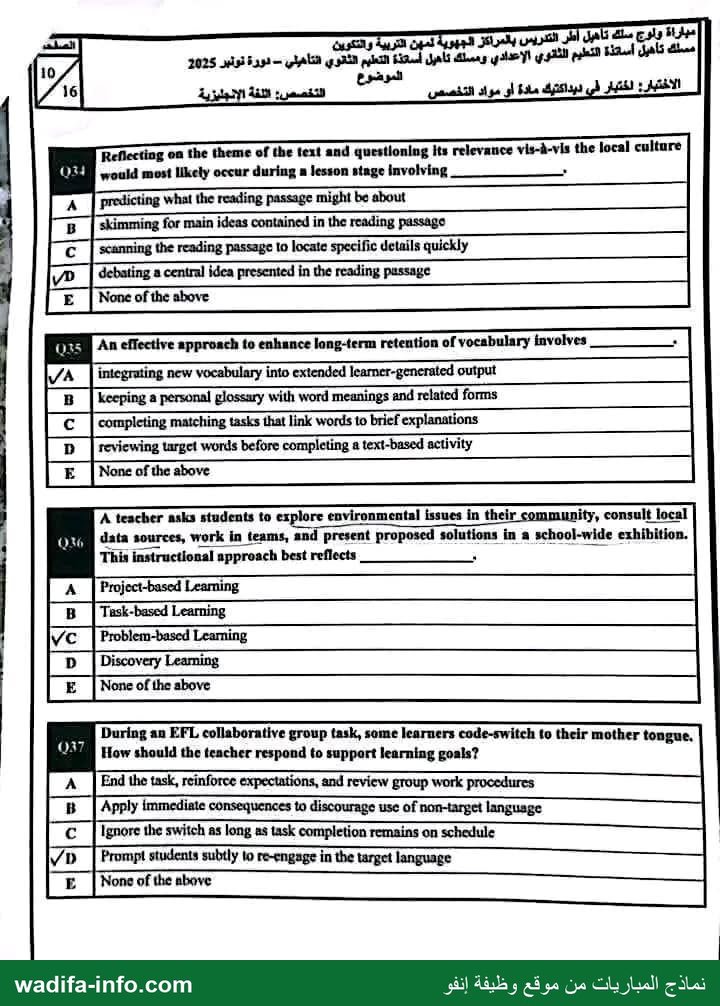
| Q34 | D | Questioning a text's relevance to the local culture is critical, post-reading work, typically done through discussion or debate. A is pre-reading, and B and C are while-reading. |
| Q35 | A | Retention improves when new words are used productively in learners' own extended output (deeper processing). |
| Q36 | A (probable answer) | Extended inquiry into a real community issue, teamwork and a public final product (an exhibition) are the hallmarks of project-based learning. Problem-based learning is also defensible because the work centres on proposing solutions to a problem. |
| Q37 | D | Code-switching is a natural communication strategy; a subtle prompt brings learners back to English without breaking the task or punishing them. |
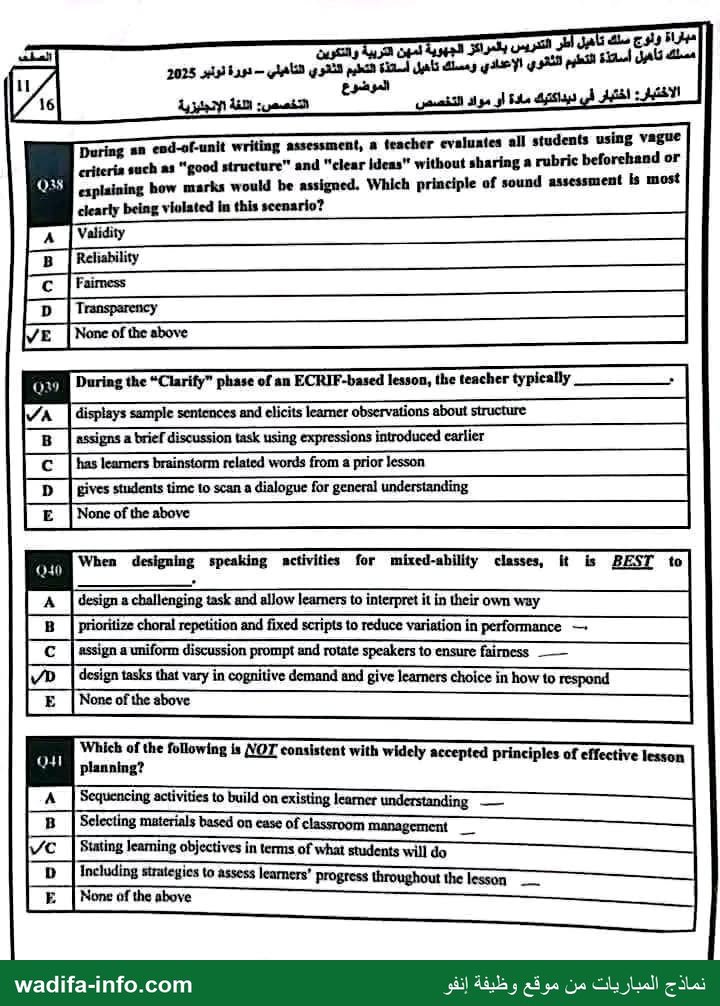
| Q38 | D | Criteria were neither explained nor shared beforehand, so transparency is breached. Vague criteria also threaten reliability, but the scenario stresses the lack of disclosure. |
| Q39 | A | ECRIF = Encounter, Clarify, Remember, Internalize, Fluently use. In Clarify the teacher helps learners notice and check form, meaning and pronunciation, for example by eliciting observations from sample sentences. B is a use stage and C an Encounter/warm-up. |
| Q40 | D | Mixed-ability classes need differentiated tasks (varying cognitive demand) and choice in how to respond. |
Q41 – Q60
| Item | Answer | Why |
|---|---|---|
| Q41 | B | Materials should be chosen for the objectives and the learners, not for ease of classroom management. |
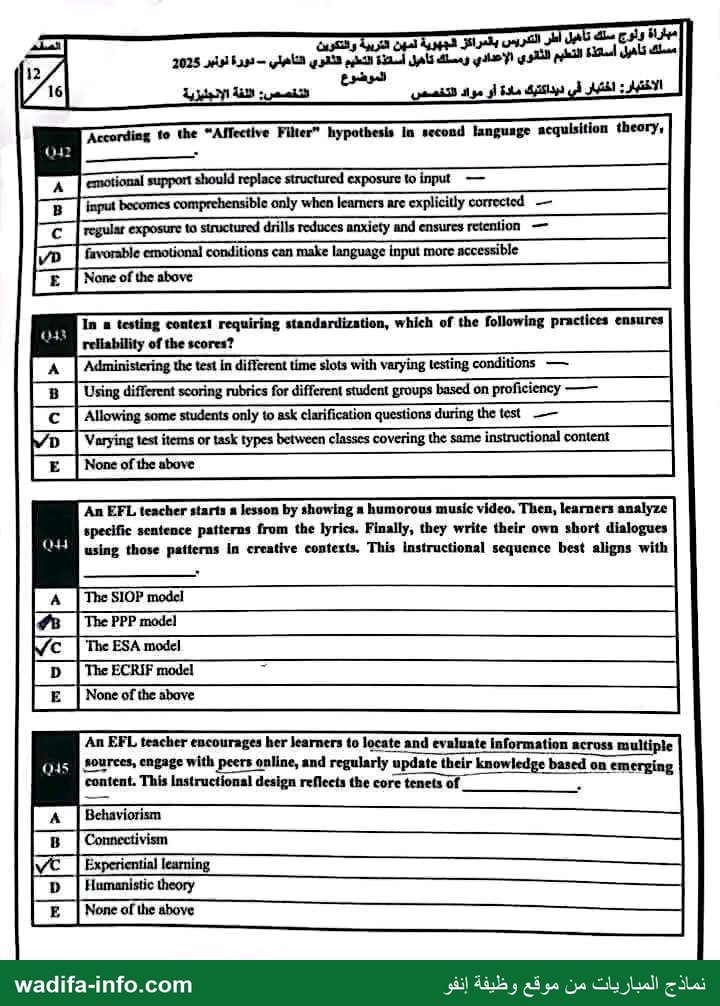
| Q42 | D | Krashen: low anxiety and high motivation lower the filter so comprehensible input can be taken in. |
| Q43 | E | Every option introduces variation (conditions, rubrics, help, items), which lowers reliability. Standardisation requires the same conditions, items and scoring for all. |
| Q44 | C | Harmer's ESA: Engage (the funny video), Study (analysing the patterns), Activate (creative dialogues). |
| Q45 | B | Connectivism (Siemens) sees learning as navigating networks: finding and evaluating information across sources, learning with online peers and updating knowledge constantly. |
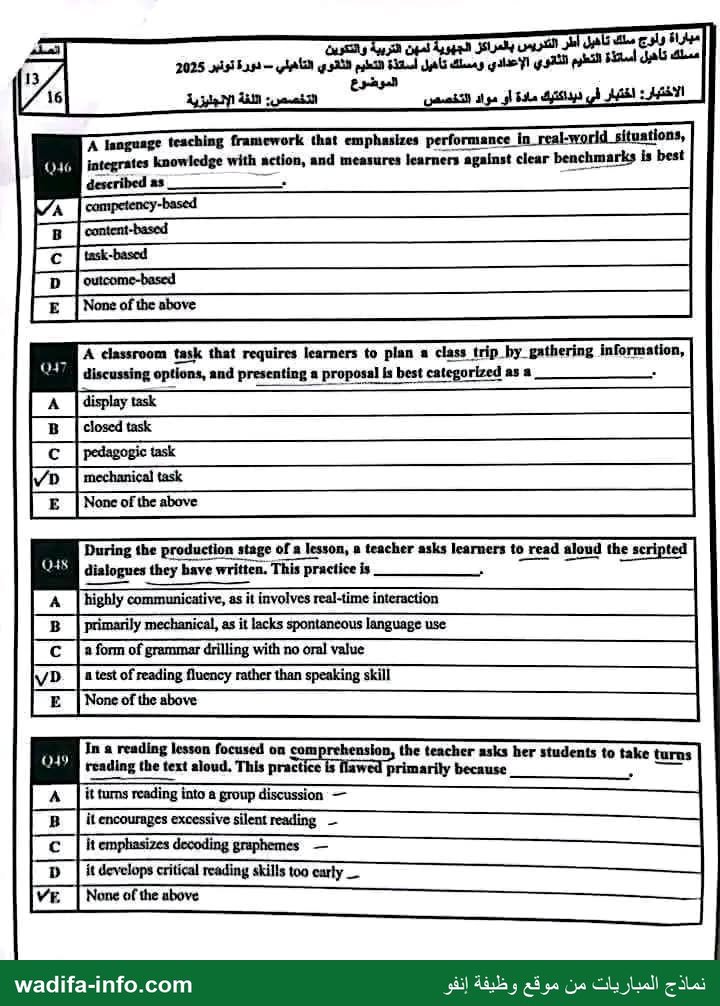
| Q46 | A | Competency-based teaching integrates knowledge with action in real-life situations and measures performance against benchmarks. |
| Q47 | C (probable answer) | Planning a trip by gathering information, discussing and presenting is an open, meaning-focused classroom task, a "pedagogic task" in Nunan's sense. Display, closed and mechanical tasks have fixed, predictable answers. If the expected label is "real-world task", the key would be E. |
| Q48 | B | Reading out pre-written scripts lacks spontaneous language use, so it is mechanical practice, not real production. |
| Q49 | C | Round-robin reading focuses attention on decoding and pronunciation rather than on meaning. |
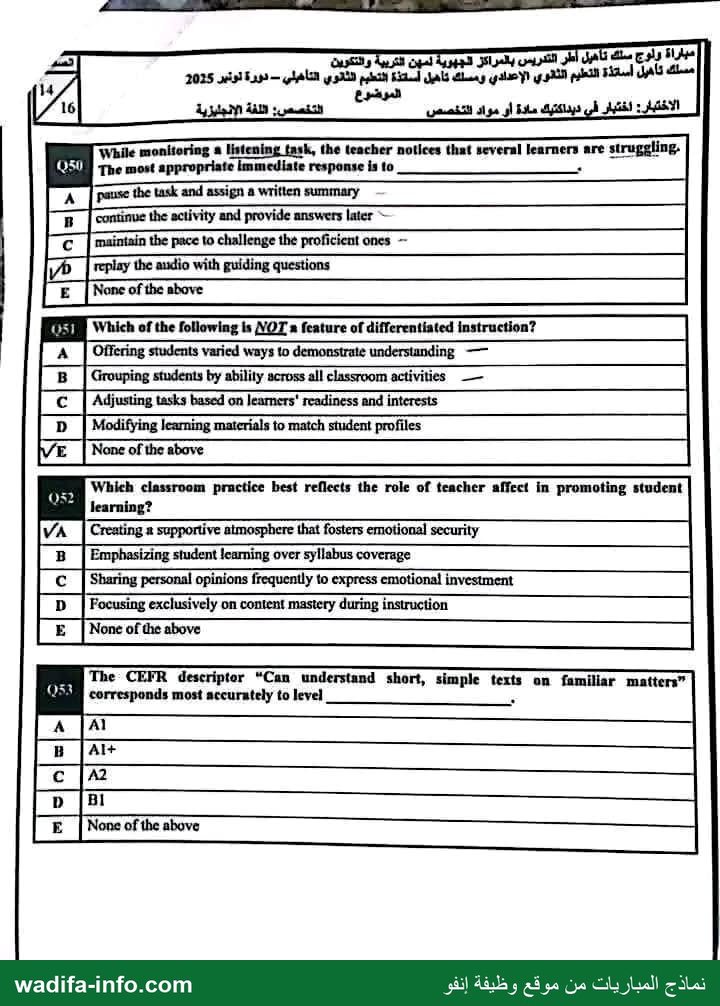
| Q50 | D | Replaying the audio with guiding questions gives immediate, targeted support while keeping the listening task going. |
| Q51 | B | Grouping by ability across all activities is fixed tracking; differentiation uses flexible grouping. |
| Q52 | A | Teacher affect means a supportive climate that gives learners emotional security and lowers anxiety. |
| Q53 | C | This is the CEFR A2 reading descriptor ("short, simple texts on familiar matters of a concrete type"). |
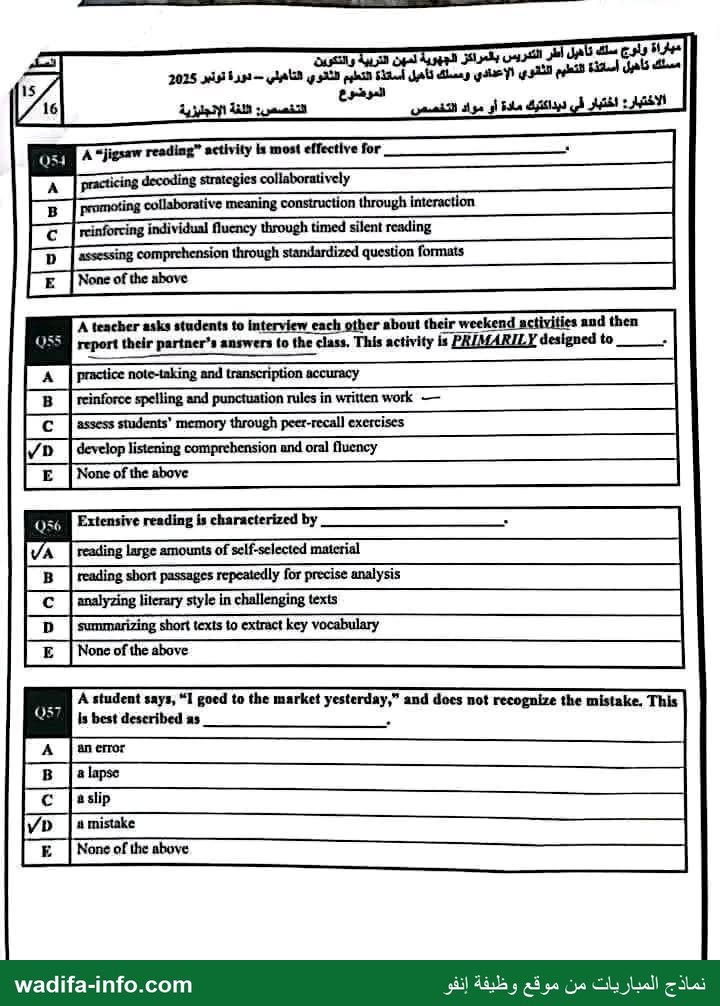
| Q54 | B | In a jigsaw, each learner holds part of the text and the group rebuilds the meaning by exchanging information. |
| Q55 | D | Interviewing and reporting practise listening and oral fluency, with a genuine information gap. |
| Q56 | A | Extensive reading means large amounts of self-selected, fairly easy material read for pleasure and general meaning; B, C and D describe intensive reading. |
| Q57 | A | Corder: an error reflects a gap in competence and the learner cannot self-correct it; a mistake (or lapse/slip) is a performance slip the learner can recognise. |
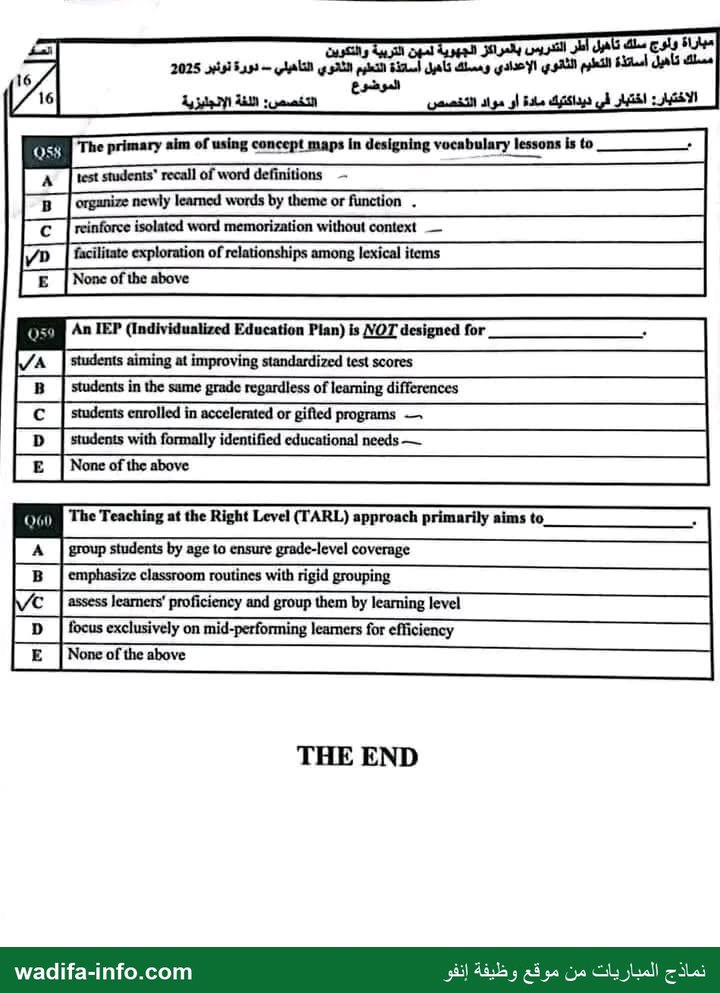
| Q58 | D | Concept maps show relationships between words (meaning, collocation, word family). |
| Q59 | B (probable answer) | An IEP is individualised by definition, so it is not designed for whole groups taught alike "regardless of learning differences". It targets learners with identified needs (D) and, in some systems, gifted learners (C). A is also not a standard purpose, but B contradicts the very idea of an IEP. |
| Q60 | C | TaRL assesses learners' actual level and groups them by learning level rather than by age or grade. |
Answer grid
1 B – 2 C – 3 C – 4 E – 5 C – 6 C – 7 D – 8 E – 9 C – 10 B – 11 E – 12 C – 13 A – 14 E – 15 B – 16 A – 17 A – 18 A – 19 B – 20 E
21 E – 22 E – 23 A – 24 D – 25 E – 26 D – 27 B – 28 B – 29 C – 30 B – 31 E – 32 C – 33 B – 34 D – 35 A – 36 A – 37 D – 38 D – 39 A – 40 D
41 B – 42 D – 43 E – 44 C – 45 B – 46 A – 47 C – 48 B – 49 C – 50 D – 51 B – 52 A – 53 C – 54 B – 55 D – 56 A – 57 A – 58 D – 59 B – 60 C
أسئلة شائعة حول هذا النموذج
هل يمكن تحميل هذا النموذج مجاناً؟
هل يتضمن هذا النموذج التصحيح؟
ما هي الجهة المنظمة والدرجة المعنية بهذا النموذج؟
ما هي دورة هذا الامتحان ولغة أسئلته؟
أين أجد نماذج أخرى لنفس المباراة؟
💬 ناقش هذا النموذج (0)
شارك إجاباتك أو صحّح التصحيح — إذا كان لديك رأي مختلف حول أي نقطة، اكتبه هنا ليستفيد باقي المترشحين.
لا يوجد نقاش بعد — شارك إجابتك أو سؤالك حول هذا النموذج.
⚠️ ممنوع نشر أرقام الهاتف أو الروابط أو أي عرض مقابل مال — تُحذف هذه المشاركات تلقائياً.
هل تحضّر لهذه المباراة؟
نماذج مشابهة قد تهمّك
المصدر: صفحة مستجدات الوظيفة والتعليم بالمغرب ومدونة econcours-maroc