

نموذج المباراة الوطنية المشتركة CNC 2019: اللغة الإنجليزية - شعبة MP/PSI/TSI/BCPST لولوج مدارس المهندسين
⬇️ تحميل PDF الرابط الدائم: wadifa-info.com/نموذج-مباراة/2546
باختصار
هذا نموذج امتحان كتابي سابق لمباراة طالب - الأقسام التحضيرية العلمية لدى وزارة التعليم العالي - المباراة الوطنية المشتركة لولوج مدارس المهندسين (2019)، منشور على وظيفة إنفو للاطلاع والتحميل المجاني بصيغة PDF مع تصحيح مقترح.
- الجهة المنظمة
- وزارة التعليم العالي - المباراة الوطنية المشتركة لولوج مدارس المهندسين
- الدرجة
- طالب - الأقسام التحضيرية العلمية
- التخصص
- اللغة الإنجليزية
- الدورة
- 2019
- عدد الصفحات
- 4
- لغة الأسئلة
- الفرنسية
- التصحيح
- تصحيح مقترح متوفر في هذه الصفحة
📝 نص أسئلة النموذج (مستخرج آلياً من الصفحات الممسوحة)
استُخرج هذا النص آلياً من صور الامتحان وقد يحتوي على أخطاء في القراءة — الصور أعلاه هي المرجع.
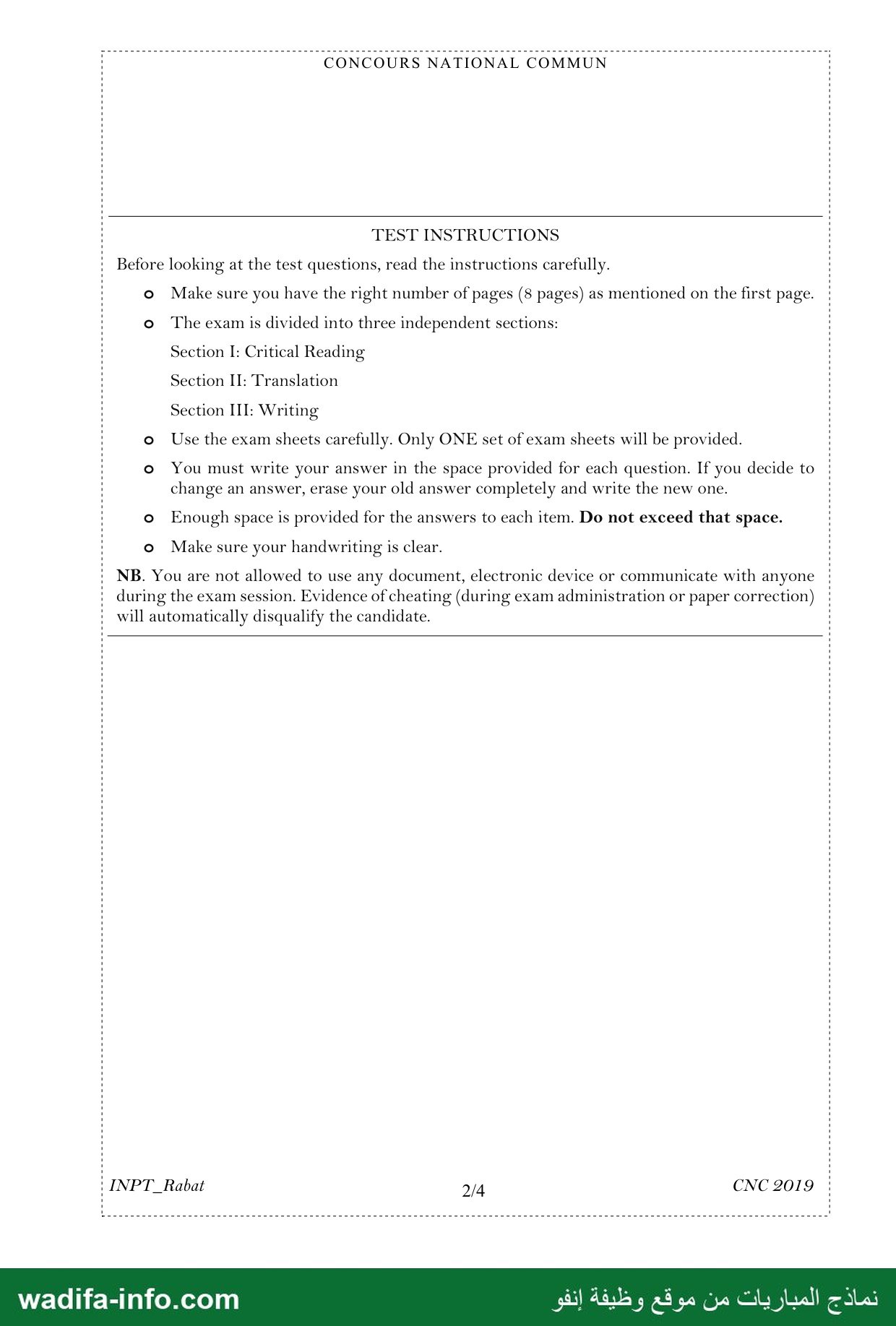
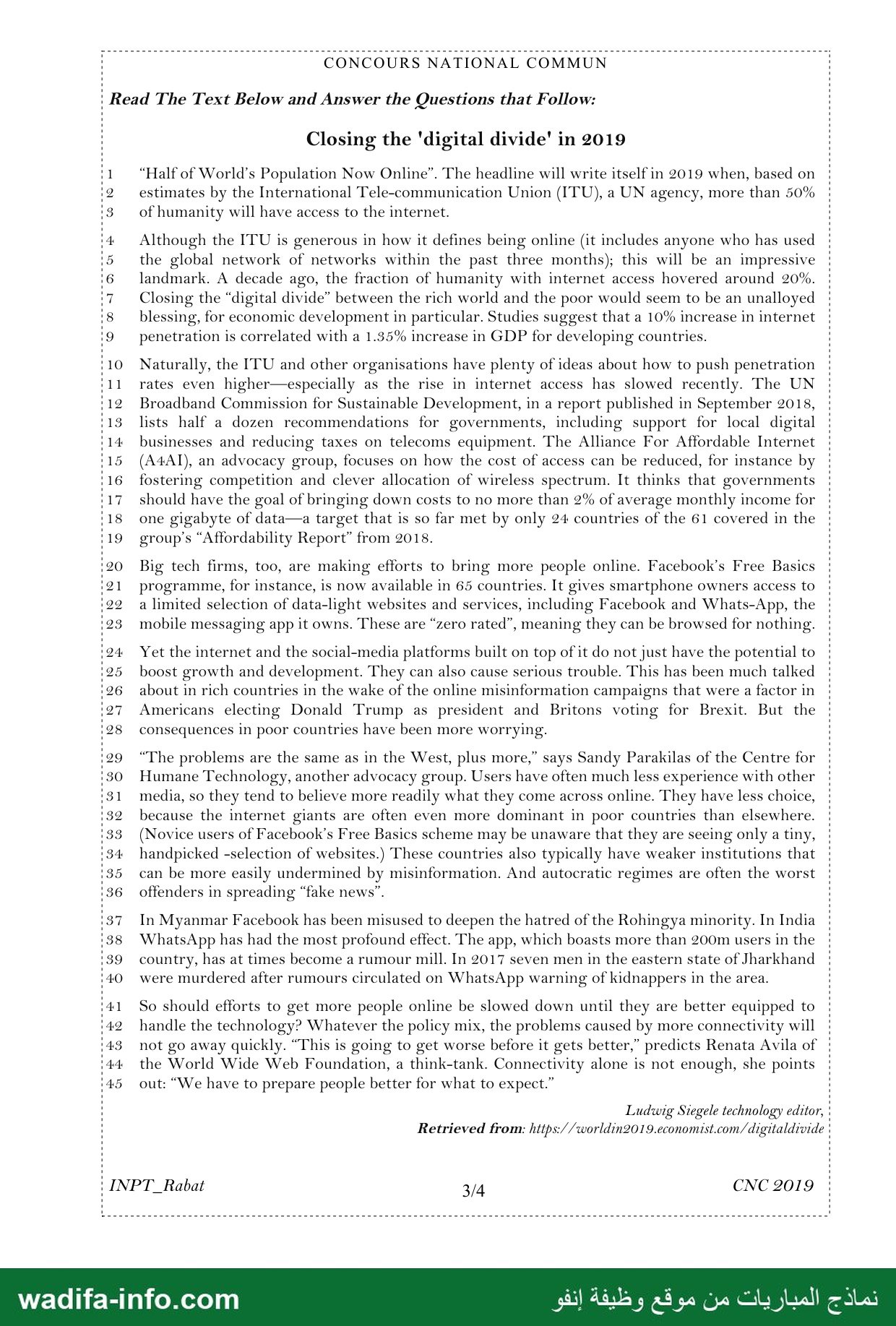
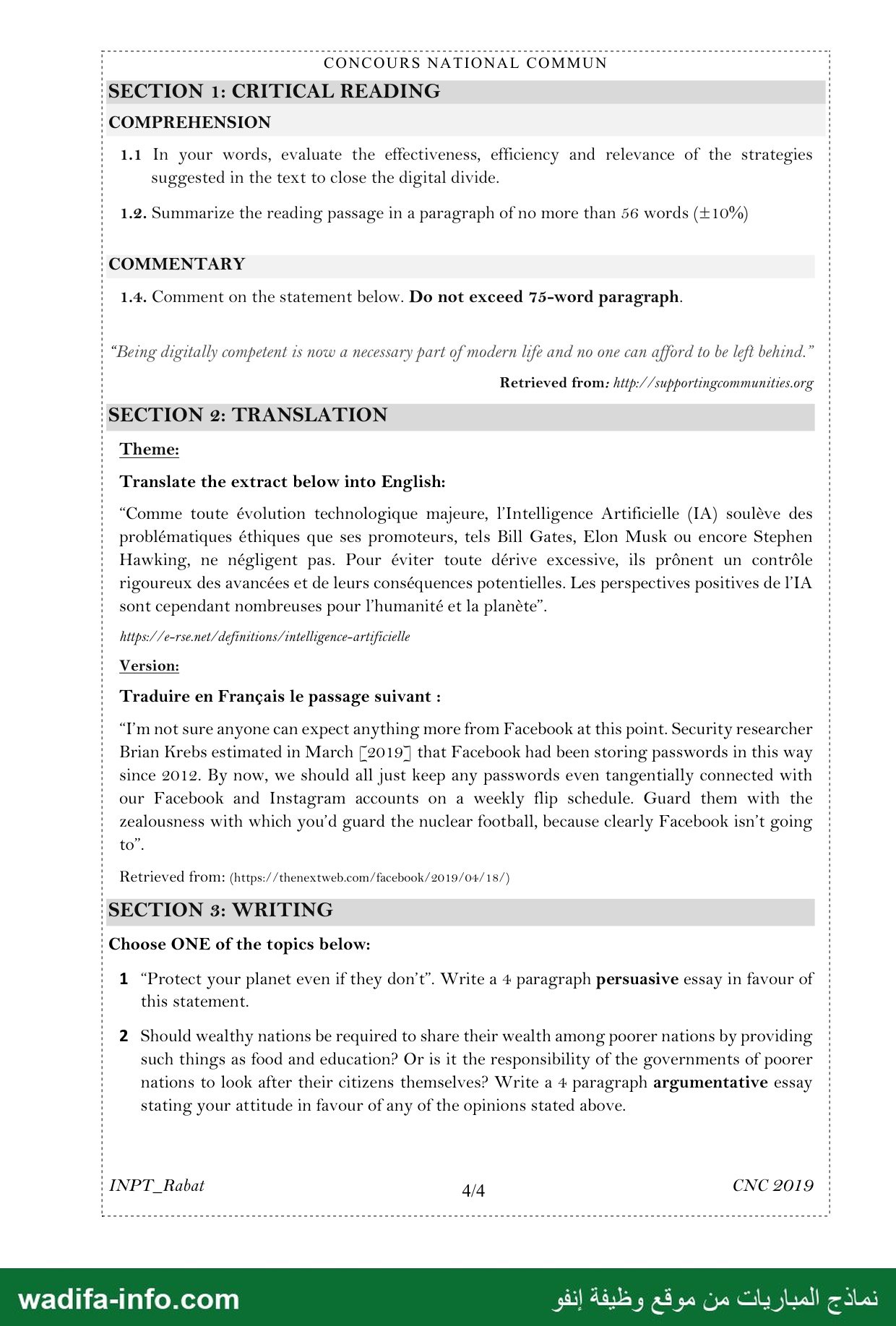
CONCOURS NATIONAL COMMUN ا Royaume du Maroc : D Es? ', Ministère de l'Éducation Nationale, de la Formation professionnelle, !, 'ٍ de l'Enseignement Supérieur et de la Recherche Scientifique 'ٍ 'ٍ Secrétariat d’État chargé de 1 Enseignement Supérieur et de la Recherche Scientifique 'ٍ Présidence du Concours National Commun 2019 Institut National des Postes et Télécommunications INPT : CONCOURS NATIONAL COMMUN | d’Admission dans les Établissements de Formation d’Ingénieurs et | ' Établissements Assimilés : : Session 9 : Épreuve d’Anglais | Filières : MP/PSI/TSI Durée 2 heures INPT_Rabat 1/4 CNC 2019 : wadifa-info.com نماذج المباريات من موقع وظيفة إنفو CONCOURS NATIONAL COMMUN ا : TEST INSTRUCTIONS : : Before looking at the test questions, read the instructions carefully. : : o Make sure you have the right number of pages (8 pages) as mentioned on the first page. : : o The exam is divided into three independent sections: : : Section I: Critical Reading : : Section Il: Translation : Section 111: Writing : o Use the exam sheets carefully. Only ONE set of exam sheets will be provided. : : o You must write your answer in the space provided for each question. If you decide to : 'ٍ change an answer, erase your old answer completely and write the new one. ؛' : o Enough space is provided for the answers to each item. Do not exceed that space. : : o Make sure your handwriting is clear. : : NB. You are not allowed to use any document, electronic device or communicate with anyone : : during the exam session. Evidence of cheating (during exam administration or paper correction) : : will automatically disqualifÿ the candidate. ; | INPT_Rabat 2 CNC 2019 | wadifa-info.com نماذج المباريات من موقع وظيفة إنفو ً' CONCOURS NATIONAL COMMUN : Read The Text Below and Answer the Questions that Follow: ; ' Closing the ‘digital divide' in 2019 ' 1 “Halfof World's Population Now Online”. The headline will write itself in 2019 when, based on ‘2 estimates by the International Tele-communication Union (ITU), a UN agency, more than 50% : ‘8 آه humanity will have access to the internet. ‘4 Although the ITU is generous in how it defines being online (it includes anyone who has used : :5 the global network of networks within the past three months); this will be an impressive : :6 landmark. À decade ago, the fraction of humanity with internet access hovered around 20%. : ‘7 Closing the “digital divide” between the rich world and the poor would seem to be an unalloyed : ‘8 blessing, for economic development in particular. Studies suggest that a 10% increase in internet : ‘9 penetration is correlated with a 1.35% increase in GDP for developing countries. ‘10 Naturally, the ITU and other organisations have plenty of ideas about how to push penetration ‘11 rates even higher—especially as the rise in internet access has slowed recently. The UN : ‘12 Broadband Commission for Sustainable Development, in a report published in September 2018, : ‘13 lists half a dozen recommendations for governments, including support for local digital : ‘14 businesses and reducing taxes on telecoms equipment. The Alliance For Affordable Internet : ‘15 (A4AT), an advocacy group, focuses on how the cost of access can be reduced, for instance by ‘16 fostering competition and clever allocation of wireless spectrum. It thinks that governments : ‘17 should have the goal of bringing down costs to no more than 2% of average monthly income for : ‘18 one gigabyte of data—a target that is so far met by only 24 countries of the 61 covered in the ‘: ‘19 group's “Affordability Report” from 2018. ‘20 Big tech firms, too, are making efforts to bring more people online. Facebook’s Free Basics ‘21 programme, for instance, is now available in 65 countries. It gives smartphone owners access to : ‘22 a limited selection of data-light websites and services, including Facebook and Whats-App, the : ‘28 mobile messaging app it owns. These are “zero rated”, meaning they can be browsed for nothing. : ‘24 Yet the internet and the social-media platforms built on top of it do not just have the potential to : ‘25 boost growth and development. They can also cause serious trouble. This has been much talked : ‘26 about in rich countries in the wake of the online misinformation campaigns that were a factor in : ‘27 Americans electing Donald Trump as president and Britons voting for Brexit. But the : ‘28 consequences in poor countries have been more worrying. :29 “The problems are the same as in the West, plus more,” says Sandy Parakilas of the Centre for : :30 Humane Technology, another advocacy group. Users have often much less experience with other : ‘31 media, so they tend to believe more readily what they come across online. They have less choice, : :32 because the internet giants are often even more dominant in poor countries than elsewhere. : 33 (Novice users of Facebook’s Free Basics scheme may be unaware that they are seeing only a tiny, : :34 handpicked -selection of websites.) These countries also typically have weaker institutions that :35 can be more easily undermined ترط misinformation. And autocratic regimes are often the worst : 36 offenders in spreading “fake news”. :87 In Myanmar Facebook has been misused to deepen the hatred of the Rohingya minority. In India ‘38 WhatsApp has had the most profound effect. The app, which boasts more than 200m users in the : 39 country, has at times become a rumour mill. In 2017 seven men in the eastern state of Jharkhand 40 were murdered after rumours circulated on WhatsApp warning of kidnappers in the area. ‘41. So should efforts to get more people online be slowed down until they are better equipped to : ‘42 handle the technology? Whatever the policy mix, the problems caused by more connectivity will : ‘43. not go away quickly. “This is going to get worse before it gets better,” predicts Renata Avila of : 44 the World Wide Web Foundation, a think-tank. Connectivity alone is not enough, she points : ‘45 out: “We have to prepare people better for what to expect.” 'ٍ Ludwig Siegele technology editor, ; ٍْ Retrieved from: https://worldin2019.economist.com/digitaldivide : : INPT_Rabat 3/4 CNC 2019 | wadifa-info.com نماذج المباريات من موقع وظيفة إنفو NATIONAL COMMON 010005 از SECTION 1: CRITICAL READING ; : COMPREHENSION : In your words, evaluate the effectiveness, efficiency and relevance of the strategies : 1.1 : suggested in the text to close the digital divide. Summarize the reading passage in a paragraph of no more than 56 words (+10%) .1.2‘ COMMENTARY : Comment on the statement below. Do not exceed 75-word paragraph. ', .1.4 ! “Being digitally competent is now a necessary part of modern life and no one can afford to be left behind.” : Retrieved from: Attp://supportingcommunities.org ; ٍ' SECTION 2: TRANSLATION ; : Theme: : Translate the extract below into English: ', : : وعل “Comme toute évolution technologique majeure, l’Intelligence Artificielle (IA) soulève : problématiques éthiques que ses promoteurs, tels Bill Gates, Elon Musk ou encore Stephen : _: Hawking, ne négligent pas. Pour éviter toute dérive excessive, ils prônent un contrôle : : rigoureux des avancées et de leurs conséquences potentielles. Les perspectives positives de l'IA : ! sont cependant nombreuses pour l'humanité et la planète”. _: Version: ' ٍ' Traduire en Français le passage suivant : ٍ ; “Tm not sure anyone can expect anything more from Facebook at this point. Security researcher_ : | Brian Krebs estimated in March [20197 that Facebook had been storing passwords in this way: ! since 2012. By now, we should all just keep any passwords even tangentially connected with : : أ our Facebook and Instagram accounts on a weekly flip schedule. Guard them with the : going ; صقا zealousness with which you’d guard the nuclear football, because clearly Facebook ٍ' Retrieved from: (https://thenextweb.com/facebook/2019/04/18/) : ! SECTION 3: WRITING : Choose ONE of the topics below: ', : “Protect your planet even if they don't”. Write a 4 paragraph persuasive essay in favour of ٍ 1 ] this statement. ; ٍ' Should wealthy nations be required to share their wealth among poorer nations by providing : 2 : such things as food and education? Or is it the responsibility of the governments of poorer : ' nations to look after their citizens themselves? Write a 4 paragraph argumentative essay : ' stating your attitude in favour of any of the opinions stated above. ', ' INPT_ Rabat 4/4 CNC 2019 | : نماذج المباريات من موقع وظيفة إنفو wadifa-info.com
التصحيح المقترح
هذا تصحيح مقترح من إعداد فريق wadifa-info لمساعدتك على فهم منهجية الإجابة — وليس تصحيحاً رسمياً صادراً عن الإدارة المنظِّمة. أسئلة هذا الامتحان محررة بالفرنسية، لذلك التصحيح محرر بالفرنسية أيضاً.
Ce modèle est l'épreuve d'anglais du Concours National Commun (CNC) 2019 d'admission dans les établissements de formation d'ingénieurs et assimilés, filières MP/PSI/TSI, présidence INPT Rabat. Durée : 2 heures. Trois sections : Critical Reading (compréhension, résumé, commentaire) sur un article de The Economist (« Closing the 'digital divide' in 2019 »), Translation (thème français → anglais et version anglais → français) et Writing (un essai au choix). Les réponses modèles sont rédigées en anglais, comme on les attend sur la copie ; les conseils sont en français.
💡 Limites de mots : elles sont notées. Comptez vos mots au brouillon et restez dans la marge indiquée (56 mots ± 10 % pour le résumé, 75 mots maximum pour le commentaire). Écrivez « in your own words » : recopier des phrases du texte coûte des points.
Section 1 — Critical Reading
Comprehension
1.1 Evaluate the effectiveness, efficiency and relevance of the strategies suggested in the text.
Le texte cite trois familles de stratégies : les recommandations de la UN Broadband Commission (soutien aux entreprises numériques locales, baisse des taxes sur le matériel télécom), celles de l'A4AI (concurrence, allocation du spectre, objectif d'1 Go à moins de 2 % du revenu mensuel moyen) et les initiatives des géants du numérique (Free Basics de Facebook). Réponse modèle :
The strategies are relevant, since cost and lack of infrastructure are the main barriers to access in poor countries. Cutting taxes on equipment and fostering competition are efficient, low-cost policies, but their effectiveness is limited: only 24 of the 61 countries studied meet the A4AI affordability target, and the growth of internet access has slowed. Facebook's Free Basics brings people online cheaply, yet it is the least relevant option, because users see only a small, hand-picked part of the web chosen by one company. Above all, all these strategies focus on access and ignore training: as the text shows, connectivity without digital literacy spreads misinformation and can even lead to violence.
1.2 Summary (56 words ± 10 %) — modèle de 57 mots :
By 2019, over half of humanity will be online, and closing the digital divide promises economic growth. UN bodies, advocacy groups and tech firms propose ways to widen and cheapen access. Yet connectivity also spreads misinformation, especially in poor countries with inexperienced users and weak institutions, sometimes with deadly results. Access must therefore go with preparing people.
💡 Les quatre idées attendues : (1) le seuil des 50 % et l'enjeu économique ; (2) les moyens proposés pour élargir l'accès ; (3) le revers : désinformation, plus grave dans les pays pauvres (exemples Myanmar, Inde) ; (4) la conclusion : la connexion seule ne suffit pas.
Commentary
1.4 Comment on: « Being digitally competent is now a necessary part of modern life and no one can afford to be left behind. » (75 mots maximum) — modèle de 74 mots :
Digital competence has become a basic condition of citizenship: administrative procedures, job applications, banking and even school registration are now online. Those who cannot use these tools lose rights and opportunities, and the gap widens between generations, regions and social classes. However, competence means more than technical skill; it includes the critical ability to check information and protect one's data. Governments and schools must therefore train everyone, so that no one is left behind.
💡 Un bon commentaire prend position, l'appuie sur un ou deux exemples et nuance (ici : compétence technique ≠ esprit critique, ce qui fait le lien avec le texte).
Section 2 — Translation
Thème (français → anglais) — traduction proposée
"Like any major technological development, Artificial Intelligence (AI) raises ethical issues that its promoters, such as Bill Gates, Elon Musk and Stephen Hawking, do not overlook. To avoid any excessive drift, they advocate strict monitoring of its advances and of their potential consequences. The positive prospects of AI for humanity and the planet are, however, numerous."
- « soulève des problématiques » → raises issues / questions (pas « problematics »).
- « ne négligent pas » → do not overlook / do not neglect.
- « dérive » → drift, excess, misuse ; « prônent » → advocate, call for.
- « contrôle rigoureux » → strict monitoring / rigorous oversight (« control » seul a le sens de « maîtrise »).
- Possible aussi : AI nevertheless offers many positive prospects for humanity and the planet.
Version (anglais → français) — traduction proposée
« Je ne suis pas sûr que l'on puisse encore attendre quoi que ce soit de plus de Facebook à ce stade. Le chercheur en sécurité Brian Krebs a estimé en mars [2019] que Facebook stockait ainsi les mots de passe depuis 2012. Désormais, nous devrions tous simplement changer chaque semaine tout mot de passe ayant le moindre lien, même indirect, avec nos comptes Facebook et Instagram. Protégez-les avec le zèle avec lequel on protégerait la mallette nucléaire, car il est clair que Facebook ne le fera pas. »
- « in this way » renvoie au contexte (des mots de passe stockés en clair) : « de cette manière / ainsi ».
- « on a weekly flip schedule » : changer selon un rythme hebdomadaire.
- « even tangentially connected » : « même indirectement liés ».
- « the nuclear football » : la mallette des codes nucléaires du président américain ; « la mallette nucléaire » est l'équivalent usuel.
- « isn't going to » : sous-entendu « isn't going to guard them » → « ne le fera pas ».
Section 3 — Writing (un sujet au choix, 4 paragraphes)
💡 « 4 paragraphs » = introduction avec thèse, deux paragraphes d'arguments (un argument principal + exemple chacun), conclusion. Le sujet 1 est persuasif (on défend une seule position) ; le sujet 2 est argumentatif (on présente le débat puis on prend parti).
Topic 1 — « Protect your planet even if they don't » (persuasive) — modèle
Introduction. It is tempting to think that individual efforts are useless when governments and large companies keep polluting. Yet protecting the planet is a personal duty that does not depend on what others do.
Paragraph 2 — Small actions add up. Millions of individual choices, such as saving water, sorting waste, using public transport or refusing single-use plastic, have a measurable effect. When Morocco banned plastic bags in 2016, the change only worked because citizens adopted reusable bags.
Paragraph 3 — Example creates change. Behaviour is contagious: children copy their parents, and consumers' choices push companies to change their products. Waiting for others to act first is the surest way for nobody to act.
Conclusion. We share one planet, and its future does not belong only to those in power. Each of us should act now, because doing nothing because others do nothing is still a choice — the wrong one.
Topic 2 — Wealthy nations' duty vs. poorer governments' responsibility (argumentative) — plan
- Introduction : présenter le débat (aide internationale contre responsabilité nationale) et annoncer sa position, par exemple : both, but aid must aim at self-reliance.
- §2 — Pourquoi les pays riches doivent aider : responsabilité historique (colonisation, échanges inégaux), défis mondiaux (épidémies, climat, migrations) qui ne s'arrêtent pas aux frontières, intérêt commun.
- §3 — Les limites de l'aide : dépendance, corruption, conditions imposées ; ce sont les bonnes politiques nationales (éducation, santé, gouvernance) qui sortent durablement un pays de la pauvreté.
- Conclusion : l'aide doit financer l'éducation et les capacités locales (« teach a man to fish »), tandis que les gouvernements restent les premiers responsables de leurs citoyens.
أسئلة شائعة حول هذا النموذج
هل يمكن تحميل هذا النموذج مجاناً؟
هل يتضمن هذا النموذج التصحيح؟
ما هي الجهة المنظمة والدرجة المعنية بهذا النموذج؟
ما هي دورة هذا الامتحان ولغة أسئلته؟
أين أجد نماذج أخرى لنفس المباراة؟
ناقش هذا النموذج (0)
شارك إجاباتك أو صحّح التصحيح — إذا كان لديك رأي مختلف حول أي نقطة، اكتبه هنا ليستفيد باقي المترشحين.
لا يوجد نقاش بعد — شارك إجابتك أو سؤالك حول هذا النموذج.
⚠️ ممنوع نشر أرقام الهاتف أو الروابط أو أي عرض مقابل مال — تُحذف هذه المشاركات تلقائياً.
هل تحضّر لهذه المباراة؟
نماذج مشابهة قد تهمّك
الجهة المنظمة: وزارة التعليم العالي - المباراة الوطنية المشتركة لولوج مدارس المهندسين · 2019 — مصدر النسخة: وثائق منشورة للعموم (Scribd / alloschool)؛ الإعلان الرسمي للمباراة هو المرجع.
كيف تستشهد بهذه الصفحة؟
صحفي أو مدوّن أو أستاذ؟ انسخ المرجع أسفله وضع رابطاً نحو هذه الصفحة.
الرابط الدائم: https://www.wadifa-info.com/نموذج-مباراة/2546/نموذج-المباراة-الوطنية-المشتركة-CNC-2019-اللغة-الإنجليزية-شعبة-MP-PSI-TSI-BCPS